Showing posts with label Healthier SG. Show all posts

Monday, 18 August 2025

National Day Rally 2025: Beyond SG60 Writing Our Next Chapter

PM Lawrence Wong calls on Singaporeans to unite, write nation’s next chapter together
Government will place citizens at centre of what it does but people must also chip in, look out for one another, he says
By Goh Yan Han, The Straits Times, 18 Aug 2025

Prime Minister Lawrence Wong called on Singaporeans to band together to write the next chapter of the nation’s story, as he set out plans to support them throughout various stages of life.

He gave the assurance that the Government will place Singaporeans at the centre of everything it does, be it navigating economic uncertainty or tackling technological disruption and demographic shifts.

In his first National Day Rally after the general election, PM Wong, who is also Finance Minister, outlined how his Government intends to address the challenges relating to the economy, senior citizens and the younger population.

It will provide job support – in particular, for fresh graduates and mid-career workers – and develop community infrastructure to support the growing population of elderly citizens.


Addressing the audience at ITE College Central in Ang Mo Kio on Aug 17, PM Wong opened his English speech by setting out the immediate challenges that Singapore is facing in a “more troubled and turbulent world”.

These include global tariffs imposed by the United States earlier this year, growing global contestation and rapid advancements in technologies like artificial intelligence (AI).


Singapore is reviewing its economic strategy on various fronts to secure its future in a changed world, he said, noting that harnessing innovation and technology will allow the country to sustainably raise its productivity and improve lives.

“Ultimately, our economic strategy is about jobs, jobs and jobs – that’s our No. 1 priority”, said PM Wong.


Three announcements in his speech centred on jobs: a job-matching scheme at the town level, enhancements to an existing SkillsFuture scheme for mid-career workers, and a government-funded traineeship programme for tertiary education graduates. The details of these schemes will be announced later.


PM Wong said new jobs will be created, as he acknowledged Singaporeans’ worries about jobs evolving or disappearing due to technological change.

“I assure you, even as we embrace AI and technology, we will not lose sight of our key priority,” he said.

“Singaporeans will always be at the centre of everything we do.”


He said the Government is committed to helping every worker progress and succeed, and will not rush headlong into adopting new technology.

There are plans to equip and empower every business, especially small and medium-sized enterprises, to harness AI effectively, he said.

The authorities will also work closely with unions and workers to redesign jobs and help Singaporeans seize new job opportunities, he added.

“The road ahead will not be easy. But we are not going to sit back and resign ourselves to being mere bystanders in a world shaped by others,” said PM Wong.

“We will take charge of our own destiny. We will shape the future we want – through our own actions, and our own choices.”


Turning to the issue of long-term care for seniors, PM Wong announced a new Age Well Neighbourhoods scheme that will adopt features from HDB Community Care Apartments – senior-friendly public housing that provides care services for residents.

The scheme is meant to allow senior citizens to live more independently in their own neighbourhoods, as Singapore’s demographics shift towards more elderly citizens and smaller family sizes.


Identified towns – starting with Toa Payoh and one or two other areas – will have more active ageing centres for seniors to gather, said PM Wong.

Home-based services such as basic health checks and housekeeping will be provided to seniors, with healthcare services brought closer to them as well, he added.


The scheme builds on the existing Age Well SG nationwide initiative for seniors to lead more active lives in their homes and communities.

“That’s how we will grow old – not in isolation, never alone, but always together as one Singapore family,” PM Wong said.


On challenges faced by the younger generation, PM Wong brought up vaping and excessive screen time.

Flagging vaping as a serious concern, he said the Government will take much tougher action and treat it as a drug issue.


It is also studying how other countries manage access to the internet and social media for children, he added.

Setting out the Government’s stance on responding to technological developments – like the use of AI by students – PM Wong said Singapore has to strike the right balance between protecting young people from potential harms and empowering them to fully exploit the benefits of technology.


He also sketched out plans for the northern part of the island, building on the Urban Redevelopment Authority’s Draft Master Plan 2025, which covers Singapore’s development plans for the next 10 to 15 years.

These plans include redeveloping the areas in Woodlands North, Kranji racecourse and Sembawang Shipyard.

As the Government reimagines new uses for existing land, it is also developing plans to protect the country’s coastline against rising sea levels, he added.


“So even as climate shifts and circumstances evolve, one thing is certain: Singapore’s progress will never be left to chance. We are – and have always been – a nation that adapts, reinvents and dares to dream,” said PM Wong.

Good plans and strategies are just the first step for Singapore’s continued progress, said PM Wong as he wrapped up his speech.

“What matters just as much – and even more – is the collective will of our people,” he said, adding it is this Singapore spirit that binds everyone together.


Going forward, Singapore must be a “we first” society with a people that considers others and not just themselves, said PM Wong.

“If each of us does our part for the ‘we’ – care, contribute and look out for one another – then the ‘me’ will thrive and flourish too,” he added.

His team will continue to involve Singaporeans in policy discussions, and will open up more avenues for people to be heard and to get involved.


“We certainly do not want to end up as a society where people rely solely on the government. It’s about all of us – government, businesses, workers and unions, community groups and civil society – doing our part,” he said.

“That’s how my team and I intend to lead. Not just doing things for Singaporeans – but doing things with Singaporeans.”


The nation cannot stand still as it looks beyond SG60, as standing still today is the same as falling behind, said PM Wong.

He urged Singaporeans to dream bigger, be bolder in pushing new frontiers, and be ready to try new things, even if they stumble or fall.


“We take pride in whatever we do, and strive to be the best possible versions of ourselves,” he said.

“We never give up and we never let each other down. That’s how we’ve achieved exceptional performance. That’s how we will continue to stay exceptional – as a people and a country.”

Saturday, 12 April 2025

Healthcare financing in Singapore: Healthcare spending could hit $30 billion a year by 2030 says Health Minister Ong Ye Kung

The Price of Good Health
Healthcare that is affordable, accessible and high quality comes at a price. Salma Khalik finds out how Singapore is striking the right balance.
The Straits Times, 10 Apr 2025

Spending on healthcare in Singapore could soon become the single biggest item in the Government’s coffers, said Health Minister Ong Ye Kung, as he assured Singaporeans that their basic healthcare needs will continue to be affordable.

In 2025, the Government has set aside $20.9 billion for health, second only to spending on defence, which has a budget of $23.4 billion.

Citing the trajectory of government healthcare expenditure, which had gone up from $9 billion in 2015, the year he joined politics, to $18 billion in 2024, Mr Ong predicted that by 2030, it would likely be close to $30 billion a year.

A lot of the money will go towards building more facilities, including new hospitals, nursing homes and community care centres, and for manpower costs.

But a substantial portion will be spent on subsidies to keep costs down for patients.

“We can make it affordable to the patient, but there’s no doubt that with an older population, healthcare expenditure, whether by the Government or nationally, is going to go up,” he told The Straits Times in an exclusive interview.

Older people not only tend to get sick more frequently, but they are also more sick and stay longer in hospitals as many have more than one medical condition.

Mr Ong said: “You’re seeing a lot more older patients coming in, not because of very severe diseases, but due to infections. Because they are old, there is underlying illness after Covid-19. They are more frail and one infection is all it takes for them to be in the ICU (intensive care unit).”

As a result, the average length of stay in public hospitals has gone up, from 6.1 days in 2019 to seven days by 2022. This represents a 15 per cent increase in patient load, he added. While this trend worries him, Mr Ong is confident that the quality of healthcare for patients in the future will not suffer as a result of the higher demand.


Even as the quality of healthcare here has been getting better over the years, with advances in medical science and technology, he said the Government will continue to enhance the definition of basic healthcare, which it has always promised will remain affordable. As an example, he pointed to the announcement that from October, MediShield Life will start covering treatments using cell, tissue and gene therapy products.

These are individualised treatments tailored to a person’s specific medical problem, some of which were previously untreatable. As each treatment is designed and produced for a specific patient, the cost is high.

The move marks an “inflection point” for basic healthcare here, said Mr Ong. In spite of the high cost, he said “we decided that this is the way to go” because today, if there is an available treatment, people expect to have access to it.

“At some point, that becomes people’s expectation. So we have to start embracing this,” he said.

This is one reason why a large part of government expenditure will go towards subsidising healthcare costs. People will also have to share in the cost of better care, largely with insurance and their MediSave funds, Mr Ong said.

The good news is that the Government is unlikely to need to raise taxes to pay for the higher healthcare expenditure, he added.

Said Mr Ong: “We expect our GDP (gross domestic product) to grow. So long as the Singapore economy grows, tax receipts will go up. And a big part of it, a significant part of it in future, will be for healthcare.”

Friday, 9 August 2024

National Day Message 2024: Prime Minister Lawrence Wong promises more support for families, help with employment setbacks

More support for families, help for Singaporeans facing employment setbacks: PM Wong
By Tham Yuen-C, Senior Political Correspondent, The Straits Times, 9 Aug 2024

Families will get more support, and help will be given to Singaporeans who have met with setbacks in employment, Prime Minister Lawrence Wong said on Aug 8 as he set out how the Government intends to work with the people to build a better Singapore.

PM Wong said he will share plans to boost social safety nets at the National Day Rally, which will be held on Aug 18.

In his first National Day message, PM Wong outlined three strategies to take Singapore forward: Forging new opportunities for the people, redoubling efforts to keep the cost of living stable and strengthening the system of social support.


Addressing the nation in front of Sri Temasek within the Istana grounds, he said the two-storey bungalow – where his temporary office is while the main building is renovated – was where founding prime minister Lee Kuan Yew and his family spent the night of Aug 8, 1965.

Mr Lee had tossed and turned that night before Singapore’s formal separation from Malaysia and independence, consumed with worry over how to build a nation from scratch.

What keeps PM Wong awake at night are the challenges brought by developments such as the conflicts in Europe and the Middle East, tensions between the United States and China, growing populism, economic nationalism and protectionism across the world, and politics turning vicious in many countries.

“These are powerful forces that shape our operating environment,” said Singapore’s fourth prime minister.


While Singapore has become a shining red dot on the global stage, the country cannot afford to cruise along and just rely on existing formulas, as the world has changed dramatically, he noted.

“We have to act with agility, foresight and gumption. We have to seek fresh solutions, and chart our own path to take Singapore forward.”

He devoted the rest of his message to the strategies to navigate this new world.

One of them is to strengthen social support, since there will be those who will find it hard to keep pace with the rapid changes, he said.


Singapore’s ageing population will require more help, and so will those who are “sandwiched”, having to look after children as well as elderly parents, he added.

This is why the Government is investing more in social infrastructure, including launching schemes to boost retirement adequacy and the pay of lower-wage workers, as well as initiatives like Healthier SG to take better care of seniors, he said.

“We intend to do more,” he added.

Friday, 2 August 2024

Singapore spending billions to help seniors stay active, socially connected

Loneliness and social isolation: A public health threat for societies
By Judith Tan, Correspondent, The Straits Times, 29 Jul 2024

A 20-something Gen Zer who laughs with colleagues, meets friends for drinks and sees family for dinner every weekend may seem to have a rich network of interpersonal connections.

In reality, he may be lonelier than his widowed grandmother alone at home with only a domestic helper except when relatives visit on some Sundays.

Though they are similar, loneliness and social isolation are not always related. Loneliness is a subject sense of distress that occurs when a person perceives that their need for meaningful connections is unmet, even if they are surrounded by people.

While social isolation – and loneliness – has been building up for decades as family and community structures change, governments are increasingly recognising it now as a crisis.

In November 2023, the World Health Organisation (WHO) declared loneliness as a pressing global health threat.

The same year, United States surgeon-general Vivek Murthy issued an 82-page public health advisory titled Our Epidemic Of Loneliness And Isolation.

The surgeon-general said that far more than a bad feeling, loneliness and social isolation are detrimental to individual and societal health. They increase the risk of premature death by 26 per cent and 29 per cent respectively, he said.

Dr Murthy warned: “The mortality impact of being socially disconnected is similar to that caused by smoking up to 15 cigarettes a day, and even greater than that associated with obesity and physical inactivity.”


Singapore, too, is concerned about the health impact of social isolation, particularly among elderly people.

It has earmarked $800 million for improving active ageing centres supporting seniors in their communities. At the launch of Age Well SG in November 2023, Health Minister Ong Ye Kung said: “For many seniors, their biggest enemy is social isolation and loneliness. That’s when your health really deteriorates. We want them to be socially connected.”

Researchers in Singapore say that seniors who live with their children and grandchildren can feel as lonely as someone living alone, if they are ignored by their loved ones going about their own busy lives.

Data collected from the Singapore Chinese Health Study, which recruited participants between April 1993 and December 1998, found almost four in five elderly people who are socially isolated lived with their families, compared with the three in 20 living on their own.

Young people feel lonely even with social media connections

While the stereotype is that an older person with dwindling social connections is at the greatest risk of loneliness, multiple studies show that it is in fact younger people who are more likely to feel socially isolated.

According to a Gallup poll of more than 140,000 people in 2023, 27 per cent of young adults aged 19 to 29 reported feeling very or fairly lonely, compared with 17 per cent of older adults aged 65 and older.

The 2023 Gallup poll of 142 countries also found that nearly one in four people in the world feels fairly or very lonely, and that rates are about even between men and women.

A 2020 report by insurance giant Cigna based on a questionnaire answered by more than 10,400 people found that 79 per cent of Gen Zers (born between the late 1990s and early 2010s) and 71 per cent of millennials (born between 1981 and 1996) considered themselves lonely, compared with 50 per cent of baby boomers, who are now aged 60 to their late 70s.


In Singapore, a 2023 survey by the Institute of Policy Studies (IPS) had similar findings.

The straw poll, carried out between November and December 2023, surveyed 2,356 Singaporeans and permanent residents aged 21 to 64. It found that people between the ages of 21 and 34 had the highest mean score for loneliness.

In contrast, people between 51 and 64 had the lowest mean score for loneliness.

It is not surprising that young people should experience feelings of abandonment and lack of support, said psychologists. Young adults are at a transitional stage of their lives, navigating uncertainties in finding partners, establishing their careers and carving out an existence for themselves apart from their parents.

Social media too often provides connections that are only fleeting and superficial.

Saturday, 28 October 2023

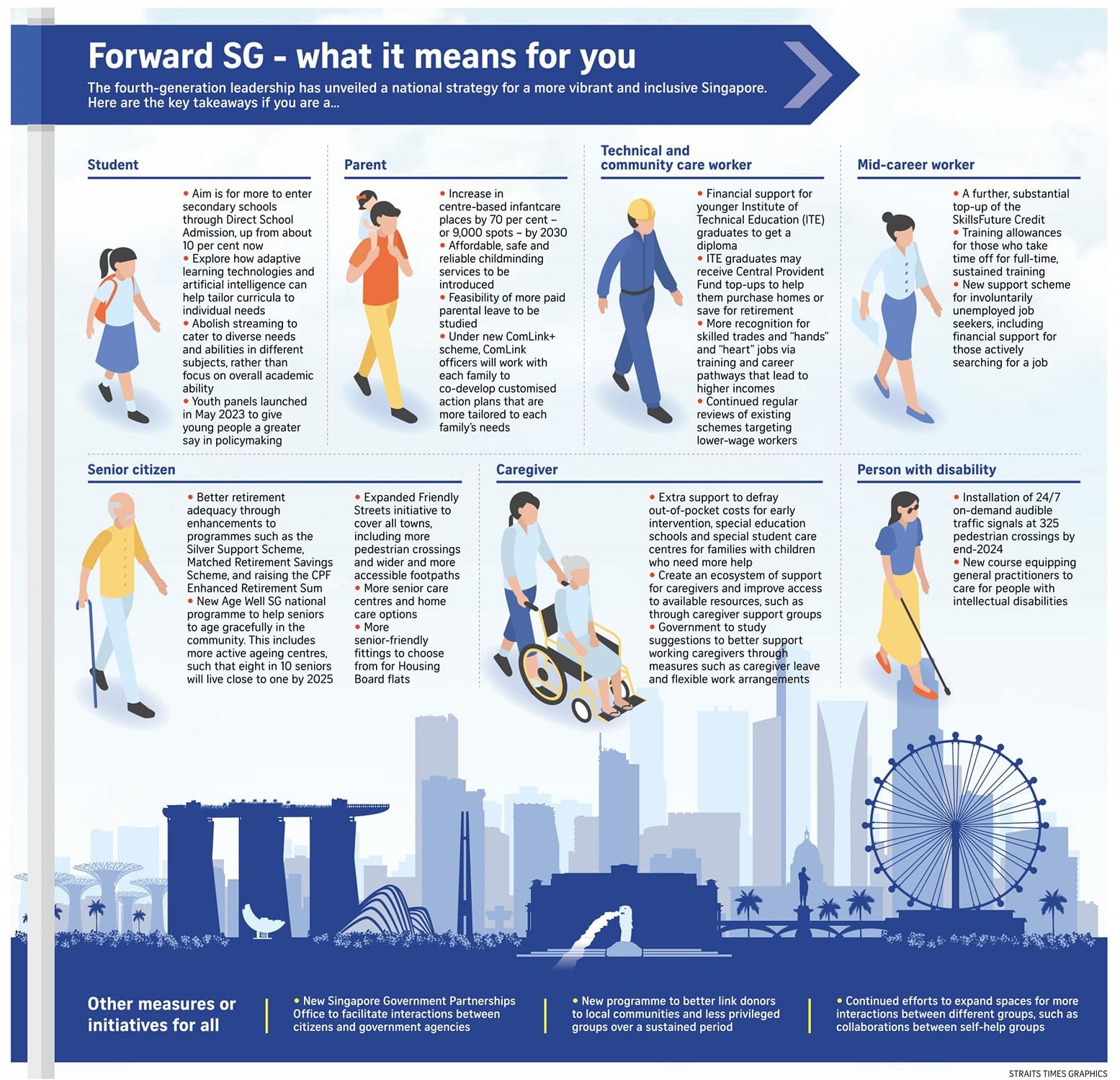
Forward SG report unveils social support plans, lays out mindset shifts needed amid changing times

Moves to ensure basic needs of Singaporeans are met and social compact is refreshed
By Goh Yan Han, Political Correspondent, The Straits Times, 27 Oct 2023

A road map towards a more equitable and thriving Singapore has been put forth by the fourth-generation (4G) leadership, fleshing out the moves the Republic will make in the coming years to stay cohesive amid a time of change.

These include a greater helping hand for groups such as the less well-off, mid-career workers and seniors, through means such as additional financial support and improved infrastructure.

And there will be more done to ensure that Singaporeans’ basic needs at every life stage will be met, such as in education, retirement, healthcare and housing.

These moves come as Singapore has reached a key inflection point where there will be more disruptions, workplace churn and impact on people’s lives, and the Government recognises that more must be done to provide assurance for the people, said Deputy Prime Minister Lawrence Wong at a press conference to launch the Forward Singapore report.


The 180-page report unveiled on Friday also articulated the mindset shifts required for Singapore to achieve the goals set out, such as for wider definitions of success and a stronger sense of collective responsibility towards one another.

It will not be possible for the Government alone to do everything through policy changes, nor is it possible for any individual to succeed on his or her own efforts alone,” DPM Wong said later at the launch of the Forward Singapore Festival, where the public can learn more about the report’s initiatives.

Instead, it will be up to everyone, including employers, community groups, families and individuals, to keep the Singapore miracle going, he added.


The report caps off a nationwide engagement exercise headed by Mr Wong that has involved more than 200,000 Singaporeans since it kicked off in June 2022.

The exercise sought to refresh Singapore’s social compact – the glue that holds society together – given the challenges facing the island, which range from a more fraught external environment to a rapidly ageing population to greater job insecurity due to rapid technological change.

One key move the 4G team intends to make to take the country forward is to create more opportunities for all Singaporeans to chart their own paths in life. This includes increasing salaries and respect for a wider range of vocations, better social support for those who face career hurdles, and nudging those who succeed to give back to society.

On the jobs and education front, the report unveiled plans to provide a “substantial top-up” of SkillsFuture Credit, as well as a “significant package” to help mature and mid-career workers reskill and upskill.

Institute of Technical Education graduates will get support to upgrade their skills early in their work life to close wage gaps, while more will be done to recognise those in jobs involving “hands” or “heart”, such as electricians and nurses.

“If society is more supportive of individuals pursuing these careers, we can create a virtuous cycle, where society in turn benefits from better and more reliable services,” it said.


Among efforts to help ageing seniors is the nationwide expansion of a pilot announced in March that will result in wider footpaths and longer green-man timings at traffic crossings.


Programmes that support retirement adequacy for those with lower incomes, such as the Silver Support Scheme and the Matched Retirement Savings Scheme, will be updated.


Young parents will also get more help, as the report recognised a need to better support families.

This includes a commitment to studying the feasibility of increasing paid parental leave, and to increase centre-based infantcare places by 70 per cent – or 9,000 spots – by 2030.

On the timeline to implement these changes, Mr Wong said the 4G team will prioritise issues that are more salient and of greater concern for Singaporeans. For instance, policy shifts have already been made or announced in the areas of housing and retirement. These include changing the housing classification system to the Standard, Plus and Prime model, and the $7 billion Majulah Package to help citizens aged 50 and over, that were announced by Prime Minister Lee Hsien Loong at the National Day Rally in August.

Other items, where specific recommendations have been set out, will be implemented in Budget 2024 and over the coming year, said Mr Wong.


Also at the press conference on Friday were other ministers including Minister in the Prime Minister’s Office Indranee Rajah, Health Minister Ong Ye Kung, Education Minister Chan Chun Sing, Manpower Minister Tan See Leng, and Social and Family Development Minister Masagos Zulkifli.

The Forward Singapore report took in people’s ideas for the country’s future, which were contributed at 275 dialogue sessions, as well as through surveys and roadshows. It noted that one topic that constantly emerged at discussions was how the idea of a “good life” had evolved, especially among the younger generation who desire meaning and purpose in life, besides a good salary. The Singapore Dream, which used to be measured by the five Cs of condominium, car, cash, credit card and country club, had fallen out of favour, but there was still a tendency for society to measure success by old yardsticks such as the size of one’s pay cheque or home, the report noted.


Mr Wong said Singaporeans today still want a good life, but it is clear from the engagements that the Singapore Dream has evolved to be about more than just material success. “It’s also about fulfilment, meaning, and purpose in what we do,” he said.

“That’s why I firmly believe the refreshed Singapore Dream is less about I, me, and mine; it’s more about we, us, and ours. It’s recognising that we are not left to fend for ourselves; but that we are all in this together.”

Besides encouraging Singaporeans to tap the range of existing programmes to give back to society, a new Singapore Government Partnerships Office will be set up for agencies to work more closely with citizens.

In sum, the report represents a vision to guide the next bound of development for the Republic, where various groups come together to build a better Singapore, it said.

Mr Wong said: “We have a full agenda ahead of us, and we look forward to working with all Singaporeans to write our next chapter of the Singapore Story,” he said.


Saturday, 11 February 2023

Singapore to lift all remaining COVID-19 measures from 13 February 2023

Masks no longer required on public transport from 13 February as Singapore moves to DORSCON green
By Goh Yan Han, Political Correspondent, The Straits Times, 10 Feb 2023

Singapore will lift its remaining Covid-19 restrictions like requiring masks on public transport from next Monday, when the country adjusts its disease outbreak response to the lowest level.

The lowering of the Disease Outbreak Response System Condition (Dorscon) from yellow to green comes as the global and local pandemic situation is stable and the disease is mild, especially among vaccinated individuals, the Ministry of Health (MOH) said on Thursday, noting that Covid-19 currently poses minimal disruption to healthcare capacity and people.

However, MOH will still require mask-wearing for visitors, staff and patients in healthcare and residential care settings such as hospital wards, clinics and nursing homes, where there is interaction with patients, the multi-ministry task force handling Covid-19 said at a media conference.

Vaccination will continue to be offered free to all Singapore citizens, permanent residents, long-term pass holders and certain short-term pass holders.

Everyone aged five and above should still get minimum protection – three doses of mRNA vaccines or the Novavax vaccine, or four doses of the Sinovac vaccine – while the Government will recommend that certain groups take booster jabs annually, said task force co-chair Ong Ye Kung, who is Health Minister.

However, pandemic subsidies will be further scaled back as Covid-19 is treated as an endemic disease. Treatment will no longer be fully subsidised, and patients will have to pay for any Covid-19 testing.


Mr Ong said Singapore’s high vaccination coverage was a key reason why it could progressively restore normal living while keeping deaths caused by Covid-19 at one of the lowest levels in the world, and arrive at Dorscon green.

About 80 per cent of the population have achieved minimum protection, and around half are up to date with Covid-19 vaccination, said MOH.

Mr Ong noted that Singapore had been worried about three areas of potential risk: the year-end travel season, the Northern Hemisphere winter and China’s shift away from its zero-Covid policy.

“But today, those risks are substantially past. We cannot rule out the future possibility of dangerous variants of concern emerging, but the uncertainties and risks we face now are significantly lower compared with one or two months ago,” he said.


Border measures will also be lifted from next Monday. All non-fully vaccinated travellers entering Singapore will no longer have to show proof of a negative pre-departure test, while non-fully vaccinated short-term visitors will also no longer be required to purchase Covid-19 travel insurance.

Meanwhile, migrant workers will no longer face community restrictions from Monday, as the Government discontinues the Popular Places Pass system meant to manage crowding in four designated popular locations on Sundays and public holidays.

From March 1, workers will also be able to recover from Covid-19 within their dormitories instead of being taken to recovery facilities.


Given the stable pandemic situation, MOH said it will step down its contact tracing systems, which comprise SafeEntry and the TraceTogether contact tracing app rolled out in 2020.

MOH has also deleted all identifiable TraceTogether and SafeEntry data from its servers and databases, it said.

A TraceTogether token return exercise will be held from next Monday to March 12 at all 108 community clubs.


The multi-ministry task force, which was convened in January 2020, will also be stood down from next Monday with the lifting of restrictions. MOH will assume management of the Covid-19 situation.

If the situation worsens significantly, an appropriate multi-agency crisis management structure will be reactivated, the ministry said.

Deputy Prime Minister Lawrence Wong, who co-chairs the task force, said the Government’s pandemic management framework and processes continue to be in place.

“We are standing down, but as many of my colleagues have said in this panel, we are continuing to maintain a high level of alertness and preparedness. So we are operationally ready, to use the words of the SAF (Singapore Armed Forces). Any time the button is pressed, we will stand up again,” he added.

These moves come more than three years after Singapore detected its first case of the coronavirus.

The Republic raised its Dorscon level from green to yellow on Jan 21, 2020, and to orange on Feb 7 that same year. The Dorscon level was lowered from orange to yellow on April 26, 2022, as the local Covid-19 situation improved.

Trade and Industry Minister Gan Kim Yong, also a co-chair of the task force, said Covid-19 will not be Singapore’s last pandemic or crisis. “We must always remain vigilant and draw on the lessons we have learnt during the Covid-19 pandemic, so that we can be better prepared for future crises.”

In a Facebook post, Prime Minister Lee Hsien Loong said battling the pandemic has been a long hard slog, with many unexpected twists and turns.

“This crisis of a generation has profoundly shaken our lives and changed the world. But standing united, we weathered the pandemic safely,” he added.

“We supported and trusted one another throughout this journey, and have emerged stronger and more resilient as a nation. This is a hard-earned achievement.”


Thursday, 22 September 2022

Healthier SG: Residents aged 60 and above can enrol in one resident, one doctor scheme from second half of 2023

Singapore Government releases White Paper on Healthier SG on 21 September 2022
By Joyce Teo, Senior Health Correspondent, The Straits Times, 21 Sep 2022

Singapore's ambitious plan to have one family physician and one health plan for each and every one of its residents will start with those aged 60 and above in the second half of 2023.

The Healthier SG Programme will also offer cheaper drugs for chronic diseases at general practitioner (GP) clinics, among other benefits. With it, MOH aims to shift its focus from "sick care" to preventive care so as to eventually help every resident stay on the path to better health.

Eligible residents will be invited to enrol in the programme with a primary care clinic of their choice via SMS. Those in the 40 to 59 age group will be invited to enrol in the following two years, the Ministry of Health (MOH) said in a White Paper that was submitted to Parliament on Wednesday. The White Paper will be debated in Parliament in October.

Since March, the ministry has engaged more than 6,000 residents and other stakeholders for their views on the strategy.


Under the Healthier SG Programme, residents will develop a relationship with a primary care doctor who will holistically manage their health.

At the first visit, which will be free, the doctor will work out a health plan that can include diet adjustments, an exercise regimen and regular health screenings and vaccinations.

Health Minister Ong Ye Kung told the media at the MOH headquarters in College Road on Wednesday that the plan has social prescriptions like "how you eat, how you sleep, how you cut down on salt and sugar, quit smoking, exercise, so on and so forth".

Community partners will be roped in to help manage residents' health, as the idea is to move healthcare away from acute hospitals to the community to help keep people healthy. Residents will be able to join free programmes to keep fit, for instance.


A key change that MOH will introduce to get residents on the programme is to make drug prices at participating GP clinics more comparable with those at polyclinics through a combination of enhanced drug subsidies and drug price limits. This will be done for drugs used to manage common chronic diseases.

With this, people will no longer have to end their relationship with their long-time GPs when they develop diabetes or hypertension just because the drugs for these conditions are cheaper at polyclinics.

MOH will announce the details for this at a later date.


The ministry also said that it will fully subsidise nationally recommended screenings and vaccinations for Singapore citizens, and waive the need for residents to co-pay 15 per cent of their bills in cash when using MediSave for the treatment of common chronic conditions under the Chronic Disease Management Programme.

"We are shifting away from co-payment for this basic preventive care to fully support residents (in) preventive care," said Mr Ong.

There will be a health points reward system to get people to take action, such as to enrol and complete their first consultation, and engage in health activities.

However, to get Healthier SG off the ground, MOH will first have to mobilise family doctors in private practice.

MOH will offer GPs an annual service fee for each enrolled resident, which will vary according to the risk profile, scope of care and the progress made, as well as a tech support grant.

These doctors will need to join a so-called Primary Care Network, partner a healthcare cluster, and be digitally enabled. The Primary Care Networks, which hire nurses and coordinators for chronic disease management and other shared tasks, will support the GPs in their work. There are currently 23 polyclinics and about 1,800 GP clinics, of which 670 clinics have formed such networks.

To ensure the level of care is consistent across GPs, MOH is developing a set of care protocols with primary care leaders to guide family doctors on how to manage key chronic conditions.


Healthier SG will start with the care protocols of three of the most common chronic conditions: diabetes, hypertension and lipid disorders. In the future, the protocols will expand to cover more conditions and areas such as mental health.

"Everyone involved, including healthcare providers, the Government and residents, will need to do things differently," MOH said in the White Paper.

"Healthier SG is probably the most significant change to the health system since Independence. We have had six decades where we emphasised reactive sick care rather than health promotion," said Associate Professor Jeremy Lim, director of the Leadership Institute for Global Health Transformation at the National University of Singapore's Saw Swee Hock School of Public Health.


The incentives under Healthier SG are created to promote health, rather than healthcare and, for the residents, inertia will be the biggest enemy, he said.

It will take years for such a major transformation of the healthcare system to take off and experts said the start will inevitably be challenging before the results show.

"Healthcare expenditure may rise initially and even more rapidly as we discover more people who have medical problems," said Dr Wong Chiang Yin, a public health specialist in the private sector.

"We must have the tenacity to stomach this and stay the course before the benefits of Healthier SG kick in at a later stage," he added.