Showing posts with label Self-Reliance. Show all posts

Sunday, 9 February 2025

CPF system geared to meet retirement needs as people live longer: PM Lawrence Wong

In an interview with Lianhe Zaobao, Prime Minister Lawrence Wong discussed how the system has evolved and how the Government will continue supporting the housing, healthcare and retirement needs of Singaporeans throughout different stages in their lives. Here is an edited extract of his interview.
The Straits Times, 8 Feb 2025

Zaobao: What makes the CPF (Central Provident Fund) system unique, and how has it helped our CPF members?

PM Wong: Our CPF system has been improved and enhanced over many years and decades. The system we have today is very different from the one that we started with, or even the one that was in place 20 or 30 years ago. And there are several unique features in our system.

In some countries, they have what you call a defined benefit scheme. So when a person retires, they get a defined payout after retirement, and that funding is supported by taxpayers. It sounds very attractive, but it can be difficult to sustain because with a rapidly ageing population, it means that there will be fewer taxpayers to support a rapidly growing pool of seniors. And then the burden continues to grow, which is why commentators looking at some of these pension systems describe it as a pension time bomb. And there are no very good solutions. People are just kicking the can down the road.

In some other countries, they do not have comprehensive support for individuals, and they ask the individuals to rely more on their own efforts to save and look after their own retirement. But that is also not ideal because then the burden on the individual is considerable. So, our system is unique because it brings together different stakeholders, individuals, employers and the Government. We all do our part, and it reflects our social compact in Singapore.


We want to help one another, and it means, within our CPF system, the individual contributes, saves part of their income every month into their CPF account. Employer pays CPF, but the Government also does its part. We run the entire system for CPF, we provide guaranteed risk-free interest rates on CPF savings. And importantly, we provide additional support for the more disadvantaged and vulnerable groups in different ways, and by all parties coming together, we have a CPF system that can look after individuals’ retirement, housing and healthcare. And that’s also quite unique.

While the system is primarily designed for retirement, it is a system that has also enabled Singaporeans to take care of their own healthcare needs. They can use their MediSave for hospital bills and also for payments of their insurance premiums. As they start work and they want to set up a family, they can use their CPF for housing. Eventually, when they retire, they have CPF Life to take care of their retirement needs. So this is how we have over the years improved and enhanced considerably our CPF system. It is now a critical pillar in our social safety net. But of course, while it is a good system today, we are not resting on our laurels. We will continue to improve and enhance it, and make sure it remains a critical plank in our social security system, and can meet the current and future needs of all Singaporeans.


ZB: PM, you talked about Singaporeans living longer, so this means that they will need more funds for their retirement years. Some are worried that they may not have enough to support their golden years. How is the Government responding to this?

PM Wong: This is an issue that many countries are grappling with, especially those with rapidly ageing populations. And there are no easy answers. Because as the population ages and you have more seniors to look after, then whatever funds you have for retirement must stretch out for a much longer period.

The challenge is how do you look after people who are living longer? And in the end, the answer is that you need more funding. But the big question is who pays for the funding? We have been grappling with this issue for some time because we could see the trends. Even 20, 30 years ago, we could already see the trends. And we have been grappling with this.


When Singapore started out in the 1960s as an independent country, our average life expectancy was about 60-plus. People retired in their 50s, and they just needed to look after about 10 years of retirement. Nowadays, average life expectancy is around 85. And if you drill into the data, you have more and more people who are living beyond 90, even beyond 100. Our number of centenarians is growing rapidly. So when you retire, you have quite a long period of retirement to look after and to ensure that you have enough funds for your retirement years. What is the answer, then? How do we help everyone ensure that they have peace of mind during retirement?

I think there are two parts to it. One is we have to be prepared to stay employed and work longer. And that’s why we have been talking about raising the retirement age and the re-employment age for some time. Today, our retirement age is 63, the re-employment age is 68, which means employers must be prepared to offer the seniors a re-employment contract to work up to 68. And we have shared that we plan to raise this to 65 and 70 by 2030.

But we also know that it’s not easy for people, for older workers, to stay employed. And so we are not leaving Singaporeans to fend for themselves. It’s one major reason why we are investing so much in SkillsFuture, and we want to make sure that we continue to reskill and upskill our older workers, give them a substantial injection of new skills so that they can stay competitive and relevant.

And of course, all of us must start to change our mindsets and attitudes. Because in the past, it was very simple. Study, work – and often the work involves one career, one job – and then they retire. I think with longer lifespans, we have to be prepared for studying, but you are in fact going to continue learning throughout life, and your work will have multiple phases. Even if it’s one industry, you may have different kinds of job responsibilities, and very often it will be different industries, different seasons, different second, third acts in life, before you eventually retire. And SkillsFuture is there to support Singaporeans through these different phases. That’s one important way in which we help.


The second way we help is when someone retires, for example at 65, you want to ensure that their retirement savings can go on throughout their lifetime no matter how long they live. So we have CPF Life, which we implemented some time back, and this provides an annuity payout for the individual’s lifetime. And if you have your Basic Retirement Sum at 55 in 2025, by the time you are 65, you should be able to get a CPF Life payout of around $900 a month on the Standard Plan (in 2035). If you are able to work in a job that pays more, and you accumulate the Full Retirement Sum, the payout will be higher at around $1,700 a month (in 2035).

So it’s a scheme that allows you to design payouts, provide some flexibility. You can decide how much you want to save, and you can design the payouts to suit your own lifestyle and needs. What we want to do is to assure every Singaporean that so long as you make the effort, you work consistently throughout your lifetime – it doesn’t mean that you have to work every single year, but as long as you put in consistent work, and if you start young – by the time you get old and you want to retire, you should have enough protection through the CPF system to provide for your retirement. That’s our assurance to all Singaporeans.

Sunday, 14 July 2024

Singaporeans identify items deemed essential for a normal life in Singapore: Household Needs Study by SMU

Singapore residents say Air-Con, Smartphones, Short Holidays are essential: Study by Singapore Management University
Most Singapore residents prioritise self-reliance for essential needs: Institute of Policy Studies poll from May 2022 to February 2023
By Shermaine Ang, The Straits Times, 12 Jul 2024

More than nine in 10 Singapore residents polled in a new study said a smartphone with a data plan is essential, while 64 per cent think air-conditioning is a must.

A trip each year to a South-east Asian destination is also essential, said 56 per cent of those polled. And social connections are important too, with 90 per cent saying family bonding is essential.

These were among 40 items and activities that respondents deemed essential in the study on household needs conducted by Singapore Management University (SMU) and funded by the Ministry of Social and Family Development (MSF).

It polled a nationally representative sample of around 4,000 Singapore residents and comes amid growing public interest in the resources needed to achieve basic living standards.

Respondents were asked how essential they considered a total of 51 items and activities across categories such as household appliances, digital connectivity and social participation.

Essential items were those perceived to be so by at least half the respondents.

The study – which also included respondents taking part in focus group discussions between May 2022 and February 2023 – focused on affordability of essential items and attitudes on poverty.

For example, two-thirds of respondents said they were able to afford all the items deemed essential.

For the remaining one-third, the top essential items they cited being unable to access or afford included emergency savings of at least three months of expenses and an annual overseas vacation in a South-east Asian country.


A separate study done by the Institute of Policy Studies (IPS) that garnered 2,000 responses collected in June 2024 looked at public perceptions of who should provide for essential needs, be it the Government, the community, the individuals themselves or other parties.

Key findings from both studies were presented on July 12 at the SMU-DBS Foundation Symposium on Essential Household Needs in Singapore.

Director of SMU Centre for Research on Successful Ageing Paulin Straughan, who led the first study, said the hope is to reveal the gaps that may aid efforts to help disadvantaged Singaporeans break out of deprivation, which is defined in the study as being unable to afford items considered essential.

Sharing other insights, she noted that perceptions towards higher expenditure activities and items like holidays and the need for adequate savings differed across income groups.

Households in the lowest income group earned up to $2,499 a month while the top band earned over $17,000 a month.

One in two among the lowest income band see dining at restaurants once a month as essential, compared with over 60 per cent in higher income bands.

And only 49 per cent in the lowest income band see air-con as essential, compared with 70 per cent in the highest income band.

Items deemed unnecessary by respondents included private tuition – considered essential by 49 per cent of respondents – private enrichment classes (30 per cent) and annual staycations (27 per cent).

Respondents thought students can get help from free tuition classes offered by self-help groups rather than more costly private options – such tuition classes were seen by nearly 60 per cent of respondents as essential.


On poverty, the study showed that most believed it is attributable to personal actions and circumstances. Some 80 per cent think people are poor because they face major problems in their lives, while less than a quarter agreed that poverty is due to external factors like bad luck or divine will.

Prof Straughan said: “There’s a lot more consensus on what we can do to help ourselves... it tells us that from an approach perspective, Singaporeans can be helped and they are willing to be helped.”

She said the next run of the study may be done in five years’ time, to see if new interventions introduced can plug the gaps found, such as the lack of emergency savings.

Speaking at the symposium on July 12, Minister for Social and Family Development Masagos Zulkifli said the studies by SMU and IPS will inform MSF’s ongoing review of its ComCare scheme for low-income families. He cited how ComCare assistance now covers mobile data plans as digital connectivity has become an essential need.


Mr Masagos said the research shows there are differing views on what needs are deemed essential, particularly for items that go beyond subsistence needs.

Implicit in these views is the public’s understanding that social assistance provided by taxpayers must be reasonable and sustainable, he added.

“The studies also show that there is much room for others besides the Government to provide support for low-income and vulnerable families.”

Thursday, 23 November 2023

ComLink+: New financial incentives to spur low-income families to work towards improving their lives

Low-income families with young children to get up to $30,000 in total payouts under ComLink scheme
By Theresa Tan, Senior Social Affairs Correspondent, The Straits Times, 20 Nov 2023

Low-income families will be given financial incentives and other support if they work towards improving their lives, in a national push to give them a leg-up.

Families with children living in highly subsidised Housing Board rental flats who qualify can get up to $30,000 in total payouts if they meet certain employment criteria and make voluntary Central Provident Fund (CPF) contributions to save up to buy their own homes.


About 14,000 families on the Community Link (ComLink) scheme are eligible for these new areas of support, which will be rolled out from the second half of 2024.

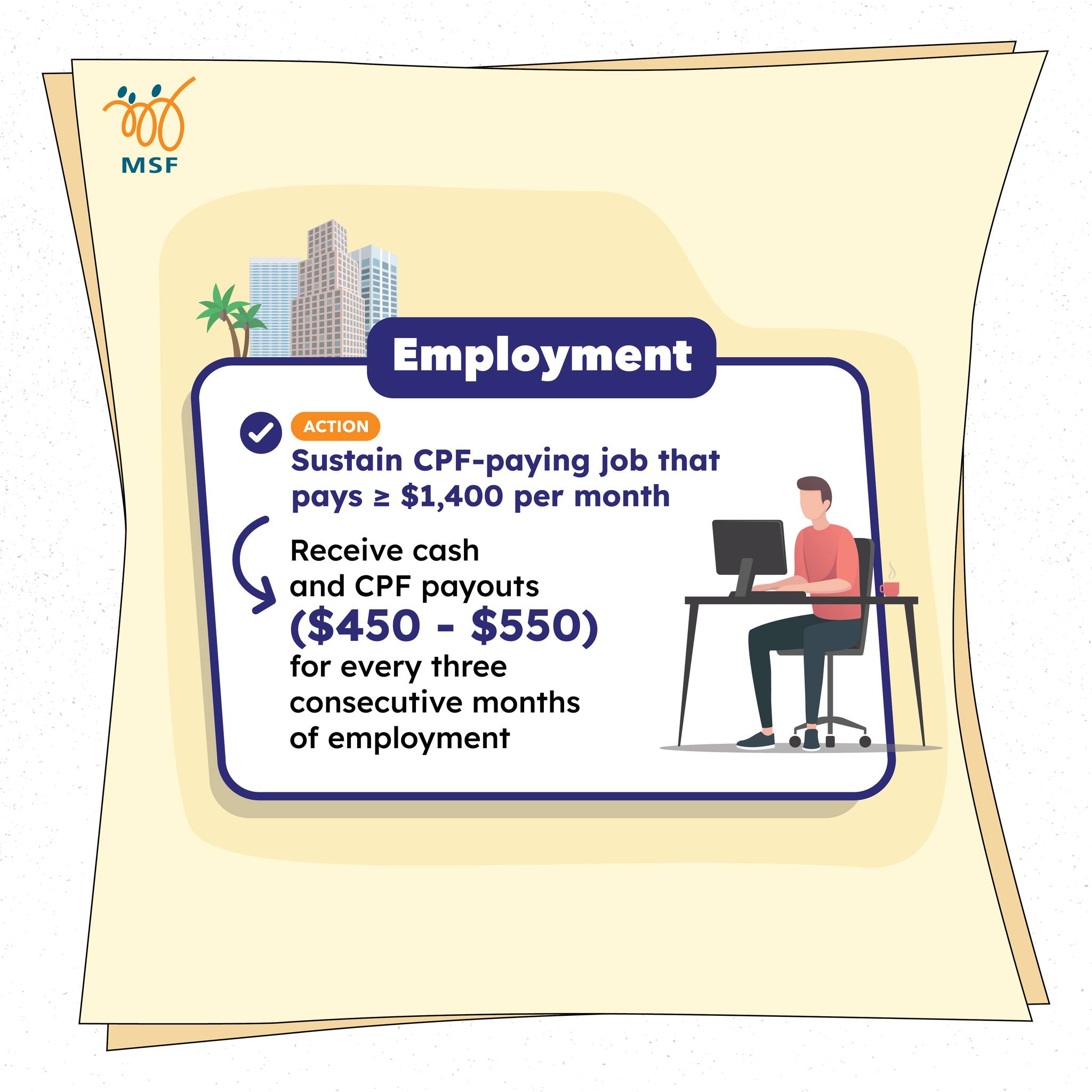
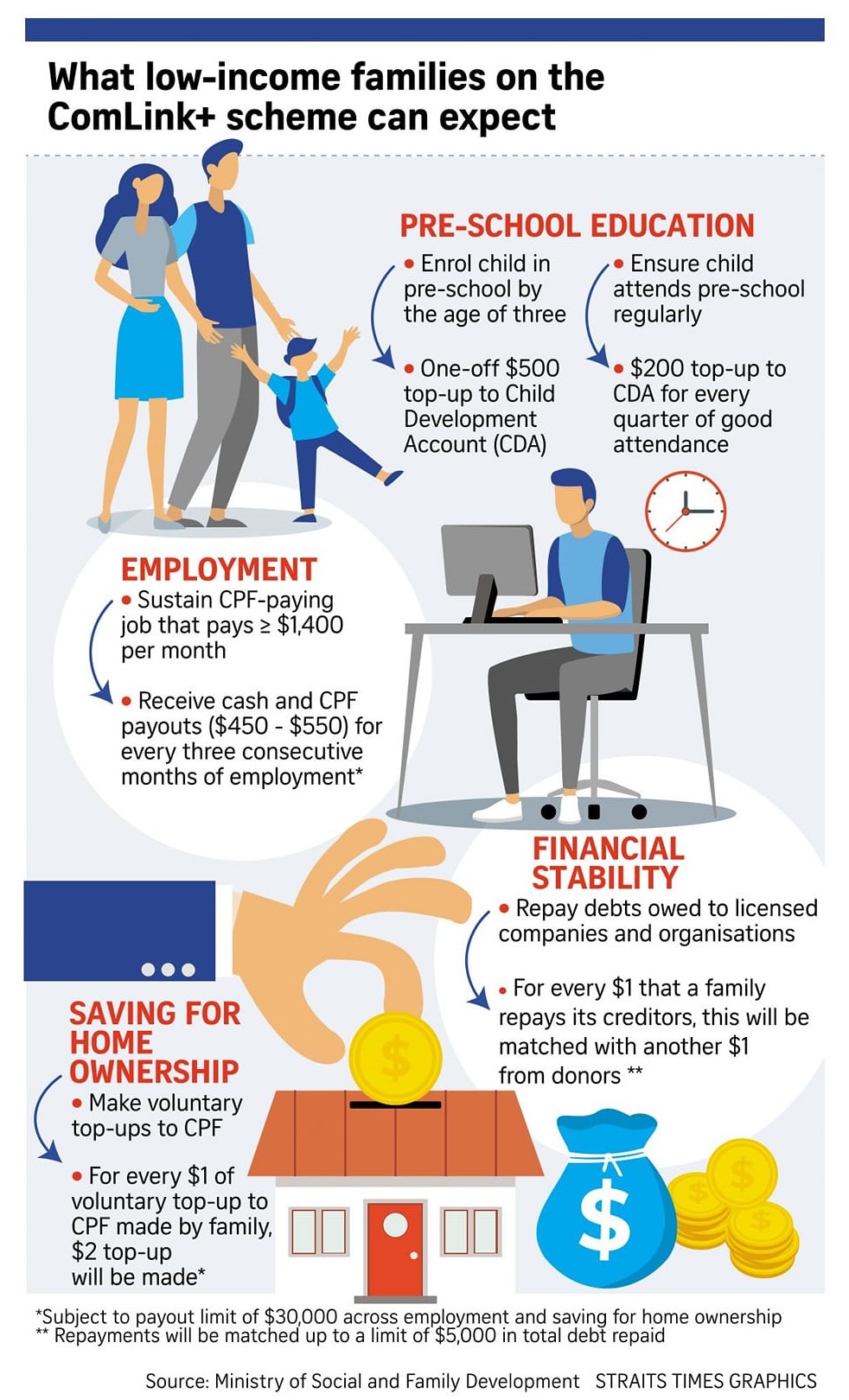
The measures are aimed at motivating families to send their children to pre-school by the age of three, find a stable job that pays CPF, and save up to buy their own homes. For example, beneficiaries can get between $450 and $550 every three months in a mix of cash and CPF payouts if they find a CPF-paying job with a salary of at least $1,400 a month.

One package helps families to clear their debt, such as for utility and housing arrears. This debt clearance package will match dollar for dollar up to $2,500 in sums repaid by the family, so the total debt cleared would be up to $5,000.

ComLink+ is a key plank of the national drive to reduce income inequality and boost social mobility under the Forward Singapore report, which was launched on Oct 27.

Speaking at the Year of Celebrating Social Service Partners appreciation event on Nov 20, Mr Masagos said: “We want Singapore to continue to be a place where social mobility is kept alive for all, especially low-income families who may face unique challenges.

“Many Singaporeans share this vision and agree that more support for low-income families is needed. At the same time, they think this needs to be done in a manner that does not erode self-reliance and agency.”


Mr Masagos described the ComLink+ scheme as a key shift beyond providing just basic, short-term social assistance. The additional financial support will help ease the financial pressures on the families and help them achieve their longer-term goals faster, he added.


“It may take a generation or more, but we know that by reinforcing families’ ability to provide their children with a good start in life today, we give them a better chance of a brighter tomorrow.”

The latest scheme builds on the existing ComLink programme that started in 2019, where low-income families with children living in HDB rental flats are given coordinated and comprehensive support ranging from job assistance to children’s development.

The ComLink+ support measures will be trialled for three years to assess their effectiveness before any potential scale-up, the Ministry of Social and Family Development (MSF) said.

Areas of support under four packages

1. Pre-school education

Each child enrolled in pre-school will get a one-time $500 top-up to the Child Development Account (CDA), which is a special savings account for the child that can be used to pay pre-school and healthcare fees, when they turn three.

Those between the ages of three and six will get a $200 top-up to their CDA every three months if they attend pre-school regularly. Regular attendance is defined as when the child is in pre-school at least 75 per cent of the time.

Local research has shown that children who attend pre-school from the age of three are less likely to require additional learning support in primary school.

However, the pre-school enrolment and attendance rate of children from lower-income families are lower than the national average, especially at the age of three and four. For example, 88 per cent of children aged three to four nationwide were enrolled in pre-school, compared with 78 per cent for those in lower-income families in 2021, the MSF told The Straits Times.

This package is funded by a corporate donor.

2. Stable employment

Beneficiaries will be given financial incentives if they find a job that pays CPF contributions with a gross salary of at least $1,400 a month. Each adult with a job that meets these criteria will get financial top-ups of between $450 and $550 in a combination of cash and CPF payouts for every quarter that he or she is employed.

If two adults in the same household qualify, they will each get an extra $50 every three months. A maximum of two adults per family can benefit from this employment package geared towards encouraging families to find a stable job.


3. Debt clearance

To help families clear their debt, this package will match dollar for dollar, up to $2,500, the amount the family repays for what the MSF calls verifiable debt. This refers to debt owed to licensed companies, such as utilities and housing arrears, that can be verified and for which repayments can be tracked. Debts to unlicensed moneylenders and sums owed to family and friends are not covered.

Families can benefit from this debt clearance package only once. To qualify, they must not be receiving financial aid from the Government’s ComCare scheme.

An MSF spokesman said: “With less disposable income and savings, lower-income families are more susceptible to falling into debt or arrears, especially if they encounter unexpected setbacks or have inherited debt.

“Even a relatively small debt can severely impact lower-income families financially, psychologically and emotionally, affecting their ability to resolve their debts and work towards long-term goals.”

This package is funded entirely by donors, including Singapore Pools.

4. Saving for home ownership

To help families save up to buy their own flats, for every dollar that the family voluntarily contributes to the CPF Ordinary Account, the Government will top up $2. A family can receive only up to $30,000 in total payouts across this package and the employment package. This package is funded by the Government and DBS Bank, an anchor partner for ComLink+.

Mr Masagos said over 170 partners, which includes DBS, OCBC, UOL’s Pan Pacific Hotels Group, are providing support to ComLink families in various ways.

The financial top-ups will be given for as long as the family remains eligible for the particular package or until the family reaches the payout limit specified for each package, whichever is earlier.

These four areas of support in the packages were designed based on the key needs and aspirations families on ComLink had shared, the MSF said.


Mr Masagos said ComLink officers will be trained to act as family coaches to motivate and support families in working towards their goals.

He said: “When families feel understood and supported, they are more likely to actively participate in the decision-making process and take steps towards their goals. With support from family coaches to meet their immediate needs and stabilise their situations, families tell us they feel more optimistic about their future.”

Wednesday, 25 January 2023

DPM Lawrence Wong at IPS Singapore Perspectives 2023

Singapore has a vision for tomorrow – to improve work and employment
Concrete suggestions to improve the future of work, the security of work and the reward in work can strengthen both the workforce and society.
By Terence Ho, Published The Straits Times, 18 Jan 2023

In his speech at the Institute of Policy Studies (IPS) Singapore Perspectives conference on Monday, Deputy Prime Minister Lawrence Wong highlighted three challenges relating to work. These are the changing nature of work, retirement security and income distribution – what Mr Wong dubbed the “future of work”, the “security of work” and the “reward of work”.

Mr Wong also articulated three corresponding responses: redoubling investments in skills and human capital, bolstering retirement security, and investing in quality jobs to make every profession and pathway viable and rewarding.

These aims are not new, but what struck me, both from the speech and the dialogue that followed, was the opportunity we have to transform society by making work better.


Given the centrality of work to Singapore’s social compact, improvements to the world of work hold the promise of building a happier, healthier and more cohesive society.

Realising this vision, however, will not be straightforward. It will take significant investments in time and finances, mindset shifts as well as partnerships across the whole of society to get us there.

Building a world-class skills, training and job placement ecosystem

The first response – stepping up human capital investment – entails strengthening the skills and training ecosystem, improving adult learning and creating pathways to better jobs. It is easy to train workers, but much harder to translate training into higher productivity, better jobs and improved pay.

Few countries have managed to build a well-oiled, comprehensive system of adult learning and placement. So if Singapore succeeds in this endeavour, it would be a notable accomplishment with significant benefits to our economy and society.


Achieving this will not be an easy task. Beyond the careful curation of training programmes to meet current and future skills demand, there is also the need to match workers to programmes and jobs that best align with their aptitude and inclination.

For those in employment, it may be a challenge to find the time to invest in training amid the demands of work and family. Without the assurance of better pay and prospects, few would commit time and effort to acquire new skills.

Company-led training is therefore critical, but cannot be the sole route of skills upgrading. After all, firms may under-invest in transferable skills that make employees more marketable elsewhere. Worker-initiated training meanwhile can open the door to new jobs and opportunities. For instance, some have taken up graduate diploma or professional certificate courses to equip themselves for a change of career.

Saturday, 9 October 2021

How much money do households in Singapore need to achieve a basic standard of living?

Family of four needs $6,426 a month for basic standard of living in Singapore: Minimum Income Standards Study 2021
By Tham Yuen-C, Senior Political Correspondent, The Straits Times, 8 Oct 2021

A family of four, with parents, a pre-teen and a teenager, needs at least $6,426 a month to afford a basic standard of living, a study on household budgets has found.

A family of two, with a single parent and a toddler or pre-schooler, meanwhile, needs $3,218 a month.

But a substantial and concerning proportion of working households in Singapore - about 30 per cent - do not earn enough to meet these needs.

The study was done by National University of Singapore Lee Kuan Yew School of Public Policy (LKYSPP) and Nanyang Technological University (NTU).

Its findings were released in the report Minimum Income Standards For Households In Singapore (2021), and were disputed by the Ministry of Finance (MOF) in a statement on Friday (Oct 8).

LKYSPP senior research fellow Ng Kok Hoe and NTU head of sociology Teo You Yenn, two of the study's six authors, said that the study on how much people need to achieve a basic standard of living in Singapore has exposed some gaps in society.

Using the figures as a benchmark and comparing them against existing income data as well as public schemes show that some segments of the population are not able to meet their basic needs, added Dr Ng at an event presenting the study's findings held over videoconferencing platform Zoom.

But the MOF said "the conclusions may not be an accurate reflection of basic needs largely due to assumptions used", pointing to the limitations of the Minimum Income Standards (MIS) approach used.

The study defined standard of living as one in which Singaporeans can afford housing, food and clothing, and also have opportunities for education, employment and work-life balance, as well as access to healthcare.

It should also enable a sense of belonging, respect, security and independence and afford the choice to participate in social activities and cultural and religious practices.

Based on this definition that emerged from focus group discussions, researchers then convened more focus groups for people to come up with lists of items people from different stages of life will need.

The researchers went to shops or websites mentioned by the participants to find out the real price of each item. These lists were then combined to form the budget of various configurations of households.

Dr Ng said a critical pillar of the MIS approach is to ensure that each focus group is economically diverse, so the budgets resulting from the discussions are not just for particular segments, say the rich or poor. Instead, these budgets apply universally for all Singaporeans, he added.

A total of 196 participants of different genders, ethnicity and socio-economic backgrounds took part in 24 focus group discussions.

Tuesday, 25 May 2021

More CPF members topped up savings in 2020 amid COVID-19 uncertainties

Almost 40% jump in CPF members who topped up savings in 2020 compared with 2019
By Calvin Yang, Correspondent, The Straits Times, 24 May 2021

More people sought to tap the benefits of the Central Provident Fund (CPF) last year to stretch their savings amid the pandemic's uncertainties.

The number of members who topped up their own or their loved ones' CPF retirement savings was nearly 40 per cent higher last year, compared with 2019.

At the same time, people who made voluntary housing refunds nearly tripled over the same period, according to the latest CPF Board figures.

Also slightly up is the proportion of members who died last year and had specified a recipient for their CPF savings.

It is no surprise that more people are channelling more cash into CPF accounts, observers told The Straits Times, since they are now realising the benefits of using the scheme to save.

Last year, some 141,130 CPF members made top-ups under the Retirement Sum Topping-Up Scheme, contributing a total of $2.97 billion.

In 2019, only 103,800 members grew their CPF funds under the scheme. Total top-ups in 2019 were also lower at $2.14 billion.


Meanwhile, about 14,980 members made voluntary housing refunds last year, putting in a total of $1.48 billion.

This involves members who had used CPF savings to pay for their property choosing to make a refund of the amount withdrawn.

In comparison, only 5,500 members did this in 2019, with a total of $513 million being refunded.


OCBC Bank's head of wealth advisory Kelvin Goh said CPF funds offer members more attractive risk-adjusted returns, compared with regular savings accounts and even some investments.

The higher take-up rate is likely boosted by the lower interest rate environment and market volatility brought about by the pandemic, said DBS Bank's head of financial planning literacy Lorna Tan, noting that the trend of CPF top-ups is expected to continue.

The Retirement Sum Topping-Up Scheme allows members to use cash or CPF savings to top up their own or their loved ones' accounts.

For recipients under 55, the Special Account can be topped up to the current Full Retirement Sum, which is $186,000 this year.

Those aged 55 and older can have their Retirement Accounts topped up to the current Enhanced Retirement Sum, which is $279,000 this year.

Mr Wilson Loy, Standard Chartered Bank Singapore's head of investment advisory and strategy, said another factor for the increase could be the tax reliefs granted for topping up CPF accounts.

CPF members can get tax reliefs of up to $7,000 per calendar year for top-ups made to their own accounts, and up to another $7,000 for top-ups made for their parents, parents-in-law, grandparents, grandparents-in-law, spouse and siblings.

Sunday, 5 July 2020

How to have a good, long life with CPF

Those who put more in CPF LIFE and defer payouts till 70 will have more cash each month
By Tan Ooi Boon, Invest Editor, The Sunday Times, 5 Jul 2020

The longer you keep your money in the Central Provident Fund (CPF), the more you will earn because of its high interest rate. This is why more Singaporeans are trying to keep their funds for a longer period in this safe haven.

No wonder the CPF Board has to do more to get eligible members to start collecting payouts when they hit 65. At that age, members can start receiving monthly payouts under CPF LIFE, the Board's longevity insurance scheme. But many choose not to ask for the payouts.

Although members get reminders six months before their 65th birthday, about 60 per cent let their funds stay in their CPF accounts.

And even after four more rounds of yearly reminders, half of those reaching 70 still do nothing.

To solve this problem, the Board now automatically disburses the funds the moment members hit 70.

While it tries to help vulnerable seniors who may not understand the scheme, many do not want to get their payouts at 65 as they will gain even more with each passing year.

Some of these retirees are likely to be savvy investors or even professionals who are still working. Indeed, a few wrote to Invest to ask whether they can pay into a second CPF LIFE account!

As they are still enjoying a steady flow of income, they choose to receive their CPF LIFE payouts only from 70. They can receive up to 7 per cent higher payouts for each year they defer their payouts.

Take a member who plans to set aside the maximum retirement amount of $288,000 in 2022. If he takes the payout at 65, he will get an estimated $2,400 a month. But if he does so at 70, he will get over $3,200.

Just like the tortoise that wins the race with the rabbit in the children's fable, members who start receiving their payouts later in life will slowly catch up and get even more.

Imagine a couple with two sets of such payments - they will have over $6,000 to spend every month just from CPF LIFE. This alone can pay for a comfortable retirement, leaving aside cash savings they are likely to have as well.

The reason CPF LIFE is the best longevity insurance scheme that money can buy is because it is backed by the Government. Unlike some other plans that may end after a number of years, the CPF LIFE payment will continue as long as you live, even beyond 100.

This is good news for future generations of seniors as their average life expectancy is likely to go up. As it is, about a third of today's 65-year-olds are expected to live beyond 90.

Also, unlike private annuities that may cost over $1 million for similar payouts, the threshold for CPF LIFE is far lower. This is possible because the "premium" that you set aside for CPF LIFE will continue to earn up to 6 per cent minimum interest.

The monthly payouts will first come out of your CPF LIFE premium. When your own premium is depleted, you will continue to receive the monthly payouts from the interest that you have accumulated within your plan, as well as the interest from the CPF LIFE pool.

You should go to the CPF website and use its very informative CPF LIFE "estimator" to see the patterns of monthly payouts based on the retirement sums you have set aside.

This interactive tool is only a guide and the results do not reflect the actual payout that members will get, due to their varied profiles.

But it does give a very insightful peek into the three CPF LIFE payout plans that you can choose to have when you hit 65.

Saturday, 2 November 2019

Give money to others instead; Elderly caregiver surprised at response to his life story and grateful for offers of assistance

Elderly good Samaritan refuses money: 'I have enough... I don't need anything else'
By Timothy Goh, The Straits Times, 1 Nov 2019

Offers of donations and assistance have poured in for Mr Lee Cho Poon, an 83-year-old retired busker who has opened his rental flat to three different housemates over the past decade, caring for their every need, including their funerals.

But when The Straits Times visited Mr Lee in his one-room apartment in Ang Mo Kio on Wednesday, he politely declined every one of them, asking instead that donors help those less fortunate than he is.

Mr Lee, who never married, lives in the flat with his housemate Neo Cheng Liang, 86, a former neighbour who moved in with him in 2017.

Mr Neo suffers from dementia and is hard of hearing.


More than 30 people have reached out to The Straits Times, offering to help Mr Lee since his story was reported on Tuesday.

One such person was pre-school director Ben Lee, 41, who said: "He gives so much with the little he has. I have so much but I give so little. It's really inspiring."

Both young and old offered a variety of donations, ranging from money to bed sheets, clothing, furniture and groceries. Some also volunteered to spend time with Mr Lee.

Lawyer Suzanne Liau, 70, said: "Mr Lee's generosity of heart and spirit is not only admirable but, given his financial circumstance, also astounding.

"There is just no comparison with people who have more, but have done very much less and are not even aware that they have not done enough."

Student Megan Lau, 23, said: "My boyfriend and I realised Mr Lee actually lives in his neighbourhood, which made it feel so much closer to home.

"We realised that the people who have so little are the most generous. It makes us want to help him out in whatever way we can."

She offered not just to donate money but also to take Mr Lee out for meals if possible.

It is not just Singaporeans who have been touched by Mr Lee's story.

Mr Ajit Iyer, an Indian citizen who has been living in Singapore for the past decade or so, offered to help Mr Lee in whatever way he could.

The 45-year-old, who works in human resources, said: "I'm not sure that when I'm 80, I'd have a heart that big. It's very humbling. It's quite amazing that he's able to do something like that."

Social services agency Lions Befrienders is currently helping to coordinate the offers of assistance for Mr Lee, who has no major illnesses despite suffering a mild stroke a few years ago.

The agency has clarified that it will not take a cut of the donations, which will all be given to Mr Lee.

Lions Befrienders' chairman William Loh said: "We are heartened by the outpouring of goodwill from the public and are immensely grateful for their strong support.

"This is indeed a hallmark of an inclusive society with a culture of giving."


Mr Lee, however, was completely unaware of the buzz his story had generated.

"All I did was take care of my friend, who's like a brother to me - why is this such big news?" he asked in Mandarin, surprised at the public's response to his life story.

He was also surprised at the many offers of assistance, and repeatedly thanked those who had reached out. However, he said he did not wish to receive anything.

He said: "I never wished for anyone else's money, as long as I can take care of my housemate and continue to live with him.

"He's like my dear brother… as long as I can continue to eat with him, that's enough. I don't want anything else, I don't need anything else.

"Please tell readers that I'm very, very grateful, but that they should give the money to people who are needier than I am."

The men live on financial assistance of $600 a month each after Mr Lee's savings from his days as a busker ran out.

He added: "We already have enough to eat... we have about $40 (for two people) a day, that's enough.

"Most importantly, I want to remain healthy, to continue caring for Mr Neo, for him to not fall ill, to eat and be happy. This is what gives me satisfaction... I have no regrets."

Thursday, 24 October 2019

Singaporeans in their 40s today are better educated, earn more than past cohorts: Ministry of Finance report on socio-economic outcomes of Singaporeans born between 1940 - 1979

But MOF report shows they have less family support as fewer are married and families are smaller
By Grace Ho, Senior Political Correspondent, The Straits Times, 23 Oct 2019

Singaporeans today are generally better educated, more able to find jobs and earn more, and live longer, according to a study by the Ministry of Finance (MOF).

The study looked at Singaporeans in their 40s today, and compared them with earlier cohorts.

It found that those in their 40s also have less family support, as fewer of them are married and families are smaller, the report published yesterday showed.

And while home ownership has risen over time, it showed that the figures for those in their 40s are slightly behind that of those in their 50s and 60s.

The study, which draws on official data, tracks the status of four generations of Singaporeans when they were in their 40s.


It shows that 44 per cent of those born in the 1970s have university degrees, compared with 21 per cent of those born in the 1960s, and 7 per cent of those born in the 1940s.

The median real gross monthly income of those in their 40s is twice that of those in their 60s, when that cohort was still in their 40s.

And the median real balance in their Central Provident Fund (CPF) Ordinary and Special accounts is three times that of those in their 60s at the same age, after accounting for inflation.

Singaporeans in their 20s and 30s are not included in the report as outcomes like retirement savings and health are better observed later on in life, said MOF.

INCOME, EDUCATION, CPF SAVINGS

The report highlighted that 79 per cent of Singaporeans in their 40s have post-secondary qualifications, compared with 49 cent of those in their 50s and 22 per cent of those in their 70s.

One factor is that those born in the 1940s grew up in a fragmented schooling landscape with uneven quality organised by different community groups. While vocational schools expanded in the 1960s and 1970s, it was not until the 1980s that a robust national curriculum was developed.

Those in their 40s benefited from major shifts in the education system focusing on technological literacy and continuing skills development - a trend set to continue with younger Singaporeans.

The report added: "Today, students benefit from well-resourced schools and a large degree of flexibility... where they can choose from multiple pathways based on their strengths and talents."


Due to an increase in the female participation rate, more are now active in the workforce. While the total labour force participation rate rose by 5 percentage points between 2009 and last year, women's participation jumped by more than 10 points during the same period.

Singaporeans in their 40s are also earning more. At $5,900, the median real gross monthly income including employer CPF contributions of all full-time workers is about twice that of older cohorts when they were at the same age. The median is the midway point in the population. This applies even to the bottom 20 per cent of income earners, who earn $3,000 or less a month - twice as much as those in their 60s, when they were in their 40s.

Overall, when shorn of inflation's effects, the median CPF account balance of those in their 40s is three times that of those in their 60s, when that cohort was still in their 40s.

Saturday, 9 March 2019

Universal Basic Income: Why should Government give handouts to everyone?

Policies involving the application of universal basic income are instituted with a broad brush (It's time to talk about a universal basic income, March 6).

Yes, they are simple to administer, will help those displaced by disruptive technology and may even enable creative endeavours not otherwise possible.

But why give an unqualified windfall to all and sundry, regardless of need, circumstances or motivation to strive for a better life?

Indubitably, the less fortunate, deprived, sick, handicapped and lower-salaried workers must be given a helping hand by the state.

But such financial aid must be targeted to be meaningful and work effectively.


With a good social welfare infrastructure under the umbrella of the National Council of Social Service, its complex administration in our small and smart nation is manageable, unlike with sprawled out populations in large countries, where those who need the most help may find it inaccessible.

We can't possibly continually give handouts to the able-bodied displaced by disruptive technology as this indicates the unremitting theme of things to come.

But retraining those eager to start afresh, of which schemes are aplenty here, and teaching them to fish again, will give them an occupation to provide food for a lifetime.

Yik Keng Yeong (Dr)
ST Forum, 8 Mar 2019

Monday, 11 February 2019

Singapore 50 years ago, and now: An Asian middle way?; Fruits of economic growth used to build fair, inclusive society, says Indranee Rajah

A Harvard professor with a long acquaintance with Singapore reflects on its socialist roots and says it should continue to show the world a middle way.
By Steven Kelman, Published The Sunday Times, 10 Feb 2019

In 1971, one year out of Harvard University, I spent two weeks in Singapore as part of my first trip to Asia. I had been lucky to win one of two "travelling fellowships" Harvard awarded to graduating seniors - allowing travel wherever one wanted, with the only requirement being to write a report when done.

Almost every winner used the fellowship to travel to Asia, because even then it was common for young Americans to travel to Europe, but much more so to Asia.

In Asia, Singapore was one of my longer stops along a route also taking me to Japan and India (one month each), Hong Kong (two weeks), Korea, Thailand, and Indonesia (one week each), and Nepal (three days).

The most interesting thing about my decision to visit Singapore at all, and to stay a full two weeks, was that it came about because of my admiration for the People's Action Party (PAP) government, which mixed strong opposition to communism with commitment to socialism.


Since junior high school, I had been very interested in politics. I had always been on the left, but at age 16, my path diverged from other political students in my high school because of disillusionment with Cuban leader Fidel Castro's embrace of dictatorship. I rejected the brutality and inhumanity of communism.

Instead, staying on the left, I became a convinced social democrat, in the tradition of the German Social Democrats, British Labour, and especially the Swedish Social Democrats.

Sweden was my first love then. An American writer in the 1930s had dubbed Sweden a "middle way" between communism and fascism. They had chosen a welfare state to promote equality and social justice while gaining the productivity and innovation benefits of keeping industry in private hands. I actually started studying Swedish in my junior year and had spent time there on a scholarship after graduating.

What brought me to this tiny speck of land 15,000km from America in 1971 was that Singapore became my second love.

This was a time when, in the context of opposition to the Vietnam War, Asian communism was on the ascendance. Many Western young people admired revolutionary leaders such as Vietnam's Ho Chi Minh and China's Mao Zedong. I learnt that Mr Lee Kuan Yew in Singapore had beaten back the communists, but remained an advocate of socialism.

In 1968, the first time I went to Sweden, Mr Lee spoke at the congress of the Socialist International, the organisation of social democratic parties. In 1970, the PAP re-affirmed its commitment to socialism, stating Singapore had made significant strides towards achievement of "our socialist goals, a more just and equal society". The PAP's frugal style and hatred of corruption, symbolised by the white garments activists wore, also appealed to me.

Stopping communism, promoting social justice, and being honest were noble causes for which the PAP was struggling. To me, Singapore was an Asian middle way, offering the world a path between communism and unfettered capitalism.

I wanted to visit to learn more. I had read about two social achievements, government-subsidised housing and its role in encouraging industrial development at Jurong.

While there, I gave myself a young social democrat's tour of Singapore.

Thursday, 28 June 2018

This is what helping families looks like

In the ongoing debate on inequality and poverty, this writer argues that Singapore's 'ecosystem' of helping the poor, which emphasises self-reliance, is working well
By Mohamad Maliki Osman, Published The Straits Times, 27 Jun 2018

When I was an undergraduate in social work three decades ago, I learnt that welfare to the poor is a temporary safety net: it is to help individuals "get back on their feet".

This lesson resonated with me. Growing up, my family diet was often rice and soya sauce. Clothes and books were handed down from older to younger siblings. My bed was a straw mat in the corridor, because our one-room rental flat was too small for all of us.

Like many families back then, we struggled. But my father, a blue-collar worker who raised nine children, taught me the values of self-reliance, hard work and family support. "There is no shortcut to success - just work hard," he would remind us.

My experience was not unique. Many of my contemporaries, now well-established in their careers, grew up in similarly challenging situations. For example, Professor David Chan of Singapore Management University lived in a rental one-room HDB flat in Bukit Merah with his parents and three siblings for the first 30 years of his life. He had to work full-time for several years to save up to pay for his subsequent university education.

Many of us grew up experiencing many years of being poor, but we also went through the journey of improving our lives with determination and hard work. So we can see things from the perspective of those who are not well-off, and also know it is possible to improve one's life in Singapore. This became even clearer to me after I graduated as a social worker and later became a Member of Parliament, as I worked almost daily with families in need of different kinds of help.

But times have changed, and there is a real difference between my growing-up years and now. Today, families in rental flats receive much more help. Financial assistance, food rations, spring cleaning and home painting, changing to energy-saving light bulbs, free tuition for their children, and many other kinds of help are readily available and regularly offered by organisations and individuals alike.

Despite the extensive help extended, some commentators claim that the poor in Singapore, especially those living in rental flats, have severe unmet needs, and are being neglected.

They say the poor are struggling because help often comes with onerous conditions; that parents do not go to work because they cannot find suitable childcare arrangements, and that they do not qualify for childcare subsidies because they are not working.

But the facts disprove these claims. There are extensive healthcare and childcare subsidies available to mothers in low-income households, including those who are not working.

Low-income households are entitled to subsidies and can pay as little as $5 a month for full-day childcare service. This low monthly fee makes childcare services entirely affordable even for the poorest, provided the parents are willing to make adjustments and take up full-time jobs, like many other low-income parents in Singapore.

Taxpayers' money should not just be given away, even to the needy, without expecting the recipients to help themselves. Social workers working with low-income households on a daily basis (sometimes for many years) have a good understanding of the difficulties they face, and the challenges in helping them. Many have learnt that imposing certain conditions on the families receiving subsidies does help them structure their lives, a necessary first step in progressing towards a better life.

The relevant point here is this: In making conclusions about the poor in Singapore, we need to be careful about using some particular cases or groups to generalise about the poor, the system, and the outcomes. We need to look at the facts and understand the situations. We should also draw lessons from the many inspiring households who got back on their feet because they took ownership of their problems, worked hard, and made good use of the help they received.

So what is really going on regarding helping low-income families living in rental flats? Let me illustrate with a real-life project we undertook over several years.