Showing posts with label Active Citizenry. Show all posts

Monday, 18 August 2025

National Day Rally 2025: Beyond SG60 Writing Our Next Chapter

PM Lawrence Wong calls on Singaporeans to unite, write nation’s next chapter together
Government will place citizens at centre of what it does but people must also chip in, look out for one another, he says
By Goh Yan Han, The Straits Times, 18 Aug 2025

Prime Minister Lawrence Wong called on Singaporeans to band together to write the next chapter of the nation’s story, as he set out plans to support them throughout various stages of life.

He gave the assurance that the Government will place Singaporeans at the centre of everything it does, be it navigating economic uncertainty or tackling technological disruption and demographic shifts.

In his first National Day Rally after the general election, PM Wong, who is also Finance Minister, outlined how his Government intends to address the challenges relating to the economy, senior citizens and the younger population.

It will provide job support – in particular, for fresh graduates and mid-career workers – and develop community infrastructure to support the growing population of elderly citizens.


Addressing the audience at ITE College Central in Ang Mo Kio on Aug 17, PM Wong opened his English speech by setting out the immediate challenges that Singapore is facing in a “more troubled and turbulent world”.

These include global tariffs imposed by the United States earlier this year, growing global contestation and rapid advancements in technologies like artificial intelligence (AI).


Singapore is reviewing its economic strategy on various fronts to secure its future in a changed world, he said, noting that harnessing innovation and technology will allow the country to sustainably raise its productivity and improve lives.

“Ultimately, our economic strategy is about jobs, jobs and jobs – that’s our No. 1 priority”, said PM Wong.


Three announcements in his speech centred on jobs: a job-matching scheme at the town level, enhancements to an existing SkillsFuture scheme for mid-career workers, and a government-funded traineeship programme for tertiary education graduates. The details of these schemes will be announced later.


PM Wong said new jobs will be created, as he acknowledged Singaporeans’ worries about jobs evolving or disappearing due to technological change.

“I assure you, even as we embrace AI and technology, we will not lose sight of our key priority,” he said.

“Singaporeans will always be at the centre of everything we do.”


He said the Government is committed to helping every worker progress and succeed, and will not rush headlong into adopting new technology.

There are plans to equip and empower every business, especially small and medium-sized enterprises, to harness AI effectively, he said.

The authorities will also work closely with unions and workers to redesign jobs and help Singaporeans seize new job opportunities, he added.

“The road ahead will not be easy. But we are not going to sit back and resign ourselves to being mere bystanders in a world shaped by others,” said PM Wong.

“We will take charge of our own destiny. We will shape the future we want – through our own actions, and our own choices.”


Turning to the issue of long-term care for seniors, PM Wong announced a new Age Well Neighbourhoods scheme that will adopt features from HDB Community Care Apartments – senior-friendly public housing that provides care services for residents.

The scheme is meant to allow senior citizens to live more independently in their own neighbourhoods, as Singapore’s demographics shift towards more elderly citizens and smaller family sizes.


Identified towns – starting with Toa Payoh and one or two other areas – will have more active ageing centres for seniors to gather, said PM Wong.

Home-based services such as basic health checks and housekeeping will be provided to seniors, with healthcare services brought closer to them as well, he added.


The scheme builds on the existing Age Well SG nationwide initiative for seniors to lead more active lives in their homes and communities.

“That’s how we will grow old – not in isolation, never alone, but always together as one Singapore family,” PM Wong said.


On challenges faced by the younger generation, PM Wong brought up vaping and excessive screen time.

Flagging vaping as a serious concern, he said the Government will take much tougher action and treat it as a drug issue.


It is also studying how other countries manage access to the internet and social media for children, he added.

Setting out the Government’s stance on responding to technological developments – like the use of AI by students – PM Wong said Singapore has to strike the right balance between protecting young people from potential harms and empowering them to fully exploit the benefits of technology.


He also sketched out plans for the northern part of the island, building on the Urban Redevelopment Authority’s Draft Master Plan 2025, which covers Singapore’s development plans for the next 10 to 15 years.

These plans include redeveloping the areas in Woodlands North, Kranji racecourse and Sembawang Shipyard.

As the Government reimagines new uses for existing land, it is also developing plans to protect the country’s coastline against rising sea levels, he added.


“So even as climate shifts and circumstances evolve, one thing is certain: Singapore’s progress will never be left to chance. We are – and have always been – a nation that adapts, reinvents and dares to dream,” said PM Wong.

Good plans and strategies are just the first step for Singapore’s continued progress, said PM Wong as he wrapped up his speech.

“What matters just as much – and even more – is the collective will of our people,” he said, adding it is this Singapore spirit that binds everyone together.


Going forward, Singapore must be a “we first” society with a people that considers others and not just themselves, said PM Wong.

“If each of us does our part for the ‘we’ – care, contribute and look out for one another – then the ‘me’ will thrive and flourish too,” he added.

His team will continue to involve Singaporeans in policy discussions, and will open up more avenues for people to be heard and to get involved.


“We certainly do not want to end up as a society where people rely solely on the government. It’s about all of us – government, businesses, workers and unions, community groups and civil society – doing our part,” he said.

“That’s how my team and I intend to lead. Not just doing things for Singaporeans – but doing things with Singaporeans.”


The nation cannot stand still as it looks beyond SG60, as standing still today is the same as falling behind, said PM Wong.

He urged Singaporeans to dream bigger, be bolder in pushing new frontiers, and be ready to try new things, even if they stumble or fall.


“We take pride in whatever we do, and strive to be the best possible versions of ourselves,” he said.

“We never give up and we never let each other down. That’s how we’ve achieved exceptional performance. That’s how we will continue to stay exceptional – as a people and a country.”

Saturday, 20 July 2024

Dialogue with Youths: PM Lawrence Wong at the Institute of Policy Studies-Varsity Voices Dialogue on 2 July 2024

Singaporeans will be supported to pursue diverse aspirations, define their own success: PM Wong
By Ng Wei Kai, The Straits Times, 3 Jul 2024

More opportunities will be provided for Singaporeans to chart their own paths and pursue their own definitions of success, said Prime Minister Lawrence Wong.

More ways for people to shape the character and tone of society will also be created, PM Wong told about 900 students from the universities, polytechnics and the Institute of Technical Education (ITE) during a dialogue on July 2, where he urged Singaporeans to contribute to the common good.

PM Wong outlined these plans as part of three strategies by which Singapore and its young can adapt and adjust to a more fragmented world on the cusp of another technological revolution.

Besides providing more opportunities and having Singaporeans play their part in shaping a better society, the Government is taking active steps to refresh Singapore’s social compact, he said.


At his first dialogue with young people since becoming prime minister in May, PM Wong said today’s students have access to far more opportunities than previous generations, with many more options and career paths.

Attitudes and mindsets are shifting, and more types of jobs are now respected. More people are opting to start their own business or take on less conventional careers, he said.

“The bottom line is that there are many more opportunities and possibilities for you to explore... We all have our own abilities and strengths. There is no need to compare with others, to squeeze into boxes we are not meant to fit,” PM Wong said at the event at Singapore Management University (SMU).


Even then, one may face rejections and setbacks, and must be prepared for dry spells. By staying focused on working hard and striving for excellence, one’s skills improve and, eventually, other doors will open, he told students at the event organised by SMU, the Institute of Policy Studies and student organisation Varsity Voices.

“I encourage all of you to embrace this attitude of learning and excelling at whatever you do. Not just when you are in school now, not just after you graduate, but throughout your lives,” he said.


“That is why we are investing significantly in SkillsFuture... As you get older, and even when you are in your 40s or when you are around my age in your 50s, you will be able to get a fresh injection of skills.”

In February, PM Wong – who is also Finance Minister – announced at Budget 2024 that all Singaporeans aged 40 and above would get a $4,000 top-up of SkillsFuture credits to encourage mid-career workers to refresh their skills and progress in their careers.

PM Wong cited some ways in which Singapore has changed since he was a student 30 years ago.

Then, about 55 per cent of each cohort went on to post-secondary education. Today, almost everyone progresses to university, polytechnic or ITE, while starting salaries have grown from $3,000 to about $5,000, he noted.


He acknowledged that powerful forces which Singapore does not have much control over, such as competition between major powers, are shaping the country’s operating environment. The dawn of artificial intelligence is also likely to have a bigger impact than the advent of the internet.

But Singapore has adapted and found a way to thrive across its 60 years of nation building, and must continue to do so, said PM Wong.

He reiterated the Government’s commitment as part of Singapore’s refreshed social compact to give greater assurance to Singaporeans at every stage of life, such as through stronger safety nets that will help them bounce back from setbacks.

Singaporeans must also do their part, such as to embrace skills upgrading and be prepared to pay more for services delivered by fellow citizens, said PM Wong.


He noted that many Singaporeans had said during the Forward Singapore exercise that they do not want a society where everyone is out for themselves, but one where benefits are shared by all.

That is why the authorities started the Singapore Government Partnerships Office, to make it easier for those who want to step forward to work with other citizens, community groups and businesses to tackle issues of the day.


Four youth panels have also been set up so far to deliberate over issues of concern to young people, such as financial security and sustainability. PM Wong said the young people involved in them are putting in their time and effort, and will present their recommendations at an inaugural Youth Policy Forum in August.

“You may not have had the chance to participate in this round of youth panels, but there will be subsequent editions, and we welcome more of you to join in,” he said.


Saturday, 28 October 2023

Forward SG report unveils social support plans, lays out mindset shifts needed amid changing times

Moves to ensure basic needs of Singaporeans are met and social compact is refreshed
By Goh Yan Han, Political Correspondent, The Straits Times, 27 Oct 2023

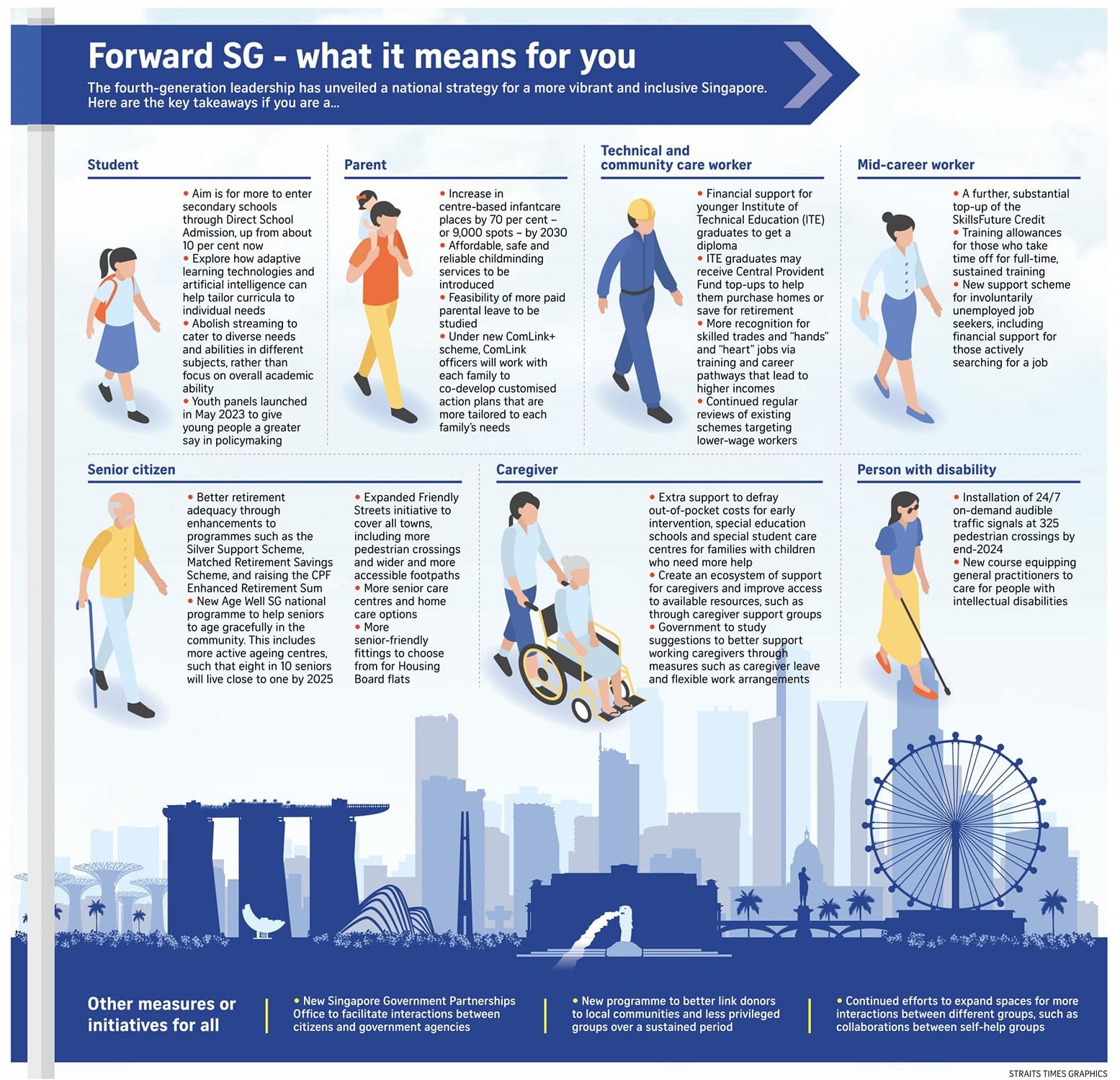
A road map towards a more equitable and thriving Singapore has been put forth by the fourth-generation (4G) leadership, fleshing out the moves the Republic will make in the coming years to stay cohesive amid a time of change.

These include a greater helping hand for groups such as the less well-off, mid-career workers and seniors, through means such as additional financial support and improved infrastructure.

And there will be more done to ensure that Singaporeans’ basic needs at every life stage will be met, such as in education, retirement, healthcare and housing.

These moves come as Singapore has reached a key inflection point where there will be more disruptions, workplace churn and impact on people’s lives, and the Government recognises that more must be done to provide assurance for the people, said Deputy Prime Minister Lawrence Wong at a press conference to launch the Forward Singapore report.


The 180-page report unveiled on Friday also articulated the mindset shifts required for Singapore to achieve the goals set out, such as for wider definitions of success and a stronger sense of collective responsibility towards one another.

It will not be possible for the Government alone to do everything through policy changes, nor is it possible for any individual to succeed on his or her own efforts alone,” DPM Wong said later at the launch of the Forward Singapore Festival, where the public can learn more about the report’s initiatives.

Instead, it will be up to everyone, including employers, community groups, families and individuals, to keep the Singapore miracle going, he added.


The report caps off a nationwide engagement exercise headed by Mr Wong that has involved more than 200,000 Singaporeans since it kicked off in June 2022.

The exercise sought to refresh Singapore’s social compact – the glue that holds society together – given the challenges facing the island, which range from a more fraught external environment to a rapidly ageing population to greater job insecurity due to rapid technological change.

One key move the 4G team intends to make to take the country forward is to create more opportunities for all Singaporeans to chart their own paths in life. This includes increasing salaries and respect for a wider range of vocations, better social support for those who face career hurdles, and nudging those who succeed to give back to society.

On the jobs and education front, the report unveiled plans to provide a “substantial top-up” of SkillsFuture Credit, as well as a “significant package” to help mature and mid-career workers reskill and upskill.

Institute of Technical Education graduates will get support to upgrade their skills early in their work life to close wage gaps, while more will be done to recognise those in jobs involving “hands” or “heart”, such as electricians and nurses.

“If society is more supportive of individuals pursuing these careers, we can create a virtuous cycle, where society in turn benefits from better and more reliable services,” it said.


Among efforts to help ageing seniors is the nationwide expansion of a pilot announced in March that will result in wider footpaths and longer green-man timings at traffic crossings.


Programmes that support retirement adequacy for those with lower incomes, such as the Silver Support Scheme and the Matched Retirement Savings Scheme, will be updated.


Young parents will also get more help, as the report recognised a need to better support families.

This includes a commitment to studying the feasibility of increasing paid parental leave, and to increase centre-based infantcare places by 70 per cent – or 9,000 spots – by 2030.

On the timeline to implement these changes, Mr Wong said the 4G team will prioritise issues that are more salient and of greater concern for Singaporeans. For instance, policy shifts have already been made or announced in the areas of housing and retirement. These include changing the housing classification system to the Standard, Plus and Prime model, and the $7 billion Majulah Package to help citizens aged 50 and over, that were announced by Prime Minister Lee Hsien Loong at the National Day Rally in August.

Other items, where specific recommendations have been set out, will be implemented in Budget 2024 and over the coming year, said Mr Wong.


Also at the press conference on Friday were other ministers including Minister in the Prime Minister’s Office Indranee Rajah, Health Minister Ong Ye Kung, Education Minister Chan Chun Sing, Manpower Minister Tan See Leng, and Social and Family Development Minister Masagos Zulkifli.

The Forward Singapore report took in people’s ideas for the country’s future, which were contributed at 275 dialogue sessions, as well as through surveys and roadshows. It noted that one topic that constantly emerged at discussions was how the idea of a “good life” had evolved, especially among the younger generation who desire meaning and purpose in life, besides a good salary. The Singapore Dream, which used to be measured by the five Cs of condominium, car, cash, credit card and country club, had fallen out of favour, but there was still a tendency for society to measure success by old yardsticks such as the size of one’s pay cheque or home, the report noted.


Mr Wong said Singaporeans today still want a good life, but it is clear from the engagements that the Singapore Dream has evolved to be about more than just material success. “It’s also about fulfilment, meaning, and purpose in what we do,” he said.

“That’s why I firmly believe the refreshed Singapore Dream is less about I, me, and mine; it’s more about we, us, and ours. It’s recognising that we are not left to fend for ourselves; but that we are all in this together.”

Besides encouraging Singaporeans to tap the range of existing programmes to give back to society, a new Singapore Government Partnerships Office will be set up for agencies to work more closely with citizens.

In sum, the report represents a vision to guide the next bound of development for the Republic, where various groups come together to build a better Singapore, it said.

Mr Wong said: “We have a full agenda ahead of us, and we look forward to working with all Singaporeans to write our next chapter of the Singapore Story,” he said.


Thursday, 30 June 2022

FORWARD Singapore: 4G ministers to engage Singaporeans in six areas to get views, update policies

Lawrence Wong launches 'Forward Singapore' to set out road map for a society that 'benefits many, not a few'
By Goh Yan Han, Political Correspondent, The Straits Times, 28 Jun 2022

Deputy Prime Minister Lawrence Wong on Tuesday (June 28) called on Singaporeans to offer ideas to shape the future of Singapore, which he described as at a crossroads post-Covid-19.

Their contributions will be part of a Forward Singapore road map to be released in the middle of next year that will set out both policy recommendations and how various parts of society can better contribute to the nation's shared goals, based on its values of a united people and a society that is just and equal.

"I hope to see a society and system that benefits many, not a few; that rewards a wide variety of talents, not a conventional or narrow few; that values and celebrates all individuals for who they are and what they can achieve; and provides all with opportunities to do better throughout their lives," he said.

Mr Wong, who took on the role of deputy prime minister on June 13, was addressing unionists at a dialogue organised by the National Trades Union Congress at the NTUC Centre at One Marina Boulevard.


The year-long Forward Singapore exercise will be led by Mr Wong and will have six pillars headed by his fellow fourth-generation leaders, in areas such as jobs, housing and health.

This is Mr Wong's first major speech since becoming DPM and since being named leader of the ruling People's Action Party's 4G team in April, paving the way for him to be Singapore's next prime minister.

Mr Wong, who is also finance minister, said that it is important to refresh and update the social compact so that it remains fit for the changing circumstances.

"A social compact that is deemed fair by all segments of society strengthens social capital and fosters trust, and this is what enables us to progress together as a nation," added Mr Wong.

On the other hand, the fraying of such compacts across Europe and North America over the past decade as people felt left out of their countries' progress has fuelled the rise of extremist political parties and caused these societies to turn inward and xenophobic, unable to reach consensus on important national issues, he said.


Mr Wong said he understood the struggles that Singaporeans face - perhaps more so today than in the past - and added that he hopes to have honest conversations about these concerns and how to tackle them together.

Students, for instance, feel pigeon-holed in a system where stakes are high from very early in their lives, while graduates and workers are anxious about their careers and being priced out of the property market.

Older workers sometimes struggle to be considered for new jobs after being displaced or retrenched, he added.

"Sometimes, those who do not meet the traditional yardsticks of merit may find opportunities closed to them. They may feel beaten down by early failure, and feel discouraged from trying again," said Mr Wong.

As the world and society have changed and continue to change, it cannot be business-as-usual as today's stable state of affairs can be easily disrupted tomorrow, he said.

He added: "If our social compact fails, a large segment of Singaporeans will come to feel estranged from the rest of society, believing the system is not on their side.

"Trust in the Government and among various segments of society will plummet. Politics in Singapore will turn nasty and polarised and we will become a low trust society, like so many others in Asia and Europe.

"And Singapore, if this happens, will surely fracture."

"Fortunately, Singapore's situation is not as dire as in many of these countries," said Mr Wong.

The city-state is in better economic shape than most, and has shown a strong sense of social solidarity amid the pandemic.

But the country is now at a crossroads - the Russia-Ukraine war fuelling global inflation; rising geopolitical tensions; disrupted supply chains and a more bifurcated world.

Domestically, Singapore is dealing with a rapidly ageing population, a concern about slowing social mobility, and fears of not doing well enough or being left behind.


Strengthening the social compact means Singapore can turn each set of challenges into opportunities, which Mr Wong cited as a key reason for embarking on this exercise.

Mr Wong outlined four key areas where the social compact can evolve: the economy, meritocracy, social support and solidarity.

First, on how the economy is run, Singapore has always relied on open and free markets to grow, but if left unchecked, the workings of the free market can lead to excessive competition and rising inequalities, said Mr Wong.

"That's why we have always tempered extreme market outcomes and resisted a winner-takes-all economic regime," he added.


For example, staying open means accepting some degree of competition from foreign workers and professionals both here and overseas, which can cause anxiety.

Mr Wong said that Singaporeans are always at the centre of everything the Government does, pointing out heavy investments in skills retraining and upcoming legislation to ensure employers uphold fair employment practices.

In the same spirit, the Government will ensure public housing remains affordable, especially for the young and first-timers, and will continue to uplift vulnerable workers through schemes such as Workfare and the Progressive Wage Model.

The progressive system of taxes and transfers will be further strengthened, so that everyone contributes something but those with more give more to help those with less, said Mr Wong.

Second, on meritocracy, Mr Wong said it is still the best way to organise society, but acknowledged its downsides, such as the rich giving their children more opportunities and the risk of privilege being entrenched across generations.

"We cannot abandon meritocracy, but I believe we can improve it and make ours a more open and compassionate meritocracy," he said.


One way to do so is to do more early in the life of every child, especially those from less well-off families, so that the circumstances of their birth do not determine their future in life, said Mr Wong, who noted that the Government has already invested in pre-school education.

Another way is to broaden the conception of merit beyond academic credentials by recognising and developing talents in diverse fields and providing opportunities for people to advance at multiple stages of their lives.

"The most important change is not something that the Government can legislate into reality, because we must all, as a society, learn to value the contributions of every worker in every profession and every field," said Mr Wong.

Third, technological and economic disruptions call for a review of whether current social support is adequate, said Mr Wong.

The Government will study how it can do more to help workers tide over difficult times and how it can provide better care for the growing number of seniors.

But all this requires more resources, so society has to collectively determine how much more the government should spend, and on what, as well as how much more people are prepared to pay to fund this spending, said Mr Wong.

Lastly, on solidarity - Mr Wong said the evolving social compact should consider how to unite Singaporeans and provide for future generations.

"Some things should not, cannot, can never change - like our fundamental principle of multi-racialism," said Mr Wong.

Singapore's diversity is a source of strength, but it also requires constant adjustments to get the balance right - progressively expanding common space while allowing each community as much room as possible to go about its way of life, he added.

A strong social compact must provide not just for this generation but across generations, and "it is our sacred duty not to squander what we have inherited", said Mr Wong.


Mr Wong said he and his 4G team are sincere and committed to listening to and partnering Singaporeans, to build on momentum gained and to apply lessons learnt over the years.

He called on Singaporeans to participate in the exercise, and noted that the journey to take Singapore forward will not be easy.

"I hope we can all approach this with open minds and big hearts, be willing to give and take, as we negotiate difficult trade-offs, so we may arrive at where we want to be, stronger and more united than when we started."

Saturday, 31 July 2021

Dover Forest to be used for both housing and nature; first housing project to be launched in 2022

HDB flats to be built in eastern half, with parts of western half kept as nature park
By Audrey Tan and Ng Keng Gene, The Straits Times, 30 Jul 2021

The plan for Dover Forest has been revised, with public housing expected to be launched in the eastern half next year while the western half is set aside for now to preserve its biodiversity.

The young secondary forest plot in western Singapore is zoned for residential use, but the plans were tweaked after scientific studies and nature enthusiasts flagged its conservation value.

To balance the country's needs for both housing and nature, only the eastern half of the 33ha site - almost eight times the size of the Padang - will be developed in the nearer term.

The plan is to develop about 11ha of land in the eastern half for public housing projects. The first of the flats there are expected to be launched in the second half of next year, said the Housing Board (HDB).

The development of the area, which is located in the mature estate of Queenstown, will be done sensitively and also feature 5ha of greenery - including a park with a natural stream.

The western half of the site will be set aside for now and relooked at in about a decade, HDB added. But parts of this segment, which is richer in biodiversity than the eastern half, will be carved out and safeguarded as a nature park.


Minister for National Development Desmond Lee said on Wednesday during a media conference: "HDB had originally intended to launch the entire parcel, known (also) as Ulu Pandan vegetated area or Ulu Pandan Forest, for public housing to meet pressing needs for public housing in the near term. But we have decided to review it and refine it."

This decision was made after feedback from members of the public and the findings of two separate scientific studies.

The first study, commissioned by HDB to inventory the wildlife on the site, had found that the western part of it was richer in biodiversity, comprising more large trees and threatened species.

The second study by the National Parks Board in consultation with experts modelled how the Dover plot connects with other forests in Singapore. This exercise had shown that the site was an important stepping stone for wildlife moving in from the Bukit Timah Nature Reserve north of the site, as well as from the vegetation in the Southern Ridges further down.

These factors informed plans for the site.


While other development projects have incorporated green features, these elements are usually included on an individual project basis. This is the first time vegetation on a site is being safeguarded via a broader landscape approach, in a way that will allow the plot to serve as a stepping stone for wildlife moving from other forests.

Mr Lee said: "Top of our minds was our role as responsible stewards of our land and natural environment, to meet the needs of current Singaporeans as well as future generations, while ensuring that we safeguard resources for (the future)."

The Dover Forest is bound by Commonwealth Avenue West, Ghim Moh Link, Ulu Pandan Canal and Clementi Road.


Public housing development plans for the site were released last December, with Mr Lee saying on Facebook then that Build-To-Order flats to be launched this year would be in the area.

Kwan Im Thong Hood Cho Temple Professor of Conservation Koh Lian Pin, who heads the National University of Singapore's Centre for Nature-based Climate Solutions, said: "Of course I would have liked to see the entire Dover Forest conserved. But when there are competing uses of the land from housing needs, for example... the (scientific exercise) is critical for providing the scientific basis to triage which half of the forest to protect."

Monday, 15 February 2021

Singapore Green Plan 2030 to change the way people live, work, study and play

Singapore poised to take green leap forward
New sustainability initiatives launched to change how people work, study and play
By Audrey Tan, Science and Environment Correspondent, The Straits Times, 11 Feb 2021

Singaporeans look set to lead much greener lives by 2030, with new sustainability initiatives launched to change the way they work, study and play.

The Singapore Green Plan 2030, released by five ministries yesterday, will chart the country's way towards a more sustainable future, "building back better" as it recovers from the fallout of Covid-19.

The plan seeks to inform all aspects of development here - from infrastructure, to research and innovation, to training programmes.


"The comprehensive plan will strengthen Singapore's economic, climate and resource resilience, improve the living environment of Singaporeans, and bring new business and job opportunities," said the ministries in a joint statement. The Ministries of Education, National Development, Sustainability and the Environment, Trade and Industry and Transport are driving the initiative.

Under the Green Plan, at least 20 per cent of schools here will be carbon-neutral by 2030.

Adults, too, will work in greener buildings, since there are plans to raise the sustainability standards of buildings. People will be encouraged to commute in a less carbon-intensive way - cycling paths will triple in length by then, and the rail network will be expanded to 360km, up from the 230km today.

This infrastructure will be built within a city cloaked in green, with more initiatives to help nature seep into the heartland.

For instance, more nature parks will sprout up over the years. By 2030, there will be a more than 50 per cent increase in nature park land where people can go hiking or birdwatching.

Even the fossil fuel haven of Jurong Island will be transformed into a "sustainable energy and chemicals park".

Behind the scenes, research and innovation in low carbon alternatives will continue, even as programmes such as the new Enterprise Sustainability Programme are rolled out to help firms develop capabilities in this area.

More details on these initiatives will be given during the Budget next week, and in the subsequent Budget debates.


Prime Minister Lee Hsien Loong said in a Facebook post that the Green Plan will build upon Singapore's past sustainability efforts.

"We need to ensure a Singapore for our future generations. All of us have to work together, and make Singapore a bright green spark for the world," said PM Lee.

Tuesday, 29 September 2020

Singapore Together Emerging Stronger Conversations 2020: Dialogue series with Singaporeans to be more inclusive

Emerging Stronger Conversations: Sessions in more languages soon, will include people with disabilities
Some ideas from recent discussion will also be translated into action, says Desmond Lee
By Grace Ho, Senior Political Correspondent, The Straits Times, 28 Sep 2020

The Singapore Together Emerging Stronger Conversations (ESC), held in English so far, will soon be conducted in Mandarin, Malay and Tamil.

Efforts, too, will be made to involve persons with disabilities (PWDs), said National Development Minister Desmond Lee.

Mr Lee, who is also the co-chairman of the Emerging Stronger Task Force, gave the assurance that the ESC will be inclusive.

"We will find a way to reach out to communities that may not automatically step forward to sign up for these conversations, including making arrangements for PWDs to participate."

He was speaking to The Straits Times at the end of one such virtual conversation held on Sept 18.

After the session, the participants - including venture capitalists, students, and working adults - continued to engage one another on Zoom chat, and offered to help in areas such as career coaching for youth.

This action-oriented spirit, said Mr Lee, is how Singapore becomes stronger.

"People step forward and say 'well, we like the energy of what's happening, we like the spirit, and we want to play a part'.

"We are going to pursue some of their ideas, and they will be translated into action."

The 17-member Emerging Stronger Task Force, set up in May to help the country deal with the longer-term impact of the COVID-19 pandemic, aims to share its preliminary recommendations with the Future Economy Council (FEC) by early next year.

The task force comes under the FEC - which drives the growth and transformation of Singapore's economy for the future - and works closely with the council and its six sub-committees.

In June, representatives from social enterprises and arts groups, among others, issued an open letter to the task force, calling for greater representation from women, minorities and vulnerable communities.

Mr Lee said the work of the task force will not end with a one-off report. As the crisis is still evolving, the recommendations will be on a "rolling basis". "We're far from out of the woods. New dimensions will emerge, and new perspectives arise. We should then surface these ideas to the FEC."

Industry-led coalitions have been set up in seven key growth areas - robotics, e-commerce, environmental sustainability, digitalisation of supply chains and the built environment, education technology, and enabling safe travel, and tourism.

These Singapore Together Alliances for Action, which are partnerships between industry players and the Government, will quickly prototype new ideas to grow the economy and create jobs.

Some have already begun doing workshops on ideas.

Citing an example of a trade flow digitalisation workshop held recently, Mr Lee said the scale and energy of the discussion which he observed were remarkable.

The participants in the workshop, he added, were not chief executives but those on the front lines of industry.

"These are the people who are operating the systems and doing the trade documentation, imports and exports - the operators and practitioners who are identifying the pain points, and where the gaps and inefficiencies are."

But it cannot just be a technical exercise, he said. Instead, it has to reflect a collaborative spirit "that will hopefully allow us to be a cut above the rest".

Linking these efforts back to the Singapore Together movement launched by Deputy Prime Minister Heng Swee Keat in June last year to involve citizens more widely in shaping policies, Mr Lee said that it is about changing the way in which Singaporeans and the private and public sectors engage with one another, so as to close gaps and seize opportunities.

"This crisis is monumental. We have to reorientate and focus on the future through action, involving Singaporeans and friends of Singapore."

Separately, Minister in the Prime Minister's Office and Second Minister for Finance and National Development Indranee Rajah told The Straits Times that the Government is "listening intently" to the views coming through the ESC, including those that are different from current policy positions.

"This process of hearing and engaging with each other is important, so that as a society, we forge a common understanding of the future we want," she said.

"We want Singaporeans to be involved not just in conversation, but also in taking action and implementing ideas.

"I hope many will step forward as the action networks are formed, and find meaningful opportunities to co-create ideas and solutions."

Sunday, 21 June 2020

National Broadcast: DPM Heng Swee Keat on Emerging Stronger Together from COVID-19

DPM Heng spells out plans for Singapore to emerge stronger after COVID-19 crisis
Robust response to crisis with past reserves tapped; present generation must 'build back better' for future
By Tham Yuen-C, Senior Political Correspondent, The Sunday Times, 21 Jun 2020

Deputy Prime Minister Heng Swee Keat yesterday made a rallying call to Singaporeans, saying that this generation will respond to the COVID-19 crisis, emerge from it stronger, and "build back better" for the future.

Underpinning this is the partnership between the Government and the people, which has become more critical than ever in the face of the twin threats of a pandemic and recession, he said in a televised address from The Treasury building.

Capping the series of six national broadcasts by ministers on the country's post-coronavirus future, he unveiled plans for Singaporeans and the Government to shape the future together.

A sum of $20 billion will be set aside to support basic and applied research, along with a series of innovation challenges to rally people to pioneer solutions for some of the world's major challenges.

Industry-led alliances have been formed to prototype ideas that can become new avenues of growth, while ideas from Singaporeans will be turned into solutions through new networks that bring together partners from different sectors.

Already, the Government has marshalled almost $100 billion in support measures to mount a robust response to what Prime Minister Lee Hsien Loong has described as "the crisis of a generation".

Mr Heng, who is also Finance Minister, said: "I never expected to put up four Budgets, one after another, within just 100 days. Never before in our history have we done so... Had we not done so, we would have lost years of progress and an entire generation."


More than half of the war chest had come from the country's past reserves, painstakingly built up by the previous generations.

"So let us remember - once we have recovered from this crisis, our generation must build back better," he added.

Amid the economic fallout of the coronavirus pandemic, Singapore will face its worst economic contraction to date and Mr Heng acknowledged people's anxiety over their livelihoods.

He said saving jobs is the Government's top priority, and it will do so by helping viable companies survive so they can keep their workers, and also by transforming the economy so more and better jobs can be created.


In the earlier broadcasts, PM Lee and the other ministers had laid out the Government's plans, explaining how it would deal with the virus, help Singapore navigate a more fractious world, transform its economy and create opportunities, as well as deepen the social compact and care for the vulnerable.

In his address to the nation, Mr Heng sketched out how all this would be jointly realised as "Singapore Together", inviting all Singaporeans to join in these efforts.

The Deputy Prime Minister, who had overseen several national engagement sessions and launched the citizens engagement movement named Singapore Together last year, said the Government has started a new series of Emerging Stronger Conversations to hear from people about how the pandemic has affected them and how to overcome the challenges.


Mr Heng also set out the work that the fourth generation ministers have been focusing on, and promised that the Government is committed to safeguarding everything that Singaporeans hold dear.

He said the Government has the will and the way to lead the country out of the crisis and added that the actions in the next five to 10 years will chart Singapore's course for decades to come.

"We will fight COVID-19 as Singapore Together. Everyone counts, and can be counted on... We will overcome this crisis of our generation. We will be a generation that emerges stronger. Together, we will be the generation that sets our children and their children onto a path to an even brighter future."