Showing posts with label GST 9%. Show all posts

Saturday, 1 March 2025

GST hike did not ‘turbocharge’ inflation, says PM Lawrence Wong as he acknowledges cost-of-living concerns

This Government will always uphold fiscal responsibility, says PM Lawrence Wong
By Wong Pei Ting, The Straits Times, 1 Mar 2025

The PAP Government will never take risks with Singaporeans’ lives and their future – this means ensuring that it keeps public finances healthy year after year and spending within its means, said Prime Minister Lawrence Wong.


PM Wong also cautioned against attempts to portray a healthy surplus as somehow detrimental to Singaporeans as he addressed criticism from opposition MPs about poor budget marksmanship.

“Let’s try not to put a wedge between the Government and the people... A strong fiscal position for Singapore is not at the expense of Singaporeans,” he said. “In fact, it benefits Singaporeans in so many ways, because we are able to invest more in Singaporeans.”

In an hour-long speech wrapping up the Budget debate on Feb 28, he also responded to the opposition’s suggestion that the Government had raised the goods and services tax earlier than it needed to, given an expected surplus of $6.4 billion for financial year 2024, compared with the $778 million that had earlier been projected.

Singapore is in a strong fiscal position today precisely because it took the necessary steps early in this term of government to raise revenues ahead of expected structural spending needs as the population ages, said PM Wong.


While the Republic was fighting the Covid-19 pandemic, it could already foresee spending needs going up on the horizon.

“This was 2020, 2021 – we had no way of knowing when the pandemic would end, how the virus would mutate, how many more new waves of infection would we face, how many more restrictions we have to impose, and how much deeper a fiscal hole we would end up with,” PM Wong said.

The authorities made the decision to proceed with the GST increase in Budget 2022, accompanied by enhancements to a package to delay the increase for most Singaporean households, when there were signs that the economy had stabilised.


“We must ask ourselves, do we want short-term populism or long-term stability?” PM Wong asked. “Do we want to kick the can down the road or take the hard but necessary decisions?”

With the GST increase in place, the Government has the additional revenues – mostly from those who are better off, foreigners and tourists – that it needs to improve healthcare infrastructure and take better care of seniors, he said.

Were it not for the GST hike, and unexpected upsides in corporate income tax collections, FY2024 would have ended in deficit, as would projections for FY2025, he added.

“That would have meant less funding for essential services, less support for our seniors and fewer resources to invest in our future,” he said.

“Basically, Singapore and Singaporeans would have ended up in a much weaker position.”


PM Wong refuted Leader of the Opposition and Workers’ Party (WP) chief Pritam Singh’s proposition that the GST hike had “turbocharged” inflation.

As Singapore is a small and open economy, inflation was driven primarily by global factors, such as war and supply chain disruptions, said the Prime Minister.

In the two years when GST was raised, price increases actually moderated, from 6.1 per cent in 2022 to 4.8 per cent in 2023 and 2.4 per cent in 2024, he pointed out.


He noted that in most countries, poor budget marksmanship refers to when governments severely overestimate revenue collections and underestimate expenditures.

This results in unfunded promises that a country cannot keep, because there is not enough money. Alternatively, it borrows to meet these commitments, thereby leaving a growing burden for the next generation.

This is not the case in Singapore, as the Republic practises responsible and prudent budgeting, PM Wong said.


Earlier in the debate, Mr Singh had called the Government’s fiscal projections “so unpredictable, but somehow always so healthy when elections have to be called”.

This point was echoed by Progress Singapore Party (PSP) Non-Constituency MP Leong Mun Wai, who said that “so much pain” had been inflicted on Singaporeans by the decision to raise GST in 2023 and 2024.

PM Wong said that, ultimately, it was not a matter of marksmanship, but a question of right or wrong fiscal principles.

“The WP and the PSP may think that we are being overly cautious in our projections, but this Government will never take risks with Singaporeans’ lives and future,” he said.

This includes raising revenues should new spending needs arise, he added.


On the charge by opposition MPs that the Government had been relying on temporary measures such as vouchers to deal with cost pressures instead of making structural reforms, PM Wong said that cost-of-living support and the SG60 package accounted for just 5 per cent of the Budget.

A far larger part of government spending is in structural programmes such as SkillsFuture to empower Singaporeans through skills and job training, he said.

“This will ensure Singaporeans do not just receive help, but are able to stand on their own feet and seize better opportunities for themselves and thrive in a rapidly changing world,” he said.


Objectively speaking, this has helped Singaporean households across different income levels achieve higher real income growth in the past decade than countries like the United States and Japan, he added.

For instance, the bottom 20 per cent of households here saw their wages rise 3.6 per cent per annum between 2013 and 2023, compared with 2.1 per cent in the US and minus 1.6 per cent in Japan.

Singapore’s fiscal approach has also stood it in good stead – while many countries use their tax revenues to service interest payments, the Republic instead receives an annual boost from its investment returns.

“Countries that have this luxury of investment returns are the ones that are endowed with oil and gas or some other natural resources – they have been blessed by the heavens with these endowments,” PM Wong said.

‘We have nothing, and yet we are in this position. It is truly unique, and it is a Singapore miracle.”

Singapore’s fiscal strength is a vital source of competitive advantage in these turbulent times, which look likely to get worse, said PM Wong.

He flagged the ongoing wars in Europe and the Middle East, and the possibility of conflict in Asia.

Today’s environment means global responses to these threats will sadly not be as well coordinated or effective as before, he added.

“But in Singapore, we know that if such shocks were to arise, we have the ability to respond swiftly to them, like we did during Covid-19,” he said.

“Our reserves and our fiscal strength will enable us to protect Singaporeans when it matters, and to turn adversity into opportunity.”

In a Facebook post in the evening, Senior Minister Lee Hsien Loong said Singapore must continue to spend prudently, so that it can tackle and recover from future challenges swiftly, as it did with Covid-19.

Reflecting on SG60 – the country’s 60th year of independence – SM Lee said the country’s strong fiscal footing has been built through the careful stewardship of the earlier generations. He said: “It gives us confidence to move forward sustainably, so that future generations can enjoy the fruits of Singapore’s progress.”

PM Wong said the Government’s approach has also achieved outcomes that reflect Singapore’s values as a society – one that is fair, prudent and progressive, where the better off contribute more to lift up those with less.

For instance, the bottom quintile of households receives $4 in benefits for every dollar of tax paid, while the top quintile of income earners receives 30 cents.

“There is no fiscal system in the world that can deliver perfect precision and equity. But I think we have found an approach in Singapore that works for us,” he said. “It’s not perfect, but we continue to make it better.”


At the end of the day, PM Wong said, Singaporeans will decide whether they prefer a government that underestimates needs and spends more from the reserves, leaving the country weaker, or one that steadfastly upholds fiscal responsibility and discipline so that current and future generations have the resources to handle unexpected challenges.

“We will continue to do our best to convince Singaporeans that ours is the right approach. It has served us well these last 60 years, and it will continue to keep Singapore on the right track in the years ahead,” he said.

Sunday, 18 February 2024

Singapore Budget 2024: Building Our Shared Future Together


A Budget for all as Singapore tackles immediate cost-of-living challenges, invests in longer-term goals
By Goh Yan Han, Political Correspondent, The Straits Times, 17 Feb 2024

Everyone will have a slice of the Budget 2024 pie, which aims to address immediate challenges like cost-of-living pressures while investing in longer-term goals of strong economic growth, better jobs and a culture of lifelong learning.

Key policy moves include enhancements to the Assurance Package like giving out more Community Development Council (CDC) vouchers.

A significant top-up of SkillsFuture credits will benefit mid-career workers, while a corporate income tax rebate aims to help companies manage rising costs.

The Government will also be rolling out strategies to improve retirement adequacy, lower healthcare costs and provide more for lower-wage workers.

Many of these moves were signposted earlier in the Forward Singapore report released in October 2023.

Budget 2024 rolls out the first instalment of the Forward Singapore programmes, Deputy Prime Minister Lawrence Wong said in Parliament on Feb 16 as he delivered his third annual Budget speech.

He laid out a $131.4 billion proposal – about 18.3 per cent of Singapore’s gross domestic product.


These moves are part of an “ambitious agenda” to achieve the shared goals of building a nation that is vibrant and inclusive, fair and thriving, as well as resilient and united, he said.

They come amid a mixed outlook for 2024, he said. Growth in major economies is expected to be resilient, but geopolitical risks continue to loom large.

At the same time, global inflationary pressures are tipped to further recede, said DPM Wong, who is also Finance Minister.

He was “cautiously optimistic” that 2024 will be better than 2023, as he projected a $0.8 billion surplus for the upcoming financial year – “essentially a balanced fiscal position”.


Tackling cost-of-living pressures

DPM Wong acknowledged the pressure of higher living costs faced by many households.

While the economic situation is expected to improve in 2024, there are still uncertainties, which is why he has further enhanced the Assurance Package, said DPM Wong.

The package, meant to offset the impact of the goods and services tax hike, will be boosted by another $1.9 billion.

This includes an additional $600 in CDC vouchers for all Singaporean households, with the first tranche of $300 to be disbursed in end-June, and the remainder in January 2025.

All adult Singaporeans with an assessable income of up to $100,000 and who do not own more than one property will also receive a Cost-of-Living Special Payment of between $200 and $400 in cash.

Other measures to help individuals with costs include a MediSave top-up of up to $300 for about 1.4 million adult Singaporeans aged 21 to 50.


To help parents, fee caps – the maximum amount that school operators can charge – will be reduced for government-supported pre-schools. There will also be fee reductions for special education schools.


In addition, there will be a personal income tax rebate of 50 per cent, capped at $200, for the 2024 year of assessment.

Businesses will also receive help to manage rising costs, such as a 50 per cent corporate income tax rebate, capped at $40,000.


Supporting workers and businesses

A key component of the Budget is a suite of measures targeted at mid-career workers.

All Singaporeans aged 40 and above will receive a $4,000 top-up in SkillsFuture Credit as part of a new SkillsFuture Level-Up programme.


This will benefit about 1.95 million Singaporeans currently, though those younger will receive the top-up as well when they turn 40.

While the existing basic tier of $500 SkillsFuture Credit covers a wide range of courses, the new credit will only be allowed for use for selected training programmes with better employability outcomes. More details will be announced later.


Under the new programme, there will be subsidies for all Singaporeans aged 40 and above to pursue another full-time diploma at polytechnics, institutes of technical education and arts institutions from the 2025 academic year onwards. Currently, only those studying for their first diploma benefit from government subsidy.

DPM Wong also unveiled a monthly training allowance for Singaporeans aged 40 and above who enrol in selected full-time courses.

These moves are meant to help Singaporeans develop to their fullest potential, and to have productive and meaningful careers, he said.

A key priority of the Government is to ensure a strong, innovative and vibrant economy – and it will do so by focusing on productivity and innovation, he added.


DPM Wong announced a new Refundable Investment Credit, a tax credit meant to help Singapore stay competitive and attract investments from global companies.

There will also be investments to upgrade the Nationwide Broadband Network to enable mass market access to broadband speeds of up to 10 gigabits per second in the second half of this decade. This would be 10 times faster than the broadband speed in most homes today.

DPM Wong also brought up the temporary financial support scheme for the involuntarily employed, which had been mentioned in the Forward SG report.


He said that the Government is working out the parameters for the scheme, and will provide more details later in the year.

“Ours must always be an economy that provides opportunities for all; an economy that benefits the many rather than the few,” he said.

In this vein, DPM Wong announced enhancements to schemes that uplift lower-wage workers, such as the Workfare Income Supplement scheme and Workfare payouts.

The Government will also provide more support for employers who raise the wages of lower-wage workers by increasing its co-funding levels of the Progressive Wage Credit Scheme – from a maximum of 30 per cent to 50 per cent.


To encourage and support more young ITE graduates in upskilling efforts, a new ITE Progression Award will be rolled out for those aged 30 and below.

This will include a $5,000 top-up to their Post-Secondary Education Accounts when they enrol in a diploma programme, as well as a further $10,000 top-up to their Central Provident Fund (CPF) Ordinary Account when they attain their diplomas.


Help for seniors

Another area that the Budget provides for is support for the retirement needs of senior citizens.

DPM Wong said there will be adjustments to the CPF system, such as an increase in CPF contribution rates for those aged 55 to 65 by 1.5 percentage points in 2025.

Employers will be able to benefit from the CPF Transit Offset for another year, to cover half of the increase in their contributions for 2025. This will help cushion the impact on business costs.

The Enhanced Retirement Sum – the maximum amount one can put in the CPF retirement account to receive CPF payouts – will also be raised from 2025, to become four times the Basic Retirement Sum (BRS). It is currently three times the BRS.

The CPF system will also be tweaked, as the Special Account will be closed for those aged 55 and above, starting in 2025. The savings in the Special Account will be transferred to the Retirement Account, up to the Full Retirement Sum. The rest will be transferred to the Ordinary Account.


In addition, there will be enhancements to retirement support schemes for seniors who need more help. These include the Silver Support Scheme and Matched Retirement Savings Scheme.


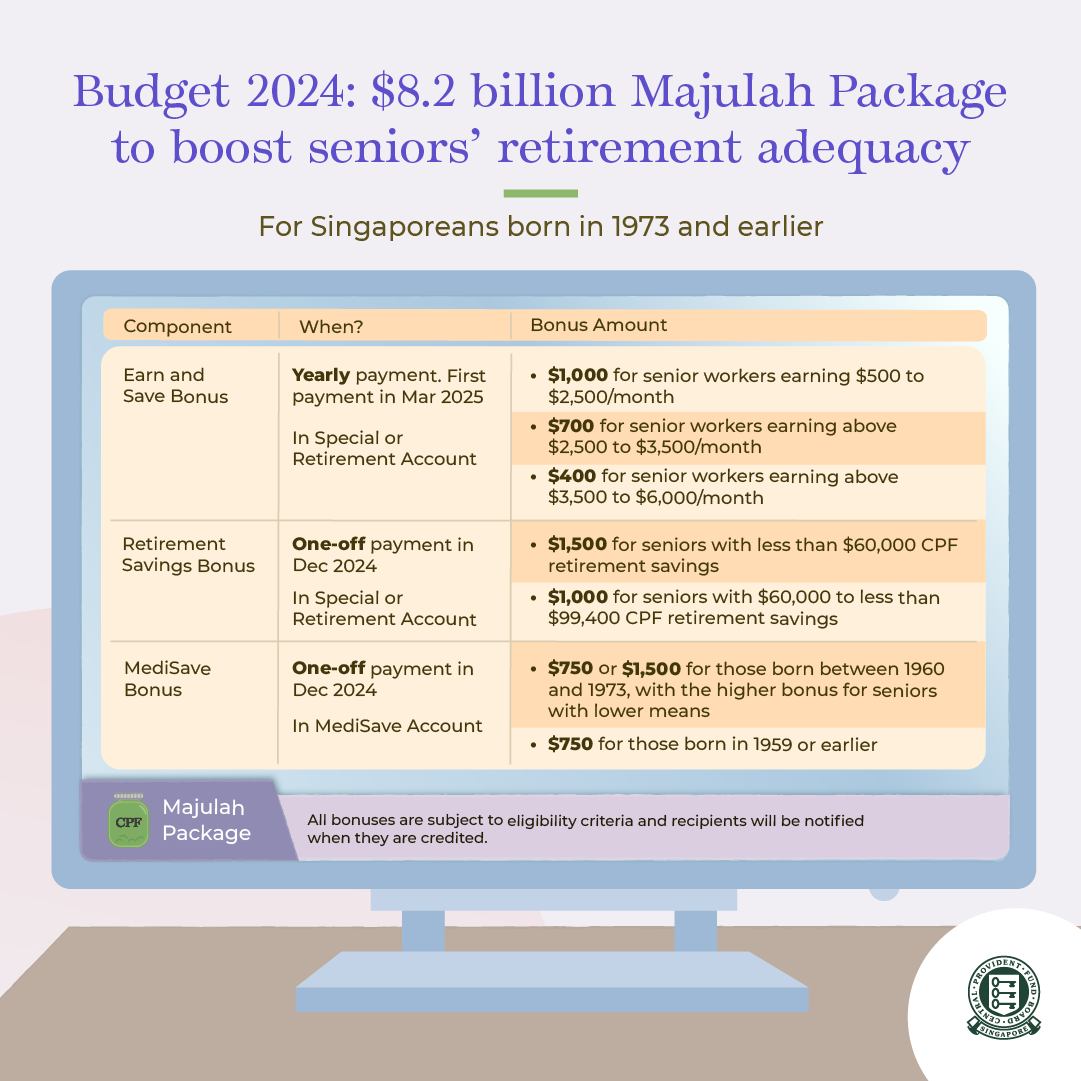
DPM Wong also provided more details on the Majulah Package, announced by Prime Minister Lee Hsien Loong at the National Day Rally in 2023. The scheme will benefit about 1.6 million Singaporeans.

The package includes an Earn and Save Bonus for seniors earning up to $6,000 a month to accumulate more retirement savings and a one-time Retirement Savings Bonus of between $1,000 and $1,500 for seniors with retirement savings below the BRS.


Rounding up his speech, DPM Wong said the Forward Singapore policy moves will cost around $5 billion in the 2024 financial year, and will in total reach close to $40 billion by the end of the decade.

Projections by the Finance Ministry in 2023 assessed that government spending would increase to around 20 per cent of GDP by 2030.

DPM Wong said that for now, that remains the Government’s assessment.

Assuming the Government stays within this range of spending increase, it should have sufficient revenues to maintain a balanced budget over the coming years, he added.

But the medium-term fiscal position is tight, as there are many pressures to spend more.

“We will have to manage these expenditures carefully, or we will end up with a significant funding gap,” he said.


This is already happening in many other advanced economies, where public finances are on an unsustainable path and fiscal systems are at risk of breaking, he added.

“We must never allow this to happen in Singapore. Instead, let us uphold the ethos of fiscal discipline and responsibility that has served us well, and ensure that our fiscal position always remains balanced, sound and sustainable.”

He reiterated that Singapore has been able to weather past storms and emerge stronger.

“I believe we can do so again in our road ahead, so long as we stay united, work together and continue to keep faith in each other.”


Parliament will debate the Budget and the spending plans of various ministries from Feb 26 to March 7.

Wednesday, 14 February 2024

PM Lee Hsien Loong addresses Singapore's public finances and reserves in Parliament on 7 February 2024

Singaporeans are both beneficiaries and stewards of the reserves: Prime Minister Lee Hsien Loong at the Debate on the Motion on Public Finances
By Tham Yuen-C, Senior Political Correspondent, The Straits Times, 8 Feb 2024

Sacrifice and careful husbandry by earlier generations was how the Republic built up its nest egg of past reserves, and the current generation should see themselves as not just beneficiaries but also trustees who protect this inheritance for future Singaporeans, said Prime Minister Lee Hsien Loong.

The past savings were built up at a unique time in Singapore’s history when it could set aside budget surpluses, and if they are gone, it will not be possible to build them up again, he stressed.

This is why it is important to have the “right instincts”: to save where possible, to resist pressures to use the reserves, and to unlock them only when really necessary, he said.


“We must not erode the patrimony, this family treasure, which we have inherited from our forefathers, nor should we burden future generations with debt nor mortgage their future,” he added.

This compact of protecting the reserves has been forged across generations of Singaporeans, and had also been upheld across both sides of the House, he said.


He reiterated the Government’s long-held stance on the reserves in response to a call by Progress Singapore Party (PSP) Non-Constituency MPs Leong Mun Wai and Hazel Poa for the Government to review its current budget and reserves accumulation policies.

The two NCMPs had proposed that more of the reserves be used to “help present-day Singaporeans reduce their financial burdens and improve their quality of life”.

They were joined in this by Leader of the Opposition Pritam Singh and Workers’ Party (WP) MPs, who repeated their party’s position that using more investment returns would not jeopardise growth of the reserves.

Mr Leong said that in the face of the goods and services tax (GST) hike and rising cost of living, accumulating reserves at the current rate “hurts the welfare of present-day Singaporeans”.

PSP’s view is that current reserves are enough, especially if the Government is raising taxes “for the sake of maintaining the current rate of reserves accumulation”.


How much is enough?

But it is a misconception that a specific number can be deemed enough when it comes to the reserves, said PM Lee.

He recounted how Singapore first tapped $4 billion of the reserves in 2008 when the global financial crisis hit, to help employers pay Central Provident Fund contributions and protect jobs.

When the Covid-19 pandemic hit, some $40 billion was drawn from the reserves to fund assurance packages and pay for vaccines to save lives and livelihoods.

That is far from the worst thing that can befall Singapore, PM Lee added. He noted that the war in Ukraine costs the Eastern European country more than US$100 million (S$134 million) a day.

These examples are why there is no sensible answer to the question of how big a nest egg is enough.


“Looking ahead 50 years, can anyone promise that Singapore will enjoy another half century of peace and tranquillity? Or guarantee that someone will come to our rescue if we ever find ourselves in the same situation as Ukraine?” he said.

“We can never say for sure how much is enough, because we do not know what kind of crises we will face in the future, or how our investments will fare.”

But that does not mean Singapore should mindlessly save for a rainy day without regard for present needs, said PM Lee.

That is why the Government had enshrined in the Constitution the “50-50” rule, which allows up to half of returns from investing the reserves to be used for current spending.

This also happens to be about the right ratio to keep the reserves in proportion with the gross domestic product, PM Lee added.

With long-term expected real returns of the reserves currently at about 4 per cent, the Government can spend about 2 per cent and save the other 2 per cent. Singapore’s economy is expected to grow at about 2 per cent a year if things go well.

Keeping this balance means the Government can count on the reserves to provide one-fifth of its annual revenue – or around 3.5 per cent of GDP – without having to double the GST, said PM Lee.


Reserves spent on current generations

Among the points Mr Leong made was that too much money from the reserves was locked up in trust and endowment funds to pay for longer-term spending, at the expense of current generations.

Ms Poa, meanwhile, suggested that it was excessive to plough the proceeds of land sales back into the reserves, since land is sold on leases and is thus more akin to a renewable resource.

The Government’s policies therefore prioritised future generations at the expense of current Singaporeans.


Rebutting these arguments, Minister in the Prime Minister’s Office Indranee Rajah said that money in these funds was “not just for the far unknown future”, but was set aside to meet specific funding commitments for the benefit of today’s Singaporeans.

These include the over $2 billion disbursed each year from the GST Voucher Fund to help lower- and middle-income households defray their GST expenses, and money in the Pioneer Generation Fund and Merdeka Generation Fund that is drawn down regularly to support Singaporeans in those cohorts.

As for funds set up to pay for large infrastructure projects, these help to smoothen the lumpy spending on such projects and ensure that future generations will not have to scramble to find money to pay for them, Ms Indranee said.

“This is prudent, thoughtful and responsible fiscal policy – not evidence of excess fiscal resources,” she added.


As for treating land sales as revenue, Ms Indranee said selling land did not generate wealth. Instead, it merely converted a physical asset into a financial asset.

The cash proceeds accrue to the reserves and are then invested to generate returns, which contribute to government spending. In this way, the proceeds of land sales are used indirectly in each year’s budget, she said.

Past savings are also a strategic asset during crises and emergencies. Thus, it would be imprudent to disclose the size of the reserves, she said in response to calls for greater transparency from PSP and WP MPs.


Take it to the ballot box

PM Lee noted that the growing political pressure to use more of the reserves was not new, and that it would always be tough to raise taxes.

Early in Singapore’s history, founding prime minister Lee Kuan Yew and his team had anticipated this, and that is why they had formulated a two-key system that required the president’s approval to unlock the country’s savings, he said.

When Singapore instituted the 50 per cent spending rule in 2001, the former prime minister intervened in the debate to remind the House that at the end of the day, the Government’s deepest obligation is to the future.

“Not just to the present; certainly not to the past,” said PM Lee.

He said that is why in taking care of today’s citizens, the People’s Action Party (PAP) Government is conscious to also safeguard the interests of young people not yet of voting age, future citizens not yet born, and the long-term interests of Singapore.


This ethos was in fact shared across the aisle in the past, he added, noting that former WP leader Low Thia Khiang had commended the Government for being prudent when it returned $4 billion to past reserves in 2009.

“Now I hear the opposition arguing that we should change the rules and draw more from reserves, and that of course they have no intention to raid the reserves, far from wanting to bankrupt Singapore,” said PM Lee.

“They say we can easily afford what they are proposing, I conclude their tune has changed.”

Mr Singh’s rejoinder was that different times call for different measures, which was why the PAP Government has said it is unlikely to return to the reserves the $40 billion it took out to deal with Covid-19.

Mr Singh, who is WP chief, also said the Prime Minister was cherry-picking what Mr Low had said.

PM Lee said the PAP is convinced that it has the right approach to stewarding the reserves.

Opposition parties who want to spend more should therefore put the issue upfront and campaign on it at the next general election, he said.

“Say you want to touch, you want to spend, you want to shift the rules,” he said. “Don’t pretend that you’re just as prudent, only more kind-hearted.”


The PAP will join the issue and convince Singaporeans that its way – taking a long-term view of the reserves, and striking the right balance between present and future needs – is the right one for Singapore, said PM Lee.

“We are confident that we will win the argument, and we’ll be able to get Singaporeans to do the right thing.”

PM Lee said he had spent 40 years of his life stewarding and safeguarding the reserves, and was now preparing to hand over to his successor a Singapore in good order, one that is more prosperous and more secure.

“I ask everyone to help them maintain the prudent policies that have served us well to keep Singapore on the right track, so that we can all continue to benefit from the nation’s success for many years to come,” he said.

Friday, 15 December 2023

Cost of living means different things to different folks in Singapore

The Economist’s Worldwide Cost of Living index does not shed light on the bills that ordinary Singaporeans pay.
By Lin Suling, Opinion Editor, The Straits Times, 13 Dec 2023

As a sign of the lengths Singapore will go to in a bid to up its wow factor and entice more travellers here, consider the dramatic four-storey waterfall display unveiled at the recently refurbished Changi Airport Terminal 2 in November.

Just about everyone I know has already visited the attraction, now the centrepiece of the T2 departure hall, and told me the four-minute musical extravaganza is not to be missed.

Now, you may be forgiven for confusing this 14m by 17m digital display with the man-made, HSBC-sponsored rain vortex at Changi Airport’s Jewel, which was opened a mere four years ago. That spectacular sight remains the world’s tallest indoor waterfall.

If two waterfalls – one digital, one physical – sound like overkill, that is probably precisely the intent. Singapore is already home to the world’s largest air-conditioned glass greenhouse, Gardens by the Bay, and hosted the first Formula One night race globally.

We must keep filling this carousel of new shiny things so we can remain vibrant and attractive to visitors, investors and corporate leaders.

Singapore thus far seems to be doing this well. Why else would expats keep coming back to Singapore despite it being billed the most expensive city nine times in the last 11 years by The Economist?

News of Singapore – along with Zurich – topping the 2023 Worldwide Cost of Living index on Nov 30, nonetheless, raised many eyebrows.

Many Singaporeans have suggested that it confirms their longstanding concerns that making ends meet in Singapore is becoming an uphill climb for the man in the street.

Online, netizens cite anecdotal experiences corroborating this jump in prices, from the doubling of the cost of a bowl of fish soup at their local coffee shop to complaints about certificates of entitlement (COEs).

Another pointed to news of thwarted attempts to smuggle 120kg of beef and pork as an unequivocal sign that more Singaporeans are turning to the black market to fill their stomachs. Never mind that meat smuggling is possibly the most creative strategy to beat inflation nobody has ever heard of.

And most discussions eventually reached the same conclusion: that the Singapore Government has slipped, in letting in foreigners who push up prices while leaving Singaporeans behind.


The most expensive city in the world for whom?

What to make of all this? Some information about how the Worldwide Cost of Living is put together offers perspective.

The full index of how cost of living stacks up across 173 countries is available only with a US$1,195 (S$1,602) fee. Its website suggests this full report is useful for human resources, corporates, financial institutions, and legal and insurance firms, as “this purpose-built Internet tool quickly calculates cost-of-living allowances and (aids in) building compensation packages for expatriates and business travellers”.

A closer look at the items used in this benchmark of relative cost of living, which is meant to be a comprehensive dataset of over 400 individual price points across 200 goods and services, throws up things such as international school tuition fees, public golf course fees and three-course dinners.

These may just be a few outliers that stick out. Even so, not only are they hardly stuff the average Singaporean spends on, they are also more accurately the make-up of what the typical expat around the world splurges on.

Here in Singapore, I would also add to this list the doubling of Additional Buyer’s Stamp Duty for purchases of homes by foreigners, and higher personal income taxes for top earners beginning from the 2024 year of assessment.

Curiously, despite these higher projected expenses, the foreigners just keep coming.

Saturday, 25 November 2023

Tripartism can work in Singapore because the PAP Government is pro-growth and pro-worker: PM Lee Hsien Loong

NTUC National Delegates’ Conference 2023 on 22 November 2023
By Jean Iau, The Straits Times, 22 Nov 2023

The pro-growth and pro-worker policies of the PAP Government are why tripartism can work in Singapore, Prime Minister Lee Hsien Loong said.

Such policies include creating good jobs while training workers to be able to do them, and making sure every Singaporean benefits from good housing and healthcare that are heavily subsidised by the state, he added.

As a result of its focus on these twin priorities of growing the economy and enabling workers to benefit fully from such growth, the Republic has created a “Singapore premium” where workers doing the same job here earn significantly more than their peers in the region.

Companies and investors are also prepared to pay more to be in Singapore to take advantage of its harmonious industrial relations and business-friendly environment, said PM Lee at the opening of the NTUC National Delegates’ Conference at Orchid Country Club on Nov 22.

“They value being in a country that knows where it is heading, where everyone pulls together for the common good, everything works, and life can get better for all.”

With the Government leading the country in the right direction, it is thus much easier for the tripartite partners to work together to create prosperity and share the fruits of growth, he added.


Tripartism is the three-way relationship between employers, unions and the Government that is focused on long-term interests and sustainable win-win outcomes.

Beyond good governance and sound national policies, the People’s Action Party (PAP) Government has also done its best to give Singaporeans good value for their tax dollars even as standards of living and aspirations go up, said PM Lee, who is the party’s secretary-general.

It has done so by running a lean and efficient public system, where government spending and taxes are kept low so that workers can enjoy the fruits of their own labour directly.

Essential public services such as public transport and water are also run efficiently and cost-effectively, requiring reasonable charges for their use without putting the whole burden on taxpayers.

This approach means charges have to go up from time to time as the cost of providing services rises, but the Government will give households that are most in need extra help, he said.


Speaking to some 1,500 union leaders, tripartite partners and other guests at the four-yearly event, PM Lee noted that founding prime minister Lee Kuan Yew had, at the watershed 1969 modernisation seminar, expressed his conviction that Singapore’s future depends on it having strong unions.

“I am convinced that in a vastly changed world – a world that is continuing to change rapidly, this is still true,” PM Lee said.

“The labour movement will play a vital role in Singapore for many years to come. And I know my successor Lawrence Wong thinks so too.”

Among the key outcomes of that seminar was the resolution for tripartite relations to be consensual instead of confrontational, and to develop a workers’ cooperative movement to provide essential goods and services while keeping prices low for members.


He noted that in the early days, PAP labour leaders such as the late Mr Devan Nair and Mr Ho See Beng formed the NTUC to rally the pro-PAP unions against the left-wing Barisan Sosialis, which organised multiple strikes and fomented mayhem to try and bring the Government down.

“I recall this history for a reason. As I told the PAP convention recently, the PAP was not born dominant and neither was the NTUC,” he said.

These baptisms of fire are why the symbiotic relationship between the PAP and NTUC is not merely an institutional arrangement, but rooted in history and forged in battle, he added.


PM Lee said that while many employers and governments elsewhere believe unions should play a smaller role in a rapidly changing world, the PAP rejects this view.

Its traditional roles of fighting for workers’ rights and ensuring good jobs will still be relevant, though the labour movement also has to reinvent and reimagine itself.

This includes guiding workers to keep up with a changing job market, working with the Government to provide all Singaporeans with a fair chance at success, and continuing to broaden its representation of different segments of the workforce, including gig workers and the migrant workforce, he said.

“We continue to strengthen our model of tripartism and keep it a lasting competitive advantage in an uncertain world,” he said.

“That way, we create a better future for our workers and for Singapore.”

Friday, 29 September 2023

$1.1 billion Cost-of-Living Support Package: Additional payment of up to $200 cash for 2.5 million eligible adult Singaporeans in December 2023

$1.1 billion Cost-of-Living Support Package to provide more relief for Singaporean households, especially lower- to middle-income families
Extra $200 CDC vouchers for Singaporean households in 2024
By Jean Iau and Natasha Ann Zachariah, The Straits Times, 28 Sep 2023

Some 2.5 million adult Singaporeans will receive an additional cash payout of up to $200 in December, and every Singaporean household will receive an extra $200 in Community Development Council (CDC) vouchers in 2024 to help with the rising cost of living.

These support measures, among others, are part of a $1.1 billion Cost-of-Living Support Package to provide relief for all Singaporean households, with more support for lower- to middle-income families. They build on the measures announced at Budget 2023.

The measures include an $800 million enhancement to the Assurance Package (AP) and the AP will now be more than $10 billion.

Announcing the support package on Thursday, Deputy Prime Minister and Minister for Finance Lawrence Wong acknowledged that many Singaporeans are anxious about the overall economic outlook, price increases and the impact on their cost of living.

“The Government is committed to supporting Singaporeans through these uncertain times,” said Mr Wong, adding that it will not be dipping into the past reserves for the package.

“As Prime Minister said at the National Day Rally recently, the Ministry of Finance has been studying how we can do more, to provide better support for Singaporeans.”


Mr Wong noted that the measures will cushion the impact of higher utility bills arising from the increases in the price of water, and also the upcoming increase in carbon tax.

AP cash special payment

The additional payment of up to $200 cash for 2.5 million eligible adult Singaporeans will be disbursed in December 2023, together with the existing AP cash component.

In total, eligible adult Singaporeans will receive up to $800 cash in December 2023. This will provide more support to lower- and middle-income adult Singaporeans.


Singaporeans aged 21 and above in 2024 who own no more than one property, and have an assessable income of $34,000 or less for the Year of Assessment 2022, will receive an additional $200, on top of the $600 under the earlier announced AP cash payment.

Those in this group who have an assessable income of more than $34,000 and up to $100,000 will receive an additional $150 on top of the $350 payout from the existing AP.

Those who own more than one property, or have an assessable income of more than $100,000, will not receive an additional payout under the AP cash special payment, but will receive $200 from the existing AP cash component.


CDC vouchers

Every Singaporean household will get an additional $200 in CDC vouchers in 2024, bringing the total amount of CDC vouchers for each Singaporean household to $500 in 2024.

The $200 worth of additional CDC vouchers will be spilt in half, with $100 of these vouchers allocated for spending at participating heartland merchants and hawkers, and $100 for spending at participating supermarkets.

The 2024 CDC vouchers should be claimed digitally at go.gov.sg/cdcv from Jan 3, 2024. The vouchers can be claimed at any time during their validity period. They will expire at the end of 2024.


S&CC rebates

Some 950,000 Singaporean HDB households will receive an additional one-off 0.5-month service and conservancy charges (S&CC) rebate in January 2024, together with the regular S&CC rebates.

This will, on average, fully offset the S&CC increase in the first year of increases for one- to four-room Housing Board flats and about 85 per cent for larger HDB flats, said the Ministry of Finance (MOF).


U-Save rebates

The 950,000 Singaporean HDB households will also receive an additional $20 per quarter in U-Save rebates from January 2024 to December 2025, or a total of $80 a year for two years.

These rebates will be disbursed together with the regular U-Save rebates, and will cushion the impact of the carbon tax and water price increases in 2024 and 2025.


Over these two years, the additional U-Save rebates will, on average, fully offset the increase in utility bills for one- to two-room HDB flats. For three- to four-room HDB flats, they will offset about 80 per cent of the increase in utility bills, and for larger flats, about 65 per cent.

On average, this translates to 3- to 4- room HDB flats paying about $2 more per month, and 5-room and larger HDB flats paying about $4 more per month.


Public transport support measures

There will be additional subsidies of about $300 million in 2024 to cover the deferred fare adjustment quantum of 15.6 per cent that will be carried over to future fare review exercises, as announced by the Public Transport Council on Sept 18.

The additional subsidies will help to moderate the increase in fares and pay for the higher costs of providing public transport services due to the continued increase in energy prices in 2022, core inflation and strong wage growth, said the MOF.

Resident households with a monthly household income per person of not more than $1,600 will each receive public transport vouchers worth $50.

The vouchers, which will be disbursed from end-December 2023, can be used to top up fare cards or buy monthly travel or concession passes.


Mr Wong said on Thursday that while the goods and services tax increase was already planned for, there were certain things that could not have been anticipated, such as some of the recent price increases, and “also the more uncertain economic outlook, possible disruptions to energy and food supplies... and the uncertainties in the global environment”.

He said the Government has been monitoring income growth very closely, and there is a likelihood that real income growth will moderate in 2023, because employers are more cautious about salary increments.

“These are the considerations that motivate us to consider whether or not there ought to be more help for Singaporeans, particularly households and families (in) the lower- and middle-income segments,” he added.

“And we’ve decided, after looking at all the factors, looking at our fiscal position, we will be able to provide within our budget for such an additional package.”


Mr Wong was also asked about the need to raise prices for water now, and the GST, which will increase to 9 per cent next year.

He explained that there are measures such as the AP in place so the majority of Singaporeans will not feel the impact of the GST rise for a few years.

“We don’t want to wait until we are at the very brink (of having) not enough money and then start raising taxes. We want to put in place all the measures that are necessary to ensure sound public finances, not just for one, two years, but for the medium- and longer-term,” he said.

On water, he noted that it is an essential, strategic resource to Singapore.

As a “water-stressed nation”, he said efforts have been made to price water properly to “make sure that consumers understand what the full price of water is.”