Showing posts with label PE 2023. Show all posts

Friday, 15 September 2023

Tharman Shanmugaratnam sworn in as Singapore’s 9th President, reiterates plans to unite nation

President Tharman Shanmugaratnam vows to strengthen multiracialism, nurture more inclusive society
By Goh Yan Han, Political Correspondent, The Straits Times, 14 Sep 2023
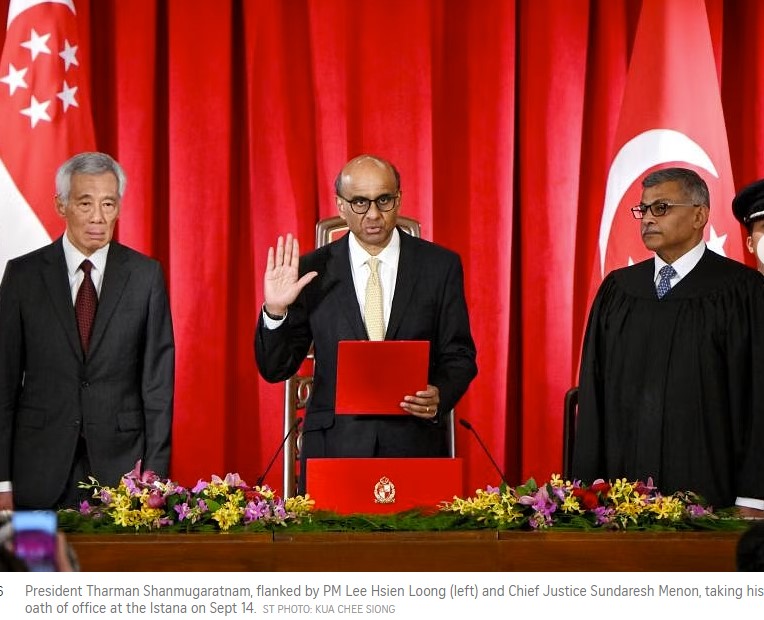
Mr Tharman Shanmugaratnam is officially Singapore’s ninth president, having been sworn in about two weeks after his resounding win at the polls.

Mr Tharman, 66, took the oath on Thursday evening at his inauguration ceremony after completing an inspection of the guards at the Istana.

Shortly before that, his predecessor, Madam Halimah Yacob, had also inspected the guards and bade farewell to the line of honour before departing the grounds for the last time as president. She was accompanied by her husband, Mr Mohamed Abdullah Alhabshee.


“This was a vote of confidence in Singapore’s future, a future where we all progress together and deepen our solidarity as Singaporeans,” he said.


He stressed that more than ever before, Singaporeans must grow their sense of togetherness.

“It will make us a better society, and add to our ballast as we face a more turbulent world.”

With the strong mandate given to him by the people, he said he will work with the Government, community groups and other voluntary organisations, and the entire nation to strengthen multiracialism and nurture a more inclusive society.


On the specific roles of the president, Mr Tharman said he will confer closely with the Council of Presidential Advisers, and be thorough and impartial in his assessments, and in exercising his veto powers on the reserves and key public service appointments.

He added that he will “be scrupulous and independent in making judgments that involve the use of the ‘second key’ on our reserves”.

Going back to his campaign promises, Mr Tharman also reiterated his plans to promote greater interactions between different communities, and enhance respect and appreciation for one another.


He added that he also plans to lend active support to the arts and sports scene here, and represent Singapore and promote its interests abroad.

To this, Prime Minister Lee Hsien Loong said in his speech that he looks forward to Mr Tharman’s support in sports and the arts, which will help Singapore become a rich and rounded society.

“I pledge my government’s full support and cooperation as we operate this unique system to protect our reserves and key appointments,” he added.


Noting Mr Tharman’s wealth of experience in economic and financial matters, and his familiarity with how the system of the second key works, PM Lee said he has every confidence in Mr Tharman’s ability to fulfil the important duty of the president in holding the second key.

PM Lee added that Mr Tharman’s experience in public service has prepared him well for his new responsibilities.

He cited Mr Tharman’s appointments in Cabinet, his time at the Monetary Authority of Singapore and his 22 years of service as an MP for Jurong GRC.


PM Lee said that the Government shares Mr Tharman’s declared goal – to build a more inclusive society, one where everyone is valued for who they are, and every Singaporean has a place.

He also said that he looks forward to Mr Tharman’s help in strengthening ties with other countries and international partners, and opening opportunities abroad for Singaporeans and local businesses as Singapore’s top diplomat.

PM Lee said he has no doubt that Mr Tharman, having held high-level appointments in international organisations and blue-ribbon advisory panels, will fulfil this role with distinction.

“The Government will work closely with you and support you to make the most of your experience and personal standing, in order to advance Singapore’s interests and enhance our status in the world,” he said.

PM Lee also noted that there is one person whose personal support will matter greatly to Mr Tharman.

“Let me take this opportunity to welcome your wife, Mrs Jane Ittogi Shanmugaratnam, to the new role that she will play as the spouse of the president in the years to come,” he said.

In closing, PM Lee said that Singapore is navigating its way forward in an increasingly troubled and uncertain world.

“Our society is in transition as we adapt to and evolve with changing circumstances. At such times, it is crucial that our nation’s highest office be occupied by someone with the right experience and abilities, values and character.

“I am sure that like your predecessors, you, too, will be a president for all Singaporeans, and serve Singapore with dedication and distinction.”


Wednesday, 13 September 2023

Halimah Yacob: A President For Everyone

Singapore’s eighth President Halimah Yacob reflects on the defining moments of her six years in office, from unlocking past reserves, to advocating for causes close to her heart.


Farewell, Madam Halimah: Singapore’s first female president’s last day in office
By Jean Iau and Natasha Ann Zachariah, The Straits Times, 14 Sep 2023

Six years after making history as Singapore’s first woman head of state, President Halimah Yacob left the highest office in the land with accolades of being a powerful symbol of unity for all Singaporeans.

At her farewell reception held at the Istana on Wednesday evening, Prime Minister Lee Hsien Loong said Madam Halimah’s efforts to expand opportunities for all made for a more united and inclusive Singapore, where everyone belongs and has a part to play.


He said that throughout her tenure, Madam Halimah showed the way with “grounded leadership, and a warm heart for the people”.

“Your ability to empathise and resonate with Singaporeans from all walks of life has brought our nation closer together, and reminded us that we all have a role to play to make Singapore a better home,” he added.


In her speech following PM Lee’s, Madam Halimah said the president plays “an important role in uniting and rallying people together”.

“In this capacity, I focused on creating a more caring, compassionate and just society,” she added.

Madam Halimah, 69, said she reached out to different communities and underprivileged people, and highlighted various programmes that she launched while in office.

She championed issues such as providing more support for caregivers, skills upgrading for lower-income families, and building interracial and interreligious harmony and social cohesion.

Diplomacy was also a key part of her work, and she saw it as a chance to raise Singapore’s international image, strengthen the nation’s bilateral ties, and open new economic opportunities for companies here.


As the first female president, Madam Halimah knew that she had the “distinct opportunity” to inspire other women and girls.

She shared that someone had told her she had “allowed people to imagine the president as a woman” and that “images and ideas give birth to reality”.

“I wish Mr Tharman Shanmugaratnam all the best in discharging his duties,” Madam Halimah said, addressing the President-elect, who was standing near the front of the audience with his wife, Ms Jane Ittogi.

Mr Tharman, 66, will be sworn in on 14 September, after securing 70.41 per cent of the vote at the presidential election on Sept 1.

As she left the podium, Madam Halimah received rousing applause from an audience of more than 200, including foreign diplomats, MPs and leaders from the social service sector.


With her husband, Mr Mohamed Abdullah Alhabshee, by her side, she received well wishes and took wefies with guests, including MPs from both sides of the House.

She had earlier in her speech called her family’s love, encouragement and sacrifices “the bedrock of (her) strength” and said she was forever grateful for their support.


Chua Chu Kang GRC MP Zhulkarnain Abdul Rahim, who was among the crowd, said Madam Halimah has been a unifying figure not just for Singapore but a symbol of aspiration for minority women everywhere.

“She will be remembered not only as a decisive president who supported the Government in steering our country out of the pandemic safely, but also as a president who is generous in lending her voice to speak up on behalf of various segments in our society such as youth, women and workers,” he said.


Before departing the Istana, Madam Halimah posed for pictures on the staircase by the main entrance with her family. She had said her farewells to members of the Istana staff earlier on Wednesday morning, shaking their hands and sharing laughs before taking a group photo.

Her aide-de-camp, Major Toh Su Sin, said it had been an honour to serve Singapore’s first female president. “As challenging as it was to plan and manage the range of events in Madam President’s packed diary, it was even more rewarding to be able to witness the difference she makes in the lives of others,” she said.

She added that Madam Halimah’s warmth and genuine care for everyone she meets will be missed.


Senior butler Zaidi Hashim recalled feeling awestruck on Madam Halimah’s first day in office. He said: “Madam President treated everyone with equal respect, dignity, and compassion – whether they were foreign dignitaries or her staff.

“It was bittersweet bidding farewell to her on her last day in office.”

Wednesday, 6 September 2023

Tharman is president-elect. Is Singapore a post-race society?

His presidency is a chance to shape race relations positively. Singapore still has some way to go.
By Mathew Mathews, Published The Straits Times, 6 Sep 2023

The election of Mr Tharman Shanmugaratnam as Singapore’s ninth president stands as a profound testament to the nation’s commitment to racial inclusivity.

Mr Tharman’s resounding victory, with 70.4 per cent of the vote, realises an aspiration shared by many Singaporeans: to elect a competent and qualified president – whether from a minority race or otherwise – through an open contest in line with the nation’s commitment to meritocracy.

Race was almost a non-factor at the ballot box in some sense. Mr Tharman’s impeccable credentials, coupled with his popularity built over two decades in politics, overcame any lingering racial prejudices.

Racial representation in the presidency

Having good racial representation in the presidency is important for the development of multiracialism in Singapore. Recognising this, Parliament consistently appointed presidents from all the main racial groups in Singapore since Mr Yusof Ishak first assumed the role, even though there was no constitutional requirement to do so.

However, the public was sensitised to this objective only after constitutional amendments were passed in 2016 to reserve the elected presidency for candidates of a particular racial group if there had not been a president from that group for the five most recent presidential terms.

The population has largely come to accept these interventions as necessary to uphold the multiracial character of the presidency. In the 2021 CNA-IPS Survey on Race Relations, over 70 per cent of the 2,000 Singaporeans surveyed believed that the reserved presidency helped preserve racial harmony in Singapore.

Seeing a minority candidate win the race was never a given. The 2011 Presidential Election, featuring four candidates from the majority race, illustrated the growing challenges facing any qualified minority candidate in the race for the top job.

With qualifying conditions subsequently tightened, the very high bar for a nomination meant that only a small number of eminent minority representatives would be eligible to contest the president’s post. They, too, might be concerned that their chances of getting elected might be adversely impacted by the potential influence of racial preferences.


The high-water mark of race relations?

While Mr Tharman’s victory represents a significant milestone, it by no means signals that Singapore has fully transcended racial divisions and become a post-race society.

Race is unlikely to lose its significance entirely after Mr Tharman’s assumption of the presidency, just as it did not disappear as a political force in the United States after President Barack Obama’s historic election win in 2008.

Many observers have remarked on the irony that the mountain top of race relations in the US coincided with Mr Obama’s inauguration as the first African-American president, only to steadily deteriorate to the valleys through his tenure with heightening racial tensions ranging from the riots in Ferguson to the rise of the Black Lives Matter movement.


Singapore has been fortunate in maintaining generally positive race relations due to a combination of state interventions and the resolve of the population. Yet, racial preferences undeniably persist within the population, as highlighted by the same CNA-IPS survey. The survey showed high levels of in-group preferences for various roles, particularly among Chinese respondents.

When asked about the acceptability of different races to manage their business, nearly all were accepting of an ethnic Chinese in that role, although only about half were accepting of a Singaporean Malay (51.9 per cent) or Indian (52.8 per cent). Similar trends were evident when respondents were asked about renting a property to people of different racial groups or having someone from another race marry into the family.

It would be overly simplistic to attribute these racial preferences, and the general proclivity to see one another in terms of race, solely to state policies, such as the Chinese-Malay-Indian-Others system and the Ethnic Integration Policy in housing. Research suggests that some of these preferences may be ingrained from infancy and reinforced through early socialisation experiences.

Saturday, 2 September 2023

Tharman Shanmugaratnam elected as Singapore’s 9th president

Landslide 70.4 per cent victory for Tharman as Singapore’s next president
By Goh Yan Han, Political Correspondent, The Straits Times, 2 Sep 2023

Singaporeans have given Mr Tharman Shanmugaratnam a resounding mandate to be Singapore’s ninth president.

The 66-year-old former senior minister scored a big win with 70.4 per cent of the vote, while Mr Ng Kok Song and Mr Tan Kin Lian received 15.72 per cent and 13.88 per cent, respectively.

Even before the official result was announced by Returning Officer Tan Meng Dui at 12.22am, it was clear who the winner was.

The sample count released at about 10.40pm showed Mr Tharman leading with 70 per cent, while Mr Ng and Mr Tan were trailing with 16 per cent and 14 per cent, respectively.


Addressing the media at Taman Jurong Market and Food Centre shortly after that, Mr Tharman said he was “humbled by the strong endorsement that Singaporeans have given to me”.

“I believe that the vote for me and what I stand for is a vote of confidence in Singapore... It is a vote of optimism for a future in which we can progress together,” he said.


He also thanked his fellow candidates for making the presidential election a worthy contest.

He spoke about the future he envisioned for Singapore – one where people have deeper respect for one another, and where every generation gets the confidence of knowing that Singapore has reserves that will help the people in the future.

“It has to be a future in which Singapore is never treated as just another small country, a future where we are taken seriously in the world, we are a partner of choice, and where we can project our voice of reason internationally,” he said.


Earlier at 10pm, when he arrived in Jurong, where he served as an MP for 22 years, Mr Tharman was mobbed by jubilant supporters holding up pineapples as he made his way through the centre.

He was greeted with chants of “ong lai” and “huat ah”, referring to his campaign symbol of a pineapple. Ong lai means pineapple in Hokkien, and it symbolises prosperity and good fortune to come.

His supporters erupted into loud cheers once the sample count result was in.


In a statement released after the official result, Prime Minister Lee Hsien Loong said he had called Mr Tharman to congratulate him, and assured him of his Government’s full cooperation.

Mr Tharman had also declared his intention to work closely with the Government, said PM Lee.

Noting Mr Tharman’s long and distinguished record of public service, PM Lee said he had every confidence that Mr Tharman would carry out his duties as president with distinction.


He said he was happy that Singaporeans were able to exercise the right to vote for their next president, and to focus on what the elected president is about.

“Now that the election is over, let us come together again as Singaporeans, to tackle the challenges ahead and build a stronger and more united nation,” said PM Lee.

Mr Tharman will be sworn in as president at the Istana on Sept 14.


Mr Ng conceded the contest shortly after the sample count result was made known.

He told the media that he received a call from Mr Tharman, who lauded him and his team for putting up a “vigorous campaign”. Mr Ng also congratulated Mr Tharman on a “magnificent victory”.

“When I came forward to stand for the presidency, I said that my No. 1 goal was to ensure that the people of Singapore have redeemed their right to vote in this presidential election. I think I have accomplished that goal because the presidential election did take place today,” said Mr Ng.

“I am delighted for him. And I am very glad for him, that he has indeed earned a mandate from the people of Singapore.”


Mr Tan said he congratulated Mr Tharman on the result, but for himself, “I expected to do much better, but I think in an election, things are uncertain”.

“I will now heed the advice of my family to take life easy and live a normal life. I will spend more time with my grandchildren. In my free time, I will continue to do my part in voicing the hardship and aspirations of the people through other channels,” he said.

More than 2.5 million Singaporeans went to the polls on Friday at 1,264 polling stations across the island, after nine busy days of hustings and a calm Cooling-off Day on Thursday.

There were 2,480,760 votes cast for the candidates, while 50,152 votes were rejected – 1.98 per cent of votes cast. Voter turnout was over 93 per cent of eligible voters.

Saturday, 19 August 2023

Singapore Reserves Revealed

Singapore’s reserves cannot be built up again once gone: Prime Minister Lee Hsien Loong
Think of Singapore’s reserves as ‘rainy day’ money
By Goh Yan Han, Political Correspondent, The Straits Times, 16 Aug 2023

Singapore’s reserves cannot be built up again once they are gone, Prime Minister Lee Hsien Loong said in an interview published on Wednesday.

The country is no longer in a situation like it was in the 1970s and early 80s. This was when it had strong growth and budget surpluses yearly, and there was the possibility of putting aside some of the prosperity for a future rainy day, he said.

Today, Singapore is not as poor as it was before, with higher incomes and a higher standard of living. But expectations and needs have also grown, noted PM Lee.

“So, to say today you put aside systematically 2 per cent, 3 per cent of GDP (gross domestic product) and build up a sovereign fund from scratch, I think it is very hard. The economy will not be able to take it,” he said.


PM Lee said he was proud that Singapore had built up the reserves, and is anxious that the country keeps it like this for as long as it can.

“Because it is one of those things – once it is gone, it will never come back again. It is finished,” he said.

“I think we need to be very, very conscious that this is a Garden of Eden state. You are here, it is marvellous. You may not always feel great, but please be aware this is the Garden of Eden because if you come out from it, you cannot go back in again by the sweat of your brow.”


PM Lee was responding to questions on Singapore’s reserves, including its functions and its history, in an interview with national broadcaster CNA that was aired on Wednesday in a documentary titled Singapore Reserves Revealed. The interview was conducted on June 8.

When asked what the reserves mean to him, PM Lee said they are a great source of comfort and reassurance that if Singapore runs into a jam, it will not be destitute and will have “one extra card to play”.

It gives the Government confidence, but is also a reminder of the forefathers’ contributions and a responsibility to generations to come, he added.

Singapore’s reserves are managed by the Monetary Authority of Singapore (MAS), the Republic’s investment company Temasek and sovereign wealth fund GIC.

The reserves also include those of key statutory boards like the Housing Board, Central Provident Fund and JTC Corporation, which together with MAS, GIC and Temasek are listed in the Constitution as Fifth Schedule entities.


Are the reserves enough?

PM Lee said that the biggest misconception among Singaporeans on the reserves was that “there is such (a) thing as enough”.

“And how much is enough? If I have more than that, I can spend it. If I have less than that, well, maybe I hope to get there. I do not know how much is enough. There is no such idea of how much is enough,” he said.

The future is unpredictable and many things can go wrong, he added.

“From the long-term point of view, will I have enough if the world is steady and peaceful? I hope so. Will I have enough under all circumstances? That is what I do not know, and that is what the Government has to worry about on behalf of Singaporeans.”


He noted that when the global financial crisis of 2008 hit, the Government needed to draw $4 billion to $5 billion from the reserves. For the Covid-19 crisis, it needed over $40 billion.

“So, you have no idea how much you will need because Covid-19 is far from the worst thing that can happen to us,” he said.

He suggested that Singaporeans look at the reserves as “rainy-day money”.

“If it is not raining, I do not touch it. If it is a sunny day and I can afford to, I put a little bit more into it.

“However much there is, I keep on having this attitude that I would like to build it up a little bit more when I can, so that the next generation will be in a more secure position than I am today,” he said.

PM Lee added that while the Government managed to put back the money it drew for the global financial crisis, he did not think it was possible for the Covid-19 draws to be put back.

When asked if there was any anxiety over Singapore’s response to the Covid-19 crisis, PM Lee said he had no doubt that the Government was doing the right thing, and it was doing what it needed to do.

“I was relieved that we were not held back because of the lack of resources to do, at least not lack of dollars, to do what we needed to do.

“It could have been overdone, but in such situations, it is not worth trying to fine-tune,” he said, adding that the eventual spending was less than expected, though still substantial.


When asked how large the reserves are, PM Lee said he could not answer the question, but said they are “enough for most circumstances” and enough to provide a substantial support in the Budget every year, by contributing to a fifth of the Government’s revenues.

“But it may or may not be enough if you have a catastrophe – who knows what the world will bring? So, I do not ask whether it is enough; I ask, can we husband it and if possible, gradually grow it bit by bit year by year,” he said.

He noted the importance of the contributions from the reserves to Singapore’s Budget, without which the Government might have to make up the revenue from other sources, such as doubling corporate income tax or personal income tax, or increasing the goods and services tax rate further.

“When people say, why don’t we use the reserves in order to benefit the current generation? The answer – we are, to a very big degree. But you may not realise because we have gotten used to it,” he said.

When asked if the structure of having MAS, Temasek and GIC overseeing the reserves is correct and useful in today’s context, PM Lee said that from time to time, the Government has asked itself if it should have two GICs.

“Because you have a certain amount of funds now, it is not small. Conceivably, you could have two and they could compete with one another, then you would know who is doing well and who is not doing so well,” he said.

“Every few years we argue about this, but finally we will conclude that building one team is hard enough, let us concentrate on making that one team succeed. And I think we keep it like that.”

The elected president

On the singular pivotal moment in the history of Singapore’s reserves, PM Lee pointed to the time when the Government decided to recognise the reserves as being a lot of money, and needing to have a second key.

The idea was first floated by former prime minister Lee Kuan Yew in his 1984 National Day Rally speech, before the scheme was worked out and implemented over the next few years.

“I think that was the key turning point because it crystallised people’s focus. They knew that there is such a thing called the reserves, that it is quite a lot of money and that it needs to be protected,” said PM Lee.


When drafting the system, it was important to protect the reserves but not paralyse the government of the day, noted PM Lee.

He noted a phrase used by the late Mr Lee on the topic.

“The phrase which he used was that one day, if you have a rogue government, everything is finished.

“That was the way we explained and marketed it, that one day, if you have a freak election, you have the wrong team in charge, you have a rogue government who wants to raid the reserves, in one term, all your life savings of generations of Singaporeans will be gone. And therefore, we must prevent that,” said PM Lee.

He also noted that when the system of the elected presidency was first devised, there was no clear distinction in the original legislation between income from the reserves and investment returns.

In those days, the portfolio was not invested as systematically and comprehensively as it is today. The premise then was that the principal sum would be locked up, and all of the income from the reserves could be spent.

PM Lee said that when former president Ong Teng Cheong took on the role, Mr Ong asked why all the income was being spent, and asked the Government to set some aside for the future.

Mr Ong then suggested that half be split for now, and the other half for the future.

The Government accepted the suggestion and amended the Constitution.

There was an arbitrariness to the decision of the 50-50 split, said PM Lee.

“But when you do deals, 50 per cent is not an arbitrary number. Fifty per cent has a certain psychological resonance to it,” he said.

At the same time, barring accidents and if everything goes well, the reserves should be able to grow by about 2 per cent yearly.

This will ensure the contribution to the Budget every year can be maintained, said PM Lee.


The Net Investment Returns Contribution (NIRC), which comes from the reserves, is the largest contributor to the Government’s revenue yearly.

When asked about potential scenarios where the 50-50 rule could be changed, PM Lee replied: “If the world completely changed, and I would say several successors from me, from now.”

He added: “Where we are does not give me any reason to need to reconsider this 50-50 NIRC rule.”


Saturday, 10 June 2023

Tharman Shanmugaratnam to run for President in Singapore

Senior Minister Tharman to run for President, will resign from Government and PAP on 7 July 2023
By Goh Yan Han, Political Correspondent, The Straits Times, 9 Jun 2023

Senior Minister Tharman Shanmugaratnam will be running for president in the upcoming election, stepping aside from politics after 22 years.

“I wish to inform you that I have decided to put myself forward as a candidate in the forthcoming presidential election. I hence wish to retire from politics and all my positions in Government,” he said in a letter to Prime Minister Lee Hsien Loong on Thursday. PM Lee is also secretary-general of the People’s Action Party (PAP).

Mr Tharman said he plans to resign from the PAP and step down from his posts as senior minister and coordinating minister for social policies on July 7 – a month from Thursday.

This is so that he can first fulfil his immediate commitments in Singapore and internationally, and ensure that arrangements are fully in place for his constituents in Jurong GRC to be well served for the rest of the electoral term, he said.


In a reply letter, PM Lee accepted his resignation and thanked him for his “distinguished service to Singapore”.

“Your departure from the Cabinet and the Party will be a heavy loss to me and my team. We will miss your leadership, insightful views, and wise counsel,” said PM Lee.

“But I understand why you have decided to make this move and run for president. It is in keeping with the spirit of public service and sense of duty that you have shown all these years,” he added.

Mr Tharman will also step down as chairman of the Monetary Authority of Singapore (MAS), deputy chairman of Singapore’s sovereign wealth fund GIC, chairman of the Economic Development Board’s International Advisory Council and other responsibilities he has been undertaking in his ministerial capacity.

“I have been humbled by the requests I have received in recent months, from Singaporeans from different walks of life, to stand in the presidential election if President Halimah chose not to stand again,” he said.


He added that it had been a difficult decision, and that he consulted his family and gave careful thought to how he could best serve the country in the years ahead.

“I believe that I can now best serve Singapore not in politics, but in a different role that has to be above politics,” he said.

“If I am fortunate enough to be elected as president, I will represent the unity of Singaporeans, of all races and religions, social backgrounds, and political leanings, at a time when views in the population are becoming more diverse.”

He added that he would be thorough and impartial in fulfilling the constitutional duties of the president with regard to the prudent use of the nation’s reserves and the key appointments that preserve the integrity of the Singapore system, and do his best to project Singapore’s interests and voice of reason in an increasingly turbulent world.


Mr Tharman also thanked PM Lee for his leadership, advice and openness to collegial debate through the years.

PM Lee said that should Mr Tharman be elected as the next president, he was confident that Mr Tharman would “carry out these duties scrupulously” and with “the independence of mind” he has always displayed.

Mr Tharman’s announcement comes after incumbent President Halimah Yacob said on May 29 that she would not be running for a second term. The election has to be called before the end of Madam Halimah’s six-year term, which expires on Sept 13.


Mr Tharman, 66, is the first candidate to throw his hat in the ring as no other presidential hopeful has made his intentions public.

He satisfies the public service requirement for eligibility under the law, due to his ministerial posts.

Under the public sector service requirements laid down in the Constitution, presidential candidates must have held office – for at least three years – as a minister, chief justice, Speaker of Parliament, attorney-general, Public Service Commission chairman, auditor-general, accountant-general or permanent secretary, among others.


Mr Tharman was first elected to Parliament in November 2001 in Jurong GRC, and has been re-elected four times since.

His current posts include Senior Minister since 2019, Coordinating Minister for Social Policies since 2015, and MAS chairman since 2011.

He has been deputy chairman of GIC since 2019, and chairs its Investment Strategies Committee.

His previously held portfolios include deputy prime minister, finance minister and education minister.

Before stepping into politics, he spent most of his professional career at MAS.


On the international stage, Mr Tharman has been chairman of the Group of Thirty, an independent global council of leading economic and financial policymakers, since January 2017.

Since April 2017, he has also been chairing the G20 Eminent Persons Group on Global Financial Governance, to review the system of multilateral financial institutions.

Mr Tharman’s decision to stand raises questions about who will take over his current posts and cover for him in his constituency.


He is the anchor minister of Jurong GRC, which is also represented by Senior Parliamentary Secretary for Health and Law Rahayu Mahzam, Dr Tan Wu Meng, Mr Xie Yao Quan and Mr Shawn Huang.

There is no requirement under the law to call a by-election if an MP resigns, even if that member is a minority.

In 2017, when Madam Halimah made her plans known that she would be stepping down as MP of Marsiling-Yew Tee GRC, she said she would ask PM Lee to assign another MP to her constituency to help out.