Showing posts with label Wisdom. Show all posts

Friday, 16 August 2024

The danger of nostalgia weighing upon the present

It is good to know our history, but we must be wary of invoking the past to make decisions about the present.
By Simon Tay, The Straits Times, 14 Aug 2024

Talking about the past of our country seems more evident today than ever before. Perhaps it is the National Day mood. As we marked our 59th year, there was a new president and a new prime minister in place, and yet the theme song and dance routines evoked the independence era.

Books, too, have contributed to such discussions, like the recently issued biography of our first foreign minister S. Rajaratnam. For me, personally, awareness is heightened because of Enigmas, my own book about my late father, Tay Seow Huah – a pioneer generation civil servant contributing to security for our then young country.

Singapore is old enough to look back on its founding decade with nostalgia. I felt this strongly when writing about Singapore’s first decade of independence in Enigmas. Beyond the work on pressing issues of the time, it is harmless and fun to remember markers of how we lived, like the eating places that my father and his generation frequented, and which I knew as a child.

But lifestyle aside, one must be wary of nostalgia slipping into decisions of policy. And yet, nostalgia seems to inform some current controversies, in public discussions and in social media.

How’s history relevant here?

A mural on the side of a Chinatown shophouse caused considerable debate with its depiction of a samsui woman, smoking and glamorous. The mural had sidestepped the usual processes of seeking permits for such public art, as well as guidelines that caution against the depiction of smoking.

But many reactions focused on the question of veracity: the fact that these women who contributed to literally building Singapore smoked, as a respite from hard labour. This reference to the past was evoked as a kind of trump card: to overcome current guidelines that censor most depictions of smoking.

That focus downplayed other elements of the mural – the woman was depicted as young, attractive and with elaborately and improbably manicured nails. Nor was its artistic merit much discussed.

My own interpretation was that this mural was not about historical fact. Rather I saw it as a comment about how Chinatown has now been gentrified and glamorised, with prices soaring for the once humble and rundown shop houses.

The final decision was a compromise. The mural with its depiction of smoking was not erased. But a fine was imposed as prior authorisation for this public art had not been obtained.

The past was also invoked in what would seem a commercial decision. This concerns the sale of a majority stake in Income Insurance to a foreign investor, Allianz. On top of the regulatory issues, some emphasised the original social mission of Income Insurance.

Much respected Ambassador-at-Large Tommy Koh was among those who took this line as he warned against Singapore becoming “a nation of people who know the price of everything but the value of nothing”, something our first foreign minister had cited.

No one can argue that it is not important to understand what was before. But past examples and statements are best set in context of the circumstances of their time. Otherwise, there is a risk that past incidents and statements can be invoked selectively in ways that may distort.

NTUC ventured into the insurance sector following a suggestion in 1969 by Dr Goh Keng Swee, who later served as deputy prime minister. Dr Goh had felt that a social enterprise by the unions was needed because “social security is in its rudimentary stages”.

Today presents a very different situation. There are many more insurers to provide for life, health and other forms of security for workers. There is, for instance, a nationwide scheme to insure full-time national servicemen on a voluntary and affordable basis. This scheme is provided by another insurer, not Income Insurance.

Can the current competitive market not meet the needs of Singaporeans? If NTUC were to be asked today about the need for unions to run an insurer, wouldn’t it, probably, arrive at a different decision?

These are among the contextual, “what if” questions to be considered if we are to apply past lessons and thinking to changing circumstances. Otherwise, if we allow the past to overly constrain current choices, history would be a heavy, dead hand.
Sunday, 10 December 2023

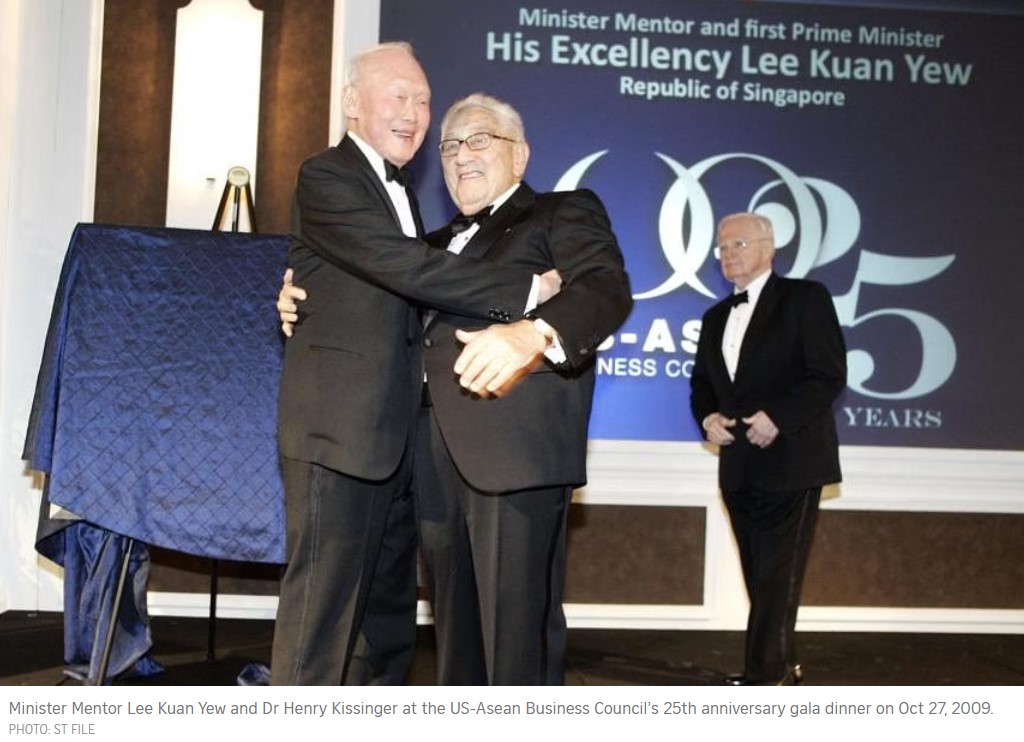
Henry Kissinger, Lee Kuan Yew and a friendship that influenced the world

Both men were realists who spoke frankly, and global leaders listened to them. They also shared a close bond.
By Shashi Jayakumar, Published The Straits Times, 8 Dec 2023

There is a delicious anecdote about a meeting in November 1968 at Harvard University, at what later became the Kennedy School of Government. Some professors were railing against the war in Vietnam and then US President Lyndon Johnson.

Singapore’s then Prime Minister Lee Kuan Yew, in Harvard for a sabbatical of five weeks, on being invited to give a response, said tersely, “You make me sick”, before proceeding to give a clear and concise summary of why America had to stay the course and provide security against the communists bent on undermining South-east Asian nations.

Mr Lee remembered the incident in his memoirs as a respectful difference of views and omitted the pungent words.

But Dr Henry Kissinger, then a professor at the faculty encountering the Singaporean for the first time, related the entire incident in his own study of Mr Lee’s leadership, and in his last book before his death last week at the age of 100.

On arrival at Harvard, Mr Lee had said that he was there “to rest, to rethink, to reformulate policies, to get fresh ideas, to meet stimulating minds, to go back enriched with a fresh burst of enthusiasm for what I do”.

And what minds they were: political scientist Samuel Huntington, Graham Allison (the young postgraduate student at Harvard assigned to accompany Mr Lee to seminars, later a famous professor who co-authored a book on him), and the economists John Kenneth Galbraith and Paul Samuelson.

Some, like Ray Vernon of the Harvard Business School, and Michael Porter (whom Mr Lee met later) were to subsequently give advice to our leaders on Singapore’s development and economic policy.

Mr Lee maintained friendly contact or correspondence with some of these men for years.

From 1967 (his first trip to the United States as prime minister), impressed with the spirit, talent and innovatory zeal he found, the Singapore leader would make annual or biannual visits to the US to understand and engage US policymakers, and to seek out and engage with other bright minds in and out of government.

November 1968 marked the beginning of a seminal friendship between Mr Lee and Dr Kissinger.

Wednesday, 9 December 2020

Valuing the wisdom of elders

In today’s disrupted times, “eldering” is a concept that countries – and companies – need to embrace
By Pratap Nambiar, Published The Straits Times, 8 Dec 2020

Almost 40 years ago, I was heading a fishnet manufacturing factory in Nigeria and just could not compete with lower-priced imports. A village elder saw my plight and promised to provide me with insight into the exact size of fish in the surrounding waters each week.

From that moment on, each week, I was able to match the mesh size of my nets with the size of the fish in the water. Result - my nets simply caught more fish.

I quickly designed a unique label, and within a few months fishermen from far and wide would come carrying my label looking for the nets that had special magic to catch more fish. The wisdom of the village elder had saved our company from potential closure.

What is 'eldering'?

Being an elder means a human being who is recognised by the community in which he lives as having some wisdom to offer on a continuing basis which is perceived to be of value.

It is not a function of age. Getting older does not entitle us to become elders. The most critical aspect is the relationship of the elder with the community and the ability to recognise the challenges of the times.

Aborigines of Australia or the Native Americans of the United States have been practising this art for a very long time. Asian cultures, too, have tapped the wisdom of elders.

The Eldering Institute in the US refers to "eldering" as "wisdom in action". The phrase suggests that if we traffic in our experience and the knowledge we have accrued without being in action or without having the capacity to inspire action in others, then our "wisdom" is little more than comforting and recounting of meaningless memories.

When the action stops, we become spectators and begin the process of detachment and inevitable decline. Eldering therefore represents the idea that even as we get older we can continue to improve. This is so long as we continue to be of service, and do not lose the ability to create and sustain relationships with the community we live in.

True elders are change-makers, who can lead by example, creating positive social change and inspiring others to do the same.

Eldering is a vision for growing older. It is an opportunity to live the rest of one's retired or not-retired life in a richer and more rewarding way as a life of contribution.

Of course, a great deal of what can be achieved depends on the ability to engage in conversations that will allow the elder to assess the community's needs and dilemmas and share his wisdom to make a positive difference.

Countries and companies

Elderhood is born out of a culture and a way of life, whether it is a country or an organisation.

It is not something that you can enforce. It has to be a calling, an attitude, a state of mind that allows eldering as a concept to become a tradition built around the telling of stories that are relevant and teach valuable life lessons.

Sunday, 5 July 2020

How to have a good, long life with CPF

Those who put more in CPF LIFE and defer payouts till 70 will have more cash each month
By Tan Ooi Boon, Invest Editor, The Sunday Times, 5 Jul 2020

The longer you keep your money in the Central Provident Fund (CPF), the more you will earn because of its high interest rate. This is why more Singaporeans are trying to keep their funds for a longer period in this safe haven.

No wonder the CPF Board has to do more to get eligible members to start collecting payouts when they hit 65. At that age, members can start receiving monthly payouts under CPF LIFE, the Board's longevity insurance scheme. But many choose not to ask for the payouts.

Although members get reminders six months before their 65th birthday, about 60 per cent let their funds stay in their CPF accounts.

And even after four more rounds of yearly reminders, half of those reaching 70 still do nothing.

To solve this problem, the Board now automatically disburses the funds the moment members hit 70.

While it tries to help vulnerable seniors who may not understand the scheme, many do not want to get their payouts at 65 as they will gain even more with each passing year.

Some of these retirees are likely to be savvy investors or even professionals who are still working. Indeed, a few wrote to Invest to ask whether they can pay into a second CPF LIFE account!

As they are still enjoying a steady flow of income, they choose to receive their CPF LIFE payouts only from 70. They can receive up to 7 per cent higher payouts for each year they defer their payouts.

Take a member who plans to set aside the maximum retirement amount of $288,000 in 2022. If he takes the payout at 65, he will get an estimated $2,400 a month. But if he does so at 70, he will get over $3,200.

Just like the tortoise that wins the race with the rabbit in the children's fable, members who start receiving their payouts later in life will slowly catch up and get even more.

Imagine a couple with two sets of such payments - they will have over $6,000 to spend every month just from CPF LIFE. This alone can pay for a comfortable retirement, leaving aside cash savings they are likely to have as well.

The reason CPF LIFE is the best longevity insurance scheme that money can buy is because it is backed by the Government. Unlike some other plans that may end after a number of years, the CPF LIFE payment will continue as long as you live, even beyond 100.

This is good news for future generations of seniors as their average life expectancy is likely to go up. As it is, about a third of today's 65-year-olds are expected to live beyond 90.

Also, unlike private annuities that may cost over $1 million for similar payouts, the threshold for CPF LIFE is far lower. This is possible because the "premium" that you set aside for CPF LIFE will continue to earn up to 6 per cent minimum interest.

The monthly payouts will first come out of your CPF LIFE premium. When your own premium is depleted, you will continue to receive the monthly payouts from the interest that you have accumulated within your plan, as well as the interest from the CPF LIFE pool.

You should go to the CPF website and use its very informative CPF LIFE "estimator" to see the patterns of monthly payouts based on the retirement sums you have set aside.

This interactive tool is only a guide and the results do not reflect the actual payout that members will get, due to their varied profiles.

But it does give a very insightful peek into the three CPF LIFE payout plans that you can choose to have when you hit 65.

Sunday, 29 December 2019

Unwarranted optimism for HDB lease top-ups turns home-buying into gamble

The proposal to provide a feasible solution to older Housing Board flats that face an undetermined fate when their 99-year lease expiry approaches is certainly well-intentioned (HDB reform proposals will further separate resale and BTO markets, Dec 23).

If all these ageing flats are granted amnesty from lease constraints and have their leases topped up - which is easy enough to do but just kicks the can down the road - then similar top-ups must be equitably extended to private housing on leasehold land for the same nominal amount of extension levies.

Otherwise giving one segment of the populace repeated bites of the cherry may be seen as being prejudicial.

It may seem a sham, then, to continue selling HDB properties on a contractual 99-year lease when this number is known to be extendable to the length that citizens can pressure the Government for.

We make informed decisions on investments based on prevailing information and must accept the natural consequences of our calculations. This is so in particular with our biggest investment - the house.

That leasehold properties have a finite shelf-life and whose values must drop beyond 30 or 40 years into the lease is not privileged information, and there is no reason to plead ignorance.

Unwarranted optimism for lease top-ups and wishful punting on the Selective En bloc Redevelopment Scheme cloud decisions, turn home-buying calculations into opportunistic gambles that will sour should the authorities stick to the contractual letter of the law and allow the 99-year leases to lapse.

China, which parcels out land in 20-or 70-year leases, has no clear policy on lease top-ups.

Obviously its problem is far more pressing than ours and there will be a lot to learn and adapt from the strategies it devises.

Yik Keng Yeong (Dr)
ST Forum, 28 Dec 2019

Sunday, 15 December 2019

Why we need Mr Rogers, Big Bird and Oscar The Grouch more than ever

By Abby Whitaker, Published The Straits Times, 14 Dec 2019

America is currently in a Mr Rogers renaissance. While television personality Fred Rogers died in 2003, between last year's premiere of the documentary Won't You Be My Neighbour? and actor Tom Hanks' recent portrayal of the sweater-clad saint in A Beautiful Day In The Neighbourhood, we have become obsessed with Rogers' wisdom.

His kindness, his ability to speak to children and his seemingly unwavering moral compass have inspired new audiences. But he is not the only person who has inspired audiences through children's television.

The late Caroll Spinney did too. Spinney once called himself "the most unknown famous person in the United States".

Most people are better acquainted with his alter ego: A 2.5m-tall canary appropriately named Big Bird. Spinney wore a suit of yellow feathers for nearly 50 years on Sesame Street.

This week, on the same day Sesame Street was honoured by the Kennedy Centre, Spinney died.

His characters, however, will live on and with them the vital role that fantasy plays in teaching children to navigate life.


Mister Rogers' Neighbourhood made its national debut on Public Broadcasting Service (PBS) in 1968, with Sesame Street premiering just over a year later. Both programmes were born out of the belief that children's educational programming had more to teach children than the basic ABCs. Neither show shied away from difficult subjects and real-world problems.

The success of both programmes also depended on characters with a special talent for communicating with children.

For Mister Rogers' Neighbourhood, it was Fred Rogers, for Sesame Street, it was Big Bird and his fellow muppets.

Yet, while both had a keen sense of how to reach children, Rogers and Spinney stood at odds with each other on how exactly to teach their young viewers.

Thursday, 18 October 2018

Does GPA matter when applying for a job?

NTU should not be faulted for exclusive job fair

Mr Ethan Chong's letter has brought some pragmatism into the emotive elitism debate (GPA represents undergrads' hard work over long period of time; Oct 13).

Why must Nanyang Technological University (NTU) succumb to populist pressure and apologise for holding a job fair exclusively for students with top grades?

Was it the one and only job fair organised by NTU and were there no other fairs that were open to all? Why can't NTU organise both general and targeted job fairs?

Who is to tell employers whom they should and should not target and what weight they should give to grades?

Employers live with the consequences of their decisions and know their needs best.

If they tell NTU that there are certain vacancies for which they would like to consider only students with top grades, should NTU be barred from providing such a service to employers?

If all job openings must be open to all students, then shouldn't headhunters be banned and all openings mandated to be openly advertised?


Employers all over the world regularly target certain students for certain jobs.

Some have even established relationships with professors so that they can be tipped off on graduating bright students, whom they then approach well before these students graduate.

Should professors be banned from recommending students based on criteria spelt out by employers?

We had better grow up, or we will be left behind in the global quest for talent.

Yes, NTU could be faulted for organising a job fair for top students in a manner not sufficiently sensitive to the feelings of the general student body.

But it does not follow that universities should either organise fairs open to all, or not at all.

In recent years, the legitimate call for inclusiveness has many a time slipped dangerously into anti-talent political correctness.

This spells disastrous consequences for a country like Singapore, which has nothing to rely on except people and talent.

Cheng Shoong Tat
ST Forum, 17 Oct 2018

Wednesday, 6 December 2017

Singapore football may be beyond saving

While I recognise and respect the efforts of our players and staff in the local football scene, it seems that the sport here is quite well beyond saving.

We have lost many matches and cannot even qualify for the Asian Cup. Stadium attendance shows that the number of people interested in the S-League and the Lions is small. The atmosphere there is also lacklustre. This is hardly the result of a lack of interest in the sport. Many Singaporeans frequently stay up late and get up early to watch Premier League and Champions League matches. They have costly subscriptions to football channels.

I can easily tell you the names of hundreds of foreign footballers and their clubs, ages, nationalities and FIFA ratings. Unfortunately, I cannot name more than five Singaporean football players.


Several solutions have been proposed to revamp our football scene, but none have worked.

We could pump several billion dollars in and set aside hectares of land for football facilities, and hope that we will have exciting matches and packed stadiums.

Or perhaps we should just enjoy the luxury that other countries have already provided for us.

Tan Yi Swee, 14
Secondary 2 student
ST Forum, 6 Dec 2017

Monday, 16 October 2017

10 CPF hacks to grow your nest egg; Choosing the right CPF Life plan

By Lorna Tan, Invest Editor/Senior Correspondent, The Sunday Times, 15 Oct 2017

It is never too early to start preparing for retirement - think of it as a lifelong journey, one that in Singapore is inevitably linked to our Central Provident Fund (CPF) savings.

Whether you're starting work, about to buy a home, raising a family or nearing retirement, small steps like CPF transfers and cash top-ups can help build up your nest egg and secure a desired future lifestyle.

The CPF Board has been organising the CPF Retirement Planning Roadshow series in the past few years to raise awareness on how the system helps retirement planning.

Last year, more than 80,000 CPF members visited the five roadshows held islandwide.

The first one this year kicked off in August at the Toa Payoh HDB Hub and featured a wide range of interactive exhibits, including an augmented reality experience booth.

Not to be left out, young CPF members are encouraged to try out a mobile game app called Ready, Get Set, Grow. The app encourages them to take action today via CPF-related messages based on the three basic needs of retirement - housing, healthcare and income.

The Sunday Times highlights 10 hacks to "game" the CPF system.

Sunday, 26 March 2017

Covered linkways a much-needed facility

Providing covered linkways for people to transport nodes is definitely not spoiling the population (Use umbrellas at unsheltered areas by Mr Alex Yeo Eng Buan; March 16).

Covered linkways are a much-needed facility, especially for the wheelchair-bound, the elderly and those who use prams and trolleys.

It is money well spent, considering the long-term and wider benefits to the community as a whole.

Using umbrellas, particularly on busy walkways linking up to transportation nodes, can inadvertently impede people's movements because the objects take up more space.

Wet umbrellas will also create puddles on MRT platforms and in buses, which may be slippery.

Certainly, money assigned to building communal amenities could be used for other purposes, like helping the poor.

But there are already many social outreach organisations across the spectrum, such as voluntary welfare organisations, community stakeholders and religious bodies, which ensure affected individuals and households receive help promptly.

The Government also provides support in the form of the ComCare scheme for the low-income.

So, let's not suggest that money for covered walkways be used to help the poor.

Priscilla Poh Beng Hoon (Ms)
ST Forum, 25 Mar 2017

Sunday, 15 January 2017

Can Singaporeans read?

Forget self-help books. Read more about the real state of the world.
By Kishore Mahbubani, Published The Straits Times, 14 Jan 2017

A new year has begun. It often begins with new hope. This year, it would be fair to say that for many Singaporeans, it is beginning with more angst than hope.

The world seems to be in a troubled place. Global economic growth is slowing down. In October 2016, International Monetary Fund chief economist and economic counsellor Maurice Obstfeld said: "Taken as a whole, the world economy has moved sideways."

Global trade is not picking up. The developed world is mired in problems. Brexit and the election of Mr Donald Trump to the United States presidency were two big shocks we experienced last year. This year promises to be a rough year for global geopolitics, with Mr Trump having already provoked China even before his inauguration on Jan 20.

Singapore has already felt some effects of this rough patch in US-China relations.

The Global Times of Beijing on Sept 21, 2016, accused Singapore of having "insisted on adding contents which endorsed Philippines' South China Sea arbitration case and attempted to strengthen the contents on the South China Sea in the document" despite "unequivocal opposition from many countries".

Somewhat unusually, a retired Chinese general, Jin Yinan, now a director at the People's Liberation Army's National Defence University, strongly criticised Singapore.

He said that China should make Singapore "pay the price for seriously damaging China's interests", adding: "We understand it has to survive among big countries, but now Singapore is not seeking balance among big countries - it is playing big countries off against each other... this is playing with fire."

READING THE RIGHT STUFF

Many Singaporeans, especially some of our businessmen, were surprised and troubled by this obvious downturn in China-Singapore relations. Some were completely surprised by these events. They did not see them coming. Yet, some of these challenges in China-Singapore relations could have been predicted.

Indeed, they were predicted. I, too, have made such predictions.

Monday, 14 November 2016

Like him or not, Philip Yeo does not care

He's a visionary to some and a megalomaniac to others, but one thing all will agree on is that Singapore would not be the same without him
By Wong Kim Hoh, Senior Writer,The Sunday Times, 13 Nov 2016

Mr Philip Yeo grabs a piece of paper on his table and starts doodling furiously.

"Life," he proclaims, right hand deftly executing a series of lines and dots, "is a series of points".

How a person's life pans out, he says, depends on who he meets, and when.

If he had not secured a Colombo Plan scholarship - which came with a five-year government bond - after his A levels, he would not have graduated with a degree in industrial engineering from the University of Toronto.

"If I had not been bonded, I would not have gone to MINDEF," says Mr Yeo, who held various appointments in the Ministry of Defence between 1970 and 1999.

And he would not have met the likes of the late founding Prime Minister Lee Kuan Yew, deputy prime minister Goh Keng Swee and minister for defence Howe Yoon Chong, three men who had a profound impact on his 50-year career as a civil servant.

"I never considered myself a career officer or a civil servant. If not for the bond, LKY, Dr Goh and Howe Yong Chong, I would have gone (into the private sector)," says Mr Yeo, who turned 70 last month. "I tried many times to leave. I stayed on because of the nature of the work."

If he had left, the Economic Development Board - which he steered in the 1980s from traditional industries to new high-tech clusters such as semiconductors, aerospace and chemicals - might have been a different kettle of fish.

And there would have been no A*Star (Agency for Science, Technology and Research), the agency synonymous with his name, or Bio- polis or Fusionopolis, the hubs which helped to put Singapore at the forefront of biomedical research. Ditto no Jurong Island, the petrochemical complex, or Batam the industrial park.

"A lot of things," he says, finishing his drawing with a dramatic dot, "would not have happened".


Indeed, Mr Yeo has left quite a mark on Singapore.

One of the country's most colourful, accomplished and controversial bureaucrats, his life has just been chronicled in a book, Neither Civil Nor Servant, written by Peh Shing Huei, a former China bureau chief and news editor of The Straits Times.

Published by Straits Times Press, the volume details a career which is as long as it is diverse, and achievements which are nonpareil in the Singapore civil service.

Sunday, 25 September 2016

Elected Presidency changes: It's not just about the politics

The debate about the elected presidency (EP) is driven not just by politics and the law, but by perceptions, values and notions of fairness. Policymakers and the public need to engage on these for fruitful discussions.
By David Chan, Published The Straits Times, 24 Sep 2016

The passion in the public discussion on the proposed changes to the Elected Presidency is palpable. This is not surprising as the issues involve multiracialism and meritocracy, which are core principles that Singapore upholds as a society.

Next month, the Government will table a Bill that encompasses changes to the elected presidency. Parliament will debate the Bill during its second reading in November.

How should policymakers and the public approach the discussions in the next two months? Here are my suggestions on ways to make a positive difference in the discourse:

PERCEPTIONS

First, we must remember that perceptions matter. We need to recognise that issues relating to the elected presidency are complex because they are interrelated. A decision on an issue can lead to benefits and positive multiplier effects, or unintended negative consequences.

The fact (or perception) that many issues are intertwined makes it difficult to look at the issue through a single lens and to evaluate the arguments for or against a proposed change or position. Instead, we must understand that people's views on the issues are likely to be affected by human psychological processes.

Discussions on the elected presidency are not just political or legal in nature, but are social and emotional as well. After all, the presidency is an institution that is meant to symbolise the unity of the nation. When an institution (and a person) is invested with such values and aspirations, it is not surprising that debate about changes to it can become heated.

Policymakers and citizens alike must thus realise that people may be unduly influenced by what is salient at the moment, such as a sound bite in the media. They may focus on the immediate past and imminent future, such as the previous presidential election and the next, rather than longer timeframes. They may also make inferences based on what the changes mean for specific individuals and concrete cases, rather than consider more abstract issues, such as how the changes will affect the system of governance or future changes in government.

And it is human to selectively seek out information and interpret it in a way to support preconceived ideas.

So for the public and policymakers alike, it is important to discuss issues frankly and keep an open mind.

Saturday, 11 June 2016

People with disabilities: Let's get off the 'euphemism treadmill'

There is no need to whitewash someone's disability to show them respect
By Justin Lee, Published The Straits Times, 10 Jun 2016

We no longer have cripples, the mentally retarded or old people in Singapore. It is not because we found some scientific solution or elixir of youth, but that the preferred terms have become "the physically disabled", "intellectually challenged" and "senior citizens", respectively.

Our polite intentions have resulted in name changes for voluntary welfare organisations that serve people with disabilities - the Singapore Association for Retarded Children became the Movement for the Intellectually Disabled of Singapore (Minds); the Spastic Children's Association of Singapore became Cerebral Palsy Alliance Singapore (CPAS); and the Society for Aid to the Paralysed became The Society for the Physically Disabled, which more recently became simply "SPD" because they now serve people with other, and not just physical, disabilities.

These politically correct terms and phrases were developed to avoid the stigmatisation and discrimination of people with disabilities. But we now have a situation of what Harvard University linguist Steven Pinker calls the "euphemism treadmill" - where words originally intended to be politically correct take on the negative connotations of the original words and new terms have to be invented to be less offensive.

The term "retarded" was originally a neutral one - intended to replace derogatory terms such as "moron" or "imbecile" - but had itself become pejorative over time. Similarly, "spastic" was a medical term that referred to a condition of stiff or tight muscles but became an insult that means "incompetence" or "clumsiness" now considered offensive by most people.

Society has moved from using the words "crippled" to "handicapped" to "disabled" to the preferred term today, "people with disabilities" or in some cases, the acronym "PWD".

But are we going too far? During a recent research project, I was informed that the acronym was itself offensive because "people should not be reduced to an acronym". I have heard of people refusing to even say that children have "special education needs". Instead, they prefer the phrase "additional support needs".

I would argue that society's constant search for new euphemisms is ultimately pointless. The problem is not with words but with attitudes.

Wednesday, 25 May 2016

What the 'CV of failures' really reveals about career setbacks

Not all rejections are equal and those followed by successes stop mattering at once
By Lucy Kellaway, Published The Straits Times, 24 May 2016

Professor Johannes Haushofer, an assistant professor of psychology at Princeton, last month published a CV recording every professional failure in his career to date. He listed the university courses he didn't get on to. The academic jobs he failed to land. The papers that were turned down for publication. The fellowships that went to someone else instead.


The resulting "CV of failures" was a Twitter sensation and picked up by newspapers around the world. So humble! So inspirational! So brave! - was the verdict. The whole thing was so popular it constituted what Prof Haushofer called a meta failure - as it attracted far more attention than his entire academic output combined.

Although amusing, his curriculum vitae doesn't strike me as brave in the slightest. If you teach at Princeton, listing your failures takes little courage. To say that the Stockholm School of Economics turned you down feels more like a taunt: Look what they missed. It is not humble: it is a humblebrag.

To prove how easy it is to be blase about failure when you've had some success, last week I cheerfully sat down to compose my own CV of rejections. It involved quite a lot of brain-racking as my memory has done me the service of forgetting most of my failures over the past 40 years but, as far as I recall, it goes roughly like this.

Tuesday, 19 April 2016

Churchill to de Gaulle - it's the people who decide how to remember

A people's need for heroes impels them to seek ways to remember their nation's great leaders
By Jonathan Eyal, Europe Correspondent, The Straits Times, 18 Apr 2016

LONDON • Many nations have grappled with the question of how best to honour their founders or outstanding leaders. Singaporeans could be forgiven for thinking that they are facing this difficult new question , and are on their own.

But they are not, for many other developed nations have had to contend with similar challenges, including how to strike a balance between the need to commemorate a leader and what he stood for, and avoiding the rise of a personality cult.

There is no doubt that the cult of personality - the elevation of an individual to the status of an all-powerful divine - has led to some of the ugliest episodes of the 20th century. We are haunted to this day by the black-and-white newsreel footage from the 1930s or 1940s, with their images of the serried ranks of hundreds of thousands of people marching like robots to praise their "Dear Leader", be that the Soviet Union's Josef Stalin or Nazi Germany's Adolf Hitler.

So, whenever the legacy of a leader attracts intense national or international admiration, someone, somewhere immediately brands it as a "cult of personality". But often, such accusations turn out to be groundless, and are based on a poor or selective understanding of history.

Wednesday, 10 February 2016

Why it's not enough for leaders to just be clever

Being quick in thoughts and retorts can actually be a drawback. In the end, wisdom matters more.
By David Chan, Published The Straits Times, 6 Feb 2016

In the world of business and politics, adaptive leaders must not only be intelligent but also clever.

For leaders to influence others, they must first attract attention. They must also demonstrate that they are different from the rest of the peers. And clever people make salient and lasting impressions. They stand out in a group.

Being clever is much more than the ability to process new information and learn easily. When calling people clever - be it in a discussion, debate or doing a deal - we mean they are able to think on their feet, provide an answer immediately and respond to an issue quickly.

Processing information speedily, responding under time pressures and making decisions under uncertainty are typical dimensions that can be found in many structured assessments of leadership used by talent-development experts.

So, is being clever an inherent part of being a good leader? It turns out that being clever is not always positively correlated with adaptive leadership.

CLEVER BUT NOT WISE

We describe people as clever when they can immediately identify an issue, readily react to a comment, confidently counter a criticism and skilfully surprise the opponent. Clever people impress others with their quick wit. Their unexpected response catches their opponents or critics off guard.

Clever people clearly make a high impact when interacting with others. By being fast, novel and salient, a clever response - and the clever person - garners attention.

When applied adequately, cleverness is adaptive and contributes to solutions.

But cleverness can also be negative. In fact, we sometimes describe a person as clever in a derogative sense. Such as using one's intelligence and wit deceitfully to mask the facts, manipulate the situation for self-interest or exploit others in a cunning way. Here, by clever, we really mean crafty.

But being clever can be maladaptive even when the clever person does not have any malicious intent.

For example, there is nothing malicious about the goal to prove one's ability and performance. But research has shown that when a person's goal is dominated by the need to publicly prove his ability and performance, he can be so focused in achieving the desired personal outcome that he becomes blind-sided.

When obsessed with a performance goal focus, the person is out to win a debate or argument at all costs to demonstrate his superiority. He is unlikely to care about the feelings of others. Or the adverse impact that his clever responses could have on them. This means the opponent - if not as clever - may end up feeling publicly embarrassed in the debate and reacting in emotive ways that lead to a lose-lose situation for all.

Monday, 7 December 2015

Top PSLE scorers, take a bow

Yes, we should broaden our definition of merit but there's no reason to downplay academic achievement
By Chua Mui Hoong, Opinion Editor, The Sunday Times, 6 Dec 2015

I don't remember the PSLE score I got as a 12-year-old. But I know it was good enough to get me into Raffles Girls' School which, then and now, is a school that strives for academic achievement - and may it never be ashamed to say so.

I was happy to get into RGS to follow in the footsteps of my big sister. But I wasn't particularly chuffed one way or another about my score or that I had topped my neighbourhood school.

In those days, no one boasted about his or her scores, but no one was ashamed of doing well either.

In secondary school, we more or less knew where each other stood academically, competed in a friendly fashion and got on with the important things in life, like playing netball and volleyball, and going window-shopping in the nearby Scotts Road shopping centres after school.

RGS then was a school with very bright kids, many from humble backgrounds like myself. Thrown together with such bright sparks, I bumbled along, eschewing the tougher science streams for the much easier "sub-science" stream once I knew I was more drawn to the humanities than the hard science. I graduated from RGS with significantly fewer A1s in my O levels than many of my friends. I also went on to get fewer As than my classmates at junior college, but won a scholarship to study literature at Cambridge, on the strength of good grades in that subject.

This litany of my quite-good- but-not-stellar academic achievements is just by way of saying that I don't understand the current reticence when it comes to PSLE results, when the Ministry of Education (MOE), schools and mainstream media all seem so shy about releasing information and stories about children who aced the Primary School Leaving Examination.

A few schools' websites list photos and names of their top scorers - but in alphabetical order. A website, kiasuparents.com, has crowdsourced a list of PSLE top scores in some schools - to the scorn of others.

Some well-known people have come forward with the humble brag that they didn't do well in the PSLE but went on to do well in life, to encourage students who might have done badly, to push ahead and continue their learning journey.

This is all very laudable.

But whatever happened to the old-fashioned virtue of celebrating success?

Saturday, 7 November 2015

Self-belief or self-doubt?

Bragging could reveal more about one's weaknesses than about one's strengths
By Gary Hayden, The Straits Times, 3 Nov 2015

In 1964, before his title bout with Sonny Liston, heavyweight boxer Muhammad Ali famously announced: "I am the greatest!"?

It was quite a boast but, as events proved, not an unreasonable one.

He went on to win the world heavyweight championship three times - in 1964, 1974 and 1978.

Moreover, in 1999, he was crowned Sportsman of the Century by America's Sports Illustrated magazine.

In the same year, he was named Sports Personality of the Century by the British Broadcasting Corporation (BBC).

It is not unusual for top-class athletes to declare their prowess as Ali did.

Partly, I think, because it is necessary to generate an enormous amount of self-belief in order to become the very best at something.

As Ali himself once put it: "It's the repetition of affirmation that leads to belief. And once that belief becomes a deep conviction, things begin to happen."

INSECURITY AND SELF-DOUBT

More often, however, bragging about one's qualities and achievements, far from being a sign of confidence and self-belief, is a sign of insecurity and self-doubt.