Showing posts with label Environment. Show all posts

Friday, 21 June 2024

Singapore’s first underground service reservoir in housing estate to supply water to Bidadari residents

By Shabana Begum, The Straits Times, 19 Jun 2024

Beneath a green field at Bidadari Park, at a depth of about two basement carpark levels, lies an underground reservoir that will supply water to the new neighbourhood from the third quarter of 2024.

Holding three Olympic-size swimming pools’ worth of treated drinking water, the $27 million Bidadari underground service reservoir (USR) – the first of its kind in a housing estate – will boost the main water supply to about 8,800 homes in the estate during peak periods to ensure users enjoy good water pressure.

Like the 10-plus other service reservoirs in Singapore, it also serves as a back-up during emergencies or disruptions to PUB’s main water supply. These service reservoirs are not to be confused with catchment reservoirs such as MacRitchie and Bedok, which are among the 17 scattered across the island to collect rainwater that is subsequently treated.


The Bidadari USR, built by national water agency PUB at the site of the former Mount Vernon Columbarium, has two large underground tanks – each about 6.5m high – to save on surface space and keep the surroundings unmarred.

Just a pumping station above ground, occupying a 700 sq m plot of land, hints at its existence. The USR was designed to be largely unmanned, with an automated control room and five centrally operated pumps.

During off-peak hours when household water demand is not high, the two tanks will be filled with potable water from existing service reservoirs such as Bukit Kalang Service Reservoir.


While other service reservoirs like Fort Canning – built in 1929, it is the only other underground service reservoir – and Mount Faber are sited on high ground to leverage gravity to channel water to homes and offices, Bidadari’s is on low terrain.

The Bidadari USR is currently undergoing testing and commissioning, and is expected to be operational in the third quarter of 2024.

The completion of the Bidadari USR was announced by Minister for Sustainability and the Environment Grace Fu on June 19 at the joint opening of the biennial Singapore International Water Week and CleanEnviro Summit Singapore conferences.

“It will help fortify water supply to meet the water demand of present and future Bidadari residents,” she said, at the Marina Bay Sands Expo and Convention Centre.


The Bidadari estate will have about 10,000 homes comprising both public and private housing. As at February, more than 70 per cent of the 8,872 Housing Board flats there have been handed over to their owners, while the remaining flats are on track to be completed by 2025.

The concept of piloting a reservoir that optimises land use and is integrated with a park in the estate was announced in 2013.

“This approach has enabled PUB to save about 1,500 sq m of space by integrating the land above the water tanks with the adjacent Bidadari Park,” the agency said.

Wednesday, 29 November 2023

Long Island to be reclaimed off East Coast could add 800ha of land, create Singapore’s 18th reservoir

Singapore to start environmental and engineering studies into "Long Island" off East Coast from early 2024
By Ng Keng Gene and Shabana Begum, The Straits Times, 29 Nov 2023

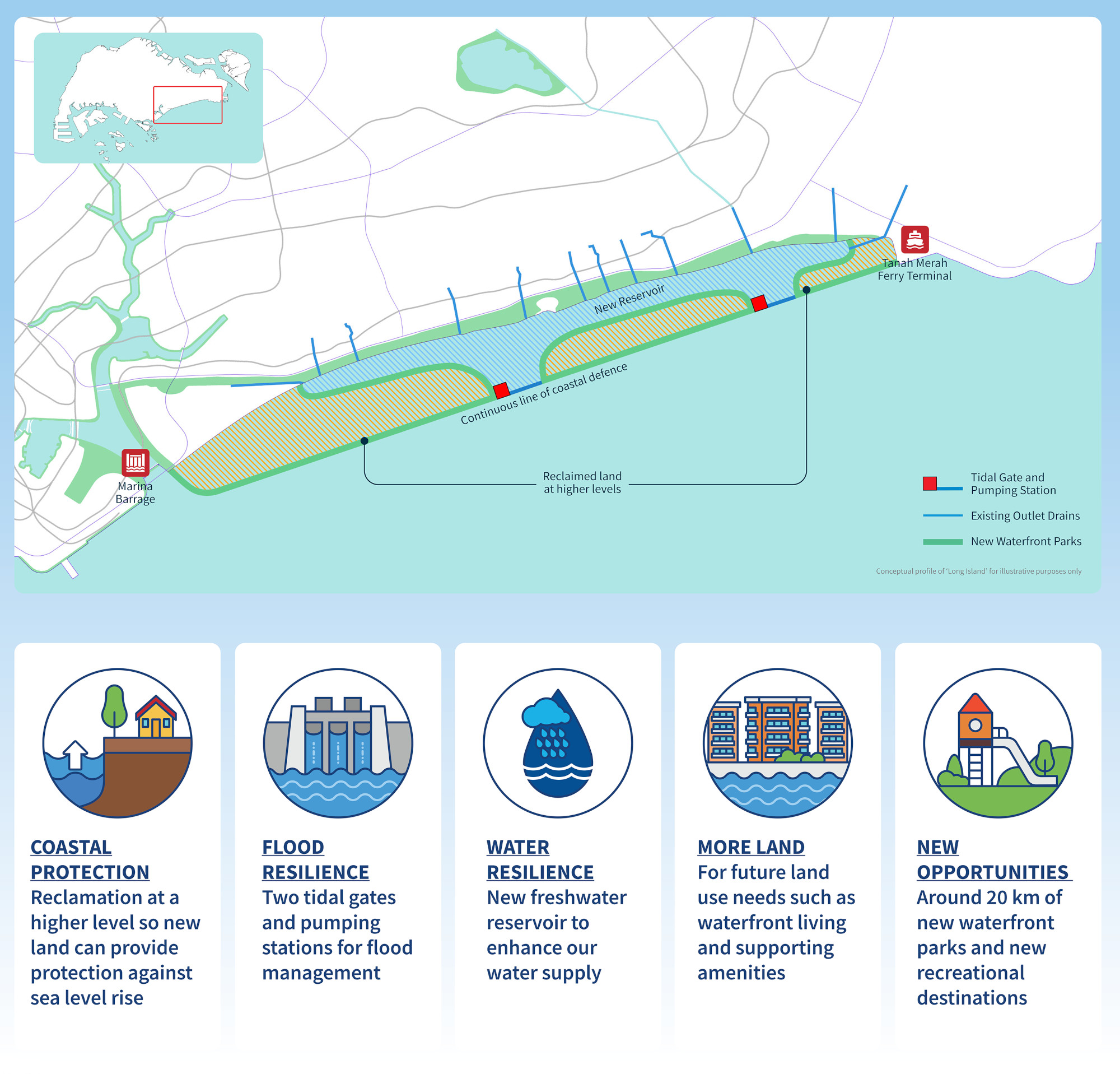
Three tracts of land could be reclaimed off East Coast Park in the coming decades, creating about 800ha of land for new homes and other amenities, as well as a new reservoir.

Called the Long Island, these land tracts – collectively about twice the size of Marina Bay – are Singapore’s response to the threat of rising sea levels and inland flooding in the East Coast area.

Land in the area is largely lower than 5m above the mean sea level, the extent that sea levels are projected to rise to by the end of this century if extreme high tides coincide with storm surges.

On Nov 28, National Development Minister Desmond Lee announced that public agencies will carry out technical studies for the Long Island project over five years, starting from early 2024.

Over the next few years, members of the public will be consulted for their ideas and suggestions for the project, which will take several decades to plan, design and develop.

The current plan is for three elongated tracts of land to be reclaimed in the area, extending from Marina East to Tanah Merah. The easternmost land tract will start from Tanah Merah, while the westernmost tract will be an extension of Marina East. Between these two tracts, a third tract will be reclaimed.

A large tidal gate and pumping station will be built in between each new land mass. These will control the water level in a new reservoir bordered by East Coast Park and the new land masses, and, in the process, reduce flood risks in the East Coast area.

National water agency PUB said the reclamation project is likely to create Singapore’s 18th reservoir.

Like the gate at Marina Barrage, the two gates at the new reservoir in East Coast will open to release excess storm water into the sea during heavy rain when the tide is low. At high tide, the pumps will be used instead to release the storm water.


Mr Lee said the new reservoir can also be used for water activities such as canoeing and dragon-boating.

Besides offering flood protection and increasing Singapore’s freshwater supply, the project will help meet future development and recreation needs, said Mr Lee.

Waterfront homes are expected to be built on the reclaimed land, along with amenities and industrial facilities. About 20km of new coastal and reservoir parks could be added, tripling the length of waterfront parks in the East Coast area, he said.


Plans for reclamation off East Coast were first unveiled in 1991, as part of the Urban Redevelopment Authority’s (URA) Concept Plan. It was envisioned then that a series of reclaimed islands would provide waterfront housing and leisure opportunities.

At the 2019 National Day Rally, Prime Minister Lee Hsien Loong said reclaiming a series of islands offshore and linking them up with barrages could protect existing low-lying areas and create a freshwater reservoir.

URA showcased a possible concept for reclamation works at its long-term plan review exhibition in 2022.


In his speech on Nov 28, Mr Desmond Lee said the Government has been studying various coastal protection options, including building a sea wall up to 3m tall that would stretch from Marina East to Tanah Merah.

The wall would be accompanied by 12 sets of tidal gates and pumping stations – one set at each of the 12 existing outlet drains along East Coast. The gates would stop seawater from flowing inland during high tide, while the pumping stations would pump storm water from the drains into the sea when the gates were closed.

Mr Lee said this option is technically feasible but not ideal for East Coast Park, as large stretches of the park would have to be closed to the public when building the sea wall. When completed, it would permanently limit park users’ access to the waterfront for recreation and sports.


The 12 tidal gates and pumping stations would take up a lot of space within East Coast Park – about the area of 15 football fields – resulting in the loss of existing greenery and recreational facilities.

Mr Lee noted that the public hopes to retain unimpeded access to the waterfront, as well as preserve the heritage and recreation spaces along the coast.

A more optimal solution is to integrate coastal protection measures with reclamation plans for the area, he added.

Friday, 29 September 2023

Singapore water price to rise from April 2024; Government to provide support for lower- and middle-income households

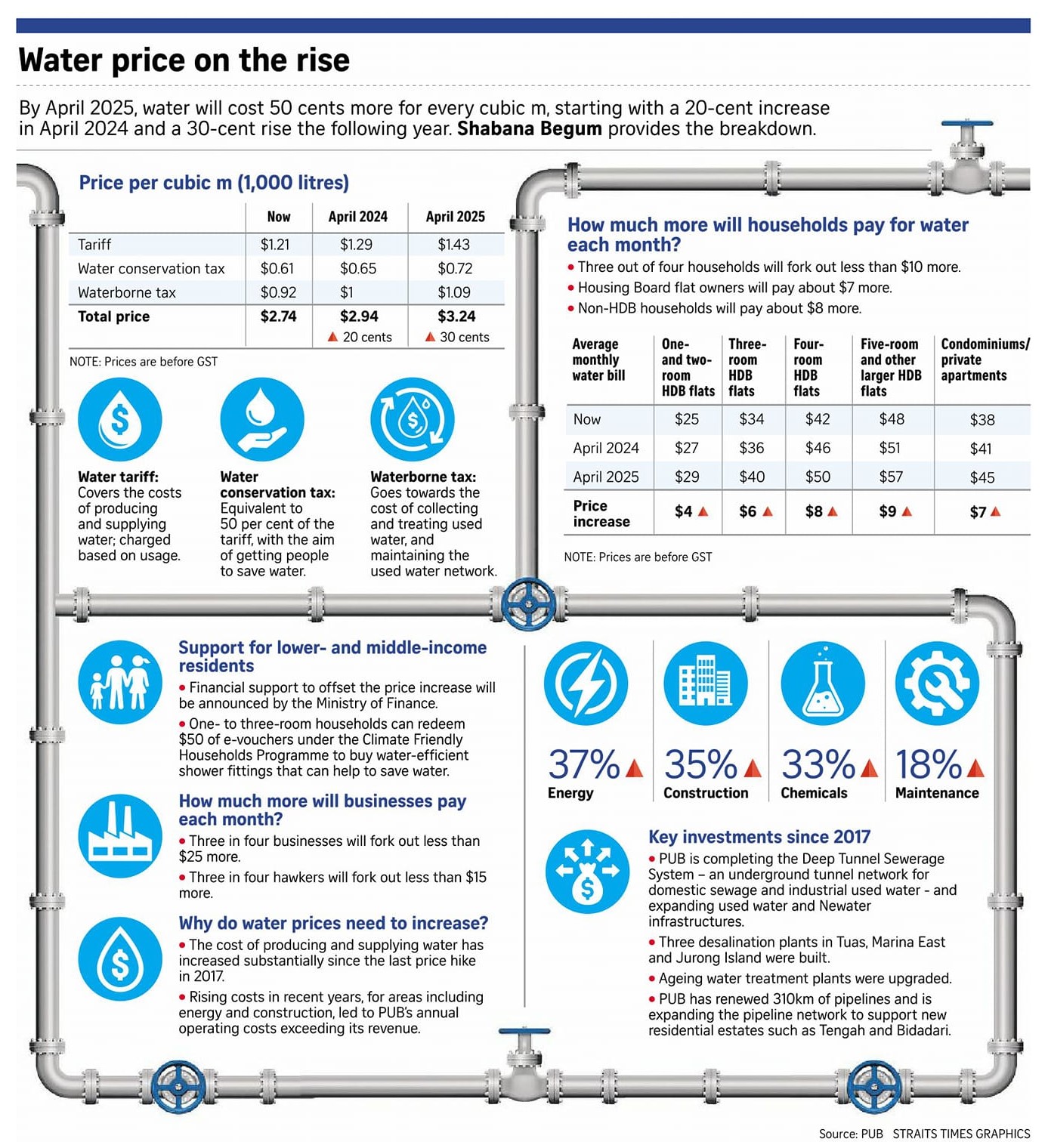
Singapore water price to rise by 50 cents per cubic metre (1,000 litres) by 2025
Three-quarters of households here will see an increase of under S$10 per month in their water bills from April 2025
By Shabana Begum, The Straits Times, 27 Sep 2023

Water will soon cost consumers an additional 50 cents per cubic metre (1,000 litres), starting with a 20-cent increase in April 2024 and a 30-cent rise in April 2025.

This means that most households will fork out an additional $4 to $9, excluding goods and services tax (GST), for their monthly water bill by 2025, said national water agency PUB on Wednesday.

In 2020, the average monthly consumption of water was 15 cubic m for condominiums and 16.2 cubic m for HDB flats.


Lower- and middle-income households will get help to offset some of the price increase. Deputy Prime Minister and Finance Minister Lawrence Wong will announce cost-of-living support measures to provide more relief for Singaporean households on Thursday.

The last water price hike of 30 per cent happened in 2017. The upcoming 50-cent rise – bringing the cost of 1 cubic m, or 1,000 litres, of water to $3.24 – is an 18 per cent increase.

The price hike between 1997 and 2000 saw water prices rising by 120 per cent for households.


The upcoming increase comes amid rising living costs, GST hikes and higher transport fares, and the water agency did not take the decision lightly, said a PUB spokesman.

“The water price increase is not popular, but necessary,” the spokesman said.

“We understand that it can draw strong reactions amid the other cost of living pressures. That’s something we are very mindful of, so PUB does not take this decision lightly.”


It has been increasingly more expensive to produce and supply water, PUB said, and there is a need to invest more in local water infrastructure – especially in weather-resilient Newater and desalinated water – to prepare Singapore for drier days ahead due to climate change.

And Singapore’s water demand, which is currently at about 1.95 million cubic m – or 440 million gallons – daily, is expected to almost double by 2065.

Singapore has four sources of water: imports from Malaysia, water from local catchments, Newater and desalinated seawater.

The pressure of higher energy prices and construction costs, among others, has contributed to PUB’s annual operating costs exceeding its revenue in the financial years of 2021 and 2022.

In 2019 and 2020, PUB saw a slight net positive in revenue owing to the 2017 water price hike.


Electricity tariffs have risen by about 37 per cent, while construction costs have gone up by 35 per cent, with higher increases for specialised works such as tunnelling and pipeline projects through highly urbanised areas.

Due to inflationary pressures and supply chain disruptions, the cost of essential chemicals to treat used water, for example, has also risen by about 33 per cent. Higher manpower costs have driven up maintenance expenses by 18 per cent.

These external cost drivers have worsened the operating deficit significantly in the latest fiscal year, said PUB.

Its spokesman said: “If we were to defer the price increase any further... essentially we would have an even bigger price increase moving forward.”


Rising operational costs and inflation are not affecting Singapore alone.

Wednesday, 26 January 2022

Progressive Wage Model: Entry-level waste collection workers salary to rise to $3,260 by 2028

Higher wages and clear career pathways for 3,000 waste management workers
By Sue-Ann Tan, Business Correspondent, The Straits Times, 24 Jan 2022

Come 2028, an entry-level waste management worker can expect his salary to double to $3,260, under a new Progressive Wage Model (PWM) for the sector that is set to start from July next year, the tripartite cluster for waste management announced on Monday (Jan 24).

Such a worker earns about $1,600 to $1,800 now, said Ms Melissa Tan, chairman of the Waste Management and Recycling Association of Singapore. She is part of the tripartite cluster, which comprises the National Trades Union Congress, employers and other stakeholders.


A total of 3,000 waste management workers here will see annual wage increments, mandatory annual bonus and a career and skills progression ladder.

The workers will also get a stipulated minimum hourly overtime pay.

From Jan 2024, they will also receive an annual bonus of at least a month's pay if they have been with their employer for at least a year. This bonus does not depend on their work performance.


These recommendations were accepted by the Ministry of Manpower on Monday.

The ministry said these improvements are consistent with the guidance by the Tripartite Workgroup on Lower-Wage Workers to ensure that such workers have meaningful and sustained wage growth to gain ground with the median worker.

Senior Minister of State for Manpower Zaqy Mohamad said: "You will see about 50 per cent wage increase growth in the coming years... I think this is a good outcome between unions and employers.

"But at the same time, we want to see the sector transform in a meaningful and sustainable way."

When asked if this move will raise costs for consumers, he said that not every change in business cost translates to higher prices for consumers.

He added that transitional support for companies will be announced during the upcoming Budget.


The PWM provides a clear career progression pathway for workers to improve their wages. To do so, they must undergo structured training to upgrade their skills.


Under the PWM for the waste management industry, workers will get a clear career progression pathway from crew to supervisor in the waste collection sub-sector, for instance, and from sorter to waste sorting plant supervisor in materials recovery.

There will also be a minimum number of Workforce Skills Qualifications modules that workers have to take at each level.

With upgraded skills, the PWM will ensure that workers see increased pay over six years, to 2029. For instance, a waste collection crew member earning $2,210 next year when the PWM kicks off, will earn $2,420 from July 1, 2024, and $3,260 in 2028. This marks a compound annual growth rate of 8.1 per cent.

By 2028, a waste collection senior driver will be earning $3,960 - from $2,910 next year - while a supervisor will be earning $3,910, from $2,860.


Mr Fahmi Aliman, chairman of the Tripartite Cluster for Waste Management, said the workers in the sector deserve due recognition for their hard work.

"The committee has been working hard for the past year to come up with a PWM that will boost the wages and skills, as well as improve career progression opportunities of our waste management workers, and in time, attract more workers to the industry," he added.

Ms Tan said the sector is facing a manpower crunch, especially amid the Covid-19 pandemic, as it relies heavily on foreign workers.

“Singaporeans are not coming forward to join this industry because it is not deemed to provide glamorous jobs,” she said.

Meanwhile, demand has risen for waste management services, especially with more packaging waste generated from e-commerce and food delivery.

“I hope that the PWM will attract more Singaporeans to come on board to carry out such jobs with pride,” she added.

Saturday, 11 December 2021

Skills Demand for the Future Economy report 2021: SkillsFuture report pinpoints skills Singaporeans urgently need in the next 3 years

By Ng Wei Kai, The Straits Times, 8 Dec 2021

The skills most urgently needed by Singaporeans have been identified in a new report by SkillsFuture Singapore (SSG).

The inaugural Skills Demand For The Future Economy Report was launched by Education Minister Chan Chun Sing on Wednesday (Dec 8). It pinpoints the top 20 clusters of skills in the digital, green and care sectors most needed in the next one to three years.

Mr Chan launched the report at the Skills Demand For The Future Economy Forum, where he gave an opening speech.

He said the report does not cover the entire economy, but spotlights jobs and skill trends in the three sectors, calling them "key growth areas" for the country.

Globally, there is a huge demand for digital skills, and the Singapore Green Plan and demographic changes will see the local sustainability and care industries expand rapidly in the next few years, he said.

He said: "Today, more than 450 job roles across 17 sectors require green skills in their job tasks... With an ageing population, the demand for local workers in the care economy will continue to grow rapidly.

"We are not here just to figure out which are the growth sectors but, more importantly, we want to help our people plan and figure out which are the skill sets required across the different sectors and across the different job scopes."


The skills highlighted are those that are required by the most number of jobs in the sectors, he added.

The report shows the 20 most important clusters of skills in the three sectors, which it calls "priority skills".

In the digital sector, the top three are technology application, data analysis and market research.

In the green sector, they are green process design, carbon footprint management and environmental management system.

In the care sector, they are conduct and ethics, stakeholder management and inclusive practices.


The report goes on to break down the sectors into sub-sections and highlights the priority skills in these.

For example, for the digital sector, the report shows the priority skills for both tech-heavy and tech-lite jobs, as well as those for digital jobs and skills in financial and retail services.

It also features personal stories from people who have changed careers or sectors, as well as insights from chief executives Wong Kim Yin of Sembcorp Industries and Chin Wei Jia of HMI Group, other business leaders and educators.

Educators The Straits Times spoke to said Singaporeans should focus not only on gaining sector-specific skills, but also the general skills the report highlights.

Saturday, 31 July 2021

Dover Forest to be used for both housing and nature; first housing project to be launched in 2022

HDB flats to be built in eastern half, with parts of western half kept as nature park
By Audrey Tan and Ng Keng Gene, The Straits Times, 30 Jul 2021

The plan for Dover Forest has been revised, with public housing expected to be launched in the eastern half next year while the western half is set aside for now to preserve its biodiversity.

The young secondary forest plot in western Singapore is zoned for residential use, but the plans were tweaked after scientific studies and nature enthusiasts flagged its conservation value.

To balance the country's needs for both housing and nature, only the eastern half of the 33ha site - almost eight times the size of the Padang - will be developed in the nearer term.

The plan is to develop about 11ha of land in the eastern half for public housing projects. The first of the flats there are expected to be launched in the second half of next year, said the Housing Board (HDB).

The development of the area, which is located in the mature estate of Queenstown, will be done sensitively and also feature 5ha of greenery - including a park with a natural stream.

The western half of the site will be set aside for now and relooked at in about a decade, HDB added. But parts of this segment, which is richer in biodiversity than the eastern half, will be carved out and safeguarded as a nature park.


Minister for National Development Desmond Lee said on Wednesday during a media conference: "HDB had originally intended to launch the entire parcel, known (also) as Ulu Pandan vegetated area or Ulu Pandan Forest, for public housing to meet pressing needs for public housing in the near term. But we have decided to review it and refine it."

This decision was made after feedback from members of the public and the findings of two separate scientific studies.

The first study, commissioned by HDB to inventory the wildlife on the site, had found that the western part of it was richer in biodiversity, comprising more large trees and threatened species.

The second study by the National Parks Board in consultation with experts modelled how the Dover plot connects with other forests in Singapore. This exercise had shown that the site was an important stepping stone for wildlife moving in from the Bukit Timah Nature Reserve north of the site, as well as from the vegetation in the Southern Ridges further down.

These factors informed plans for the site.


While other development projects have incorporated green features, these elements are usually included on an individual project basis. This is the first time vegetation on a site is being safeguarded via a broader landscape approach, in a way that will allow the plot to serve as a stepping stone for wildlife moving from other forests.

Mr Lee said: "Top of our minds was our role as responsible stewards of our land and natural environment, to meet the needs of current Singaporeans as well as future generations, while ensuring that we safeguard resources for (the future)."

The Dover Forest is bound by Commonwealth Avenue West, Ghim Moh Link, Ulu Pandan Canal and Clementi Road.


Public housing development plans for the site were released last December, with Mr Lee saying on Facebook then that Build-To-Order flats to be launched this year would be in the area.

Kwan Im Thong Hood Cho Temple Professor of Conservation Koh Lian Pin, who heads the National University of Singapore's Centre for Nature-based Climate Solutions, said: "Of course I would have liked to see the entire Dover Forest conserved. But when there are competing uses of the land from housing needs, for example... the (scientific exercise) is critical for providing the scientific basis to triage which half of the forest to protect."

Wednesday, 9 June 2021

Cleaners in Singapore to see wages increase over 6 years from 2023 under progressive wage model

Move set to benefit 40,000 workers across 1,500 cleaning businesses in Singapore
By Jolene Ang, The Straits Times, 8 Jun 2021

Cleaners will see their wages continue to go up each year from 2023, over six years, after proposals by a tripartite committee on the cleaning wage ladder were accepted by the Government yesterday.

From 2023 to 2028, the base wages of Singaporean and permanent resident cleaners across all job levels will increase each year. This will benefit about 40,000 cleaners across about 1,500 cleaning businesses in Singapore.


The first adjustment in 2023 will see base wages of general and indoor cleaners increase by, for example, almost 20 per cent from $1,312 next year to $1,570.

The move is meant to narrow the income disparity between cleaners and other workers. Under previous updates to the Progressive Wage Model (PWM) in 2016 and 2018, cleaners were slated to get 3 per cent annual wage increases from last year to next year.

The latest wage increases were among new recommendations made by the Tripartite Cluster for Cleaners (TCC), after it conducted another round of reviews of the model.


The PWM, a ladder that sets out minimum pay and training requirements for workers at different skill levels, was launched in the cleaning sector by the TCC in 2012. It has been a compulsory condition since 2014 for the licensing of cleaning companies.

The TCC - which comprises representatives from the labour movement, industry, service buyers and the Government - also recommended having cleaners trained in workplace safety and health protocols by the end of next year.

This is to ensure their personal safety when carrying out cleaning tasks, especially in the light of increased cleaning demands due to the Covid-19 pandemic.

Employers should also send cleaners for one of the core Workforce Skills Qualifications (WSQ) modules identified by the TCC for their relevant job levels.

The PWM training guidelines had earlier required that all resident cleaners attain the minimum two WSQ certificates next year.

With the latest recommendations, cleaners will have until December next year to complete the two modules.


Ms Phyllis Lim, deputy director of the National Trades Union Congress' (NTUC) U Care Centre, which supports low-wage workers, said in a press statement yesterday that training class sizes have been reduced to adhere to Covid-19 safe management measures.

"The new timeline is to allow sufficient time for cleaning businesses to comply with the training requirements... By the end of 2022, they should be able to send their cleaners (for the modules)."

Another recommendation was that beyond 2025, cleaners in lower job rungs must complete one additional module, while those in higher job rungs must complete two extra modules.

The list of WSQ training modules has been updated, and will periodically be updated to ensure its relevance, the TCC said.


The Ministry of Manpower, National Environment Agency, SkillsFuture Singapore and Workforce Singapore said in a joint statement yesterday that the recommendations will "ensure significant wage growth and skills upgrading for cleaners, and develop a more competent and productive cleaning workforce".

They said: "Together, our collective whole-of-society efforts will uplift our lower-wage workers."

NTUC secretary-general Ng Chee Meng said in a Facebook post: "I am glad that many of us are more aware of the value of work our cleaners do... Pandemic or not, uplifting the lives of our lower-wage workers matters to us."

Sunday, 16 May 2021

Return used trays and crockery: Fines for hawker centre diners who do not clear their tables from 1 September 2021

Mandatory for diners to return trays, clear own litter from 1 June 2021
Advisory period from 1 June to 31 August 2021, enforcement action to be taken from 1 September 2021
Singapore Food Agency will work with NEA to roll out enforcement progressively at coffeeshops and food courts in the fourth quarter of the year
By Adeline Tan, The Straits Times, 15 May 2021

It will be mandatory for diners to return their trays and clear their table litter from June 1, the National Environment Agency (NEA) said yesterday.

Table litter includes used tissues and wet wipes, straws, canned drinks, plastic bottles and food remnants.

In an effort to help diners adjust, no enforcement action will be taken until after Aug 31. During the three months, they will only be advised to follow the rule.

From Sept 1, enforcement action will be taken against those who do not comply with advice to clean up after themselves at hawker centres.

First-time offenders will be given a written warning. Second-time offenders will face a $300 composition fine, and subsequent offenders may face court fines, which can go up to $2,000 for the first conviction.

The Singapore Food Agency will also work with NEA to roll out enforcement progressively at coffee shops and foodcourts in the fourth quarter of this year.


NEA said the move, which comes amid a public health crisis, follows years of extensive educational efforts to change the behaviour and mindsets of diners at public places.

Its deputy chief executive of public health and director-general of public health Chew Ming Fai said: "We've been talking about these clean tables since 2013, and there's been a lot of education effort that has been put out over the years."

One example is the Clean Tables Campaign launched in February.

Mr Chew said: "Following that exercise, we've seen a small uptick in terms of tray return rates from 33 per cent to 35 per cent, but unfortunately I don't think that is significant enough."


NEA will be setting up more tray return infrastructure across the hawker centres.

Currently, there are about 900 tray return racks installed across 111 hawker centres.

During the advisory period, safe distancing ambassadors, SG Clean ambassadors, community volunteers and NEA officers deployed at hawker centres will continue to remind diners to clear their dirty trays, crockery and litter.


Visual cues such as posters and banners will also be progressively put up at hawker centres.

NEA said Covid-19 has underscored the need to maintain high public hygiene and cleanliness standards, and various members of the public and institutions have called for stronger measures to raise cleanliness standards, including the use of legislation.

Clearing dirty trays, crockery and table litter will protect not only other diners but also the cleaners, who are usually elderly folk.


Mr Chew said that while enforcement efforts will not be scaled back even after Covid-19, NEA will monitor the ground situation and make adjustments accordingly.

He said: "This is a long-term goal to raise public hygiene and cleanliness levels in Singapore. Even as we tackle the current Covid-19 crisis, we believe that this measure will be something that we need to put in place for the longer term."


Monday, 15 February 2021

Singapore Green Plan 2030 to change the way people live, work, study and play

Singapore poised to take green leap forward
New sustainability initiatives launched to change how people work, study and play
By Audrey Tan, Science and Environment Correspondent, The Straits Times, 11 Feb 2021

Singaporeans look set to lead much greener lives by 2030, with new sustainability initiatives launched to change the way they work, study and play.

The Singapore Green Plan 2030, released by five ministries yesterday, will chart the country's way towards a more sustainable future, "building back better" as it recovers from the fallout of Covid-19.

The plan seeks to inform all aspects of development here - from infrastructure, to research and innovation, to training programmes.


"The comprehensive plan will strengthen Singapore's economic, climate and resource resilience, improve the living environment of Singaporeans, and bring new business and job opportunities," said the ministries in a joint statement. The Ministries of Education, National Development, Sustainability and the Environment, Trade and Industry and Transport are driving the initiative.

Under the Green Plan, at least 20 per cent of schools here will be carbon-neutral by 2030.

Adults, too, will work in greener buildings, since there are plans to raise the sustainability standards of buildings. People will be encouraged to commute in a less carbon-intensive way - cycling paths will triple in length by then, and the rail network will be expanded to 360km, up from the 230km today.

This infrastructure will be built within a city cloaked in green, with more initiatives to help nature seep into the heartland.

For instance, more nature parks will sprout up over the years. By 2030, there will be a more than 50 per cent increase in nature park land where people can go hiking or birdwatching.

Even the fossil fuel haven of Jurong Island will be transformed into a "sustainable energy and chemicals park".

Behind the scenes, research and innovation in low carbon alternatives will continue, even as programmes such as the new Enterprise Sustainability Programme are rolled out to help firms develop capabilities in this area.

More details on these initiatives will be given during the Budget next week, and in the subsequent Budget debates.


Prime Minister Lee Hsien Loong said in a Facebook post that the Green Plan will build upon Singapore's past sustainability efforts.

"We need to ensure a Singapore for our future generations. All of us have to work together, and make Singapore a bright green spark for the world," said PM Lee.

Sunday, 6 December 2020

Cultured meat: No-kill products may be food for the future

Singapore this week approved the sale of a cultured meat product. Such alternative proteins could pave the way for more sustainable food production and better food security.
By Audrey Tan, Science and Environment Correspondent, The Straits Times, 5 Dec 2020

In a world first, Singapore on Wednesday (Dec 2) approved the sale of a cultured meat product here.

The chicken bites by Californian start-up Eat Just are made by culturing animal cells in bioreactors instead of rearing animals on farms, and are not yet available for sale and consumption anywhere else.

The Singapore Food Agency (SFA) said it was allowing the cultured chicken to be sold here after its evaluations determined it to be safe.

The company would not be drawn on a timeline on when the product will be available, but the firm's chief executive Josh Tetrick told The Straits Times on Thursday that it will be soon, and at a "higher-end" restaurant.

The aim is to make cultured meat cheaper than conventionally farmed meat, he added.


Why it matters

Alternative proteins, such as cultured meat, could pave the way for more sustainable food production and better food security.

While a report on land use by the UN's climate science body last year found that plant-based diets were still associated with a lower environmental impact compared with meat-based ones, it may not be feasible to get everyone to go vegetarian.

Culturing meat could be an alternative to rearing livestock, which according to the UN's Food and Agricultural Organisation make up 14.5 percent of emissions from human activity.

Culturing meat involves taking cells from an animal (often done in a harmless way, such as through a biopsy), and then growing the cells in a nutrient broth within a bioreactor.

This process has been associated with a number of environmental benefits.

One, it reduces emissions associated with rearing livestock.

There is less need to clear forests for farms or grow crops for animal feed, and reduces methane emissions from ruminants like cows, which releases a lot of methane during digestion of their food. Methane is considered a more potent greenhouse gas than carbon dioxide over shorter time spans.

Two, culturing meat can be done in a smaller land area compared with the livestock supply chain.

Three, it allows meat to be produced without slaughter. This avoids the need to confine livestock to small spaces, and reduces the chance of diseases spreading between humans and animals.

On the food security front, cultured meat could also boost the resilience of import-dependent nations like Singapore, which sources more than 90 per cent of its food from overseas.

Eat Just has said its cultured chicken bites will be manufactured in Singapore, and Mr Tetrick told ST on Thursday that the firm aims to produce enough not just for the domestic market, but for the rest of Asia as well.

What lies ahead

The need to feed a growing global population, which could reach almost 10 billion by mid-century, is straining food production systems.

And the impacts of climate change - whether changing rainfall patterns or more frequent extreme weather events - could put further stress on food security.

These trends highlight the need for new ways of producing food, with a smaller carbon footprint.

Critics have said the environmental impact of culturing meat - an energy-intensive process - is not definitively better than rearing animals the traditional way.

Context is important. In Singapore, for instance, most energy is generated by natural gas - a cleaner fossil fuel than coal or oil. Advancements made in renewable energy systems, and scaling up production of cultured meat, could boost efficiency and lower the carbon footprint of cultured meat.

As with many new innovations, more studies are needed to assess the different impacts of cultured meat products.

The SFA has done so on the food safety front. But even as research on environmental impact continues, another hurdle remains: Consumer receptivity to eating meat made a different way.

The impact of climate change can already be felt. Consumers can help, by keeping an open mind.

Wednesday, 14 October 2020

Carmaking returns to Singapore with Hyundai's new smart plant in Jurong

Factory to build up to 30,000 electric vehicles a year when completed by end-2022
By Christopher Tan, Senior Transport Correspondent, The Straits Times, 14 Oct 2020

Electric cars will be built at a highly automated factory in Singapore, marking the return of automobile manufacturing here and incorporating first-of-its-kind features.

At a virtual groundbreaking ceremony of the Hyundai Motor Group Innovation Centre in Jurong yesterday, Prime Minister Lee Hsien Loong noted that the investment by the South Korean carmaker was a nod to Singapore's strengths.

"I am happy that Hyundai has chosen Singapore to locate your newest facility. It is an investment of almost $400 million, and may produce up to 30,000 vehicles per year by 2025, five years from now," said PM Lee.

The centre, to be completed by end-2022, will serve as an open innovation lab for research and development into mobility concepts, which observers reckon will include autonomous vehicles and new forms of ride-sharing.

Sitting on a 44,000 sq m plot - larger than five football fields - in the Jurong Innovation District, and with a built-up area of some 90,000 sq m, the facility will be futuristic.

It will have a landing pad for passenger drones - which Hyundai is also developing - and employ renewable energy sources such as solar and hydrogen.

When ready, the facility will have a small-scale electric car assembly line which is expected to produce up to 30,000 vehicles a year.

Customers will be able to purchase and customise their vehicles on their phones. Once an order is confirmed, production will begin.

Customers can then watch their cars being assembled at the centre.


The facility will be a "vivid demonstration" that Singapore has what it takes to dream big and reinvent itself, said PM Lee. "We did not think that Singapore would one day be manufacturing cars again. But Singapore is where we have made the impossible, possible."

He said Singapore had a car assembly industry from as early as the 1940s, but abandoned it in 1980 when commercial competitiveness began to favour high-volume plants.

But 40 years on, with the revival of electric vehicles, the game has changed again with growing interest in cleaner, smarter vehicles and cities facing pressure to move people around in an environmentally sustainable manner.

Automotive activities are becoming viable in Singapore again, he said. "Electric vehicles have a different supply chain, fewer mechanical parts and more electronics, which plays to Singapore's strengths."

That is why global companies producing automotive electronics like Delphi and Infineon have been in Singapore for some time, he added.

This will hopefully open up new growth areas for the economy, he said, and create exciting jobs such as Industrial Internet of Things engineers, data scientists and digital supply chain strategists.


Joined virtually by South Korean Trade, Industry and Energy Minister Sung Yun-mo and Hyundai Motor Group executive vice-chairman Chung Eui-sun at the event, Mr Lee added that the facility could pave the way for more South Korean companies to invest here, partner with local businesses and collaborate with universities and research institutions.

Hyundai said the facility will employ various advanced manufacturing and logistical systems, including artificial intelligence, Internet of Things and robotics.

Hyundai will also trial battery-as-a-service, where consumers buy an electric car without its battery - which can account for half its cost - and then lease the cells from Hyundai. This could reduce the cost of an electric vehicle dramatically.


The company would not reveal the number of people the facility will employ, saying it "will be determined later... as the project evolves". Earlier, a spokesman said it would create "hundreds of jobs".

Hyundai's move comes after a bid by British home appliance maker Dyson to make electric cars in Singapore. Dyson, however, pulled the plug on the venture.