Showing posts with label Work-Life Balance. Show all posts

Thursday, 19 November 2020

Tripartite Advisory on Mental Well-being at Workplaces

MOM, NTUC and Singapore National Employers Federation issue new advisory to tackle mental health needs of workers
Firms asked to address workers' mental health amid Covid-19 pandemic
Advisory calls on them to train managers to spot signs of distress, give staff adequate rest
By Calvin Yang, The Straits Times, 18 Nov 2020

With lines between the workplace and home getting blurred during the Covid-19 pandemic, employers have been advised to address the mental health needs of their workers who are under more stress and facing a higher risk of burnout.

An advisory issued yesterday called on companies to recognise the need for their staff to have adequate rest outside work hours.

This can be done by establishing a work-life harmony policy to offer clarity on after-hours work communication, said the advisory, which was jointly released by the tripartite partners: the Ministry of Manpower, National Trades Union Congress (NTUC) and Singapore National Employers Federation.

The recommendations come a month after Prime Minister Lee Hsien Loong announced that an inter-agency task force has been convened to tackle the mental health needs of Singaporeans. He said the coronavirus pandemic has brought about more stresses, pressures and disruptions.

The outbreak has led many workplaces to adopt work-from-home arrangements as the norm, leading to employees feeling more stressed and putting them at a higher risk of burnout, the tripartite partners said.

They encouraged employers to organise talks and workshops on the issue, and train managers to spot signs of distress, and offer help to their colleagues.

It was important to set boundaries, they noted. For example, firms should set out a clear position that employees were not expected to respond to work-related messages sent after work hours - unless they were marked urgent or critical.


Companies were advised to extend employees' flexible benefits to cover mental health-related consultations and treatments, or offer workers access to counselling services such as employee-assistance programmes.

But workers and self-employed persons can also reach out for help if they feel overwhelmed.

Manpower Minister Josephine Teo, who introduced the advisory at the start of the Singapore Workplace Safety and Health Conference 2020, said the pandemic will be a long-drawn battle and urged employers and workers to adopt the recommendations.

"While the future remains uncertain as the world continues to battle Covid-19, let us not lose sight of our goals," she added. "It is timely for the Government, unions, businesses and workers to come together and collectively chart a future where everyone can bounce back."

It is the first time the biennial conference is being held online.


NTUC assistant secretary-general Melvin Yong said that workers were facing greater stress from juggling work and personal commitments during this period of prolonged telecommuting work arrangements. He said the advisory will "help to reassure workers that safeguards are in place to support their mental well-being".

Workplace Safety and Health Council chairman John Ng added that the advisory will help employers to take proactive steps to look after their workers' mental health, "so that they are able to stay focused at work, work safely and stay healthy".

"In turn, employers will benefit from a healthy and productive workforce which can contribute to better business performance," he added.

Sunday, 22 September 2019

Sentosa-Brani Master Plan: $90 million project to link Sentosa's north, south shores

Sentosa Merlion to make way for themed linkway project
By Tiffany Fumiko Tay, The Straits Times, 21 Sep 2019

One of Sentosa's famous structures will be making way for a themed thoroughfare that will link its north and south shores.

The demolition of the Merlion statue is part of long-term plans to reshape the resort island and the adjacent Pulau Brani into a premier leisure and tourism destination.

The last day of operations for the Merlion will be on Oct 20.

Work to demolish the towering 37m statue, located in the heart of Sentosa, will begin by the year end, when construction on the $90 million Sentosa Sensoryscape project will commence.

The new double-level thoroughfare, which will occupy about 30,000 sq m, will connect the mainland-facing Resorts World Sentosa with the beaches in the south, and replace the existing walkway.

Lookout points, water features and other architectural elements will create a multi-sensory experience for visitors strolling across the island, Sentosa Development Corporation (SDC) said yesterday.

Its completion by 2022 will mark the first milestone of the blueprint for the two islands, to be rolled out in phases over the next two to three decades.

Details of the Sentosa-Brani masterplan, announced by Prime Minister Lee Hsien Loong during the National Day Rally last month, were revealed at a media briefing on Sentosa yesterday.


The two islands will be divided into five zones. The Vibrant Cluster zone, which spans the two islands, will have large-scale attractions. Island Heart will feature hotels, conference spaces, dining and shops, while the Waterfront zone on Pulau Brani will house a Discovery Park.

The Ridgeline zone will connect green spaces from Mount Faber to Mount Imbiah and feature nature and heritage attractions, while Sentosa's beaches will be rejuvenated with a water show, fairgrounds and other attractions in the Beachfront zone.

Transport connectivity will also be enhanced, and a "Downtown South" resort modelled after the labour movement-run Downtown East in Pasir Ris will likely be built on Pulau Brani.

The 1.22 sq km Pulau Brani, about a quarter the size of Sentosa, now houses a port terminal, which will move to Tuas by 2027, along with the terminals in Keppel and Tanjong Pagar.


SDC chief executive Quek Swee Kuan said that rather than having distinct identities, the islands will be linked and integrated in their development, leveraging their island charm and proximity to the city.

When the Merlion statue was constructed in 1995, visitorship to Sentosa was between four million and six million, compared with more than 19 million last year, said Mr Quek. There is thus a need for a wider thoroughfare, and the Sensoryscape will double the current pedestrian capacity, he said.

"We won't relocate the Merlion because of its size, but we are considering how to commemorate it," said Mr Quek.

A new icon for Sentosa is also being considered, he added.


He confirmed that the Police Coast Guard headquarters on Pulau Brani will remain, but said that other plans for the island are still being developed.

Senior Minister of State for Trade and Industry Chee Hong Tat, who revealed plans to reshape the two islands in line with plans for the mainland last year, said that the blueprint aims to position Singapore as a leading tourist destination over the coming decades.

"There are also plans to see how we can, in the short and medium term, enhance the value of... the Southern Islands for eco-tourism, for families to visit and learn about a part of Singapore," he said.

Friday, 30 August 2019

Lower pre-school fees and more help with fertility treatments to encourage marriage and parenthood from 2020

Full-day childcare may cost only $3 a month for needy; more help too with fertility treatments
By Amelia Teng, Education Correspondent, The Straits Times, 29 Aug 2019

Pre-school expenses will be cut for many and more help will be offered with fertility treatments - even for older couples - as part of the latest moves to encourage more Singaporeans to start families.

From next year, lower-income families may only need to pay as little as $3 a month for full-day childcare. The monthly household income ceiling for additional childcare and kindergarten subsidies is also being raised to $12,000.


Meanwhile, there will be no more age limit for women undergoing assisted reproductive technology (ART) treatments from January. It currently stands at 45 years old.

Manpower Minister Josephine Teo, who oversees population matters, Minister for Social and Family Development Desmond Lee and Senior Minister of State for Health Amy Khor announced the measures at a My First Skool pre-school in Punggol yesterday.

With the higher subsidies from next year, more families could find themselves paying between $3 and $390 a month for full-day childcare at pre-schools run by anchor operators that charge monthly fees of $770.

With the measures, eight in 10 young children should have a place in more affordable government-supported pre-schools by around 2025.

This is similar to the proportion that receives government help in the housing and healthcare sectors.

Mr Lee said fee caps will also be lowered at government-supported pre-schools as their share of the sector expands. In time, this would allow working families with a child in full-day childcare to pay about $300 per month, even without additional subsidy.

In 2021, the partner operator scheme will also be expanded to more childcare operators beyond the existing 23. For the first time, it will also include a small number of kindergartens which offer quality programmes.


Subsidy amounts for families at different income tiers will go up. From next year, the monthly household income ceiling for additional kindergarten subsidies and childcare subsidies will be raised from $6,000 and $7,500 respectively to $12,000 so that it benefits 30,000 more households.

Currently, 41,000 families receive these means-tested subsidies.

Low-income families will pay even less, with those earning $3,000 or less per month paying just $3 per month for full-day childcare at anchor operators, or $1 per month for kindergartens run by anchor operators and the Education Ministry.

Mrs Teo noted that there is strong interest among Singaporeans to marry and have children. "But it is also a fact that our people are marrying later. And they're also starting families and they're having children later," she said.

She encouraged couples to marry earlier and start trying to conceive earlier, so that they would be more successful in having children.

Nonetheless, older couples trying for babies will also get more support from January next year, amid fewer marriages last year and an eight-year low in the number of babies born here last year.


The Health Ministry will remove the age limit for women undergoing ART treatments.

There will also be no cap on the number of cycles they can go for.

In addition, couples undergoing intra-uterine insemination procedures - a less invasive fertility treatment than ART - will benefit from government co-funding of up to 75 per cent, capped at $1,000 per treatment cycle, for three such cycles.

Tuesday, 23 April 2019

Jack Ma is wrong: 12-hour days are no 'blessing'

By Bryce Covert, Published The Straits Times, 23 Apr 2019

Mr Jack Ma, the richest man in China and founder of e-commerce company Alibaba, is a big fan of extreme overwork.

He recently praised China's "996" practice, which refers to those who put in 12-hour days - 9am to 9pm - six days a week. This is not a problem, he said in a recent blog post, but a blessing.

The response from others in China was swift.

"If all enterprises enforce a 996 schedule, no one will have children," one person argued on the same platform. "Did you ever think about the elderly at home who need care, the children who need company?"

It even prompted a response from Chinese state media, which reminded everyone: "The mandatory enforcement of 996 overtime culture not only reflects the arrogance of business managers, but is also unfair and impractical."


Managers who think like Mr Ma can be found the world over.

In the United States, Mr Elon Musk, co-founder of Tesla, has argued that "nobody ever changed the world on 40 hours a week".

Uber reportedly used the internal mantra, "Work smarter, harder and longer". (It's now just "smarter" and "harder".) It has also rebranded second jobs as clever "side hustles".

WeWork decorates its co-working spaces with phrases like "Don't stop when you're tired, stop when you are done". Other tech and business gurus try to sell us on "toil glamour".

The truth is that they're all wrong.

Workers certainly suffer when forced to put in extreme hours. But business fares just as poorly. No one benefits from people pushing themselves to the brink of exhaustion.

One of the reasons Mr Ma said he supports 996 culture is that people who work longer get the "rewards of hard work".

But they are apparently not in store for monetary rewards. A group of academics just released research finding that working longer hours than someone else in the same job doesn't earn you more money; instead, it leads to a 1 per cent decrease in wages. Another analysis similarly found that after 40 hours a week, there is no clear financial return for clocking more hours.

Excessive work effort has even been linked, perversely, to worse career outcomes.

Sunday, 13 January 2019

Govt will help workers cope with job changes and economic restructuring, says PM Lee Hsien Loong; Singapore's labour crunch: Why it's happening and what more can be done

30,000 got new jobs in 2018 through Adapt and Grow
By Joanna Seow, Manpower Correspondent, The Straits Times, 12 Jan 2019

Amid anxiety over jobs and the state of the economy, Prime Minister Lee Hsien Loong's message to Singaporeans is that resources and the resolve are in place to help them train and take on new jobs.

The journey is not easy, and many people are anxious and might worry about their career prospects, job security and families, he said. Older people may be more worried about new technology, he noted.

"We have the resources, the plans and the resolve. We will help everybody to get through difficulties. We will help you, walk together with you, to overcome these troubles," he said on a visit to Workforce Singapore's Careers Connect at Lifelong Learning Institute in Paya Lebar. It lets jobseekers meet career coaches and tap a wide range of resources.

Yesterday, PM Lee met workers who had changed or were changing jobs, employers and career coaches, and spoke to them about their experiences for around 21/2 hours.

"A lot of good work is done, there is a lot of passion," he told reporters at the end of his visit, adding that Singaporeans should have confidence that they can cope with economic transformation.


Singapore has made a lot of progress in its restructuring journey, he noted, citing how employment rates have gone up, particularly for women and the elderly.

The journey is not over, he said. But if it is done right, in 10 years, Singaporeans will be in a better position than they are in today, he said.

Saturday, 25 November 2017

Basic pay for security guards to go up by $300 by 2021, limit on overtime hours

Higher wages, less overtime work ahead for security officers
Basic pay to rise by around $300 between 2019 and 2021; firms won't be allowed to apply for overtime extensions
By Yuen Sin, The Straits Times, 24 Nov 2017

Security guards will be paid more while working fewer overtime hours each month in future.

Their basic pay will increase by around $300 between 2019 and 2021.

After that, they will receive an annual basic pay increment of at least 3 per cent, under recommendations accepted by the Government yesterday.

All security guards will also be allowed to put in a maximum of only 72 overtime hours a month.

The current practice - in which security companies apply for overtime exemptions so that their employees can work past this limit - will be discontinued from 2021.

The higher basic pay and subsequent annual increments are meant to offset the cap on overtime hours.

Security agencies must adopt the recommendations from Jan 1, 2019.

The Security Tripartite Cluster (STC) yesterday unveiled details of its proposals, which were made to draw younger Singaporeans to a sector facing growing demand, with more buildings and infrastructure being constructed amid the rising threat of terrorism.

STC chairman Zainal Sapari, assistant secretary-general of the National Trades Union Congress, said security guards surveyed often cite excessive working hours as a reason for leaving the industry.

"To attract young people or make it practical for older people to join the industry, reducing overtime is something that must be done," he said, adding that guards also need enough rest to do their job well.

The changes will benefit more than 34,000 Singaporeans and permanent residents working as security guards.

They follow a review of the progressive wage model in the security industry - a wage ladder that aims to raise the salaries of low-wage workers through skills upgrading and improvements in productivity.

It is compulsory for companies licensed in the cleaning, security and landscape sectors to adopt the wage model. This specifies a starting wage of at least $1,100 a month for security guards, with salaries starting from $1,300 and more for those who are higher-skilled.

Their pay has risen since 2014, when the wage model was introduced, said the STC. It became mandatory in September last year.

Between 2014 and last year, the median basic wage of full-time security guards grew by 23 per cent per year. It was $1,300 in June last year.


With the changes, their basic monthly wages will go up by $75 in 2019 and 2020, followed by a $150 raise in 2021.

Those in senior ranks will see a total increase of $285 in monthly pay: $60 more for the first two years, followed by a $165 raise in 2021.

Saturday, 18 November 2017

Let's not condemn Singaporeans to extinction

Some European cities have managed to reverse declining fertility rate trends. Singapore, too, must persevere in its society-wide efforts to become more pro-family.
By Paulin Tay Straughan, Published The Straits Times, 17 Nov 2017

As a novice sociologist in 1991 returning to the National University of Singapore after completing my PhD, the very first project I embarked on was on work-life balance for women from dual-income families.

As a young mother and a new assistant professor, I found it daunting to have to manage job expectations as well as be a good mother to my sons. My husband was facing similar challenges at his workplace, and we felt entrapped in a circumstance we seemed to have little control over.

The power of sociological methodologies framed me with lenses that revealed the inter-connectedness of social agencies. Thus began my journey to distil the complexities of our population woes.

That was in 1991.

Along the way, I matured as a sociologist and learnt more about the intricacies of the world we live in. My sociological model for understanding fertility decisions became more complex, and also more focused. Meanwhile, Singapore's marriage and birth rates continue to fall, making it more urgent to devise policies to ease transition to an ageing population.

Some have argued that we should just face the inevitable, and focus on the advantages of growing a "quality" Singapore family, rather than think in terms of growing the quantity or size of the Singapore population. I find that disturbing on several grounds. Let me address these systematically.

That we should accept that the Singapore population would shrink and do nothing about it, to me is nothing short of being irresponsible. This perspective may allay concerns of the present population as we struggle through spatial congestion and economic competition. But it does little to advance the needs of the younger and future generations.

The correlation between population growth and economic health is notable. As a small city state that relies heavily on foreign investment to generate employment opportunities, Singapore's ageing labour force would not place us in good stead to compete with emerging markets in the region with younger and lower-cost labour forces.

LIMITS OF IMMIGRATION

One argument suggests immigration as the solution to our population woes. Carefully calibrated immigration strategies do help in mitigating our ageing demographics, and a globalised workforce adds significant value to our cultural diversity. But relying primarily on immigration for population augmentation is not sustainable in the long run.

First, to rely on surplus labour from the region puts our economic stability at high risk as we cannot control the supply of manpower inflow as and when the need arises.

Second, the 2011 elections and conversations on the Population White Paper revealed how Singaporeans might be nervous about the inflow of immigrants. If we over-compensate through immigration to address the needs of the economy, we may aggravate social tensions and jeopardise racial harmony on home ground. For a multi-ethnic nation like Singapore, any attempts to segregate by national identities will inadvertently lead to dangerous discourse on race relations.

Saturday, 7 October 2017

Workplace role model: The chef who gave up his Michelin stars

By Stefan Stern, Published The Straits Times, 6 Oct 2017

Maybe life is too short to stuff a mushroom after all. That is one conclusion to draw from the news that three-star Michelin chef Sebastien Bras has decided to renounce the accolade for a simpler existence in the kitchen instead.

"I want to give a new meaning to my life… and redefine what is essential," he said last month in a Facebook video message. He still wants to cook, it seems, just not so much of the fancy stuff and not under constant scrutiny.


How should you react to achieving a lifetime's ambition? The restless and the neurotic would press on, set new goals, imagining new threats or rivals to dispatch.

Alexander the Great was said to have wept when he saw there were no new lands to conquer. But having reached the top, Bras has decided it is time to do something else, to choose a calmer life. Once you have reached a peak, it is hard to avoid a sense of slipping downhill. But keeping up a three-star culinary performance does not seem to Bras to be worth the candle, the linen or the silverware.

Motivation and satisfaction in doing a job well can be shattered if you feel disrespected, menaced or taken for granted. Indeed, that elusive third star sometimes seems to have as much to do with staffing levels and degrees of luxury as it does with the cooking. It costs money to run a place like that. If clients don't spend an average of £100 (S$180) a head, a three-star establishment would probably struggle to break even.

The real significance of Bras' decision is what it tells us about motivation and meaningful achievement at work. What he likes is cooking, not the theatre or outward frippery of the three-star venue. Nor does he want to be measured by the anonymous Michelin inspectors who might descend at any moment. He wants to do work that he feels good about, that matters to him. He wants to satisfy customers, not hit arbitrary targets or conform to other people's ideas of quality. His motivation comes from within. He cannot be motivated or "incentivised" by other people. It is all down to him.

Tuesday, 8 August 2017

Our Tampines Hub: PM Lee opens Singapore's first integrated community and lifestyle hub

One-stop lifestyle centre launched in Tampines
Residents get 5,000-seat stadium, theatre, relocated library, sports facilities and more
By Charissa Yong, The Straits Times, 7 Aug 2017

Life just got a whole lot easier for Tampines residents with the completion and grand opening of Our Tampines Hub yesterday.

Previously, community activities were held at temporary spaces such as the plot of land next to Tampines MRT station, or the open space behind the train station.


Now, residents have a 5,000-seat stadium with a high-quality synthetic football pitch at the hub, called the Town Square.

"You can go shopping - there are all kinds of services and retail outlets. And you can just drop by Our Tampines Hub on your way home and get everything you need here," said Prime Minister Lee Hsien Loong, who was the guest of honour at the launch.

The hub is Singapore's first integrated lifestyle hub and was born out of the ideas of thousands of residents, noted Mr Lee.

"From the idea to the realisation, residents have been involved in the process and consulted because we wanted to build a hub by the residents for the residents," he said.

This was a case of the Government trying out new things and improving as it went along, Mr Lee said, adding: "We will continue to learn, and to improve."


The first of the integrated community hub's facilities opened last November, and more were gradually opened over the past eight months.

Friday, 17 March 2017

PM Lee opens SMU's School of Law building and Kwa Geok Choo Law Library

School lawyers of tomorrow in many fields: PM Lee
Encourage more cross-disciplinary learning to keep up with changing law practice, he says
By Ng Huiwen, The Straits Times, 16 Mar 2017

Singapore's law schools need to produce lawyers who are prepared for the demands of a new working environment marked by disruption and new technologies, Prime Minister Lee Hsien Loong said yesterday.

Speaking at the official opening of the Singapore Management University's (SMU) new law school building, Mr Lee said the way law is being practised will change in the future, and more cross-disciplinary learning should be encouraged.

He said the Government will be supporting the bigger law firms to venture into new areas of legal practice while helping the smaller ones raise their productivity and deliver better services to clients.

Mr Lee said the SMU School of Law, Singapore's second law school, was set up in 2007 not just to increase the number of law graduates. "We wanted a law school that would provide a rigorous legal education, coupled with exposure to other disciplines, such as business, economics, accountancy, social sciences or information systems."

He added: "We hoped that the graduates will be more versatile, able to apply their knowledge of the law in many different fields, and to contribute to our economy."


He was speaking to some 800 guests at the school's function hall, where future convocation and commencement ceremonies can now be held in-house for up to 1,400 people.

Mr Lee later toured the new 23,000 sq m School of Law building, located at the junction of Armenian Street and Stamford Road. The building was completed last December at a cost of $165 million.

Previously, law students and faculty members shared facilities across the road with SMU's accountancy and business schools.

The building features the Kwa Geok Choo Law Library. Madam Kwa, a lawyer, was one of the founders of Lee & Lee, one of Singapore's oldest firms. Madam Kwa, who died in 2010, is PM Lee's mother.

SMU chairman Ho Kwon Ping, in his speech, said the 2,200 sq m Kwa Geok Choo Law Library will be "at the heart of legal education and scholarship in Singapore".

He added: "Universities around the world are known for their iconic libraries, and this one is strategically placed at the high point of the site next to Stamford Green."

The three-storey library, which can seat more than 500 people, will focus on developing special collections in commercial law, dispute resolution and ASEAN law, among other areas.

Tuesday, 7 March 2017

Budget 2017 Committee of Supply Debate: MINDEF, MHA, MFA, MTI, MinLaw, PMO


Committee of Supply debate: Ministry of Defence

Singapore strengthens cyber defence with new organisation
It will also bolster round-the-clock protection of networks, build force of cyber defenders
By Adrian Lim, The Straits Times, 4 Mar 2017

Singapore is setting up a new Defence Cyber Organisation (DCO) to bolster its defences against the growing threat of online attacks, as it moves to boost the round-the-clock protection of its military networks.

It will also build a force of cyber defenders - tapping national servicemen, both full-time and operationally ready men - who will lead the charge in this new battlefront.

These moves are vital in the light of the Defence Ministry's (MINDEF) disclosure earlier this week that the personal details of 850 NSmen and staff were stolen, a theft uncovered last month.


"We can expect more of such cyber attacks in the future," Defence Minister Ng Eng Hen said yesterday when announcing the DCO in Parliament during the debate on MINDEF's budget.

Dealing with such security threats, including fake news, is increasingly important for the Singapore Armed Forces (SAF), which as a fighting force is relying more often on computer technology.

Cyber warfare is a growing phenomenon. Dr Ng cited Ukraine's power grid being hit by cyber attacks and, in the US presidential election, the computers of the Democratic National Committee were hacked by unknown sources to discredit its candidate Hillary Clinton.

Fake news inflamed ethnic and political tensions in Indonesia, prompting it to form an agency to counter cyber crime and fake news.

"Modern militaries can no longer choose to ignore these external threats through the digital front,'' said Dr Ng.

Explaining the make-up of the DCO, he said it is "at the highest level of our organisational hierarchy".

It will have four formations, each with different roles, including overseeing the cyber security of all defence agencies and building up cyber defence capabilities.

The DCO will be led by a deputy secretary and the formations by a colonel or a flag officer, who is either a general or an admiral.

It fortifies the military's past efforts at securing its cyber defence. These include the 2013 Cyber Defence Operations Hub, which gathers its cyber-security experts under one command.

The round-the-clock monitoring of the military networks will be carried out by two units of the Cyber Defence Group (CDG) formation.

They are the Security Monitoring Unit and Incident Response and Audit Unit, whose teams will identify and neutralise cyber threats.

Saturday, 12 November 2016

Two weeks paternity leave from January 2017; unwed mums to get 16-week maternity leave

By Kok Xing Hui, The Straits Times, 11 Nov 2016

Fathers of newborns will have paternity leave doubled to two weeks from Jan 1 next year.

All women will also be entitled to 16 weeks of maternity leave - whether they are married or not.

Parliament yesterday passed changes to the Child Development Co-Savings Act that Social and Family Development Minister Tan Chuan-Jin said "further support parents in caring for and bonding with their children".

Mothers with adopted children will also get more paid leave from July next year - 12 weeks of adoption leave, up from four now.

Mothers will have the option of sharing up to four weeks of maternity leave with their husbands from next July, from just one week now.

"The combined enhancements to paternity leave and shared parental leave mean a father can take a maximum of eight weeks' leave in his baby's first year - two weeks of paid paternity leave, four weeks of paid shared parental leave if his wife so elects to share, six days of paid childcare leave and one week of unpaid infant care leave," Mr Tan said.

These "support fathers in experiencing the joys and challenges of parenthood with their wives".


He urged parents to take advantage of the leave: "Mothers usually are there but fathers need to be there as well. This is something we can encourage and support, but ultimately the individual parents must make those choices."

All nine MPs who spoke welcomed the changes, but asked if more could be done for unwed mums. Still, Mr Seah Kian Peng (Marine Parade GRC) called the extension of maternity leave "a baby step in the right direction".

Firms welcomed the pro-family steps, but some felt they could be a stretch on their manpower.

Friday, 21 October 2016

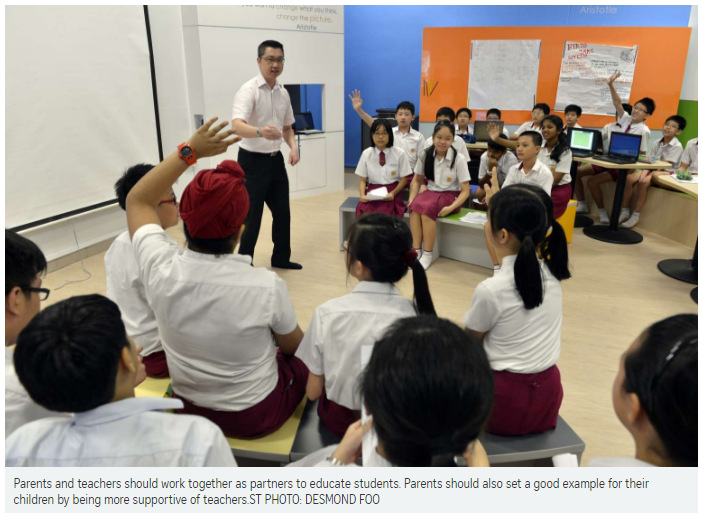
Teachers are mentors, not vendors

And students are not mere MOE 'customers', but the future of our nation. Parents should support educators, not criticise them.
By William Wan, Published The Straits Times, 20 Oct 2016

So a well-intentioned Forum letter ("Working after school hours part of 'service'", Oct 8) provoked a backlash against the writer and against "the system".

Well-intentioned, because in a follow-up letter ("Teachers' overtime work driven by parents' expectations", Oct 13), the writer, Ms Lee Wei Yin, clarified that she actually agreed with the detractors, and called for all stakeholders to find workable solutions, particularly to help teachers manage their working hours.

Let's backtrack. Ms Lee, a parent, wrote to highlight how she feels a school could improve - by providing an added service, among other concerns.

On taking up my current role as general secretary of the Singapore Kindness Movement six years ago, I was surprised that students and parents were considered by the Ministry of Education (MOE) as "customers". I expressed my surprise and concern in discussion with my friends in the MOE management team.

What we call a thing has a big impact on how people perceive the thing itself. Would it really affect our treatment of teachers and the education system if we called our students and their parents "customers", I wondered.

The word "customer" is based on a commercial concept. It is by definition, a transaction with which parties buy and sell among each other. And in sales and service, an often-used cliche is that the customer is always right. Hence, the customer is more likely the one in the stronger bargaining position.

Thursday, 13 October 2016

Josephine Teo: Sex and babies in the Lion City

You don't need much space to have sex: Josephine Teo on ‘no flat, no child’ belief
By Janice Tai, The Straits Times, 12 Oct 2016

You do not need much space to have sex.

That was the feisty rejoinder from Senior Minister of State Josephine Teo, who oversees the National Population and Talent Division (NPTD), to a question on whether young people are not getting their flats early enough to have children.

The suggestion was that this could be a chicken-and-egg problem. To qualify for the Parenthood Priority Scheme, which gives first- time married couples first dibs on getting a flat, they must be expecting or have a citizen child below 16.


But to have a child, some say they need to have a flat first.


With a straight face, Mrs Teo declared: "You need a very small space to have sex."


Known for her candid blog posts on dating and marriage, Mrs Teo does not mince her words - think "menstruation" and "cysts" - when it comes to urging young people to look for love and settle down early.

In an interview on marriage and parenthood issues last week, the mother of three teenage children tackled issues ranging from infertility to why the Government should not be "too kaypoh" (Hokkien for busybody).


She noted that the Singaporean love story has a different arc from that of countries in the West. "In our case, man meets woman, man falls in love with woman, man proposes to woman, they then plan the wedding and do the house," she said.


"In France, in the UK, in the Nordic countries, man meets woman, tonight they can make a baby already. They love each other. Both of them partly have their own family, so it is a matter of living in yours or living in mine, and they also don't have to worry about marriage - that comes later," she added.


So how about having a couple declare that they wish to have a child in two years and get the flat first?

"What if they can't conceive? Take back the flat from them? How do you know they really tried to conceive? Can we check whether they use contraceptives? Cannot, right?" she replied, amused.

Instead of having the Government poke its nose into the bedroom, Mrs Teo relied instead on persuasion. She urged women to have babies early as they would not know if they are fertile or not.

"You never really know that you're not fertile until you try. Unfortunately, it is one of those things. There is no fertility indicator. As a woman you will know, if you have regular menstruation, okay, (there is a) likelihood. But maybe you have a major cyst and how would you know until you attempt to conceive, only to realise that you can't?"

Friday, 17 June 2016

Healthy Workplace Ecosystem extended to SMEs at industrial estates

Healthy life made easier for SME staff
HPB takes workplace scheme to 5,000 workers of 800 firms in Tampines Industrial Park
By Felicia Choo, The Straitts Times, 16 Jun 2016

Some 5,000 workers from small and medium-sized enterprises (SMEs) at Tampines Industrial Park A stand to benefit from free health screenings and exercise classes right where they work, through the Health Promotion Board's (HPB) ongoing healthy living initiative.

It is the first time the Healthy Workplace Ecosystem has been implemented on such a scale in an industrial estate. A pilot last year involved just 800 workers from about 140 companies at industrial estates in Ang Mo Kio and Bedok.

This time, about 800 SMEs are involved in the collaboration between the HPB, HDB, the Tampines Small and Medium Enterprise Association and the Tampines Industrial Manufacturers Association.


"Today's launch really is a major milestone for us, in terms of taking innovative, holistic and customised health programmes into the workplace and making it accessible and convenient," said Senior Minister of State for Health Amy Khor, who attended the launch event yesterday.


She said SMEs typically have smaller workforce sizes, with limited access to workplace health programmes - an issue the initiative seeks to address.


As nearly half of the workers attended to yesterday are at least 40 years old, the focus is on chronic disease detection and management.


Wednesday, 13 April 2016

Maids trained to be counsellors to peers

NUS-HOME initiative teaches them to spot stress, call for help in bid to improve mental health
By Kok Xing Hui, The Straits Times, 11 Apr 2016

Some maids in Singapore are being trained to recognise signs of mental stress and to offer help, in a move to improve mental health support for foreign domestic workers here.

The aim is to help distressed domestic workers who have mental stress symptoms that go unidentified, or do not know where to go for help.

By next month, 39 Filipino foreign domestic workers would have completed the training, an initiative by the National University of Singapore (NUS) and Humanitarian Organisation for Migration Economics (HOME), a migrant worker welfare group.

One participant, Ms Robina Lavato, 43, for instance, now knows what to do if she spots symptoms of depression, such as being withdrawn and losing sleep, in her friends. She will plan activities they enjoy to cheer them up.

If the situation deteriorates and the friend talks about suicide, Ms Lavato knows it is time for professional help and she has the numbers to dial.

"The idea here is for them to serve as a bridge between the professional mental health community and their own community," said the research initiative's principal investigator, Dr Keng Shian-Ling, assistant professor at the Department of Psychology at NUS.

A study by HOME last year found that more than one in five of the 546 maids from Indonesia, the Philippines and Myanmar polled had psychological distress. This was based on a measurement of nine markers, including depression and anxiety.

Filipino domestic workers fared the worst, with 36 per cent experiencing mental distress, compared with 11 per cent in the Indonesian workers and 26 per cent among those from Myanmar.

Researchers decided to train Filipino maids as "paracounsellors" as they seemed the most vulnerable, said Dr Keng.

Monday, 21 March 2016

2 weeks of paternity leave to be legislated: Josephine Teo

2nd week of paternity leave, now voluntary for bosses, to be made mandatory: Josephine Teo
By Charissa Yong, In Copenhagen, The Sunday Times, 20 Mar 2016

Fathers will soon get more leave to spend time with their newborns.

A second week of paternity leave, now voluntary for employers, will be made compulsory, Senior Minister of State Josephine Teo said.

"We are looking at when we should put this into law," she told the Singapore media on Friday, at the end of a visit to Denmark and South Korea to study population policies.

Mrs Teo, who oversees population issues, also said that employers will be given adequate notice.

When paternity leave was first introduced in 2013, they were notified of the change four months before the law kicked in. "They adjusted quite well. I'll see what I can do to give them a little more notice."

This extension of paternity leave, paid for by the Government, is one of the changes - to help parents balance work and family as well as lift birth rates - likely to be announced when Parliament debates ministries' plans next month.

Singapore had 33,793 citizen babies last year, 600 more than 2014, and the highest figure in 13 years.

There are also plans to let working mums share more of their four-month paid maternity leave with their husbands. Couples can now share only one of the 16 weeks.

Mrs Teo feels this can be expanded as some mums would like to return to work sooner. "We are in consultation with employer groups and the labour movement," she said.

Also being studied are more childcare facilities for infants under 18 months, including arrangements like having professional caregivers look after small groups at home.

The Government will also discuss more flexible work arrangements with employers and unions.

Several companies have expressed concern about these moves raising business costs, but Mrs Teo said such pro-family policies had to be seen from a broader perspective.