Showing posts with label Budget 2023. Show all posts

Friday, 15 December 2023

Cost of living means different things to different folks in Singapore

The Economist’s Worldwide Cost of Living index does not shed light on the bills that ordinary Singaporeans pay.
By Lin Suling, Opinion Editor, The Straits Times, 13 Dec 2023

As a sign of the lengths Singapore will go to in a bid to up its wow factor and entice more travellers here, consider the dramatic four-storey waterfall display unveiled at the recently refurbished Changi Airport Terminal 2 in November.

Just about everyone I know has already visited the attraction, now the centrepiece of the T2 departure hall, and told me the four-minute musical extravaganza is not to be missed.

Now, you may be forgiven for confusing this 14m by 17m digital display with the man-made, HSBC-sponsored rain vortex at Changi Airport’s Jewel, which was opened a mere four years ago. That spectacular sight remains the world’s tallest indoor waterfall.

If two waterfalls – one digital, one physical – sound like overkill, that is probably precisely the intent. Singapore is already home to the world’s largest air-conditioned glass greenhouse, Gardens by the Bay, and hosted the first Formula One night race globally.

We must keep filling this carousel of new shiny things so we can remain vibrant and attractive to visitors, investors and corporate leaders.

Singapore thus far seems to be doing this well. Why else would expats keep coming back to Singapore despite it being billed the most expensive city nine times in the last 11 years by The Economist?

News of Singapore – along with Zurich – topping the 2023 Worldwide Cost of Living index on Nov 30, nonetheless, raised many eyebrows.

Many Singaporeans have suggested that it confirms their longstanding concerns that making ends meet in Singapore is becoming an uphill climb for the man in the street.

Online, netizens cite anecdotal experiences corroborating this jump in prices, from the doubling of the cost of a bowl of fish soup at their local coffee shop to complaints about certificates of entitlement (COEs).

Another pointed to news of thwarted attempts to smuggle 120kg of beef and pork as an unequivocal sign that more Singaporeans are turning to the black market to fill their stomachs. Never mind that meat smuggling is possibly the most creative strategy to beat inflation nobody has ever heard of.

And most discussions eventually reached the same conclusion: that the Singapore Government has slipped, in letting in foreigners who push up prices while leaving Singaporeans behind.


The most expensive city in the world for whom?

What to make of all this? Some information about how the Worldwide Cost of Living is put together offers perspective.

The full index of how cost of living stacks up across 173 countries is available only with a US$1,195 (S$1,602) fee. Its website suggests this full report is useful for human resources, corporates, financial institutions, and legal and insurance firms, as “this purpose-built Internet tool quickly calculates cost-of-living allowances and (aids in) building compensation packages for expatriates and business travellers”.

A closer look at the items used in this benchmark of relative cost of living, which is meant to be a comprehensive dataset of over 400 individual price points across 200 goods and services, throws up things such as international school tuition fees, public golf course fees and three-course dinners.

These may just be a few outliers that stick out. Even so, not only are they hardly stuff the average Singaporean spends on, they are also more accurately the make-up of what the typical expat around the world splurges on.

Here in Singapore, I would also add to this list the doubling of Additional Buyer’s Stamp Duty for purchases of homes by foreigners, and higher personal income taxes for top earners beginning from the 2024 year of assessment.

Curiously, despite these higher projected expenses, the foreigners just keep coming.

Friday, 29 September 2023

$1.1 billion Cost-of-Living Support Package: Additional payment of up to $200 cash for 2.5 million eligible adult Singaporeans in December 2023

$1.1 billion Cost-of-Living Support Package to provide more relief for Singaporean households, especially lower- to middle-income families
Extra $200 CDC vouchers for Singaporean households in 2024
By Jean Iau and Natasha Ann Zachariah, The Straits Times, 28 Sep 2023

Some 2.5 million adult Singaporeans will receive an additional cash payout of up to $200 in December, and every Singaporean household will receive an extra $200 in Community Development Council (CDC) vouchers in 2024 to help with the rising cost of living.

These support measures, among others, are part of a $1.1 billion Cost-of-Living Support Package to provide relief for all Singaporean households, with more support for lower- to middle-income families. They build on the measures announced at Budget 2023.

The measures include an $800 million enhancement to the Assurance Package (AP) and the AP will now be more than $10 billion.

Announcing the support package on Thursday, Deputy Prime Minister and Minister for Finance Lawrence Wong acknowledged that many Singaporeans are anxious about the overall economic outlook, price increases and the impact on their cost of living.

“The Government is committed to supporting Singaporeans through these uncertain times,” said Mr Wong, adding that it will not be dipping into the past reserves for the package.

“As Prime Minister said at the National Day Rally recently, the Ministry of Finance has been studying how we can do more, to provide better support for Singaporeans.”


Mr Wong noted that the measures will cushion the impact of higher utility bills arising from the increases in the price of water, and also the upcoming increase in carbon tax.

AP cash special payment

The additional payment of up to $200 cash for 2.5 million eligible adult Singaporeans will be disbursed in December 2023, together with the existing AP cash component.

In total, eligible adult Singaporeans will receive up to $800 cash in December 2023. This will provide more support to lower- and middle-income adult Singaporeans.


Singaporeans aged 21 and above in 2024 who own no more than one property, and have an assessable income of $34,000 or less for the Year of Assessment 2022, will receive an additional $200, on top of the $600 under the earlier announced AP cash payment.

Those in this group who have an assessable income of more than $34,000 and up to $100,000 will receive an additional $150 on top of the $350 payout from the existing AP.

Those who own more than one property, or have an assessable income of more than $100,000, will not receive an additional payout under the AP cash special payment, but will receive $200 from the existing AP cash component.


CDC vouchers

Every Singaporean household will get an additional $200 in CDC vouchers in 2024, bringing the total amount of CDC vouchers for each Singaporean household to $500 in 2024.

The $200 worth of additional CDC vouchers will be spilt in half, with $100 of these vouchers allocated for spending at participating heartland merchants and hawkers, and $100 for spending at participating supermarkets.

The 2024 CDC vouchers should be claimed digitally at go.gov.sg/cdcv from Jan 3, 2024. The vouchers can be claimed at any time during their validity period. They will expire at the end of 2024.


S&CC rebates

Some 950,000 Singaporean HDB households will receive an additional one-off 0.5-month service and conservancy charges (S&CC) rebate in January 2024, together with the regular S&CC rebates.

This will, on average, fully offset the S&CC increase in the first year of increases for one- to four-room Housing Board flats and about 85 per cent for larger HDB flats, said the Ministry of Finance (MOF).


U-Save rebates

The 950,000 Singaporean HDB households will also receive an additional $20 per quarter in U-Save rebates from January 2024 to December 2025, or a total of $80 a year for two years.

These rebates will be disbursed together with the regular U-Save rebates, and will cushion the impact of the carbon tax and water price increases in 2024 and 2025.


Over these two years, the additional U-Save rebates will, on average, fully offset the increase in utility bills for one- to two-room HDB flats. For three- to four-room HDB flats, they will offset about 80 per cent of the increase in utility bills, and for larger flats, about 65 per cent.

On average, this translates to 3- to 4- room HDB flats paying about $2 more per month, and 5-room and larger HDB flats paying about $4 more per month.


Public transport support measures

There will be additional subsidies of about $300 million in 2024 to cover the deferred fare adjustment quantum of 15.6 per cent that will be carried over to future fare review exercises, as announced by the Public Transport Council on Sept 18.

The additional subsidies will help to moderate the increase in fares and pay for the higher costs of providing public transport services due to the continued increase in energy prices in 2022, core inflation and strong wage growth, said the MOF.

Resident households with a monthly household income per person of not more than $1,600 will each receive public transport vouchers worth $50.

The vouchers, which will be disbursed from end-December 2023, can be used to top up fare cards or buy monthly travel or concession passes.


Mr Wong said on Thursday that while the goods and services tax increase was already planned for, there were certain things that could not have been anticipated, such as some of the recent price increases, and “also the more uncertain economic outlook, possible disruptions to energy and food supplies... and the uncertainties in the global environment”.

He said the Government has been monitoring income growth very closely, and there is a likelihood that real income growth will moderate in 2023, because employers are more cautious about salary increments.

“These are the considerations that motivate us to consider whether or not there ought to be more help for Singaporeans, particularly households and families (in) the lower- and middle-income segments,” he added.

“And we’ve decided, after looking at all the factors, looking at our fiscal position, we will be able to provide within our budget for such an additional package.”


Mr Wong was also asked about the need to raise prices for water now, and the GST, which will increase to 9 per cent next year.

He explained that there are measures such as the AP in place so the majority of Singaporeans will not feel the impact of the GST rise for a few years.

“We don’t want to wait until we are at the very brink (of having) not enough money and then start raising taxes. We want to put in place all the measures that are necessary to ensure sound public finances, not just for one, two years, but for the medium- and longer-term,” he said.

On water, he noted that it is an essential, strategic resource to Singapore.

As a “water-stressed nation”, he said efforts have been made to price water properly to “make sure that consumers understand what the full price of water is.”

Singapore water price to rise from April 2024; Government to provide support for lower- and middle-income households

Singapore water price to rise by 50 cents per cubic metre (1,000 litres) by 2025
Three-quarters of households here will see an increase of under S$10 per month in their water bills from April 2025
By Shabana Begum, The Straits Times, 27 Sep 2023

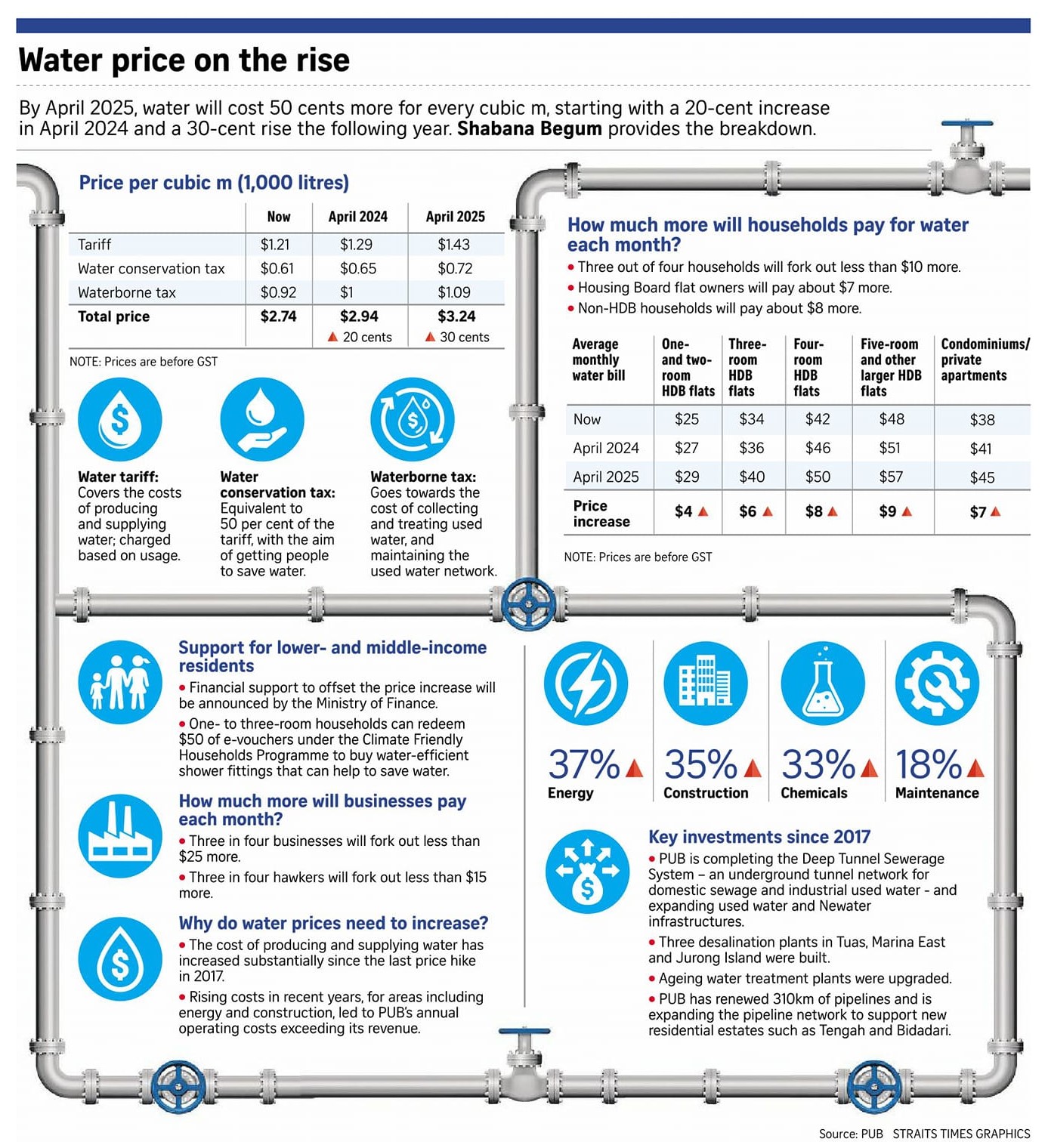
Water will soon cost consumers an additional 50 cents per cubic metre (1,000 litres), starting with a 20-cent increase in April 2024 and a 30-cent rise in April 2025.

This means that most households will fork out an additional $4 to $9, excluding goods and services tax (GST), for their monthly water bill by 2025, said national water agency PUB on Wednesday.

In 2020, the average monthly consumption of water was 15 cubic m for condominiums and 16.2 cubic m for HDB flats.


Lower- and middle-income households will get help to offset some of the price increase. Deputy Prime Minister and Finance Minister Lawrence Wong will announce cost-of-living support measures to provide more relief for Singaporean households on Thursday.

The last water price hike of 30 per cent happened in 2017. The upcoming 50-cent rise – bringing the cost of 1 cubic m, or 1,000 litres, of water to $3.24 – is an 18 per cent increase.

The price hike between 1997 and 2000 saw water prices rising by 120 per cent for households.


The upcoming increase comes amid rising living costs, GST hikes and higher transport fares, and the water agency did not take the decision lightly, said a PUB spokesman.

“The water price increase is not popular, but necessary,” the spokesman said.

“We understand that it can draw strong reactions amid the other cost of living pressures. That’s something we are very mindful of, so PUB does not take this decision lightly.”


It has been increasingly more expensive to produce and supply water, PUB said, and there is a need to invest more in local water infrastructure – especially in weather-resilient Newater and desalinated water – to prepare Singapore for drier days ahead due to climate change.

And Singapore’s water demand, which is currently at about 1.95 million cubic m – or 440 million gallons – daily, is expected to almost double by 2065.

Singapore has four sources of water: imports from Malaysia, water from local catchments, Newater and desalinated seawater.

The pressure of higher energy prices and construction costs, among others, has contributed to PUB’s annual operating costs exceeding its revenue in the financial years of 2021 and 2022.

In 2019 and 2020, PUB saw a slight net positive in revenue owing to the 2017 water price hike.


Electricity tariffs have risen by about 37 per cent, while construction costs have gone up by 35 per cent, with higher increases for specialised works such as tunnelling and pipeline projects through highly urbanised areas.

Due to inflationary pressures and supply chain disruptions, the cost of essential chemicals to treat used water, for example, has also risen by about 33 per cent. Higher manpower costs have driven up maintenance expenses by 18 per cent.

These external cost drivers have worsened the operating deficit significantly in the latest fiscal year, said PUB.

Its spokesman said: “If we were to defer the price increase any further... essentially we would have an even bigger price increase moving forward.”


Rising operational costs and inflation are not affecting Singapore alone.

Wednesday, 15 February 2023

Singapore Budget 2023: Moving Forward in a New Era

Family-friendly Budget offers help to weather inflation, uncertain future
By Goh Yan Han, Political Correspondent, The Straits Times, 15 Feb 2023
  • More cash payouts to cope with GST increase
  • Higher Baby Bonus and more paternity leave
  • CPF salary ceiling to go up to $8,000 by 2026
  • Higher taxes for high-end property and luxury cars
Budget 2023 proposes to decisively address the pressing concerns of Singaporeans, such as inflation and long waiting time for flats, while strengthening social safety nets to keep the nation in sound shape over the longer term.

The tax system is also being made more progressive, with changes to the buyer’s stamp duty regime for properties and additional registration fee tiers for cars, to fund the Government’s growing expenses. Buyers of more expensive properties and higher-end cars will have to fork out relatively more.

The Budget unveiled on Tuesday also tackled several longstanding issues such as the low fertility rate and the retirement adequacy of seniors as the Government widened its support for citizens in need. The Central Provident Fund (CPF) monthly salary ceiling is being raised, for example, to ensure that Singaporeans have enough to draw upon in their silver years. Families will also be given more help to offset the expenses of raising children.

At the same time, there will be more measures to reduce waiting times for new Housing Board flats and more monetary support for first-timer families seeking to purchase resale flats.


Deputy Prime Minister Lawrence Wong, in his Budget speech in Parliament, loosened the Government’s purse strings in a $123.7 billion proposal – about 18.2 per cent of Singapore’s gross domestic product.

This comes amid a mixed and uneven global economic outlook, said Mr Wong, who is also Finance Minister.

While a global recession is not expected, there are major uncertainties ahead, he said. These include the possibility that the United States and European Union economies could decline more steeply than expected and tip the world into recession. The prolonged Russia-Ukraine war may also escalate and disrupt global trade, or a new Covid-19 variant may emerge.

Headline inflation is also expected to remain high in Singapore, at least for the first half of the year, said Mr Wong.

To tackle this, the Assurance Package, meant to offset the impact of the goods and services tax hike, will be further boosted to $9.6 billion, up from $8 billion following a November 2022 update and $6.6 billion announced in Budget 2022.

The enhanced package will see increases in cash payouts for eligible adult Singaporeans, and a boost of $100 to the 2024 tranche of Community Development Council vouchers to a total of $300.


Mr Wong also announced new one-off support measures under the package, such as a Cost-of-Living Special Payment of between $200 and $400 for adult Singaporeans aged above 21 who have an annual assessable income of less than $100,000 and do not own more than one property, to be given out in June.

He also unveiled a Cost-of-Living Seniors’ Bonus cash payout of between $200 and $300 for about 850,000 eligible senior Singapore citizens also to be given out in June.

Budget 2023 also had a strong focus on stepping up support for families in terms of housing and financial needs, and sharing the caregiving load between parents.

Mr Wong acknowledged that while the HDB already sets aside the bulk of its Build-To-Order flats for first-timer families, who are given priority in flat applications, the pool of first-timers covers a wide range, such as those who already have their own homes but have not received housing subsidies before.

The Government will focus on first-time applicants who are families with children, as well as young married couples aged 40 and below who are buying their first home, through measures such as giving them an additional ballot chance in BTO flat applications, said Mr Wong. He also announced enhancements to the CPF Housing Grant for resale flats for first-timer families.


To support parents with the costs of raising children, the Baby Bonus cash gift will be increased by $3,000, such that eligible first- and second-born children will now receive $11,000 and subsequent children will receive $13,000.

The Government will also increase its contributions to the Child Development Accounts, which parents can use to directly offset pre-school and healthcare expenses, said Mr Wong.

Paternity leave will be doubled from two to four weeks, with the extra two weeks given on a voluntary basis for a start, to give more time for employers to adjust, said Mr Wong.

The paternity leave allowance was last doubled from one to two weeks in 2017.


Another key move in Budget 2023 was the announcement of the increase to the CPF monthly salary ceiling, meant to help middle-income Singaporeans save more for their retirement.

This move is expected to have wide repercussions, ranging from increased employer contributions and thus business costs, to a larger pool of funds for Singaporeans to tap for housing loans as well as a bigger nest egg for retirement.

The current ceiling, set at $6,000, was last updated in 2016. Starting this September and in January 2024, 2025 and 2026, the ceiling will move up to $8,000 eventually, to keep up with rising wages.


Mr Wong also announced a slew of tax changes – increased marginal buyer’s stamp duty rates for higher-value properties to take effect on Wednesday and increased additional registration fee rates for higher-end cars to take effect from the next round of certificate of entitlement (COE) bidding.

He also unveiled a 15 per cent increase in excise duty on all tobacco products with effect from Tuesday to discourage the consumption of such products. The tobacco tax was last hiked by 10 per cent in 2018.


Mr Wong, who leads the nationwide Forward Singapore engagement exercise launched in June 2022, also provided an update on the discussions.

He noted that long wait times for new flats and rising resale home prices are key concerns for many young Singaporeans, and parents have also called for help to better balance work and family commitments, which are areas that the Government is moving sooner on in rolling out measures.


He added that to achieve shared aspirations of a fairer and more inclusive society, the Government is pursuing new strategies in some key areas – uplifting lower-wage worker salaries, better support for reskilling and upskilling, giving everyone opportunities throughout their lives to uplift themselves, and better care for the growing number of seniors.

“These are important but complex issues which require further exploration,” said Mr Wong.

“It is not just a matter of having the Government do more to provide greater assurance and support… Government actions must reinforce the values of personal effort, responsibility for the family and mutual support in the community.”


Parliament will debate the Budget and the spending plans of various ministries from Feb 22 to March 6.


Monday, 2 January 2023

As GST goes up, is it time to rethink support from Government?

As prices stay high and Singaporeans get older, some are calling for more government help. But what kind of help do they need, and where should the money come from?
By Grace Ho, Insight Editor, The Straits Times, 1 Jan 2023

For many, getting older stirs mixed feelings of anticipation – finally, retirement! – and anxiety for the future.

With one in four citizens here aged 65 and older by 2030, more Singaporeans will have to grapple with the challenges of living longer, from maintaining job security and health, to caregiving and finances. As seniors become more well-educated and have richer work experience, they, too, are likely to be more vocal about their needs and wants.

How can their expectations be funded sustainably? Is government aid a universal right of citizenship, or should it be targeted at the poor? These and other burning questions were tackled in a recent study on ageing-related policies by researchers from the National University of Singapore.

As part of the study, two workshops were conducted with 82 citizens of different ages and socio-economic backgrounds. Participants took a survey before the first workshop to establish their baseline sentiments on policies, and were surveyed again after the second workshop to measure the change in their opinions.

More help wanted for caregiving and health

When asked how they would make use of an extra $10,000 per person for age-related government policies and programmes, participants cited the following:
  • Health ($2,900)
  • Caregiving, to help with physical mobility ($1,700)
  • Transfer payments to seniors ($1,700)
  • Housing ($1,200)
  • Social and emotional support ($1,200)
  • Transport ($970)
Health and caregiving were top-of-mind. Those in the sandwiched generation were worried about sacrificing their wages and time, should they become caregivers for their elderly family members and children.

They felt that the Home Caregiving Grant – $200 a month in cash to support family members with at least permanent moderate disability – was not enough to tip the balance in making the decision to take on caregiving responsibilities easier.

They also wanted the state to come up with nursing care and broader caregiving arrangements, including those to manage dementia among the growing number of seniors.

Middle-income participants felt they did not have the heavily subsidised support that lower-income households enjoy. Means-testing, they said, is too blunt an instrument, especially for those who are asset-rich yet cash-poor. They proposed assistance that is more attuned to the health rather than socio-economic status of seniors.

What about caregivers whose work is unpaid and invisible? The study suggests that tax reliefs and having caregivers’ savings multiplied through the Central Provident Fund (CPF), compared with just having family members contribute to their personal bank accounts, can move the needle.

Today, the maximum annual tax relief for cash top-ups to family members’ Special/Retirement Accounts and/or MediSave Accounts is $8,000 – not a huge sum considering that some caregivers have to completely give up work, and hence their retirement security, to look after an unwell senior.

One solution is to extend this tax incentive so that caregivers have up to the Basic Retirement Sum for CPF Life, or achieve a payout equivalent to it, said Institute of Policy Studies deputy director for research and senior research fellow Gillian Koh, who is one of the study’s co-authors.

“The difference would be to either remove the current cap of $8,000 or provide more leeway to reach a sensible limit, so that anyone who is a caregiver has that assurance of a basic payout sum from CPF upon reaching 65 years of age,” she said, adding that a more ambitious target could be the Full Retirement Sum.

Depending on whether the support is more generous or restrained, some criteria can be set, such as whether there has been significant disruption to a person’s earnings. More discussion and design work are needed to identify a suitable upper limit for the top-ups. But as Dr Koh pointed out, this is not an insurmountable problem.

Where will the money come from?

At first, the participants’ preferred sources to fund the increase in public expenditure were:
  • Corporate tax ($2,200)
  • National reserves ($2,100)
  • Income tax ($1,600)
  • Stamp duty on purchases of property ($1,600)
  • Goods and services tax ($1,300)
  • Carbon tax ($1,200)
This isn’t surprising; people the world over love taxing corporates and the rich. But what’s interesting is that after they attended the workshops, 15.2 per cent of the participants said the Government should draw more on GST to meet demands for ageing-related social support.

There was a distinct shift in attitudes towards the use of GST when the policy trade-offs – as well as greater help for lower-income households, such as permanent GST vouchers and cash transfers through the Assurance Package – were explained to them.

There’s an educational dimension here: Participants with only post-secondary education were more likely than those with polytechnic diplomas, university degrees or other professional qualifications to indicate support for generating more resources from GST.

This is because those in the lower socio-economic strata, of which education is a proxy indicator, understood that they would benefit significantly from the help.

Another notable point is that participants ranked the national reserves second highest among the funding sources.

Not only did this not decrease after the workshops, but 8.3 per cent of the participants allocated even more to the reserves to finance expanded age-related policies. A similar proportion of participants also allocated more to property tax.

Does this mean that Singaporeans expect the Government to tap its own resources before relying on individual efforts or families? Not quite: The participants said in the same breath that they planned to save more and get more help from family and friends.

Wednesday, 9 November 2022

Why is Singapore raising the GST?

Singapore's GST hike to go through after Bill passed in Parliament on 7 Nov 2022

GST will increase from 7 per cent to 8 per cent from Jan 1, 2023 and from 8 per cent to 9 per cent from Jan 1, 2024

Tourists, foreigners living in Singapore paid half of net GST in 2018 and 2019

Assurance Package to help households offset GST hike to get $1.4 billion boost, will now total $8 billion

Workers’ Party’s alternatives to GST hike do not add up, GST hike among options needed to meet funding gap: DPM Lawrence Wong
By Hariz Baharudin and Ng Wei Kai, The Straits Times, 7 Nov 2022

The suggestion that the goods and services tax (GST) increase should be postponed due to current inflationary pressures does not hold water, Deputy Prime Minister Lawrence Wong told Parliament on Monday.

The Government’s support measures delay the effect of the hike by at least five years for the majority of Singaporean households, he said.

That the support is targeted at lower- to middle-income households, rather than broad-based, will also minimise any additional inflationary pressures, he added.


“We have designed the overall package to ensure we neither stoke inflation inadvertently nor choke aggregate demand, and this is an appropriate macroeconomic stance to adopt at this juncture,” he said.

Rounding up the debate on the GST (Amendment) Bill, which saw 15 MPs speak, Mr Wong rebutted alternatives raised by Workers’ Party MPs Louis Chua and Jamus Lim (both Sengkang GRC) saying these entailed spending more from past reserves and leaving less for the future.

The Government has also explored other sources of revenue, and still needs to raise the GST, he said.


Why increase GST now?

The Government had considered the GST hike carefully and decided that it was necessary to do so, given how Singapore’s economic challenges are not just near-term or cyclical in nature, Mr Wong said.

The ongoing war in Ukraine, disruptions to energy and food supplies, rising geopolitical tensions and more fragmented supply chains are realities Singapore has to deal with possibly for a more prolonged period, he added.

“International economic conditions have fundamentally changed,” he said.


While inflationary pressures here are expected to ease in the second half of next year, inflation rates are unlikely to go back to what they were over the past decade, he added.

It is for this reason that the Government has extended comprehensive support to Singaporeans, especially lower and middle income families.

Mr Wong had at the start of the debate announced a $1.4 billion boost to the support package for households to offset the GST hike’s impact, amid higher inflation. This means the Assurance Package, first announced in 2020, will now be worth $8 billion, up from $6.6 billion before.


Responding to a point Mr Chua made on how households’ annual expenditure will increase due to inflation, Mr Wong said that the support they get will increase.

Mr Chua had cited the example of a middle-income couple with two young children, and estimated that with inflation, their annual expenditure would go up by $2,500.

Mr Wong acknowledged the rise in spending, but pointed out that the support they get this year would be around $1,500.

This support will keep to the Government’s commitment to offset more than half of the inflation-driven increase in cost of living this year for middle-income households, he said, adding this does not take into account wage rises for individuals which many will likely enjoy.


Associate Professor Lim had also cited how Japan saw an increase in inflation after it increased its version of the GST three times in the past 25 years.

Mr Wong pointed out that Japan was in a deflationary environment, and had raised the GST and had its inflation double from a “chronically low” 1 per cent to 2 per cent - and temporarily.

“Let’s avoid raising these alarmist examples that may not be so relevant to our context,” he said, adding that Singapore must continue to learn the right lessons from others.

He noted that while there are considerable uncertainties in the economic outlook, there is nothing uncertain about government expenditures, especially in healthcare.


Noting that MPs like Mr Liang Eng Hwa (Bukit Panjang), Mr Sharael Taha (Pasir Ris-Punggol GRC) and Ms Joan Pereira (Tanjong Pagar GRC) had made this point, Mr Wong said even as Singapore deals with healthcare spending, it has to resource many other spending needs.

These include planned investments on early childhood education, efforts to uplift lower wage workers as well as helping to ease concerns of SMEs, self-employed persons and those keen to purchase HDB flats.

“It’s a few billion here, a few billion there, they all add up. None of these needs has become less urgent because of the global economic situation. On the contrary, we must do more, especially in an uncertain and volatile environment,” said Mr Wong.

“That is why having considered this so carefully before the Budget, after the Budget, even in the last few months when the global economic environment had deteriorated, we felt that there was no possibility for us to delay the GST increase any further.”


Why not try alternatives to the GST hike?

Mr Wong also addressed four alternatives to the GST hike that WP MPs had raised.

One, the suggestion that Singapore has enough fiscal surplus to delay the hike of 1 percentage point set for January 2023.

Mr Wong said: “I wish that were so.”


He noted Prof Lim had suggested the Government is shielded from inflation because when inflation goes up, so does its revenues as prices also increase.

“But he didn’t mention this: Government spending must also go up correspondingly,” said Mr Wong, citing public servants’ salaries and support schemes for residents.

He added that while the Government collected more revenue than expected in the last financial year and had a surplus of $1.9 billion, it had already used this surplus as well as the return from the first half of this year to fund two support packages.

In June and October 2022, the Government announced two $1.5 billion support packages targeting lower-and-middle income Singaporeans.

Mr Wong said: “The bottom line is that any surpluses are imaginary - they are not there and will not allow us to delay the GST.”


Two, there have been suggestions to use more of Singapore’s reserves, including increasing the proportion used from returns on investments and changing the definition of land sales revenues.

Mr Wong said WP’s position, which it said was not raiding but slowing down the rate of accumulating reserves, sounds attractive but will leave future generations with less resources.

Such a move would be irresponsible, he added. “Let’s not succumb to the temptation of taking this easy way out, making things worse for our children and grandchildren.”

Mr Wong noted that global uncertainties are also likely to slow the growth of Singapore’s investments anyway, making tapping on these to delay a GST hike even more untenable.


Three, Prof Lim had suggested exempting essential items from GST, a point that had been raised by Ms He Ting Ru (Sengkang GRC) at the Budget Debate in February.

Mr Wong said this does not work in practice.

Such tiered GSTs are cumbersome, he said, citing a recent BBC article about India’s system.

In August, an Indian firm making pizza toppings went to court claiming their mozzarella topping should be classified as cheese - which had a GST of 12 per cent.

The court disagreed, arguing that because the topping had other ingredients such as vegetable oil it should be taxed at 18 per cent in a class known as ‘edible preparations’.

Mr Wong said there is no end to these challenges, and such tiered systems are not effective.

“When you exempt a basket of goods or essential items in the end you benefit the well-to-do, because the well-to-do will spend more on everything, not just luxury items but basic necessities as well,” he said.

This was a conclusion also reached by studies from numerous governments and the Organisation for Economic Co-operation and Development (OECD), he added.

Mr Wong said Singapore’s GST system - with its series of offsets and rebates - is deliberately designed to be fair and effective, contrary to Prof Lim’s view that these were a patchwork of offsets.


Four, suggestions continue to be made that Singapore should explore other streams of revenue such as property, income, corporate and sin taxes.

Mr Wong said while these have been carefully considered, the sums do not add up.

Increasing corporate and income taxes could result in investors leaving Singapore, especially amid tight global competition for talent and investments, he said.

He added that GST revenue alone is in fact not enough to fund policies the Government wants to push through, from healthcare spending to improving conditions for low-wage workers.

“Really, that question is not GST or these other alternatives - we need GST, and these other alternatives,” he said.

Mr Wong added: “The WP is entitled to your own position. By all means, oppose the GST, adopt a different position, fine.”


Saturday, 19 January 2019

Singapore selects F-35 jets to replace ageing F-16 fighters

RSAF may first buy a small number to evaluate their capabilities before deciding on a full fleet
By Lim Min Zhang, The Straits Times, 19 Jan 2019

Singapore has identified the United States F-35 Joint Strike Fighter as the most suitable aircraft to be its next-generation fighter jet.

The Ministry of Defence (MINDEF) said this yesterday as it revealed that the Republic of Singapore Air Force (RSAF) and the Defence Science and Technology Agency have completed their technical evaluation to select the replacement for the ageing F-16s. The F-35 JSF has been dubbed the world's most advanced fighter jet.

MINDEF said the evaluation concluded that the RSAF should first purchase a small number of F-35 JSFs for a full evaluation of their capabilities and suitability before deciding on a full fleet.

In the next phase, MINDEF will enter into talks with relevant parties in the US before confirming its decision to purchase the fighter jet.

No further details were given on the exact number or variants of the F-35s - manufactured by Lockheed Martin - that will be acquired.

The F-35 has stealth functions that make it difficult to detect by enemy radar. It also has network capabilities in fusing information from other F-35s and friendly forces to build up a picture of the battle space.

There are three variants of the aircraft, including a short take-off and vertical landing version that can land like a helicopter.


In a Facebook post yesterday, Defence Minister Ng Eng Hen wrote that the talks with US counterparts could take nine to 12 months before a decision is made.

"Even then, we want to procure a few planes first to fully evaluate the capabilities of the F-35 before deciding on the full acquisition of a full fleet," he added.

"We must prepare well and cater enough time to replace our F-16s."

Dr Ng pointed out that the RSAF's F-16s, in service since 1998, will have to retire soon after 2030 even after their mid-life upgrades.

"That is not very far away, just over 10 years, to acquire their replacement and, just as important, to build the logistic support and train pilots individually and as a fleet to guard our skies," he wrote.