Showing posts with label Disabled. Show all posts

Saturday, 22 February 2025

Singapore Budget 2025: Onward Together for a Better Tomorrow

PM Lawrence Wong unveils bumper SG60 Budget for all Singaporeans
By Goh Yan Han, The Straits Times, 19 Feb 2025

Every Singaporean will receive something from Budget 2025, from vouchers for all adults to personal income tax rebates, as part of an SG60 package.

Prime Minister Lawrence Wong on Feb 18 unveiled what he termed “a Budget for all Singaporeans”, which includes expanding existing schemes to benefit more citizens and greater support for seniors as well as the vulnerable.

He also set out measures to grow Singapore’s economy, help workers upskill and meet its green targets.

The broad suite of measures announced tally up to a record $143.1 billion, an increase from the $134.2 billion spent in the 2024 financial year.

This is about 18.7 per cent of Singapore’s gross domestic product, and is in line with projected trends for government spending that is expected to reach about 20 per cent of GDP by 2030.

The moves are financed by changes to the tax system made earlier in this parliamentary term that put Singapore “on a stronger fiscal footing”, and larger-than-expected revenue collections.


Corporate income tax collections were more than expected in the 2024 financial year. This is now the single largest contributor to total government revenue, higher than the Net Investment Returns Contribution (NIRC), said PM Wong as he set out the Government’s fiscal position. The NIRC refers to the returns on investments of Singapore’s reserves.

He expects a surplus of $6.8 billion, or 0.9 per cent of GDP, for the 2025 financial year.

“When Singapore thrives, every citizen benefits,” said PM Wong, who is also Finance Minister.

“Every Singaporean is supported from birth to old age, with more support given to those with less. No one is left behind.”


PM Wong said the Budget was “shaped together with all Singaporeans”. It lays out the second instalment of plans on the Forward Singapore agenda, which seeks to keep society strong and united.

He noted that Singapore has to navigate a turbulent external environment, with the US and China locked in a fierce contest for global supremacy. Despite the global uncertainties, the Republic can look ahead with a degree of confidence as it is far stronger than it was 60 years ago, he added.

Noting that 2025 marks the country’s 60th year of independence, PM Wong said: “It has been a remarkable journey, reflecting the grit and resilience of generations of Singaporeans in building our nation.”


Something for all Singaporeans

He announced a new SG60 package to recognise the contributions of all Singaporeans and share the benefits of the nation’s progress.

In July, all Singaporeans aged 21 to 59 will receive $600 in SG60 vouchers, while those aged 60 and above will get $800. These vouchers, amounting to about $2 billion, will function like the CDC ones.

Under the package, individuals will also get a 60 per cent personal income tax rebate, capped at $200, for the 2025 year of assessment.

All Singaporean babies born this year will get an SG60 Baby Gift, PM Wong added, among other measures in the package.


The hotly anticipated Budget, which comes ahead of an upcoming general election widely expected by mid-year, also tackles top-of-mind issues for Singaporeans such as cost-of-living pressures and job insecurity.


To alleviate rising costs, PM Wong announced another $800 of CDC vouchers for all Singaporean households, totalling about $1 billion. The first $500 will be given out in May 2025, while the remaining $300 will be issued in January 2026.

He also announced more utility rebates and credits for families with children to defray household expenses.


While inflation is expected to ease further in 2025, PM Wong acknowledged that Singaporeans are still adjusting to new price realities. “We will continue to provide support for as long as needed, within our means,” he said.


To help parents who have or plan to have three or more children, PM Wong detailed a new Large Families Scheme.

The scheme will disburse $16,000 to such families for each third and subsequent child born from Feb 18, and help to cover pre-school and healthcare expenses, as well as household spending.


PM Wong also announced that several schemes will be extended to private property owners, including the climate vouchers programme that all Housing Board households can currently tap to buy energy- and water-efficient household appliances.

HDB households will get an additional $100, on top of the $300 they received last year, while households in private properties will get $400 in climate vouchers.

The Enhancement for Active Seniors (EASE) scheme that provides subsidised senior-friendly fittings and installations in HDB households will be extended to private property households up to 2028, said PM Wong.


Supporting workers, securing the future

While the Government has taken measures to mitigate the impact of rising costs, the best way in the longer term to adjust to higher prices is to grow the economy and increase productivity, he said.

Dedicating a significant portion of his Budget speech to new moves to grow the economy, he announced more funding for research and development and a new $1 billion fund to provide more financing options for high-growth local enterprises.

At the same time, workers must be equipped with the skills needed to stay competitive and relevant, said PM Wong.


He said that the SkillsFuture Level-Up Programme, announced in 2024 to support mid-career Singaporeans who are upskilling full-time, will also be extended to part-time training.

The Workfare Skills Support scheme, which currently covers short courses for lower-wage workers, will have an enhanced tier of support that covers longer-form courses, he added.

The Prime Minister also outlined measures to support more vulnerable groups of workers, including older workers, former offenders looking to reintegrate into society, and people with disabilities.


PM Wong said the Budget also lays the groundwork for the country to become stronger and more resilient.

It includes measures to tackle climate change, like a $5 billion top-up to the Coastal and Flood Protection Fund. The fund covers long-term plans such as land reclamation for Long Island and structures like sea walls and tidal gates.


Singapore will need to have its own domestic sources of clean power to ensure greater energy resilience, PM Wong said, adding that the country will study the potential deployment of nuclear power and take further steps to systematically build up capabilities in this area.

Apart from plans to access more sources of clean energy, the Government will accelerate efforts to decarbonise the transport sector, he said.

It will roll out a new emissions scheme and electric charging grant to incentivise the purchase of clean energy variants of heavy vehicles. Adoption of such vehicles has been slower compared with that of electric and hybrid cars.


Singapore will continue to improve its public transport system, said PM Wong, noting that $60 billion will be invested in this decade to grow and renew the rail network.

“We are continuing to study how our rail network can be expanded,” he added.


Concluding his speech, PM Wong said Singaporeans have to brace themselves for new challenges in the next phase of nation building.

The country has confronted tough external circumstances repeatedly over the past six decades, and “we can draw confidence from what we have been through together”, he added.


At every turn, Singaporeans have chosen determination over despair, innovation over stagnation, and solidarity over division, said PM Wong.

“Budget 2025 sets out clear plans for us to continue this journey with confidence.”


Saturday, 28 October 2023

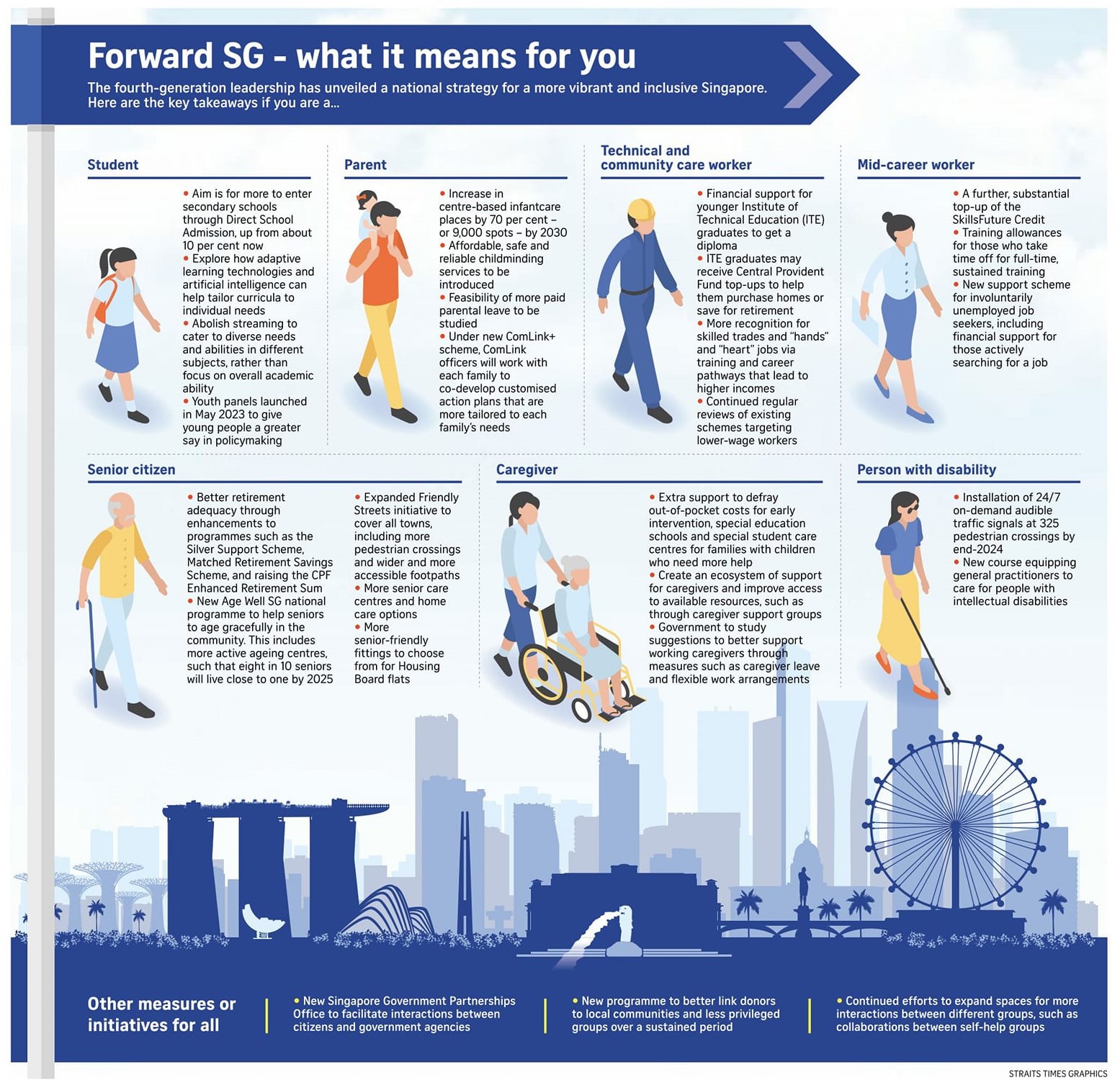
Forward SG report unveils social support plans, lays out mindset shifts needed amid changing times

Moves to ensure basic needs of Singaporeans are met and social compact is refreshed
By Goh Yan Han, Political Correspondent, The Straits Times, 27 Oct 2023

A road map towards a more equitable and thriving Singapore has been put forth by the fourth-generation (4G) leadership, fleshing out the moves the Republic will make in the coming years to stay cohesive amid a time of change.

These include a greater helping hand for groups such as the less well-off, mid-career workers and seniors, through means such as additional financial support and improved infrastructure.

And there will be more done to ensure that Singaporeans’ basic needs at every life stage will be met, such as in education, retirement, healthcare and housing.

These moves come as Singapore has reached a key inflection point where there will be more disruptions, workplace churn and impact on people’s lives, and the Government recognises that more must be done to provide assurance for the people, said Deputy Prime Minister Lawrence Wong at a press conference to launch the Forward Singapore report.


The 180-page report unveiled on Friday also articulated the mindset shifts required for Singapore to achieve the goals set out, such as for wider definitions of success and a stronger sense of collective responsibility towards one another.

“It will not be possible for the Government alone to do everything through policy changes, nor is it possible for any individual to succeed on his or her own efforts alone,” DPM Wong said later at the launch of the Forward Singapore Festival, where the public can learn more about the report’s initiatives.

Instead, it will be up to everyone, including employers, community groups, families and individuals, to keep the Singapore miracle going, he added.


The report caps off a nationwide engagement exercise headed by Mr Wong that has involved more than 200,000 Singaporeans since it kicked off in June 2022.

The exercise sought to refresh Singapore’s social compact – the glue that holds society together – given the challenges facing the island, which range from a more fraught external environment to a rapidly ageing population to greater job insecurity due to rapid technological change.

One key move the 4G team intends to make to take the country forward is to create more opportunities for all Singaporeans to chart their own paths in life. This includes increasing salaries and respect for a wider range of vocations, better social support for those who face career hurdles, and nudging those who succeed to give back to society.

On the jobs and education front, the report unveiled plans to provide a “substantial top-up” of SkillsFuture Credit, as well as a “significant package” to help mature and mid-career workers reskill and upskill.

Institute of Technical Education graduates will get support to upgrade their skills early in their work life to close wage gaps, while more will be done to recognise those in jobs involving “hands” or “heart”, such as electricians and nurses.

“If society is more supportive of individuals pursuing these careers, we can create a virtuous cycle, where society in turn benefits from better and more reliable services,” it said.


Among efforts to help ageing seniors is the nationwide expansion of a pilot announced in March that will result in wider footpaths and longer green-man timings at traffic crossings.


Programmes that support retirement adequacy for those with lower incomes, such as the Silver Support Scheme and the Matched Retirement Savings Scheme, will be updated.


Young parents will also get more help, as the report recognised a need to better support families.

This includes a commitment to studying the feasibility of increasing paid parental leave, and to increase centre-based infantcare places by 70 per cent – or 9,000 spots – by 2030.

On the timeline to implement these changes, Mr Wong said the 4G team will prioritise issues that are more salient and of greater concern for Singaporeans. For instance, policy shifts have already been made or announced in the areas of housing and retirement. These include changing the housing classification system to the Standard, Plus and Prime model, and the $7 billion Majulah Package to help citizens aged 50 and over, that were announced by Prime Minister Lee Hsien Loong at the National Day Rally in August.

Other items, where specific recommendations have been set out, will be implemented in Budget 2024 and over the coming year, said Mr Wong.


Also at the press conference on Friday were other ministers including Minister in the Prime Minister’s Office Indranee Rajah, Health Minister Ong Ye Kung, Education Minister Chan Chun Sing, Manpower Minister Tan See Leng, and Social and Family Development Minister Masagos Zulkifli.

The Forward Singapore report took in people’s ideas for the country’s future, which were contributed at 275 dialogue sessions, as well as through surveys and roadshows. It noted that one topic that constantly emerged at discussions was how the idea of a “good life” had evolved, especially among the younger generation who desire meaning and purpose in life, besides a good salary. The Singapore Dream, which used to be measured by the five Cs of condominium, car, cash, credit card and country club, had fallen out of favour, but there was still a tendency for society to measure success by old yardsticks such as the size of one’s pay cheque or home, the report noted.


Mr Wong said Singaporeans today still want a good life, but it is clear from the engagements that the Singapore Dream has evolved to be about more than just material success. “It’s also about fulfilment, meaning, and purpose in what we do,” he said.

“That’s why I firmly believe the refreshed Singapore Dream is less about I, me, and mine; it’s more about we, us, and ours. It’s recognising that we are not left to fend for ourselves; but that we are all in this together.”

Besides encouraging Singaporeans to tap the range of existing programmes to give back to society, a new Singapore Government Partnerships Office will be set up for agencies to work more closely with citizens.

In sum, the report represents a vision to guide the next bound of development for the Republic, where various groups come together to build a better Singapore, it said.

Mr Wong said: “We have a full agenda ahead of us, and we look forward to working with all Singaporeans to write our next chapter of the Singapore Story,” he said.


Sunday, 30 July 2023

Conversation on euthanasia should enter end-of-life discussions in Singapore

Assisted dying is a sensitive subject but, with its population ageing, Singapore may need to discuss what we think about it
By Salma Khalik, Senior Health Correspondent, The Straits Times, 29 Jul 2023

As more Singaporeans age, urgent discussions are taking place on how we approach end-of-life issues.

The roles of nursing homes, hospices and home palliative care are part of ongoing discussions on easing and widening different approaches towards how we age, and ultimately pass on.

There is, however, one issue that has gained traction elsewhere but which hardly ever figures in our end-of-life discussions here: assisted dying.

Assisted dying can either take the form of assisted suicide, where the final act is undertaken by the person involved, often with the aid of a medical practitioner; or euthanasia, where another person, again often a doctor, performs the act of terminating life.


Assisted dying is illegal in Singapore.

But given that our population continues to age rapidly, and more older people will increasingly find themselves in continuous pain that even palliative care can do little to help, this is not an issue we should entirely ignore. What could be at stake is the dignity and personal choice of a segment of our population.

Several countries are well ahead of Singapore on this count, both in terms of having mainstream discussions, as well as in having legal frameworks on assisted dying.

Most countries that have legalised assisted dying allow both assisted suicide and euthanasia. Some, like Switzerland, which was the pioneer in allowing assisted suicide in 1942, allow the former but keep euthanasia illegal.

Should one or both options be legalised here, to give those desperate to end their lives a way of doing so with grace?

Monday, 28 March 2022

Will you love my autistic cousin when his parents are gone?

By Ang Qing, The Straits Times, 27 Mar 2022

If you were part of the evening rush hour on the MRT earlier this month, you might have seen an excited 1.9m-tall man humming and swaying. You might have stared at him glancing around non-stop and wondered whether he was a "suspicious-looking person" because of his visibly different behaviour.

That was likely to be my autistic cousin Zack (not his real name), who ran off without his mother after his daily training programme at Enabling Village in Bukit Merah.

Zack, 22, loves travelling on the bus and MRT but he is not allowed to go home alone because he gets distracted by his surroundings.

That day, my cousin and his peers were let go 15 minutes before the usual dismissal time at 5pm, so Zack went off on his own before his mum picked him up. What ensued was a nerve-wracking ordeal for his family. While my aunt told him to alight at certain stations over a call, he went from Redhill to Pasir Ris, then back to Joo Koon before changing to the North-South line, which is the line near his home.

At the same time, my aunt informed the MRT staff of the situation and they alerted all control stations to look out for a young man wearing an orange T-shirt. Some 90 minutes later, my cousin's phone went dead because the battery ran out.

Three hours after boarding the train, Zack was finally spotted wandering around a bus interchange near his home by his younger sister. He was wearing his orange top but it was covered by a blue jacket that he uses during training.

That is just a snapshot of the daily struggle of caring for those with special needs.

Although it might be exhausting for family members to look after them, there are many sides to them that make them lovable. For one, Zack is the most responsible citizen I know because he scans the SafeEntry QR code of every shop and station. Inadvertently, this leads to some embarrassing situations when he enters shops like salons, which are only for women.

He also never forgets the birthdays of all 19 (living) members of our extended family. Before a long day at work, it brightens my day to receive texts from him asking what I am doing.

While he can perform basic tasks like brushing his teeth, showering and mopping the floor with supervision, there are certain things that he will never be able to understand.

He sees the world literally.

Heaven is in Mandai Crematorium because this is where his loved ones - my grandfather and my 10-year-old cousin - went when they died.

Zack also cannot understand social cues. This means he can get uncomfortably close to you and will not understand why you inch away.

After receiving numerous stares from strangers gawking at Zack's behaviour whenever we go on family outings, I learnt early on that he would need a lot of care and patience for the rest of his life.

The struggles of parents with children born with special needs are many and will only pile on as they get older: the high costs for support and the onset of burnout, with the greatest concern being who will take care of their children after they are gone.

Friday, 18 June 2021

Census 2020: Singapore population growth at slowest pace since 1965

More staying single while those who marry are having fewer babies, latest census shows
By Grace Ho, Senior Political Correspondent, The Straits Times, 17 Jun 2021

Singapore's population grew at its slowest pace since independence, with more residents staying single and even those who marry having fewer babies.

The nation's sixth census since independence in 1965 also found other key trends set in motion decades ago to have solidified further. Singapore residents of all ages and races are now better educated and more do not consider themselves as having a religion.

Conducted once every 10 years, the census is the largest national survey undertaken here on key characteristics of the population such as demographic, social, economic and employment trends.

More findings from the Census of Population 2020 will be released tomorrow.

Over the past 10 years, Singapore's total population grew by 1.1 per cent each year - the lowest decade of growth since independence.

The number of citizens grew from 3.23 million to 3.52 million, while the number of permanent residents held steady at around half a million.

The population is ageing. Those aged 65 years and older formed 15.2 per cent of the resident population last year, a marked rise from 9 per cent in 2010.


In a trend that has implications for continued population growth, the proportion of singles rose across all age groups over the past 10 years, with the sharpest increase among younger Singaporeans aged 25 to 34 years.

Less-educated men were more likely to stay single, whereas the opposite was true of women.

Women, especially if they were more educated, had fewer children. The average number of children born per resident woman aged 40 to 49 years who had ever been married fell from 2.02 in 2010 to 1.76 last year.

Within this age group, women who were university graduates had an average of 1.66 children last year - marking a steady decline from 1.74 children 10 years ago and 1.95 in 2000.


Singaporeans are also better educated. Among residents aged 25 years and over, almost six in 10 (58.3 per cent) attained post-secondary or higher qualifications, up from less than half (46.5 per cent) in 2010. The Chinese, Malay and Indian communities all saw improvements.

Women closed the educational gap with men in each successive cohort. When it came to those aged 25 to 34 years, the proportion of women (90.2 per cent) with post-secondary or higher qualifications exceeded men (90 per cent).

English was the language most frequently spoken at home for 48.3 per cent of residents aged five years and over last year, up from 32.3 per cent in 2010. Most of them also spoke a vernacular language at home.

There are growing numbers of Singaporeans who cite no religious affiliation.

The proportion was 20 per cent last year, up 3 percentage points from a decade ago. This number was 15 per cent in 2000.

The increase took place across all age groups and most types of educational qualifications.


At a media briefing on Monday, Minister in the Prime Minister's Office Indranee Rajah said the census data showed Singaporeans had enjoyed significant progress over the past 10 years, and that the country remains multiracial, multi-religious and multilingual.

Observing that Singapore citizens account for a greater proportion of population growth in this decade, she said: "Singaporeans who wish to start and raise families remain a priority because we want to grow the Singapore population, the Singapore core. At the same time, we have to supplement our population with some immigration, because we also need to support our economy. But that has to be very carefully calibrated."

Tuesday, 29 September 2020

Singapore Together Emerging Stronger Conversations 2020: Dialogue series with Singaporeans to be more inclusive

Emerging Stronger Conversations: Sessions in more languages soon, will include people with disabilities
Some ideas from recent discussion will also be translated into action, says Desmond Lee
By Grace Ho, Senior Political Correspondent, The Straits Times, 28 Sep 2020

The Singapore Together Emerging Stronger Conversations (ESC), held in English so far, will soon be conducted in Mandarin, Malay and Tamil.

Efforts, too, will be made to involve persons with disabilities (PWDs), said National Development Minister Desmond Lee.

Mr Lee, who is also the co-chairman of the Emerging Stronger Task Force, gave the assurance that the ESC will be inclusive.

"We will find a way to reach out to communities that may not automatically step forward to sign up for these conversations, including making arrangements for PWDs to participate."

He was speaking to The Straits Times at the end of one such virtual conversation held on Sept 18.

After the session, the participants - including venture capitalists, students, and working adults - continued to engage one another on Zoom chat, and offered to help in areas such as career coaching for youth.

This action-oriented spirit, said Mr Lee, is how Singapore becomes stronger.

"People step forward and say 'well, we like the energy of what's happening, we like the spirit, and we want to play a part'.

"We are going to pursue some of their ideas, and they will be translated into action."

The 17-member Emerging Stronger Task Force, set up in May to help the country deal with the longer-term impact of the COVID-19 pandemic, aims to share its preliminary recommendations with the Future Economy Council (FEC) by early next year.

The task force comes under the FEC - which drives the growth and transformation of Singapore's economy for the future - and works closely with the council and its six sub-committees.

In June, representatives from social enterprises and arts groups, among others, issued an open letter to the task force, calling for greater representation from women, minorities and vulnerable communities.

Mr Lee said the work of the task force will not end with a one-off report. As the crisis is still evolving, the recommendations will be on a "rolling basis". "We're far from out of the woods. New dimensions will emerge, and new perspectives arise. We should then surface these ideas to the FEC."

Industry-led coalitions have been set up in seven key growth areas - robotics, e-commerce, environmental sustainability, digitalisation of supply chains and the built environment, education technology, and enabling safe travel, and tourism.

These Singapore Together Alliances for Action, which are partnerships between industry players and the Government, will quickly prototype new ideas to grow the economy and create jobs.

Some have already begun doing workshops on ideas.

Citing an example of a trade flow digitalisation workshop held recently, Mr Lee said the scale and energy of the discussion which he observed were remarkable.

The participants in the workshop, he added, were not chief executives but those on the front lines of industry.

"These are the people who are operating the systems and doing the trade documentation, imports and exports - the operators and practitioners who are identifying the pain points, and where the gaps and inefficiencies are."

But it cannot just be a technical exercise, he said. Instead, it has to reflect a collaborative spirit "that will hopefully allow us to be a cut above the rest".

Linking these efforts back to the Singapore Together movement launched by Deputy Prime Minister Heng Swee Keat in June last year to involve citizens more widely in shaping policies, Mr Lee said that it is about changing the way in which Singaporeans and the private and public sectors engage with one another, so as to close gaps and seize opportunities.

"This crisis is monumental. We have to reorientate and focus on the future through action, involving Singaporeans and friends of Singapore."

Separately, Minister in the Prime Minister's Office and Second Minister for Finance and National Development Indranee Rajah told The Straits Times that the Government is "listening intently" to the views coming through the ESC, including those that are different from current policy positions.

"This process of hearing and engaging with each other is important, so that as a society, we forge a common understanding of the future we want," she said.

"We want Singaporeans to be involved not just in conversation, but also in taking action and implementing ideas.

"I hope many will step forward as the action networks are formed, and find meaningful opportunities to co-create ideas and solutions."

Sunday, 30 August 2020

CareShield Life: Singapore's national disability insurance will be launched on 1 October 2020

MediSave Care, which allows cash withdrawals from MediSave accounts for long-term care needs will also launch in October 2020
By Ang Hwee Min, Channel NewsAsia, 28 Aug 2020

Long-term care support schemes CareShield Life and MediSave Care will be launched on Oct 1, the Ministry of Health (MOH) announced on Friday (Aug 28).

The CareShield Life and Long-term Care Bill was passed in September 2019, allowing for Singaporeans born in 1980 or later, including those with pre-existing disabilities, to be enrolled in compulsory long-term disability insurance.

The MediSave Care scheme allows for cash withdrawals from MediSave accounts for long-term care needs.

CareShield Life was originally scheduled to launch in mid-2020, but was delayed because agencies and vendors had to reduce the “pace of development and testing work” due to COVID-19 safe distancing measures and the “circuit breaker” period, Minister for Health Gan Kim Yong had said in June.

Singapore residents aged 30 to 40 in 2020 - or those born between 1980 and 1990, inclusive - will be the first cohorts to join the scheme from Oct 1 or their 30th birthday, whichever is later.

These individuals will receive a CareShield Life welcome package by Sep 2, or up to two months before their 30th birthday.

Subsequent cohorts, or those born after 1990, will automatically join the scheme when they turn 30, and will also receive a CareShield Life welcome package before they turn 30.

Those who are enrolled between 2020 and 2024 will receive up to S$250 in transitional subsidies, said the Health Ministry in a press release on Friday.


The scheme is optional for Singapore residents born in 1979 or earlier. Details on when these cohorts can join CareShield Life will be released in 2021, said MOH.

They will have the opportunity to join CareShield Life, with the option to switch from ElderShield towards the end of 2021. The launch of the scheme for existing cohorts was originally planned for mid-2021.

At S$600 per month in 2020, starting CareShield Life payouts for Singaporeans with severe disability will be higher than under the existing ElderShield Scheme, and will increase annually until age 67, or when a successful claim is made, said the Health Ministry.

While ElderShield pays out S$300 or S$400 per month for up to six years, CareShield Life’s higher payout lasts potentially for life, and as long as the person remains severely disabled.

Singapore residents can use MediSave to pay for their own CareShield Life premiums and for approved dependents, said MOH.

“No one will lose coverage because of an inability to pay their premiums,” said the ministry, adding that the Government will provide support measures to ensure that premiums remain affordable.

Up to two-thirds of households will be eligible for CareShield Life premium subsidies of up to 30 per cent, with permanent means-tested subsidies for lower- to middle-income Singapore residents, it added.

“Singapore citizens in financial need who are unable to pay for their premiums even after the premium subsidies can apply for additional premium support from the Government.”


MEDISAVE CARE

Under MediSave Care, which also launches from Oct 1, Singapore residents aged 30 and above can tap on their own and their spouse’s MediSave accounts to withdraw cash of up to S$200 per month for long-term care needs, or a total of S$2,400 per year.

The amount that can be withdrawn is dependent on the MediSave account balance. A minimum of S$5,000 has to be set aside in the MediSave account “to ensure sufficient savings for other medical expenses such as hospitalisation and selected costly outpatient treatments”, said MOH.

Individuals whose MediSave account balances are insufficient can tap on their spouse’s MediSave account to supplement the withdrawal, up to a combined total of S$200 per month.

“As our population ages, we want to ensure that Singaporeans continue to have accessible and affordable long-term care. With CareShield Life, severely disabled Singaporeans can be assured that they will receive financial support for life,” said Mr Gan in Friday’s press release.

“They will also have another avenue to fund their long-term care needs, by tapping on their MediSave savings under MediSave Care," he added.

"Together with ElderFund, which provides discretionary government assistance to lower-income, severely disabled Singapore citizens, these schemes will collectively enhance support for long-term care costs.”


Claim applications for both schemes will be open from Oct 1, and interested applicants should arrange for a disability assessment by an MOH-accredited severe disability assessor and submit the scheme application to the Agency for Integrated Care.


Saturday, 28 March 2020

Don't let social distancing become anti-social

Look out for the vulnerable and disabled among us in public spaces such as the MRT
By William Wan, Published The Straits Times, The Straits Times, 28 Mar 2020

COVID-19 is the new normal now. At the start of this year, not many of us would have thought that in a short three months (it's not even April!), we would be subject to a public health pandemic worse than SARS, that the optimism of the new year would give way to prospects of a looming recession and anxieties over personal health. Terms such as telecommuting, split teams and social distancing are now on everyone's lips.

But as we get used to the new normal, we need to understand that even before the coronavirus reared its ugly head, life as per "normal" was already a challenge for some members of the community.

People who suffer from physical disabilities or visual impairment often need more care when navigating the streets and corners of Singapore.

Whether it is ramps and lifts for wheelchair users or tactile paving (those raised dots on footpaths, stairs, pedestrian crossings and train stations) for the blind, there is infrastructure in place to aid them. Nevertheless, a helping hand is always welcome, whether it is on the train or bus, or on pavements.

But now, in the time of COVID-19, when social distancing encourages us to be no closer than 1 metre of each other, how can we extend a hand to help when we can't even get near enough to touch?

Mr Chong Kwek Bin, who is in charge of advocacy at the Singapore Association of the Visually Handicapped (SAVH), said: "The visually impaired typically need two types of help: information and taking them to some place."

Information such as bus service numbers can be provided without physical contact. But guiding them to a place, such as the toilet or to a seat or door, requires physical contact and cannot be done effectively otherwise.

Mr Chong told me that SAVH is concerned that this might lead to the general public becoming less willing to offer assistance.


Psychotherapist and social advocate Cassandra Chiu, who is blind and uses a guide dog, said: "Friends have shared in the last couple of days that when they ask for help, people are either very far away or do not respond to them.

"Social distancing is necessary given the current situation, of course, but it is posing a challenge to those who are blind or suffering from vision loss. This is because we do require a fair amount of help, especially those of us who don't have a guide dog."

Social distancing doesn't just affect those who are blind. And neither is its effects limited to those in Singapore.

Human rights advocate Catalina Devandas Aguilar, who is the World Health Organisation's (WHO) special rapporteur on the rights of persons with disabilities, warned on March 17 that across the world, little has been done to provide guidance and support to people with disabilities.

"People with disabilities feel they have been left behind," she said.

"Many people with disabilities depend on services that have been suspended and may not have enough money to stockpile food and medicine, or afford the extra cost of home deliveries."


Another WHO officer, Ms Lindsay Lee, who uses a wheelchair, explained in a Q&A session hosted on the WHO Twitter account that people with disabilities can suffer a higher risk of getting COVID-19. For example, some may have difficulties in implementing the additional hygiene practices needed, or be unable to practise social distancing because they need care or support.

She said: "These (difficulties) can be exacerbated in crisis situations."

Sunday, 8 March 2020

Committee of Supply 2020 Debate Highlights

Less rhetoric, more robust actions is the Singapore way, says Speaker Tan Chuan-Jin
By Linette Lai, Political Correspondent, The Straits Times, 7 Mar 2020

Speaker Tan Chuan-Jin is sometimes asked to view clips of parliamentary debates overseas, showing fistfights or speeches that are eloquent, humorous or sharply satirical. "But I ask myself, after this, what is next? What then do we do?" he told the House yesterday, as he stressed the importance of translating rhetoric into action.

In contrast, MPs' speeches in Singapore are often "substantive and heavy", Mr Tan said. Some may be challenging to sit through, or could benefit from more flair and panache. But such speeches also feature "solid, down-to-earth ideas, plans and execution, and not just creating beautiful castles in the air", he said. They also give a sense of how the Government intends to address Singaporeans' concerns, and realise their collective vision.


In a speech capping the nine-day debate on Budget 2020, Mr Tan noted that last year's edition centred on killing the "sacred cow" of secondary-level streaming. This year, he quipped that the Budget debate included "Mandai Zoo, River Safari and Jurong Bird Park" as MPs and ministers highlighted various creatures when debating about food security, disease outbreaks and environmental conservation.

There were Impossible Meat satay and gyoza, Aedes in the war on dengue, and the Raffles' banded langurs that monkeyed around in the Central Catchment Nature Reserve, he added, bringing smiles to faces.

But all this talk is just "small slivers of a bigger whole... Nothing is too trivial not to be addressed (by the MPs)," Mr Tan said. He noted that Singapore has learnt lessons from the coronavirus outbreak, a point also made by Leader of the House Grace Fu in her round-up.

Although the virus has generated fear and anxiety, it has also shown the community at its best, Ms Fu said. Larger businesses are stepping up to help smaller ones, while community groups and companies have banded together to help the needy.

The challenges Singapore faces will be "increasingly complex and unexpected". But if citizens work together - as they are doing in the current outbreak - problems can be turned into possibilities, she added.

She listed four themes in this year's Budget that will shape Singapore in the years to come: forging a resilient nation, establishing a city of possibilities, creating opportunities for all, and building a caring and cohesive community.

"I am heartened to hear the theme of partnerships come through strongly in our debates," said Ms Fu, who is Minister for Culture, Community and Youth. "The momentum is clear. Singaporeans can and want to play a bigger role in shaping Singapore."

Mr Tan noted that one criticism of the Government is that it spends on the future and, therefore, has less to spend on the present. "We all know the common complaint that Singaporeans may have," he said. "Why do you not care for me today? I've got problems today."

But this approach allows Singapore to do what it is doing in the current outbreak, he said.

"With our prudence and savings, we are able to fund and deal with this event... Imagine if we decided to spend more, save less. It is far easier to be popular than to be prepared."

Beyond all the "political bluster", Mr Tan saw a strong unity in approach from MPs on both sides. It is the people's support that allows Parliament to have the courage to take "the more difficult, but yet perhaps the more correct path".

"This support will not and does not exist if there is no sense of unity and no sense of togetherness, which is why the idea of Singapore Together is really so precious," he added. "It is not just a slogan, something that we just mouth off in Parliament. There are actually things that we can do."

Monday, 23 December 2019

Government spent $2.9 billion on Home Improvement Programme for HDB flats

As of 31 Oct 2019, 170,400 units have had works done, while 132,300 are undergoing upgrades
By Sue-Ann Tan, The Sunday Times, 22 Dec 2019

The Government has spent about $2.9 billion on the Home Improvement Programme by the Housing Board (HDB) as of 31 March 2019.

As of 31 Oct 2019, about 170,400 flats have had upgrading works completed, while another 132,300 are undergoing the upgrades.

A total of 320,000 flats under the 1986 age-band were selected as eligible to undergo the programme.

These figures were released by the HDB yesterday. It said in a statement that the remaining works will be implemented progressively.

The programme was announced in 2007 to benefit residents and improve their quality of life through enhancing their safety and comfort at home. It focuses on improvements within the flat and helps owners address common maintenance problems related to ageing units in a systematic and comprehensive manner.

The scheme was previously offered to HDB flats built up to 1986 that had not undergone the previous main upgrading programme.

In August last year, Prime Minister Lee Hsien Loong announced that the programme would be extended to flats built between 1987 and 1997.

This extension will benefit about 230,000 more HDB households.


The programme looks at essential improvements that are related to public health and safety and these are fully paid for by the Government. These include repairing structural cracks, replacing waste or soil discharge stacks, which are parts of pipes, and upgrading the electrical load.

Flat owners can also choose optional improvements and pay for their share of works carried out in their flats. These include new decorative doors, metal grille gates and refuse-chute hoppers.

The programme can proceed only when at least three-quarters of a block's eligible households that are made up of Singapore citizens have voted for it.

There is also an upgrading option for elderly and vulnerable residents who need the programme, or whose blocks do not qualify for it.

This scheme, known as the Enhancement for Active Seniors (EASE) programme, allows seniors to choose from elderly-friendly fittings such as slip-resistant treatment for existing floor tiles of bathrooms, installation of grab bars in toilets and ramps.

More than 206,000 households have applied for the EASE programme as of Oct 31. The Government has spent about $80 million on the programme as of March 31.

Madam Kwan Kum Lai, 78, had her flat in Hougang upgraded in April under the Home Improvement Programme and the EASE scheme. She has been living there since 1985.

She said: "I was very happy when I heard about these programmes. I know upgrading can be messy and troublesome, but it is very worth it."

Ramps were installed at the entrance of the living room and the kitchen to help Madam Kwan, who is a wheelchair user, enter and leave on her own.

"Previously, my husband had to support me and be on standby all the time. Now the ramps help me to be more independent," she said.

Her husband, Mr Chan Meng Kwong, 79, had suffered a stroke a few years earlier.

Grab bars were also installed in the toilets and the tiles received slip-resistant treatment to make them safer for the couple.

"It used to be very slippery in the bathroom and I was scared my husband would fall," Madam Kwan said. "Now I have more confidence when using the bathroom and I can transfer myself from the wheelchair to the toilet seat with the bars to hold on to."


A full package under the Home Improvement Programme for a household living in a five-room flat like hers would cost about $1,260. The full suite of upgrades under the EASE programme with five single-step ramps would cost another $250.

Another resident who has benefited from the upgrades is housewife Kamariah Mohd, 52, who paid about $1,100 for the renovations, which included the toilet door, wall and floor tiles, the door grille gates and rubbish chute.

"If I went to a private contractor, it would be much more expensive. It was almost two weeks of construction but it was worth it."