Showing posts with label Terrorism. Show all posts

Saturday, 19 October 2024

Terror attack foiled: 17-year-old self-radicalised Singaporean arrested weeks before planned attack in Tampines

Youth shared radical materials with his social media followers
By Samuel Devaraj, The Straits Times, 18 Oct 2024

A 17-year-old Singaporean supporter of terror group ISIS was arrested just weeks before he could carry out his plan to kill non-Muslims in Tampines.

And this was a very close shave, said Law and Home Affairs Minister K. Shanmugam on Oct 18.

The youth, who was from a mainstream school, had planned to carry out his attack during the September school holidays and practised stabbing motions with a pair of scissors.


He had traced his steps from his home to an open area in Tampines Street 81, near supermarkets, provision shops and coffee shops, a children’s art school and a tuition centre, where he had planned to stab non-Muslim men.


The teenager chose this HDB heartland area near Tampines West Community Club as it was crowded and near his home.In a press statement on Oct 18, the Internal Security Department (ISD) said he was issued a two-year order of detention in September.

The teen had also planned to travel to Syria to fight, said ISD. He had got in touch with an online foreign contact for travel advice and researched flight routes.

The youth saw his plan to fight in Syria as meaningful, as he would be able to fight and die with fellow ISIS fighters to establish an Islamic state in Syria, ISD added.

He knew it would be difficult to travel to Syria without arousing the suspicions of his family, ISD said. So, he decided to strike here, a plan that he felt would be easier to carry out and fulfil his aspirations to be a martyr.


Speaking to the media at the site of the planned attack, Mr Shanmugam said thousands of people walk through the area daily, and it would have been more crowded during the school holidays.

The minister said: “He knew that he would be intercepted by the agencies, the police. He had made up his mind to die in the course of the attack. He wanted to become a martyr.

“I would say this was a very close shave. It is very fortunate that ISD arrested him in time.”

Mr Shanmugam said that compared with past cases, this was one of the plans that came closest to being carried out.

He said the youth was detained because of the extent of radicalisation and how close he was to carrying out his plans.

He said: “It is very easy to attack people here. People are defenceless. They are not coming here expecting to be attacked.

“People go around in Singapore feeling safe, so you could easily have gone on a rampage and killed a lot of people around here.

“Look at the kind of people who are around. Kids are playing, senior citizens are resting. They are easy targets for such an attacker.”


ISD said the youth came across the teachings of foreign radical preachers in August 2023 while searching for religious knowledge online.

He embraced segregationist religious beliefs, including the view that Muslims should not extend festive greetings to non-Muslims.

ISD said that following Hamas’ attack on Israel on Oct 7, 2023, online extremist materials by ISIS increased, and he became self-radicalised.

ISD added that he joined online groups that provided updates on ISIS activities, and believed in the use of armed violence to establish an Islamic caliphate.

By January, he aspired to die as a martyr while fighting for the group.

In May, he took a bai’ah or pledge of allegiance to ISIS in his room.

The teen was inspired by ISIS propaganda, which glorified suicide knife attacks, ISD said.

Besides the pair of scissors, he considered using a kitchen knife in his home to stab people in the neck to kill or wound them.

Said ISD: “He felt a sense of pride knowing that his planned attack, if successfully executed, would be the first terrorist attack in Singapore in recent decades.”

The teen had crafted a declaration of armed jihad against non-Muslims, which he planned to release before his attack, to inspire other Muslims to engage in armed violence.

Thursday, 28 January 2021

16-year-old Singaporean detained under ISA for planning terrorist attacks on two mosques; 20-year-old who planned to kill Jews at a Waterloo Street synagogue also detained

He aimed to kill Muslims here with machete on March 15 anniversary of Christchurch attacks in New Zealand
By Lim Min Zhang, The Straits Times, 28 Jan 2021

A 16-year-old Singaporean student has been detained under the Internal Security Act (ISA) after the authorities uncovered his plans to attack two mosques and kill worshippers in Singapore on March 15 - the second anniversary of the Christchurch terror attacks.

A Protestant Christian of Indian ethnicity, he is the first detainee to be inspired by far-right extremist ideology and the youngest person detained under the ISA for terrorism-related activities to date, said the Internal Security Department (ISD) yesterday.


The secondary school student was found to have made detailed plans and preparations to conduct terrorist attacks using a machete at the two mosques, the ISD said.


He had chosen Assyafaah Mosque in Sembawang and Yusof Ishak Mosque in Woodlands as his targets because they are near his home, it added. He planned to rent a BlueSG car to travel between the two sites and had watched videos on operating an automatic transmission vehicle.

Influenced by the Christchurch attacker Brenton Tarrant, the youth had mapped out his route, bought a flak jacket, intended to buy a machete on online marketplace Carousell and wanted to live-stream his planned massacre.

"He was self-radicalised, motivated by a strong antipathy towards Islam and a fascination with violence," said ISD, adding that he had also watched the live-streamed video of the terrorist attack on the two mosques in Christchurch, New Zealand, and had read the attacker's manifesto. Tarrant, a white supremacist, gunned down 51 people in the attacks on March 15, 2019.


The Singaporean youth also watched Islamic State in Iraq and Syria (ISIS) propaganda videos, and came to the erroneous conclusion that ISIS represented Islam, and that Islam called on its followers to kill non-believers, said ISD.

ISD said it was clear from his plans and preparations that he was influenced by Tarrant's actions and manifesto, such as how he planned to carry out the attacks on the anniversary of the Christchurch attacks, and had intended to modify a tactical vest he bought online such that the attack could be live-streamed from a mobile device.


Mr Shanmugam told reporters: "How do we weed out or find out every single person who wants to do something like this? I have asked ISD and the Ministry of Culture, Community and Youth to engage the religious organisations to be more vigilant across the different religions, and advisories have been issued to religious organisations to strengthen their crisis preparedness to be more alert."

The minister added that the youth will be rehabilitated, instead of treating him as a criminal, charging him and putting him in jail. "So here, with rehabilitation, my hope is that after a number of years, he can be released and carry on with his life."


ISD said its investigation so far indicates that the youth had acted alone. There was also no indication that he had tried to influence anyone with his extreme outlook or involve others in his attack plans.

Religious leaders issued calls for solidarity yesterday.

The National Council of Churches of Singapore said it wanted to assure the Muslim community that it remained committed to defeating hatred and violence. "We will not be deterred from our common goal to build harmony and cohesion in multi-religious Singapore society," it added.


Monday, 11 January 2021

In silencing President Donald Trump, Twitter and Facebook show where power lies

The muzzling of a president by Twitter and Facebook will stoke free-speech debate and deepen conservatives' grievance over Silicon Valley's political bias
By Kevin Roose, Published The Straits Times, 11 Jan 2021

In the end, two billionaires from California did what legions of politicians, prosecutors and power brokers had tried and failed to do for years: They pulled the plug on President Donald Trump.

Twitter's decision to permanently suspend Mr Trump's account on Friday "due to the risk of further incitement of violence", after a decision a day earlier by Facebook to ban the President at least to the end of his term, was a watershed moment in the history of social media.

Both companies had spent years defending Mr Trump's continued presence on their platforms, only to change course days before the end of his presidency.

Why these companies' chief executives - Mr Jack Dorsey of Twitter and Mr Mark Zuckerberg of Facebook - decided to act now is no mystery. They have been under pressure for years to hold Mr Trump accountable, and that pressure intensified enormously this past week, as everyone from Ms Michelle Obama to the companies' own employees called for a permanent ban in the wake of Wednesday's deadly Capitol riot.


These companies, corporate autocracies masquerading as mini-democracies, often portray their moderation decisions as the results of a kind of formulaic due process, as if "don't incite an insurrectionist mob" had been in the community guidelines all along.

But high-stakes calls like these typically come down to gut decisions made under extreme duress. In this case, Mr Dorsey and Mr Zuckerberg considered the evidence, consulted their teams, weighed the trade-offs and risks of inaction - including the threat of a worker revolt that could damage their ability to attract top talent - and decided that they'd seen enough.

Journalists and historians will spend years unpacking the improvisational nature of these bans, and scrutinising why they arrived just as Mr Trump was losing his power and Democrats were poised to take control of Congress and the White House.

The bans have also turned up the heat on a free-speech debate that has been simmering for years. On Friday night, pro-Trump Republicans raged, claiming Twitter's move was an example of Silicon Valley's tyrannical speech controls.


THE SHAPERS OF PUBLIC DISCOURSE

And while many liberals cheered Twitter's decision as an overdue and appropriate step to prevent more violence, some also cringed at the thought of so much control resting in so few hands. "We understand the desire to permanently suspend him now," Ms Kate Ruane, a lawyer for the American Civil Liberties Union, wrote in a statement on Friday. "But it should concern everyone when companies like Facebook and Twitter wield the unchecked power to remove people from platforms that have become indispensable for the speech of billions - especially when political realities make those decisions easier."


Above all, Mr Trump's muzzling provides a clarifying lesson in where power resides in our digital society - not just in the precedent of law or the checks and balances of government, but in the ability to deny access to the platforms that shape our public discourse.

Mr Dorsey's and Mr Zuckerberg's names have never appeared on a ballot. But they have a kind of authority that no elected official on earth can claim.

Thursday, 7 May 2020

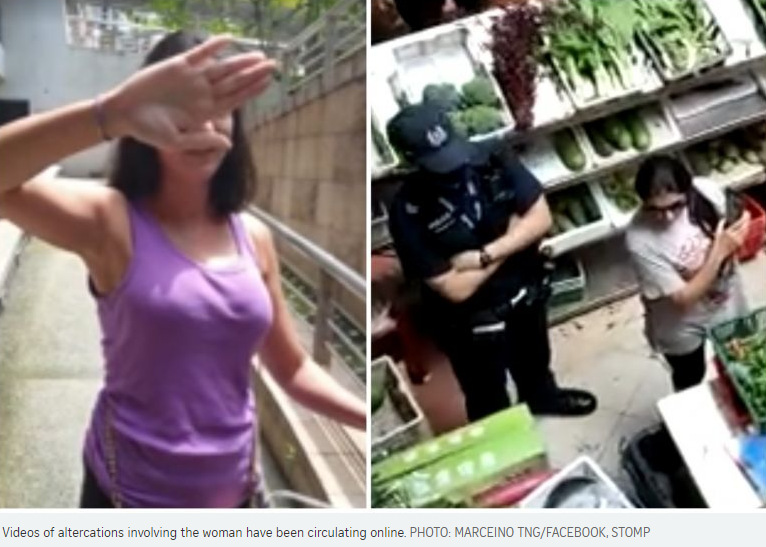
I am a Sovereign: Singapore woman who refused to wear face mask charged with breaking COVID-19 rules

Sovereign woman charged in court and remanded at IMH
By Shaffiq Alkhatib, Court Correspondent, The Straits Times, 6 Mar 2020

A woman accused of not wearing a mask at Shunfu Mart near Upper Thomson Road amid the coronavirus outbreak was charged in the district court yesterday with one count of being a public nuisance and three counts of violating COVID-19 rules.

Paramjeet Kaur, 40, who made headlines on Sunday after videos emerged of her claiming to be a "sovereign" when confronted at the market, allegedly failed to wear a mask when she was outside her home, as required by law, on more than one occasion.

Kaur was accused of failing to wear a mask over her nose and mouth when she went to a food stall in Upper Thomson Road at around 9.20pm on April 30.

She is similarly accused of not wearing a mask when she went to Shunfu Mart at around 12.20pm on Sunday. That same day, Kaur is said to have caused annoyance to the public by shouting loudly and creating a scene at the market.


She also allegedly ate at a table in front of a stall at Shunfu Mart at around 9.30am on April 14, seven days after circuit breaker measures began. The measures include no dining at hawker centres.

Kaur was arrested on Monday. She is represented by lawyer Satwant Singh.

Appearing in court via video-link from the Central Police Division building with a mask across her chin, Kaur said: "I am a living woman and that is my only capacity in this matter. I extend my sovereign immunity to Satwant and I asked Satwant to represent me."


In videos circulating online, the Singaporean, who was born here, can be seen claiming to be a "sovereign" while in a heated argument with passers-by.

"It means I have nothing to do with the police, it means I have no contract with the police. They have no say over me," she says.

A man, who is off-screen, responds: "This doesn't even make any sense. If you're a person in Singapore, you have to follow the rules of Singapore."

But the woman replies: "That's the thing - I'm not a person, I'm 'we the people'."

Home Affairs and Law Minister K. Shanmugam had commented on the incident on Monday, saying he checked what she might have meant by referring to herself as a "sovereign".


"There is a movement in the US, and adherents to that movement (broadly speaking) reject government, reject the police and any kind of authority," he wrote.

"Well and good. But then such people should not live within society - she should not expect any of the benefits that come from this system of governance, including her security, medical care, other benefits," he added.

A report by Chinese evening paper Lianhe Wanbao yesterday quoted a woman who identified herself as Kaur's mother, saying that Kaur is a physiotherapist who had lived in Australia for 20 years before returning last year.

Kaur will be remanded at the Institute of Mental Health and will be back in court on May 19.

Wednesday, 12 February 2020

17-year-old secondary school student detained under Internal Security Act for supporting ISIS

His journey to radicalisation began in 2017 when foreign contact introduced him to pro-ISIS social media groups
By Tham Yuen-C, Senior Political Correspondent, The Straits Times, 11 Feb 2020

A 17-year-old secondary school boy was detained last month under the Internal Security Act (ISA) for supporting the Islamic State in Iraq and Syria (ISIS) terror group.

He is the youngest person detained under the ISA to date.

In a statement yesterday, the Ministry of Home Affairs (MHA) said he was first investigated in September 2017 when he was 15, after he posted defaced images of President Halimah Yacob on social media and called on ISIS to behead her.

Madam Halimah was elected that year as president of Singapore, which the student viewed as an "infidel" state.


Commenting on his arrest yesterday, the Islamic Religious Council of Singapore (Muis) categorically debunked the view that Muslims cannot live in a secular country and take up any roles in government or serve as head of state.

"The Singapore Muslim community is a clear example of confident Muslims thriving in our secular and multi-religious context and actively contributing to our public institutions and society as a whole," said Muis.

The boy's journey to radicalisation began in 2017, when he was introduced to pro-ISIS social media groups by a foreign online contact.

Through these groups, he gained access to what he believed was exclusive ISIS content, said MHA.

"In his eyes, ISIS was a powerful group that was fighting for Islam and its use of violence against its opponents was therefore justified."

MHA said that after this came to light in 2017, it tried to steer the boy away from radicalism, but he remained a staunch supporter of ISIS.

A spokesman for MHA told The Straits Times that arrangements were made for the youth to undergo religious counselling, and its officers also reached out to him.

His parents were informed so that they could keep a closer eye on him, she said. "Unfortunately... he persisted with viewing pro-ISIS materials online and hid his continued support for ISIS from those trying to help him."

In its statement, MHA said the student continued to believe in ISIS, even with the demise of the group's so-called caliphate in Syria and Iraq, and was willing to assist ISIS in its online propaganda efforts.

He was also willing to undertake other activities if called upon by ISIS to do so, MHA added. It noted, however, that there were no signs that the student had spread his pro-ISIS views to others around him.

Muis said the boy's case underscored the importance of ensuring that young Muslims in Singapore have credible religious teachers to learn from and also a strong support network of family, teachers and friends they can turn to.

Thursday, 26 September 2019

PM Lee Hsien Loong receives World Statesman Award recognising Singapore's religious harmony

Singapore works hard to maintain religious harmony: PM Lee
He cites the creation of structures that curb chauvinism and nudge social behaviour in positive ways
By Charissa Yong, US Correspondent In New York, The Straits Times, 25 Sep 2019

Singapore is ranked the most religiously diverse country in the world, but its harmonious society did not come about by chance, Prime Minister Lee Hsien Loong said in New York on Monday.

Rather, it worked hard to lay the foundation for religious harmony and maintain it over the years, he said in a speech on Singapore and the Government's approach to race and religion.

"We did not become so because Singaporeans are a uniquely virtuous people," he added when accepting the World Statesman Award from the Appeal of Conscience Foundation, a New York-based interfaith group promoting mutual acceptance and respect. "We created structures - constitutional, political, social - that discouraged intolerance, curbed chauvinism and nudged social behaviour in positive ways."

As examples, he cited the country's "strictly secular, but not anti-religious" constitutional approach that treats all faiths impartially, as well as electoral rules to boost multiracial politics, and policies to encourage people of different races to live and study together.

"I went to a Catholic school - there is a church in the school grounds and across the road, there is a synagogue," said PM Lee, referring to Catholic High School when it was in Queen Street, and Maghain Aboth Synagogue in Waterloo Street.


He also noted the compromises religious groups make. For example, mosques tone down their loudspeakers that carry the prayer call, and to make up for it, the call is broadcast on national radio.

On their part, Christians exercise restraint in proselytising to people of other faiths, he added. "Because to you, it is the gospel - the good news - but to people of other faiths, if it is not done sensitively, it can be taken amiss and can cause offence."

PM Lee said he accepted the award on behalf of all who contributed towards building a harmonious society in Singapore.

The World Statesman Award honours leaders who support peaceful coexistence and mutual acceptance in multi-ethnic societies. World leaders given the award in the past included German Chancellor Angela Merkel and former Indonesian president Susilo Bambang Yudhoyono.


Reading the citation was former US secretary of state Henry Kissinger, 96, whom PM Lee called a long-time friend of Singapore and a close friend of his father, the late founding prime minister Lee Kuan Yew.

Dr Kissinger traced Singapore's success as an extraordinarily modern country despite it being a small island surrounded by large countries, describing its population as one that has faith in itself.

"I have had the good fortune of knowing the (Lee) family for most of my public life, and I have always believed in their contributions to peace and stability in Asia," he said.

PM Lee said Singapore's harmonious society, however, is facing a world that is changing, and Singaporeans need to adapt to new forces.

He listed four: Growing religiosity among all faiths, external influences, provocative views that proliferate on social media, and violence in the name of race and religion.

First, people of all faiths are practising their faiths more fervently, which in itself is not a bad thing, he said. "But as convinced as one might be of one's own faith, we cannot... show disrespect to other people's faiths or other people's gods."

This is why Singapore opposes practices that discourage people from befriending those of other faiths or exchanging greetings during their religious festivals.


Second, racial and religious groups in Singapore have extensive links with their larger counterparts abroad, which can result in the import of disputes from other lands. This can undermine social cohesion.

Singapore therefore bans or expels foreign preachers who bring their foreign quarrels into the country, or who want to persuade Singaporeans to practise their religions in ways inappropriate for local society, said PM Lee. "At the same time, we explain to Singaporeans that different societies often practise the same religion in different ways."

Third, social media means a single offensive or thoughtless post can go viral and be seen by millions.

"It has become dangerously easy for people to cause offence and to take umbrage. We must not allow those who spread toxic views and poison on the Internet to get away with what may literally be murder."

But policing the Internet was a Sisyphean task that still needed to be done, he said, referencing the new Protection from Online Falsehoods and Manipulation Act.

It allows the Government and the courts to compel the correction of misinformation and falsehoods online and take action against those who deliberately spread untruths.

Fourth is the continuing threat of terrorists who pervert and misuse religion to justify violence.

PM Lee cited how Singapore thwarted a planned terror attack just after the Sept 11 attacks in 2001, and strove swiftly to reinforce trust and confidence between religions.

Muslim leaders condemned the terrorists, while non-Muslims expressed continued confidence in their Muslim brethren, he said.


But government actions alone cannot bring about religious harmony, he said, calling on "responsible voices" to spread the message of tolerance and respect.

"I hope future generations of Singaporeans will cherish this harmony... and strengthen it further. We must never allow religion to be weaponised, or used as a front for other conflicts," he added.

Sunday, 23 June 2019

International Conference on Cohesive Societies, 19 - 21 June 2019

Need to nurture, expand our common spaces: DPM Heng Swee Keat
Fault lines are growing but global community must work together to combat them, he says
By Linette Lai, Political Correspondent, The Straits Times, 22 Jun 2019

Building an inclusive, cohesive society is always a work in progress, both in Singapore and the wider world, Deputy Prime Minister Heng Swee Keat said yesterday.

This is why leaders and others must come together to learn from one another, share best practices and tackle common challenges, he added at the close of the three-day inaugural International Conference on Cohesive Societies.

Pointing to today's global challenges, he said unprecedented levels of trade, technological advancement and migration have combined in a way that has not worked for some, fuelling tension and conflict.


Fault lines have deepened, made worse by the ease with which falsehoods and extremist ideas proliferate online and are exploited.

"Increasingly, nationalism and intolerance are displacing openness and harmony," he added.

He cited supremacist hate groups and rising hostility to minorities generating a vicious circle of conflict, a factor which led President Halimah Yacob to suggest the event to discuss ways to deepen harmony in and across societies grappling with diversity.

Mr Heng, who is also Finance Minister, said common challenges can be tackled well only if the global community works together, stressing that mutual trust and respect, as well as deeper understanding and harmony, are the foundations on which such efforts must be based.

"To combat extremist and intolerant views, we must work together to create an ever widening ripple of understanding, trust and respect," he said. "Just as each society achieves more together than as disparate individuals, the global community achieves more together when all societies can pursue common goals and tackle common challenges."


Mr Heng added that every society will need to find its own path to cohesion, shaped by its history, context, culture and demands.

He pointed out that throughout human history, many societies that embraced their diversity thrived - like the Malacca Sultanate in the 15th century, whose inhabitants came from all over, bringing with them their unique religious beliefs, intermarrying and exchanging cultures.

As for Singapore, he said, it is becoming more diverse, and this means its common spaces will "be harder to maintain, and must be deliberately nurtured and expanded".

"As our racial and religious demographics shift, so too must our approach to building bridges and encouraging discourse," he added.

Mr Heng noted there are now more interfaith families in Singapore - an opportunity to deepen mutual understanding.

Also, 22 per cent of marriages are between people of different ethnic groups, and nearly 20 per cent of Singaporeans do not identify with a religion. He said: "We must learn to include their perspectives in our discourses."


He also outlined Singapore's approach to deepen cohesion.

First, it expands common spaces and shared experiences, while preserving racial and religious diversity. Next, it is vigilant to guard against forces that can tear society apart, including establishing institutional structures that prevent groups or individuals from exploiting racial and religious fault lines.

Lastly, the Government works to provide Singaporeans with better lives and to ensure all share in the fruits of progress.

"In growing our economy, we put a special focus on creating good jobs for all Singaporeans, regardless of which community they belong to," he said.

"Some workers have benefited more from this growth than others. This is why we continue to work hard to address social inequality, to better distribute the fruits of growth."

Wednesday, 10 April 2019

15 percent of Singaporeans find Muslims threatening

Probe ripples under surface calm of 'racial harmony'
Issues like Islamophobia in Singapore require us to confront uncomfortable truths about ourselves and have honest dialogues
By Tee Zhuo, The Straits Times, 10 Apr 2019

Racial and religious harmony is an ideal deeply ingrained in our national consciousness. When an issue disrupts our self-image of a socially harmonious society, you can expect Singaporeans to react strongly.

So when a recent survey showed that 15 per cent of Singaporeans and permanent residents (PRs) find Muslims threatening, it drew an overwhelmingly negative response online.

Many commenters labelled that finding “fake news” and said it stirred up issues where there were none. Some even asked for a Straits Times article on it to be taken down.

The finding was from a recent Institute of Policy Studies (IPS) study on religion based on face-to-face interviews with a nationally representative random sample of 1,800 residents late last year. One question was: “Do you consider those belonging to the following groups as threatening or non-threatening?”

Buddhists were seen as the least threatening; 2.8 per cent of respondents found them very or somewhat threatening, followed by Hindus (4.2 per cent ), atheists (5.1 per cent), Jews (5.3 per cent), Christians (6.5 per cent), and Muslims (15.6 per cent).

An ST article on the finding shared on Facebook attracted hundreds of “angry” reactions and now has over 1,600 irate comments.

A typical comment was: “Who even allowed this to be published? Irresponsible journalism. In this climate, such an article is totally uncalled for. Please take it down!”

Several said publishing the finding was “dangerous”, “divisive” and “insensitive”.

Such reactions, to my mind, point to a certain desire to be protective of racial and religious harmony, and a perception that the finding is inimical to it. To be sure, the intensity of the sentiment is not a bad thing in itself. We are, understandably, fiercely protective of an ideal that has guided diverse Singaporeans to co-exist peacefully for years.

But beneath the desire to protect “harmony”, I wonder if the angry response to the finding is also the result of Singapore having been “too” successful in maintaining social peace, so much so that any negative fact or feeling around race and religion proves highly discomfiting.

When the surface of a lake is too calm, any ripple can cause unease. Indeed, two-thirds (66 per cent) of those surveyed in a different 2016 Channel NewsAsia-IPS study felt that talking about racial issues causes “unnecessary tension”.

ISLAMOPHOBIA IN SINGAPORE

The value of the IPS survey is that it confronts Singaporeans with an unpalatable truth: That Islamophobia is a fact of life in Singapore.

Seeing Muslims as threats is a classic example of Islamophobia, or prejudice based on an irrational fear of Islam and Muslims.

It was not just that 15 per cent here found Muslims threatening. This figure was more than double the number of people who found Christians threatening, and about thrice the respective numbers for Hindus, atheists and Jews.

Monday, 8 April 2019

Doxxing set to be outlawed under changes to harassment laws to deter online vigilantism

Practice of doxxing set to be outlawed but observers see challenges ahead
Online vigilantes' practice of publishing personal info of individuals online set to be outlawed, but observers see challenges ahead
By Cara Wong, The Sunday Times, 7 Apr 2019

Many have been shamed publicly, some received death threats, others lost their jobs, and a number have even fled the country - all because they have been "doxxed".

Online vigilantes have "doxxed" these individuals by publishing their personal information online - in the pursuit of justice or malicious fun - after viewing them as perpetrators in incidents usually involving public spats, ungracious behaviour or offending online posts.

In making public information such as the individuals' names, contact numbers, addresses or employment details on online forums or social media, the aim is to cause and facilitate harassment, violence or fear of violence towards such victims.


This practice of "doxxing" is now set to be outlawed with the amendments to the Protection from Harassment Act introduced last Monday to plug an existing gap in the legislation that only forbids using abusive and insulting language and behaviour to harass a victim.

But observers say the new law may face challenges in implementation, citing several grey areas that have to be clarified, such as how to define "doxxing" and how to determine culpability.

Professor David Tan of National University of Singapore's (NUS) law faculty said a big challenge is to define what constitutes permissible online shaming and what would be harassment.

For example, simply identifying a person who parked in a disabled parking space should be allowed.

But a post that includes a call to action - such as urging others to share contact details of such an inconsiderate person to make prank calls or food deliveries - would be "doxxing" and is forbidden, said Prof Tan, who teaches courses in privacy and data protection law.

However, complications arise in determining whether an act is "doxxing" or not, as it depends on the context in which the comments are made, said lawyers and experts.


One potential loophole could be when a netizen does not make a call to action to harass the victim but merely posts identifiable details about a person along with an angry comment, said lawyer Lionel Tan.

Mr Tan said the netizen behind such a post could argue that the information was meant to shame the person into changing his behaviour.

As there is no real threat of violence or harassment, the defence could argue the predominant intent was not to harass the person, said Mr Tan, who specialises in social media at law firm Rajah and Tann.

However, even if the original publisher argues he did not intend to harass the victim by publishing details such as his name and a video of him driving dangerously, other netizens may interpret his original post differently and take action, he added.

The prosecution could still make a case if it establishes that it is clear, from the circumstances, that the publisher knew or ought to know that his acts would have resulted in harassment, said Mr Tan.

Criminal lawyer Joel Ng said that in certain scenarios, the prosecution may have to rely heavily on the type of information revealed to demonstrate the person's intent.

It would be obvious when netizens post information, like phone numbers or addresses, that provides avenues for the person to be contacted and harassed, he added.

"These are the certain kinds of information which would be very difficult for one to say that they can't reasonably expect harassment to occur as a result of it," said Mr Ng.

The offence should still stand if the identifiable information is already available online, like through the person's public Facebook page or workplace address, he added.

"Just because certain information can be found publicly doesn't mean that you should still post them to the world at large," he said.

Wednesday, 3 April 2019

Hate speech: Singapore is prepared to err on the side of caution to preserve racial harmony, says Law and Home Affairs Minister K. Shanmugam

Minister outlines Republic's approach to preserving racial harmony and tackling hate speech
By Linette Lai, Political Correspondent, The Straits Times, 2 Apr 2019

Singapore is prepared to err on the side of caution to preserve racial harmony, said Law and Home Affairs Minister K. Shanmugam, stressing that good relations among different communities in Singapore "didn't fall ready-made from the sky".

"There is nothing natural about it. We engineered this over many decades," he told Parliament yesterday in a 90-minute ministerial statement on Singapore's approach to tackling hate speech.

"If anything, we are prepared to err on the side of caution and risk overreacting to preserve harmony, rather than take chances and risk explosions."


He traced the smooth ties among Singaporeans to the country's founding leaders, recounting how they were determined for Singapore to be a multiracial, multi-religious society organised horizontally - in which all races and religions are treated equally and on the same level.

"Our uniqueness in this respect should not be underestimated. Equality of races and religions is not the natural order of things; it has to be defended," he said.

Mr Shanmugam quoted founding prime minister Lee Kuan Yew, who had said: "This will not be a Chinese nation, not a Malay nation, not an Indian nation."

The late Mr Lee, reflecting in a New York Times interview, said in 2010: "I believe (our younger generation) has come to believe that this is a natural state of affairs... They think you can put it on auto-pilot. I know that this is never so."

He urged Singaporeans to heed Mr Lee's warning, saying: "What we have in Singapore is precious, hard fought."

In his speech, the minister also dwelt on Singapore's approach to secularism and set out his decision to cancel black metal band Watain's local concert.


Setting out the effects of hate speech, Mr Shanmugam said it "disengages" morality and dehumanises its victims.

Once normalised, such mindsets are hard to reverse and result in deep social divides.

Although offensive speech may not veer into the territory of hate speech, it can have the same impact in the long run. In fact, it can be even more insidious as people are "drip-fed" such harmful notions.

He highlighted how some comedians use racist caricatures in their skits, and recounted a woman making disparaging comments about Malay weddings at void decks. "If we normalise offensive speech, after a while, the tone and texture of public discourse will change."

Turning to the Singapore brand of secularism, he said the Government does not take a hands-off approach on matters of race and religion. It actively works to foster good relations among different communities from a practical, nuanced and neutral position.

This sets it apart from countries like France, where secularism means the state will not interfere in religious matters and people can publish material that vilifies any religion, Mr Shanmugam said.

"Why should that right to publish override the right of a religious group not to have its texts, beliefs, practices ridiculed?" he asked. "What about obligations of citizens to preserve harmony and unity?"

When deciding on such issues, the Government assesses the reaction of the majority in the affected community, the security implications of that opinion, and where the weight of mainstream opinion lies.


On the Watain ban, Mr Shanmugam quoted an interview with the band's frontman Erik Danielsson, who had said: "I totally encourage any kind of terrorist acts committed in the name of Watain... That is the way rock and roll works."

Critics of the Watain ban had hit out at the Government's "self-righteous" behaviour, with some saying people can listen to the band without being influenced by its beliefs, and churches can urge their members not to attend such concerts.

Seen in isolation, these are valid points, Mr Shanmugam said, adding that Singaporeans should look at the bigger picture.

If the Watain concert got the go-ahead, the Government would have to permit future shows with similar themes.

Over time, this could deepen racial and religious faultlines and normalise hate speech, he said.

He also dismissed online comments suggesting a "Christian conspiracy" influenced the Government's decision, and that Christians are over-represented in institutions of power.

"They tried to turn it into a 'Christian versus others' debate. These people are nasty, opportunistic and dangerous," he said. "No one, Christian or otherwise, influenced me. I am not a Christian. I also decided to ban two Christian preachers in 2017. So, what does one make of that?"

He added in his closing speech that one of the risks of a weak political leadership is it seeks favours from specific religious groups, warning that this approach "will lead to disaster".

"So, many governments, both in this region and outside, have gone down that route. It is one of the easiest ways to get votes," he said. "You really need a strong political leadership which is fair between the different religions."


Mr Shanmugam also said hate speech has travelled faster and farther because of social media, and Singapore needs to do more to deal with it as social media platforms are unable or unwilling to do so.

The Protection from Online Falsehoods and Manipulation Bill is one step, but further steps must be taken, he added.

In all, 16 MPs spoke after his speech, with some such as Ms Denise Phua (Jalan Besar GRC) and Nominated MP Walter Theseira asking about the grey areas where offensive speech is concerned.

"It is inevitable that one man's belief or culture, when put into the public sphere, may give offence to another," Dr Theseira said, citing how the consumption of specified food may be normal for one religious group but offensive to others.

Ms Phua added: "Where is the line between public discourse and platforms like private WhatsApp group chats?"


Yesterday, the House observed a minute of silence to remember the victims of the attacks on two New Zealand mosques last month.

Sunday, 31 March 2019

Institute of Policy Studies report on Religion in Singapore 2019

Keep religion out of politics, Singaporeans say
One in four open to extremists sharing views online or at events, finds IPS report
By Linette Lai, Political Correspondent, The Straits Times, 29 Mar 2019

Most Singaporeans are religious, but still frown on religious behaviour that could influence politics or disrupt social harmony, a new report by the Institute of Policy Studies (IPS) has found.

They also feel that having different religious views is no barrier to getting along when living in close proximity.

But the researchers noted that a sizeable proportion of people have no qualms about letting religious extremists publish their views online, or hold public meetings to talk about them.

When surveyed, one in four people said putting such views online is acceptable as long as they do not instigate harm against others, and younger respondents were even more likely to think so - possibly because of more liberal attitudes towards free speech among the young, the researchers said.

But the overwhelming consensus across all age groups is that it is unacceptable for religious leaders to incite hatred or violence against other religions.

The working paper's authors, however, noted there is a fine line between espousing extremist views that consider other faiths as enemies and making hate speech.

"How the Government navigates the desire by this significant segment of the population for freedom of speech pertaining to extremist views in future will be of interest,'' they added.

The findings on people's attitudes towards religion were part of an international study involving multiple countries. It was written by IPS senior research fellow Mathew Mathews, research associate Leonard Lim and research assistant Shanthini Selvarajan.

"Religion is an influential and powerful force, and seeps into multiple domains of public and private life," the authors said.

"Tracking the expansive reach and influence of religion is thus crucial in maintaining inter-religious harmony and surveying public sentiment in public policy."

A total of 1,800 Singapore residents aged 18 and older were surveyed for the local component of the international study.

Face-to-face interviews were carried out between August and December last year by market research company ML Research Consultants.

Participants were asked about their religious beliefs and how these influence their views on issues such as public policy, religious harmony and infidelity.

Although 80 per cent have religious beliefs, only 40 per cent said they would consider themselves to be a "spiritual person". Buddhists, Taoists and Hindus were more likely to have religious beliefs but not identify as spiritual.

Most also had at least some level of belief in life after death, heaven, hell and religious miracles.

On religious harmony, seven in 10 people said they feel people from different religious backgrounds can get along when living close together.

Even so, around 15 per cent of them said they found Muslims at least somewhat threatening. This was higher than for any other religious group.

When asked about religion and politics, most agreed religious leaders should not try to influence voting at elections or make remarks about politicians' characters.

Three-quarters also agreed the country's laws should not be based on a particular religion.

Religion was also found to influence people's views on moral issues such as infidelity, abortion and homosexual sex.

The younger and better educated respondents, as well as those with no religion, tend to have more liberal attitudes.