Showing posts with label Climate Change. Show all posts

Friday, 16 May 2025

Changi Airport Terminal 5 breaks ground: PM Lawrence Wong hails bold move, says Singapore must stay connected to the world

Prime Minister Lawrence Wong breaks ground on Changi Airport T5 on 14 May 2025; all SIA, Scoot flights to move there when it opens
By Vanessa Paige Chelvan, The Straits Times, 15 May 2025

Prime Minister Lawrence Wong has broken ground on Changi Airport Terminal 5 (T5), an expansion project more than a decade in the making that will position the airport to ride an expected surge in air travel within the Asia-Pacific and beyond.

With the May 14 ground-breaking, work on the mega terminal has begun, following delays owing to the Covid-19 pandemic.

National carrier Singapore Airlines (SIA) and its budget arm Scoot will consolidate their operations under one roof at T5 when the terminal opens in the mid-2030s, said operator Changi Airport Group (CAG).

The airlines now operate across Terminals 1, 2 and 3, and SIA Group said the consolidation at T5 will provide space for its future growth and improve “operational synergies”.

There will be room at T5 and other terminals for other carriers to expand their operations, CAG added.

When asked about the other airlines that could operate from T5, CAG said it was too early to tell, as flight operations are dynamic and can change over the next decade.


Designed to handle about 50 million passengers a year, T5 will effectively double the size of Changi Airport and allow it to handle 140 million passengers yearly – boosting its current capacity of 90 million by more than 55 per cent.

Passenger traffic in the Asia-Pacific – already the world’s largest air travel market, taking about a third of the global share – is projected to double in the 2040s.

CAG said the extra capacity at T5 will enable Singapore to take advantage of this growth.


While prize-winning Changi Airport is a source of pride for many Singaporeans, PM Wong said Singapore can never be complacent about its achievements and “cannot presume that our success can continue just on its own”.

Amid sharpening competition from other airports and an uncertain global economy, the Prime Minister said Singapore must continue to work hard and remain connected to the world.

Hence, it is making a “bold move” with T5’s development to ensure Singapore’s air hub stays competitive.

At present, Changi Airport is linked to more than 170 cities. With T5, the airport will be able to reach its target of more than 200 city links by the mid-2030s, said PM Wong.


Construction on T5 will intensify in the next few years and peak around 2029, said Mr Ong Chee Chiau, CAG’s managing director for Changi East.

Works completed so far include a new runway, the airport’s third; an underpass for vehicular traffic; and tunnels for baggage and automated people-mover systems similar to the Skytrain.

With three runways operational by the time T5 opens, a second control tower will be built to manage air traffic, Mr Ong said.

T5 is located within the 1,080ha Changi East development, which is almost as big as the land area of today’s Changi Airport, he added.


In a first for the airport, T5 will house a ground transport centre, bringing together the Thomson-East Coast and Cross Island MRT lines, buses, taxis and other transport services.
State-of-the-art systems

T5 will have overlapping curved roofs with varying heights, in a nod to “Singapore’s unique blend of nature and city”, said CAG.

It will also have natural light and landscaping, giving the terminal “the familiar cosy yet uplifting feel that Changi is known for”.

Besides its facade and interior, the mega terminal will have state-of-the-art systems, and will leverage technology and automation to improve efficiency and passenger experience.


Plans include baggage robots that can operate in poor weather conditions, as well as video analytics and artificial intelligence tools that can track aircraft turnarounds to predict potential delays. A turnaround refers to the time between the arrival of an aircraft and its next departure.

These technologies are being tested now to prepare for their roll-out when T5 opens, said CAG.


To make it easier for passengers to move around, three automated people-mover systems as well as travelators will reduce walking distances.

There will be two people-mover systems within T5 that can connect departing passengers to their gates and arriving passengers to two arrival immigration halls. A third people-mover system will link T5 to T2, facilitating passenger transfers to other terminals.

“Most passengers arriving in Singapore will still be able to hop onto a taxi or the MRT within 30 minutes after leaving the aircraft,” said CAG chief executive Yam Kum Weng.

Meanwhile, transfer passengers at T5 can expect to connect to another flight in less than an hour. “Faster than Changi today,” Mr Yam added.

Passengers departing from T5 will undergo security checks near their boarding gates at the multiple security screening points for each cluster of gates.

This means more flexibility for the airport operator, as it can choose to open or close a particular cluster of gates according to demand, Mr Ong said.

T5 will be powered by more clean energy to reduce the airport’s carbon footprint. Its rooftop solar system – one of Singapore’s largest – will have the potential to generate enough energy to power up to 20,000 four-room Housing Board flats for a year.

It will also be ready to support viable alternative jet fuels, including sustainable aviation fuels.

From 2025, all new light vehicles, forklifts and tractors on the airside will be electric, and T5 will be able to support a fully electric airside fleet, CAG said. The airside is the part of the airport beyond passport control, where aircraft operate.

Saturday, 22 February 2025

Singapore Budget 2025: Onward Together for a Better Tomorrow

PM Lawrence Wong unveils bumper SG60 Budget for all Singaporeans
By Goh Yan Han, The Straits Times, 19 Feb 2025

Every Singaporean will receive something from Budget 2025, from vouchers for all adults to personal income tax rebates, as part of an SG60 package.

Prime Minister Lawrence Wong on Feb 18 unveiled what he termed “a Budget for all Singaporeans”, which includes expanding existing schemes to benefit more citizens and greater support for seniors as well as the vulnerable.

He also set out measures to grow Singapore’s economy, help workers upskill and meet its green targets.

The broad suite of measures announced tally up to a record $143.1 billion, an increase from the $134.2 billion spent in the 2024 financial year.

This is about 18.7 per cent of Singapore’s gross domestic product, and is in line with projected trends for government spending that is expected to reach about 20 per cent of GDP by 2030.

The moves are financed by changes to the tax system made earlier in this parliamentary term that put Singapore “on a stronger fiscal footing”, and larger-than-expected revenue collections.


Corporate income tax collections were more than expected in the 2024 financial year. This is now the single largest contributor to total government revenue, higher than the Net Investment Returns Contribution (NIRC), said PM Wong as he set out the Government’s fiscal position. The NIRC refers to the returns on investments of Singapore’s reserves.

He expects a surplus of $6.8 billion, or 0.9 per cent of GDP, for the 2025 financial year.

“When Singapore thrives, every citizen benefits,” said PM Wong, who is also Finance Minister.

“Every Singaporean is supported from birth to old age, with more support given to those with less. No one is left behind.”


PM Wong said the Budget was “shaped together with all Singaporeans”. It lays out the second instalment of plans on the Forward Singapore agenda, which seeks to keep society strong and united.

He noted that Singapore has to navigate a turbulent external environment, with the US and China locked in a fierce contest for global supremacy. Despite the global uncertainties, the Republic can look ahead with a degree of confidence as it is far stronger than it was 60 years ago, he added.

Noting that 2025 marks the country’s 60th year of independence, PM Wong said: “It has been a remarkable journey, reflecting the grit and resilience of generations of Singaporeans in building our nation.”


Something for all Singaporeans

He announced a new SG60 package to recognise the contributions of all Singaporeans and share the benefits of the nation’s progress.

In July, all Singaporeans aged 21 to 59 will receive $600 in SG60 vouchers, while those aged 60 and above will get $800. These vouchers, amounting to about $2 billion, will function like the CDC ones.

Under the package, individuals will also get a 60 per cent personal income tax rebate, capped at $200, for the 2025 year of assessment.

All Singaporean babies born this year will get an SG60 Baby Gift, PM Wong added, among other measures in the package.


The hotly anticipated Budget, which comes ahead of an upcoming general election widely expected by mid-year, also tackles top-of-mind issues for Singaporeans such as cost-of-living pressures and job insecurity.


To alleviate rising costs, PM Wong announced another $800 of CDC vouchers for all Singaporean households, totalling about $1 billion. The first $500 will be given out in May 2025, while the remaining $300 will be issued in January 2026.

He also announced more utility rebates and credits for families with children to defray household expenses.


While inflation is expected to ease further in 2025, PM Wong acknowledged that Singaporeans are still adjusting to new price realities. “We will continue to provide support for as long as needed, within our means,” he said.


To help parents who have or plan to have three or more children, PM Wong detailed a new Large Families Scheme.

The scheme will disburse $16,000 to such families for each third and subsequent child born from Feb 18, and help to cover pre-school and healthcare expenses, as well as household spending.


PM Wong also announced that several schemes will be extended to private property owners, including the climate vouchers programme that all Housing Board households can currently tap to buy energy- and water-efficient household appliances.

HDB households will get an additional $100, on top of the $300 they received last year, while households in private properties will get $400 in climate vouchers.

The Enhancement for Active Seniors (EASE) scheme that provides subsidised senior-friendly fittings and installations in HDB households will be extended to private property households up to 2028, said PM Wong.


Supporting workers, securing the future

While the Government has taken measures to mitigate the impact of rising costs, the best way in the longer term to adjust to higher prices is to grow the economy and increase productivity, he said.

Dedicating a significant portion of his Budget speech to new moves to grow the economy, he announced more funding for research and development and a new $1 billion fund to provide more financing options for high-growth local enterprises.

At the same time, workers must be equipped with the skills needed to stay competitive and relevant, said PM Wong.


He said that the SkillsFuture Level-Up Programme, announced in 2024 to support mid-career Singaporeans who are upskilling full-time, will also be extended to part-time training.

The Workfare Skills Support scheme, which currently covers short courses for lower-wage workers, will have an enhanced tier of support that covers longer-form courses, he added.

The Prime Minister also outlined measures to support more vulnerable groups of workers, including older workers, former offenders looking to reintegrate into society, and people with disabilities.


PM Wong said the Budget also lays the groundwork for the country to become stronger and more resilient.

It includes measures to tackle climate change, like a $5 billion top-up to the Coastal and Flood Protection Fund. The fund covers long-term plans such as land reclamation for Long Island and structures like sea walls and tidal gates.


Singapore will need to have its own domestic sources of clean power to ensure greater energy resilience, PM Wong said, adding that the country will study the potential deployment of nuclear power and take further steps to systematically build up capabilities in this area.

Apart from plans to access more sources of clean energy, the Government will accelerate efforts to decarbonise the transport sector, he said.

It will roll out a new emissions scheme and electric charging grant to incentivise the purchase of clean energy variants of heavy vehicles. Adoption of such vehicles has been slower compared with that of electric and hybrid cars.


Singapore will continue to improve its public transport system, said PM Wong, noting that $60 billion will be invested in this decade to grow and renew the rail network.

“We are continuing to study how our rail network can be expanded,” he added.


Concluding his speech, PM Wong said Singaporeans have to brace themselves for new challenges in the next phase of nation building.

The country has confronted tough external circumstances repeatedly over the past six decades, and “we can draw confidence from what we have been through together”, he added.


At every turn, Singaporeans have chosen determination over despair, innovation over stagnation, and solidarity over division, said PM Wong.

“Budget 2025 sets out clear plans for us to continue this journey with confidence.”


Wednesday, 29 November 2023

Long Island to be reclaimed off East Coast could add 800ha of land, create Singapore’s 18th reservoir

Singapore to start environmental and engineering studies into "Long Island" off East Coast from early 2024
By Ng Keng Gene and Shabana Begum, The Straits Times, 29 Nov 2023

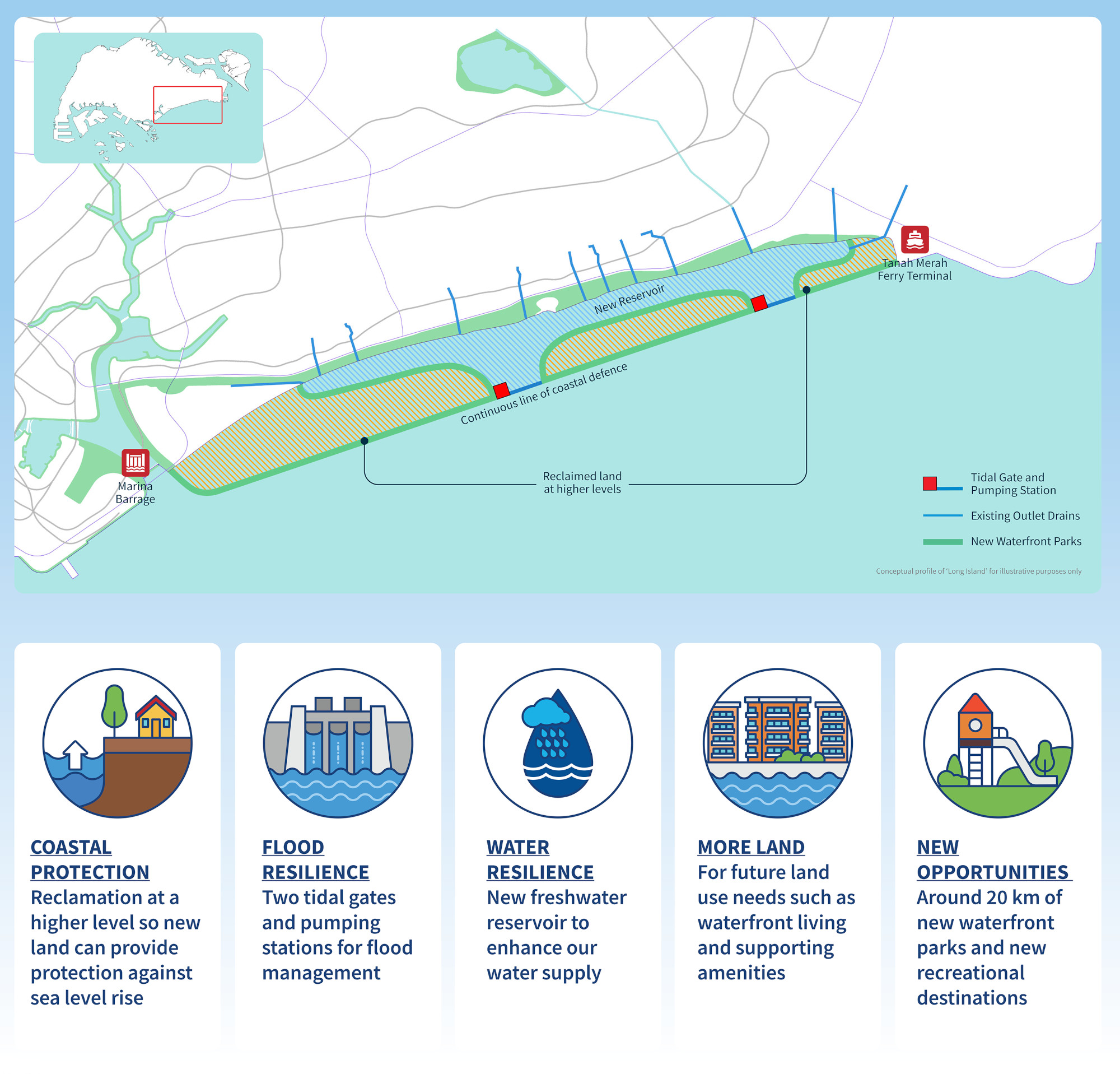
Three tracts of land could be reclaimed off East Coast Park in the coming decades, creating about 800ha of land for new homes and other amenities, as well as a new reservoir.

Called the Long Island, these land tracts – collectively about twice the size of Marina Bay – are Singapore’s response to the threat of rising sea levels and inland flooding in the East Coast area.

Land in the area is largely lower than 5m above the mean sea level, the extent that sea levels are projected to rise to by the end of this century if extreme high tides coincide with storm surges.

On Nov 28, National Development Minister Desmond Lee announced that public agencies will carry out technical studies for the Long Island project over five years, starting from early 2024.

Over the next few years, members of the public will be consulted for their ideas and suggestions for the project, which will take several decades to plan, design and develop.

The current plan is for three elongated tracts of land to be reclaimed in the area, extending from Marina East to Tanah Merah. The easternmost land tract will start from Tanah Merah, while the westernmost tract will be an extension of Marina East. Between these two tracts, a third tract will be reclaimed.

A large tidal gate and pumping station will be built in between each new land mass. These will control the water level in a new reservoir bordered by East Coast Park and the new land masses, and, in the process, reduce flood risks in the East Coast area.

National water agency PUB said the reclamation project is likely to create Singapore’s 18th reservoir.

Like the gate at Marina Barrage, the two gates at the new reservoir in East Coast will open to release excess storm water into the sea during heavy rain when the tide is low. At high tide, the pumps will be used instead to release the storm water.


Mr Lee said the new reservoir can also be used for water activities such as canoeing and dragon-boating.

Besides offering flood protection and increasing Singapore’s freshwater supply, the project will help meet future development and recreation needs, said Mr Lee.

Waterfront homes are expected to be built on the reclaimed land, along with amenities and industrial facilities. About 20km of new coastal and reservoir parks could be added, tripling the length of waterfront parks in the East Coast area, he said.


Plans for reclamation off East Coast were first unveiled in 1991, as part of the Urban Redevelopment Authority’s (URA) Concept Plan. It was envisioned then that a series of reclaimed islands would provide waterfront housing and leisure opportunities.

At the 2019 National Day Rally, Prime Minister Lee Hsien Loong said reclaiming a series of islands offshore and linking them up with barrages could protect existing low-lying areas and create a freshwater reservoir.

URA showcased a possible concept for reclamation works at its long-term plan review exhibition in 2022.


In his speech on Nov 28, Mr Desmond Lee said the Government has been studying various coastal protection options, including building a sea wall up to 3m tall that would stretch from Marina East to Tanah Merah.

The wall would be accompanied by 12 sets of tidal gates and pumping stations – one set at each of the 12 existing outlet drains along East Coast. The gates would stop seawater from flowing inland during high tide, while the pumping stations would pump storm water from the drains into the sea when the gates were closed.

Mr Lee said this option is technically feasible but not ideal for East Coast Park, as large stretches of the park would have to be closed to the public when building the sea wall. When completed, it would permanently limit park users’ access to the waterfront for recreation and sports.


The 12 tidal gates and pumping stations would take up a lot of space within East Coast Park – about the area of 15 football fields – resulting in the loss of existing greenery and recreational facilities.

Mr Lee noted that the public hopes to retain unimpeded access to the waterfront, as well as preserve the heritage and recreation spaces along the coast.

A more optimal solution is to integrate coastal protection measures with reclamation plans for the area, he added.

Friday, 29 September 2023

Singapore water price to rise from April 2024; Government to provide support for lower- and middle-income households

Singapore water price to rise by 50 cents per cubic metre (1,000 litres) by 2025
Three-quarters of households here will see an increase of under S$10 per month in their water bills from April 2025
By Shabana Begum, The Straits Times, 27 Sep 2023

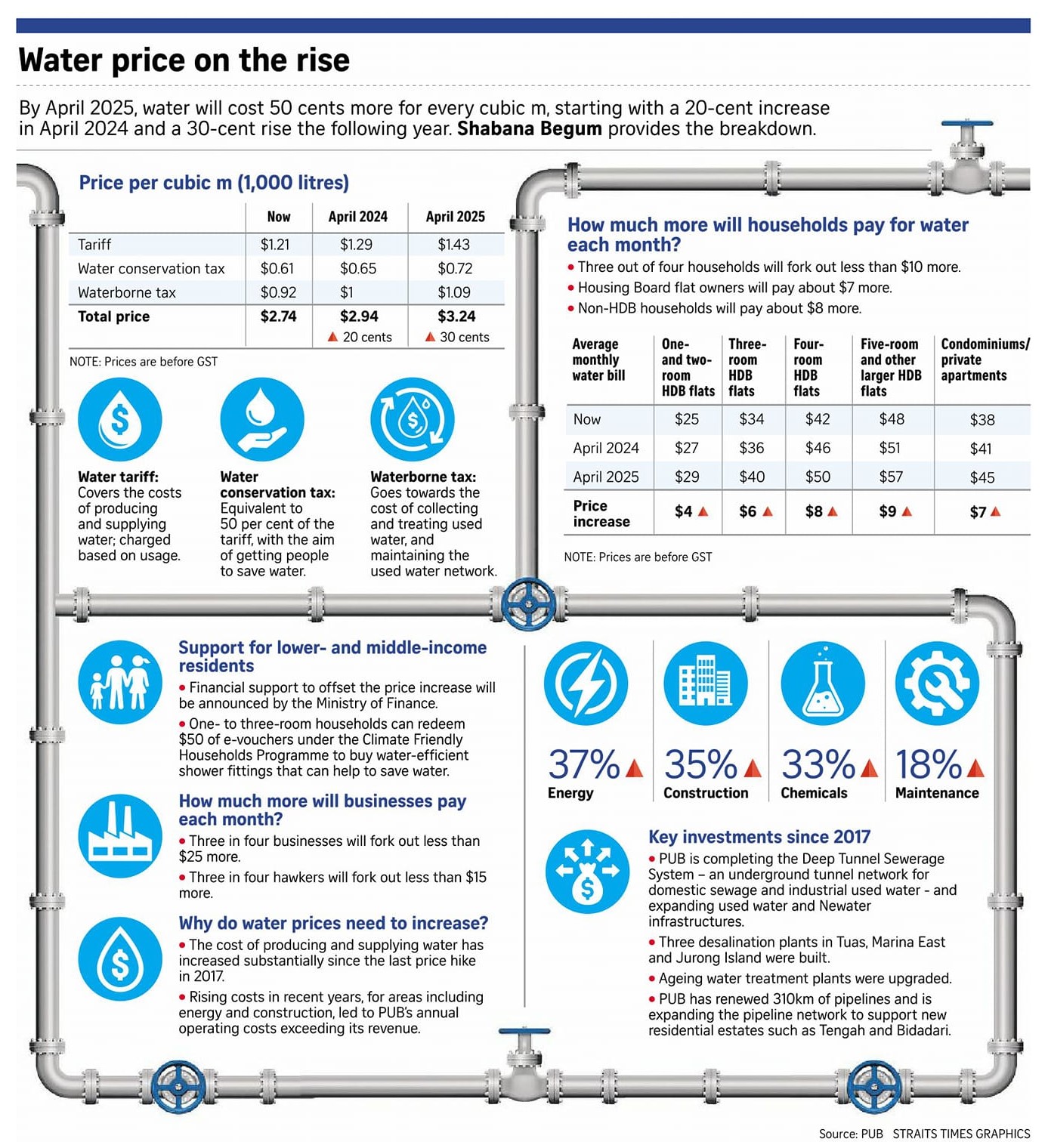
Water will soon cost consumers an additional 50 cents per cubic metre (1,000 litres), starting with a 20-cent increase in April 2024 and a 30-cent rise in April 2025.

This means that most households will fork out an additional $4 to $9, excluding goods and services tax (GST), for their monthly water bill by 2025, said national water agency PUB on Wednesday.

In 2020, the average monthly consumption of water was 15 cubic m for condominiums and 16.2 cubic m for HDB flats.


Lower- and middle-income households will get help to offset some of the price increase. Deputy Prime Minister and Finance Minister Lawrence Wong will announce cost-of-living support measures to provide more relief for Singaporean households on Thursday.

The last water price hike of 30 per cent happened in 2017. The upcoming 50-cent rise – bringing the cost of 1 cubic m, or 1,000 litres, of water to $3.24 – is an 18 per cent increase.

The price hike between 1997 and 2000 saw water prices rising by 120 per cent for households.


The upcoming increase comes amid rising living costs, GST hikes and higher transport fares, and the water agency did not take the decision lightly, said a PUB spokesman.

“The water price increase is not popular, but necessary,” the spokesman said.

“We understand that it can draw strong reactions amid the other cost of living pressures. That’s something we are very mindful of, so PUB does not take this decision lightly.”


It has been increasingly more expensive to produce and supply water, PUB said, and there is a need to invest more in local water infrastructure – especially in weather-resilient Newater and desalinated water – to prepare Singapore for drier days ahead due to climate change.

And Singapore’s water demand, which is currently at about 1.95 million cubic m – or 440 million gallons – daily, is expected to almost double by 2065.

Singapore has four sources of water: imports from Malaysia, water from local catchments, Newater and desalinated seawater.

The pressure of higher energy prices and construction costs, among others, has contributed to PUB’s annual operating costs exceeding its revenue in the financial years of 2021 and 2022.

In 2019 and 2020, PUB saw a slight net positive in revenue owing to the 2017 water price hike.


Electricity tariffs have risen by about 37 per cent, while construction costs have gone up by 35 per cent, with higher increases for specialised works such as tunnelling and pipeline projects through highly urbanised areas.

Due to inflationary pressures and supply chain disruptions, the cost of essential chemicals to treat used water, for example, has also risen by about 33 per cent. Higher manpower costs have driven up maintenance expenses by 18 per cent.

These external cost drivers have worsened the operating deficit significantly in the latest fiscal year, said PUB.

Its spokesman said: “If we were to defer the price increase any further... essentially we would have an even bigger price increase moving forward.”


Rising operational costs and inflation are not affecting Singapore alone.

Wednesday, 6 April 2022

More support, earlier roll-out of Budget 2022 measures

Singaporean households to get $100 CDC vouchers, other support measures earlier amid rising prices
By Goh Yan Han, Political Correspondent, The Straits Times, 4 Apr 2022

More support is on the way for households given the economic impact of the conflict in Ukraine, and some Budget measures will be rolled out earlier, Finance Minister Lawrence Wong told Parliament on Monday (April 4).


He noted that the war has contributed to a further spike in inflation around the world and other factors, such as supply chain issues, have contributed to rising prices.

As such, the $100 worth of Community Development Council (CDC) vouchers for 2022, which was announced in this year's Budget, will be given out to every Singaporean household by the middle of May, said Mr Wong.


This comes after the first tranche of $100 CDC vouchers for all Singaporean households was disbursed four months ago last December to help Singaporeans with their daily expenses.

Mr Wong said: "I understand the concerns that many households and businesses have about the current situation... Where possible, I will bring forward the implementation of our Budget measures."


More financial support is also on the cards for lower-income households that will be more impacted by the higher prices during this period.

All new ComCare short- to medium-term assistance applicants between April and September 2022 will be given at least six months' worth of support from the social service offices, said Mr Wong.

Households that are already on this assistance scheme can also have their assistance extended for at least another three months if they need more help.


Lower-income households will also get more help with their public transport fares.


These vouchers had been made available last December to help households cope with the public transport fare hike.

This group will hence receive $60 worth of the vouchers in total, which will roughly cover the additional fares paid by a family of four this year following the fare hike last December.

These vouchers are also available to all households with a monthly income per member of up to $1,600. Applications are open from now to Oct 31, 2022. Eligible households who had already received the first voucher, and who need a second voucher, can also apply again, said Mr Wong.

Mr Wong also announced that to help businesses, he will bring forward the disbursement of the Small Business Recovery Grant, which provides up to $10,000 for small- to medium-sized enterprises most affected by Covid-19 restrictions over the past year.


Most eligible businesses will be able to receive the grant by June, he said. Originally, eligible businesses for the grant would have been notified from June 2022.

The finance minister was responding to MPs who had asked if the Government would be enhancing the support measures announced in the Budget.

"We will need time to allow these measures to take effect and feed through the economy, before we can monitor their impact, assess the overall situation and then consider what additional steps we might want to take," he said.


Mr Wong also noted that the Budget had included rebates for service and conservancy charges (S&CC) and utility bills for households.


"This will address a key cost of living component which several members asked about," he said.

Other measures in place include the Covid-19 Recovery Grant to help those experiencing job loss or sustained income loss - available till the end of the year - and the Taxi Subsidy Scheme for lower-income persons with disabilities who require point-to point services to commute.

Mr Wong said: “If the situation worsens and more support is needed, the Government stands ready to do so.”


Thursday, 31 March 2022

PM Lee Hsien Loong's Dialogue with the Council on Foreign Relations on 30 March 2022

Ukraine war heightens Asia's security concerns: PM Lee
By Charissa Yong, US Correspondent, The Straits Times, 31 Mar 2022

WASHINGTON - The war in Ukraine has negatively impacted Asia and damaged the international framework for law and order and peace, said Prime Minister Lee Hsien Loong on Wednesday (March 30).

The crisis has also impaired the global multilateral system, a worrying development for a small nation like Singapore which depends on globalisation for its livelihood, he added.

At an hour-long dialogue organised by the Washington-based Council on Foreign Relations think-tank, PM Lee laid out how Russia's invasion of its neighbour affects Asia, including Singapore, a deep concern that he and United States President Joe Biden expressed after their meeting on Tuesday.

Much of the wide-ranging dialogue was centred on the Ukraine war and its ripple effects on the world, from climate cooperation to energy security.


PM Lee, who has spent the week meeting America's top leaders, also gave his take on South-east Asia's security and economic landscape amid US engagement in the region.

He condemned the Russian invasion as something that endangered the sovereignty of all countries, especially small ones.

"If a principle is accepted, that crazy decisions and historical errors are the justification for invading somebody else, I think many of us are going to be feeling very insecure," he said at the event, attended in person by dozens of industry leaders and officials, and streamed online to more.


Moreover, he said, the conflict has rent relations in Europe between developed countries and Russia, making it more difficult for countries to work together on issues from trade to nuclear non-proliferation.

"Now, it is win-lose, you want the other guy to be down, fix him, crash his economy. So, how then do most of the countries hang together and cooperate with one another and not fall into disorder, autarky or anarchy?" he said.

What happens in Ukraine will also further strain US-China relations, affecting the rest of the world, said PM Lee.


Governments in the region will also draw from the crisis their own lessons about who they can rely on for defence, he added.

He cited how the crisis has prompted some in Japan to publicly consider whether the country should host US nuclear weapons, even though the government has rejected the idea, and how South Korea opinion polls have of late reflected a public reception to the idea of nuclear capabilities.

"The thought is planted and it will not go away because the implication from Ukraine is that nuclear deterrence is something which can be very valuable," said PM Lee. "I think we're heading into very dangerous directions."

Opinion polls have shown a decline in confidence among the Taiwanese public that America will come to their aid should Taiwan be attacked, he said. "These calculations will be made. It will not change the scene overnight. But all these are significant strategic recalibrations," said PM Lee.

The crisis has also highlighted the importance of having institutions in the Asia-Pacific that can help avoid conflict and head off a failure of deterrence, he added.

These institutions will have to enable a difficult adjustment - "how to accommodate a China which is going to become more developed, larger... and yet not become overbearing on the rest of the world and acceptable to the US, which currently is the dominant military power worldwide".

PM Lee said: "You need to give thought to this and steer things in a direction which does not lead you to a hot conflict."


The dialogue followed a day of meetings in Washington for PM Lee, including with Vice-President Kamala Harris, on Tuesday.

They discussed new areas of cooperation, including cyber security, space cooperation and infrastructure development.


Saturday, 19 February 2022

Singapore Budget 2022: Charting Our New Way Forward Together

Finance Minister Lawrence Wong unveils major tax measures to fund spending needs


Singapore to raise GST from 7% to 9% in two stages in 2023 and 2024

Assurance Package increased to $6.6 billion; GST Voucher scheme beefed up to offset GST hike

Higher personal income taxes for top 1.2% of taxpayers in Singapore

Higher taxes on residential properties, luxury cars, as Singapore adjusts wealth taxes
By Justin Ong, Political Correspondent, The Straits Times, 18 Feb 2022

Singapore on Friday (Feb 18) unveiled a slew of progressive tax measures aimed not only at generating revenues to fund major programmes needed over the next few years, but also at addressing social inequalities.

The hike in goods and services tax (GST) to fund the recurring social and healthcare needs of a rapidly ageing population was further delayed to 2023 in response to concerns over rising prices.

The hike will be staggered over two steps - with GST rising from 7 per cent to 8 per cent on Jan 1 next year, and then to 9 per cent from Jan 1, 2024. The impact of the increase will be cushioned, especially for low-income households.

The wealthy will also pay more of other taxes.

"Those who earn more, contribute more," said Finance Minister Lawrence Wong in his first Budget since assuming the portfolio in May last year, as he outlined increases in personal income, property, vehicle and carbon taxes as part of an expansionary $109 billion Budget, including special transfers.

He also announced a $6 billion draw on the reserves as part of Singapore's continuing fight against Covid-19, and over $1 billion in support for businesses, households and individuals hard-hit by the pandemic.

With a view to future challenges and opportunities, Mr Wong said he would commit up to another $1 billion or so to spur companies to invest in new capabilities, while further tightening workforce policies to ensure foreign hires of the "right calibre".


This year's Budget will run up an expected overall deficit of $3 billion, amid a tone of cautious optimism sounded by Mr Wong as Singapore enters a period of transition and recovery after two years of grappling with the pandemic and its fallout.

"The global economy is still vulnerable to pandemic-related risks, and further supply chain disruptions. Geopolitical and security risks loom," he warned at the start of his speech, which was around two hours long. "We may also see a slowdown in external demand as the major economies scale back their pandemic support, and central banks tighten their accommodative monetary policies to deal with the threat of inflation."

But barring fresh disruptions, Mr Wong said he expects the Singapore economy to continue to do well, and grow by 3 per cent to 5 per cent this year.

Looking ahead, with government expenditures projected to increase significantly in the coming years - especially in healthcare - enhancements to Singapore's tax system would be needed to raise additional revenue, he added.

"That means everyone chips in and contributes to a vibrant economy and strengthened social compact, but those with greater means contribute a larger share," said Mr Wong, who also co-chairs a multi-ministry task force handling the pandemic.


To that end, personal income tax will be increased from 2024. The portion of chargeable income in excess of $500,000 up to $1 million, will be taxed at 23 per cent, up from 22 per cent currently. Chargeable income in excess of $1 million will be taxed at 24 per cent.


Property tax rates will also be increased, with more significant hikes for high-end properties, said Mr Wong.

For non-owner-occupied residential properties, including investment properties, tax rates will go up from the current 10 per cent to 20 per cent range, to 12 per cent to 36 per cent.

For owner-occupied ones, tax rates for the portion of annual value in excess of $30,000 will be increased from the present 4 per cent to 16 per cent, to 6 per cent to 32 per cent.

Luxury cars will be taxed at a higher rate, with an additional Additional Registration Fee tier for cars at a rate of 220 per cent for the portion of Open Market Value in excess of $80,000.


The GST hike, pushed back to 2023 and staggered over two steps, will be heavily cushioned.


To better support the daily needs of the lower-income and elderly, the permanent GST Voucher scheme - now comprising cash, utilities and medical rebates - has also been enhanced, with service and conservancy charge (S&CC) rebates becoming an additional permanent component.


Meanwhile, the projected $6 billion draw on the reserves "to maintain a multi-layered public health defence" against Covid-19 has received in-principle support from President Halimah Yacob.

This will be the third year in a row that the reserves are being tapped, bringing the total expected drawdown for the three financial years of 2020 to 2022 to $42.9 billion - less than the initial sum of $52 billion the Government earmarked in 2020.

This reflects Singapore's prudence in the use of past reserves, he said, explaining that Singapore's pandemic response had averted worse public health outcomes, and that the rebound in economy and businesses had been stronger than expected.

Still, in recognition that some segments of society continue to struggle, Mr Wong announced a $500 million Jobs and Business Support Package, which includes a Small Business Recovery Grant for those most affected by Covid-19 restrictions, such as food and beverage and hospitality enterprises.

They will receive a $1,000 payout per local employee, up to a cap of $10,000 per firm.


A $560 million Household Support Package will also help Singaporeans with utility bills, education and daily essentials. It includes GST Voucher-U-Save rebates for the rest of the year, and additional $100 in Community Development Council Vouchers for all.


To plan ahead for a post-pandemic world and the opportunities it offers, Singapore will also commit an additional $200 million over the next few years to schemes to build digital capabilities in business and workers; and around $600 million to expand the Productivity Solutions Grant for SMEs to implement automation efforts.

New initiatives such as the Singapore Global Enterprises and Singapore Global Executive Programme will help larger firms grow overseas and attract the next generation of leaders.


At the same time, to ensure that incoming employment pass holders are comparable in quality to the top third of the local professionals, managers, executives and technicians (PMET) workforce, from September this year their qualifying salary threshold will be raised from $4,500 to $5,000; and from $5,000 to $5,500 for the financial service sector.


Environmental sustainability was also on the Budget agenda, with Mr Wong revealing that Singapore will now target net zero emissions by or around 2050.

Its previous aim was to halve emissions by then, with a view to achieving net-zero "as soon as viable in the second half of the century".

To match these new ambitions, taxes on carbon emissions will be raised from the current $5 per tonne to $25 in 2024 and 2025, and $45 in 2026 and 2027, with a view to reaching $50 to $80 by 2030.


Another key plank of this year's Budget was renewing and strengthening Singapore's social compact.

For lower-wage workers, a new Progressive Wage Credit Scheme will see the Government helping businesses by co-funding wage increases between 2022 and 2026, for employees earning up to $2,500. For those earning above $2,500 and up to $3,000, co-funding support will be offered until 2024.

From Jan 1, 2023, the qualifying income cap for the Workfare Income Supplement will be raised from $2,300 to $2,500.


Mr Wong also sketched out other efforts in boosting retirement adequacy, investing in children, integrating social service delivery, preparing for future healthcare needs, and better supporting the charities sector; with more details to come when MPs debate the Budget and spending plans of various ministries in the coming weeks.


Prime Minister Lee Hsien Loong said in a Facebook post that this Budget will lay the basis for “sound and sustainable government finances, post-pandemic and beyond”.

“We are building a greener and more sustainable city, transforming our economy to create good jobs for Singaporeans, expanding our healthcare system for an ageing society, and strengthening social programmes so that no one is left behind,” he added.


"Looking back at what we have been through during these Covid-19 years, we have nothing to fear. We will always overcome. We will always prevail," he concluded.

"We will chart a new way forward together. We will see through the pandemic today, and build a better Singapore tomorrow."