Showing posts with label Social Work. Show all posts

Thursday, 23 November 2023

ComLink+: New financial incentives to spur low-income families to work towards improving their lives

Low-income families with young children to get up to $30,000 in total payouts under ComLink scheme
By Theresa Tan, Senior Social Affairs Correspondent, The Straits Times, 20 Nov 2023
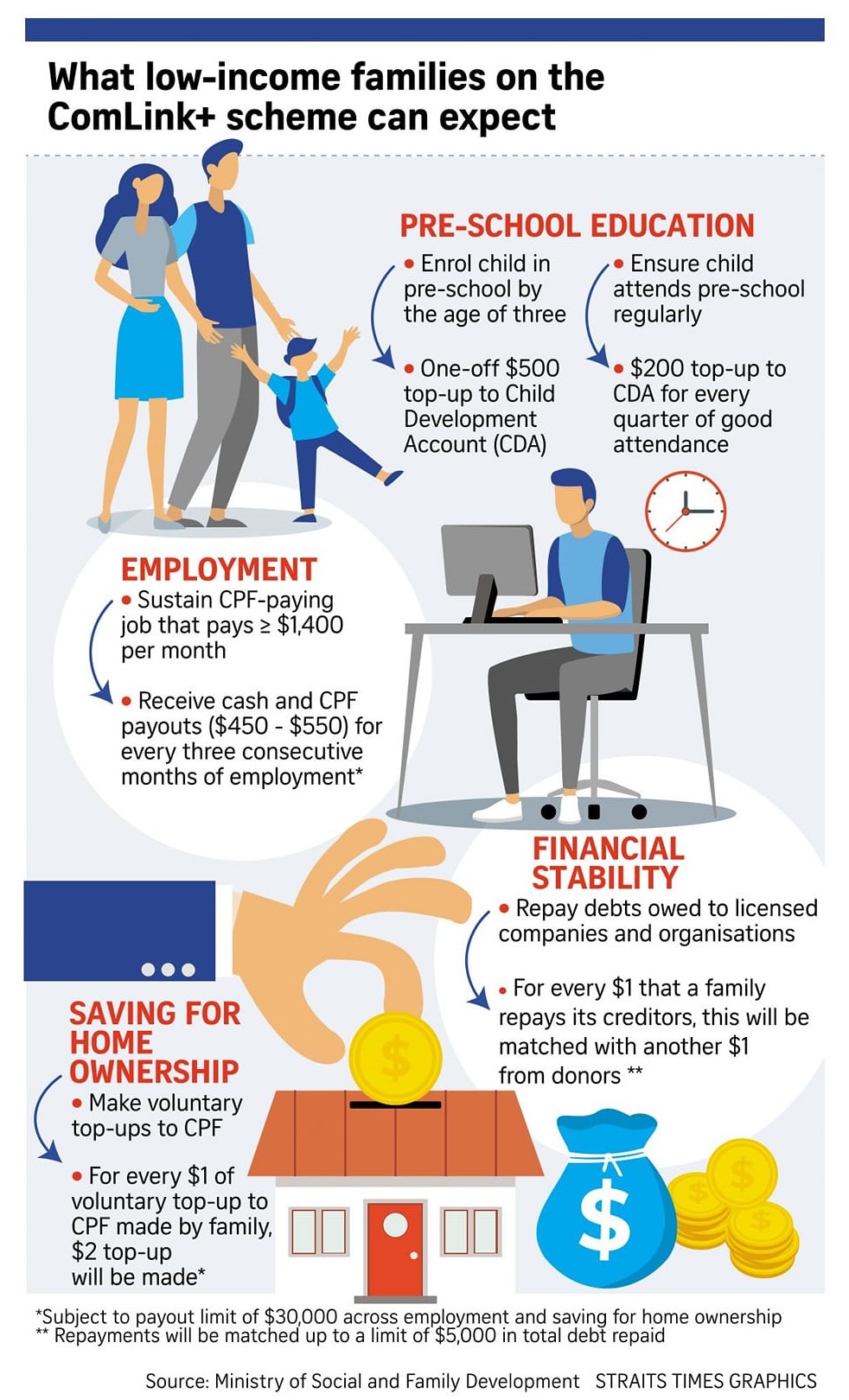
Low-income families will be given financial incentives and other support if they work towards improving their lives, in a national push to give them a leg-up.

Families with children living in highly subsidised Housing Board rental flats who qualify can get up to $30,000 in total payouts if they meet certain employment criteria and make voluntary Central Provident Fund (CPF) contributions to save up to buy their own homes.


About 14,000 families on the Community Link (ComLink) scheme are eligible for these new areas of support, which will be rolled out from the second half of 2024.

The measures are aimed at motivating families to send their children to pre-school by the age of three, find a stable job that pays CPF, and save up to buy their own homes. For example, beneficiaries can get between $450 and $550 every three months in a mix of cash and CPF payouts if they find a CPF-paying job with a salary of at least $1,400 a month.

One package helps families to clear their debt, such as for utility and housing arrears. This debt clearance package will match dollar for dollar up to $2,500 in sums repaid by the family, so the total debt cleared would be up to $5,000.

ComLink+ is a key plank of the national drive to reduce income inequality and boost social mobility under the Forward Singapore report, which was launched on Oct 27.

Speaking at the Year of Celebrating Social Service Partners appreciation event on Nov 20, Mr Masagos said: “We want Singapore to continue to be a place where social mobility is kept alive for all, especially low-income families who may face unique challenges.

“Many Singaporeans share this vision and agree that more support for low-income families is needed. At the same time, they think this needs to be done in a manner that does not erode self-reliance and agency.”


Mr Masagos described the ComLink+ scheme as a key shift beyond providing just basic, short-term social assistance. The additional financial support will help ease the financial pressures on the families and help them achieve their longer-term goals faster, he added.


“It may take a generation or more, but we know that by reinforcing families’ ability to provide their children with a good start in life today, we give them a better chance of a brighter tomorrow.”

The latest scheme builds on the existing ComLink programme that started in 2019, where low-income families with children living in HDB rental flats are given coordinated and comprehensive support ranging from job assistance to children’s development.

The ComLink+ support measures will be trialled for three years to assess their effectiveness before any potential scale-up, the Ministry of Social and Family Development (MSF) said.

Areas of support under four packages

1. Pre-school education

Each child enrolled in pre-school will get a one-time $500 top-up to the Child Development Account (CDA), which is a special savings account for the child that can be used to pay pre-school and healthcare fees, when they turn three.

Those between the ages of three and six will get a $200 top-up to their CDA every three months if they attend pre-school regularly. Regular attendance is defined as when the child is in pre-school at least 75 per cent of the time.

Local research has shown that children who attend pre-school from the age of three are less likely to require additional learning support in primary school.

However, the pre-school enrolment and attendance rate of children from lower-income families are lower than the national average, especially at the age of three and four. For example, 88 per cent of children aged three to four nationwide were enrolled in pre-school, compared with 78 per cent for those in lower-income families in 2021, the MSF told The Straits Times.

This package is funded by a corporate donor.

2. Stable employment
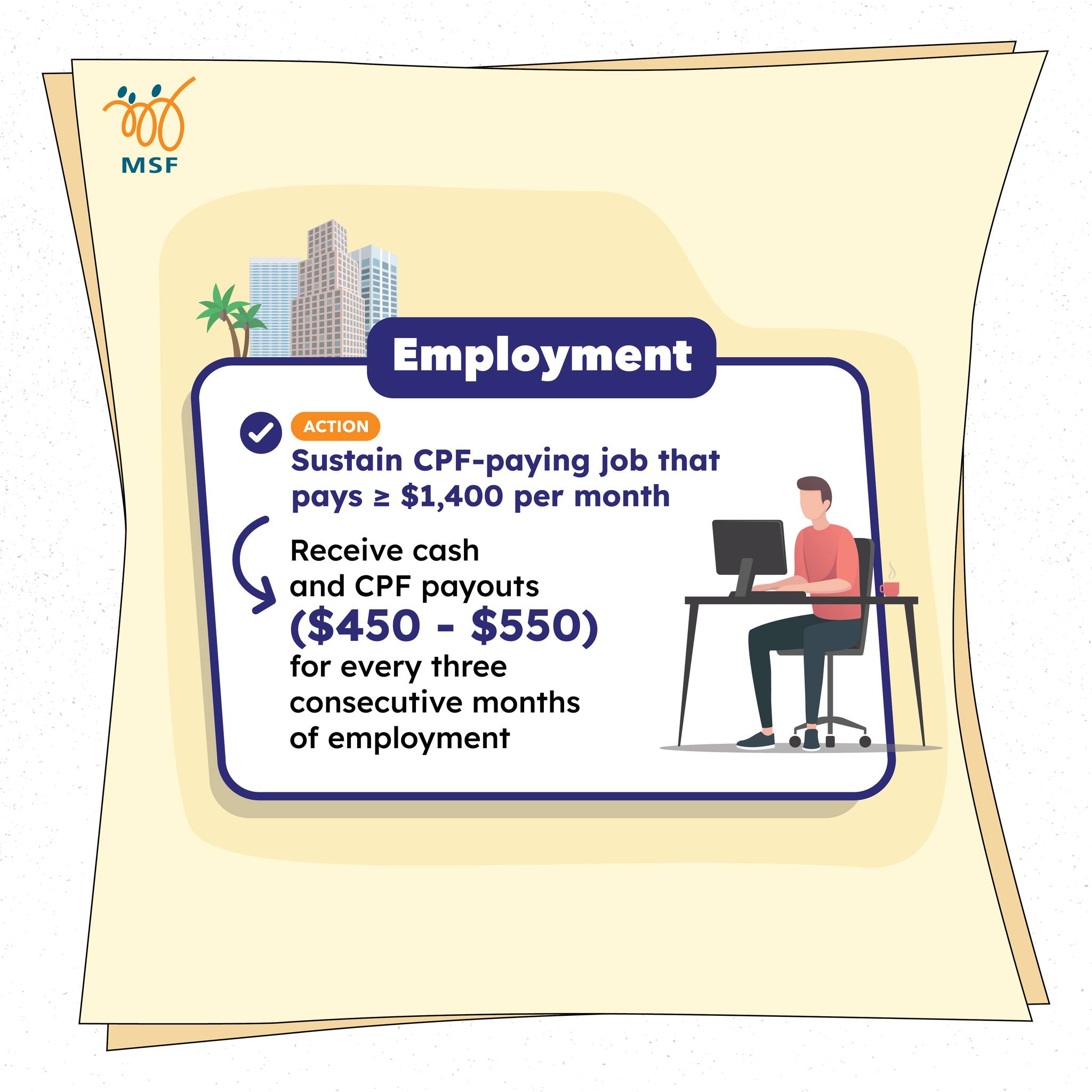
Beneficiaries will be given financial incentives if they find a job that pays CPF contributions with a gross salary of at least $1,400 a month. Each adult with a job that meets these criteria will get financial top-ups of between $450 and $550 in a combination of cash and CPF payouts for every quarter that he or she is employed.

If two adults in the same household qualify, they will each get an extra $50 every three months. A maximum of two adults per family can benefit from this employment package geared towards encouraging families to find a stable job.


3. Debt clearance

To help families clear their debt, this package will match dollar for dollar, up to $2,500, the amount the family repays for what the MSF calls verifiable debt. This refers to debt owed to licensed companies, such as utilities and housing arrears, that can be verified and for which repayments can be tracked. Debts to unlicensed moneylenders and sums owed to family and friends are not covered.

Families can benefit from this debt clearance package only once. To qualify, they must not be receiving financial aid from the Government’s ComCare scheme.

An MSF spokesman said: “With less disposable income and savings, lower-income families are more susceptible to falling into debt or arrears, especially if they encounter unexpected setbacks or have inherited debt.

“Even a relatively small debt can severely impact lower-income families financially, psychologically and emotionally, affecting their ability to resolve their debts and work towards long-term goals.”

This package is funded entirely by donors, including Singapore Pools.

4. Saving for home ownership

To help families save up to buy their own flats, for every dollar that the family voluntarily contributes to the CPF Ordinary Account, the Government will top up $2. A family can receive only up to $30,000 in total payouts across this package and the employment package. This package is funded by the Government and DBS Bank, an anchor partner for ComLink+.

Mr Masagos said over 170 partners, which includes DBS, OCBC, UOL’s Pan Pacific Hotels Group, are providing support to ComLink families in various ways.

The financial top-ups will be given for as long as the family remains eligible for the particular package or until the family reaches the payout limit specified for each package, whichever is earlier.

These four areas of support in the packages were designed based on the key needs and aspirations families on ComLink had shared, the MSF said.


Mr Masagos said ComLink officers will be trained to act as family coaches to motivate and support families in working towards their goals.

He said: “When families feel understood and supported, they are more likely to actively participate in the decision-making process and take steps towards their goals. With support from family coaches to meet their immediate needs and stabilise their situations, families tell us they feel more optimistic about their future.”

Wednesday, 13 September 2023

Halimah Yacob: A President For Everyone

Singapore’s eighth President Halimah Yacob reflects on the defining moments of her six years in office, from unlocking past reserves, to advocating for causes close to her heart.


Farewell, Madam Halimah: Singapore’s first female president’s last day in office
By Jean Iau and Natasha Ann Zachariah, The Straits Times, 14 Sep 2023

Six years after making history as Singapore’s first woman head of state, President Halimah Yacob left the highest office in the land with accolades of being a powerful symbol of unity for all Singaporeans.

At her farewell reception held at the Istana on Wednesday evening, Prime Minister Lee Hsien Loong said Madam Halimah’s efforts to expand opportunities for all made for a more united and inclusive Singapore, where everyone belongs and has a part to play.


He said that throughout her tenure, Madam Halimah showed the way with “grounded leadership, and a warm heart for the people”.

“Your ability to empathise and resonate with Singaporeans from all walks of life has brought our nation closer together, and reminded us that we all have a role to play to make Singapore a better home,” he added.


In her speech following PM Lee’s, Madam Halimah said the president plays “an important role in uniting and rallying people together”.

“In this capacity, I focused on creating a more caring, compassionate and just society,” she added.

Madam Halimah, 69, said she reached out to different communities and underprivileged people, and highlighted various programmes that she launched while in office.

She championed issues such as providing more support for caregivers, skills upgrading for lower-income families, and building interracial and interreligious harmony and social cohesion.

Diplomacy was also a key part of her work, and she saw it as a chance to raise Singapore’s international image, strengthen the nation’s bilateral ties, and open new economic opportunities for companies here.


As the first female president, Madam Halimah knew that she had the “distinct opportunity” to inspire other women and girls.

She shared that someone had told her she had “allowed people to imagine the president as a woman” and that “images and ideas give birth to reality”.

“I wish Mr Tharman Shanmugaratnam all the best in discharging his duties,” Madam Halimah said, addressing the President-elect, who was standing near the front of the audience with his wife, Ms Jane Ittogi.

Mr Tharman, 66, will be sworn in on 14 September, after securing 70.41 per cent of the vote at the presidential election on Sept 1.

As she left the podium, Madam Halimah received rousing applause from an audience of more than 200, including foreign diplomats, MPs and leaders from the social service sector.


With her husband, Mr Mohamed Abdullah Alhabshee, by her side, she received well wishes and took wefies with guests, including MPs from both sides of the House.

She had earlier in her speech called her family’s love, encouragement and sacrifices “the bedrock of (her) strength” and said she was forever grateful for their support.


Chua Chu Kang GRC MP Zhulkarnain Abdul Rahim, who was among the crowd, said Madam Halimah has been a unifying figure not just for Singapore but a symbol of aspiration for minority women everywhere.

“She will be remembered not only as a decisive president who supported the Government in steering our country out of the pandemic safely, but also as a president who is generous in lending her voice to speak up on behalf of various segments in our society such as youth, women and workers,” he said.


Before departing the Istana, Madam Halimah posed for pictures on the staircase by the main entrance with her family. She had said her farewells to members of the Istana staff earlier on Wednesday morning, shaking their hands and sharing laughs before taking a group photo.

Her aide-de-camp, Major Toh Su Sin, said it had been an honour to serve Singapore’s first female president. “As challenging as it was to plan and manage the range of events in Madam President’s packed diary, it was even more rewarding to be able to witness the difference she makes in the lives of others,” she said.

She added that Madam Halimah’s warmth and genuine care for everyone she meets will be missed.


Senior butler Zaidi Hashim recalled feeling awestruck on Madam Halimah’s first day in office. He said: “Madam President treated everyone with equal respect, dignity, and compassion – whether they were foreign dignitaries or her staff.

“It was bittersweet bidding farewell to her on her last day in office.”

Saturday, 15 August 2020

Telling stories of the marginalised in an ethical manner

Netizen meets low-income person and shares story online. It goes viral, with some blaming the Government, which then clarifies. Vulnerable person feels bruised. There are better ways to discuss poverty.
By Yuen Sin, The Straits Times, 13 Aug 2020

An episode involving a low-wage elderly cleaner that went viral last month has shed light on a problematic trend in how we discuss issues of inequality and social hardship on public platforms.

If this continues, it can lead to consequences for all parties involved, particularly vulnerable groups. The incident has also sparked discussion on how Singaporeans can discuss issues on poverty and share stories of the vulnerable in a more responsible manner.

What happened was this: Last month, a young man met an elderly cleaner, who told him that her wages are insufficient for her needs, and that she had lost her husband and only son.

He turned to Instagram and posted a story with photos of her, which gave details of how much she said she was being paid, where her workplace is, and the town where she lives.

He went on to suggest that the progressive wage model - a wage ladder that specifies higher pay for workers as they upgrade their skills - is not working, among other things.

The post was widely shared and went viral. Some concerned members of the public sought the woman out at her workplace, and even managed to trace her to her home, though the young man did not reveal her address.


However, the Ministry of Social and Family Development (MSF) later clarified details about the woman's circumstances in a Facebook post.

It gave more information on the wages that she was actually receiving and how her salary had been affected by the COVID-19 situation. It also gave details about her housing and family situation.

It also listed the various forms of financial support that she will be receiving as a permanent resident, including monthly $120 food vouchers for the next six months.

MSF also said the woman "indicated she was unaware of being photographed or that her comments and photo would be shared in public on social media".

The woman later told the young man she was "very stressed" by the unwanted attention received, according to another Facebook post he put up. He also said he apologised to her, and took down his original Instagram post.

Incidents like these are not new; as far back as 2013, online posts about individuals facing hardship have attracted scrutiny. They play out in a similar trajectory. Someone meets a poor or vulnerable person, talks to the individual and posts a story online. After attracting public sympathy, the story goes viral. The authorities then rush to investigate the matter and issue a public clarification, if details of the original post were inaccurate or if it has sparked discussion.

THE DANGER OF RELYING ON A SINGLE STORY

Personal anecdotes and stories help people develop understanding of and empathy for social issues. But it is problematic to rely on a single anecdote to make sweeping generalisations about Singapore's social policies.

After all, the existence of people who need help or fall through the cracks is not evidence of systemic failure on the part of the Government, though there is certainly room for policies to evolve.

In the recent case and other similar episodes in the past, vulnerable individuals whose details are shared online involuntarily get caught in the crossfire between vociferous netizens, who criticise the Government after reading the story, and public agencies, which want to clarify facts to defend themselves.

Their privacy may end up being sacrificed as a result, as various parties share, debate and scrutinise details about them released online. Yet others may question their motives, pronounce judgment or make denigratory remarks.

Friday, 7 August 2020

Senior activity centres zoom in on virtual care during COVID-19 pandemic

Moves to help seniors be more tech-savvy so they can connect with others amid pandemic
By Theresa Tan, Senior Social Affairs Correspondent, The Straits Times, 6 Aug 2020

Retired bartender Yong Chow Foo, who has no children, used to visit the Care Corner Senior Activity Centre in Woodlands every weekday to chit-chat and play card games like rummy with other old folks.

When the coronavirus pandemic struck and Singapore enforced the two-month-long circuit breaker, senior activity centres were closed and life became boring, particularly so for Mr Yong as he is not tech-savvy.

The 80-year-old uses his mobile phone for calls but does not know how to use a computer, surf the Web or send e-mails.

Mr Yong, who lives in a one-room rental flat with his wife, recalled in Mandarin: "It felt suffocating as we stayed at home all day, watching TV or staring at the walls."

But now that senior activity centres have reopened, a new life is opening up for Mr Yong, as they are teaching seniors how to go online and have some fun.

Recently, staff from Care Corner Singapore lent Mr Yong a SIM card with a data plan, installed the Skype app on his phone and taught him how to log on to activities through it.

On July 24, he went to the Woodlands senior activity centre to join a virtual tour of Gardens by the Bay with nine other seniors. At the centre, he could either use his phone to take part in the virtual tour or watch it projected onto a screen through a live stream. He chose the latter option.

A group of seniors from another Care Corner senior activity centre also joined the virtual tour, and a few others did so from their homes through Skype.

Conducted through a live stream by a horticulturist, the virtual tour was the first by Gardens by the Bay.


OCBC Bank employees who volunteer at Care Corner Singapore were also at the senior activity centre to interact with the seniors.

Mr Yong described the virtual activities as interesting, though they felt foreign to him.

Singapore has 78 senior activity centres, according to the Yearbook of Statistics 2019. These centres usually hold activities such as mass exercises and karaoke sessions for seniors to socialise with one another.

Social workers say those who attend the events are poor, often live alone and have little or no support from their families. But at the centres, they can interact with other seniors while staff keep an eye on them.

But as large group outings or gatherings are not possible now to keep the coronavirus at bay, the centres have turned to virtual outings and online activities to engage seniors.

These centres are teaching seniors how to use communication tools such as WhatsApp and Zoom and to go online for various activities.

Ms Sandy Goh, manager at Touch Senior Activity Centre, said: "The pandemic has disrupted the way we do things. We have to rethink the way we deliver our services so that seniors will continue to get the help they need."

Wednesday, 27 May 2020

Fortitude Budget: Singapore Government sets aside $33 billion more to help workers, businesses in fourth COVID-19 support package

$33 billion set aside in Fortitude Budget, Singapore's fourth Budget in less than four months, bringing Singapore's COVID-19 war chest to nearly $100 billion
Unprecedented crisis calls for landmark package to help Singaporeans: DPM Heng Swee Keat
By Lim Yan Liang, Assistant Political Editor, The Straits Times, 27 May 2020

Deputy Prime Minister Heng Swee Keat yesterday announced a $33 billion supplementary Budget aimed primarily at helping workers and businesses pull through the COVID-19 pandemic and the bleak economic outlook ahead.

Called the Fortitude Budget, Singapore's fourth Budget in less than four months sets aside $2.9 billion to extend job protection and co-pay salaries to help firms retain workers. It also provides for the $3.8 billion that went towards helping Singaporeans tide over the extension of the circuit breaker measures.

Together with the earlier Unity, Resilience and Solidarity Budgets, the Government is dedicating close to $100 billion - or nearly 20 per cent of gross domestic product - to support Singaporeans in this battle against COVID-19, said Mr Heng, who called it "a landmark package, and a necessary response to an unprecedented crisis".

Singapore's economy has been deeply impacted by the global shocks caused by COVID-19, said Mr Heng, who is also Finance Minister, as he introduced the Budget in Parliament.

He noted that the resident unemployment rate rose to 3.3 per cent in March, the highest in over a decade. The economy is now expected to shrink between 4 per cent and 7 per cent this year, potentially Singapore's worst recession since independence.


Still, Prime Minister Lee Hsien Loong said the Republic is in a strong position to overcome this crisis and emerge stronger due to the Pioneer Generation's sacrifices and stewardship, and the fiscal prudence and discipline of successive governments.

"Saving and creating jobs will be our priority," wrote PM Lee on Facebook yesterday, while stressing that no one will be left behind.

"We will help businesses adapt and transform, create new jobs and provide more training opportunities to workers."

Mr Heng also underscored the focus on jobs. Payments under the Jobs Support Scheme will be extended by one month to provide more relief to firms as they reopen after the circuit breaker period.


In total, the Government will disburse $23.5 billion to support firms' wage costs for 10 months, said Mr Heng.

Businesses such as retail outlets, gyms and cinemas that cannot reopen immediately after the circuit breaker period ends on June 1 will continue receiving 75 per cent wage support until August or when they can resume operations, whichever is earlier.


There will also be help for businesses in the construction and offshore and marine sectors which cannot resume operations on-site for now. They will see the foreign worker levy waiver and rebate extended for up to two months.

Business costs will be cut further as the planned increase in Central Provident Fund contribution rates for senior workers will be deferred by one year to January 2022.


As a landlord, the Government will lead by example by providing two more months of rental waivers for commercial tenants and hawkers, and one more month of rental waivers for industrial, office and agricultural tenants.

A Bill will be introduced next week mandating that landlords grant a rental waiver to their tenants who are small and medium-sized enterprises and have suffered a significant revenue drop.


Households with at least one Singapore citizen will also get a one-off $100 Solidarity Utilities Credit to offset their utility bills, on top of the U-Save Special Payment that was previously announced.

Mr Heng also launched an SG United Jobs and Skills Package to create close to 100,000 opportunities in three areas - 40,000 jobs, 25,000 traineeships and 30,000 paid skills training places.

This Budget will require a further $31 billion to be drawn from past reserves, which President Halimah Yacob has given in-principle support for. In all, the Government is looking at drawing up to $52 billion from the reserves this financial year, said Mr Heng.

"While we will try to preserve jobs in the midst of this crisis, we cannot protect every job," he said. "However, you have my assurance that the Government will protect every worker."

"Our promise to workers is this: As long as you are willing to pick up new skills and adapt, to access available opportunities to work or learn, the Government will provide our strongest support to help you."


Parliament will debate the Budget when it next sits on June 4.

Saturday, 9 May 2020

Life will not go back to normal after COVID-19 circuit breaker ends on 1 June 2020: Lawrence Wong

All staff, residents at homes for the elderly to be tested for COVID-19

Vulnerable seniors being supported during circuit breaker

Public urged not to rush out when measures ease on 12 May

40,000 daily tests have to be done in strategic, coordinated way

Clearing smaller dorms of coronavirus will take time

Ministry of Manpower takes 228 companies, work pass holders to task for flouting circuit breaker rules, stay-home notices

Contact tracing dongle among options being explored to boost tracking


Coronavirus curbs won't all be lifted after 1 June 2020, says Lawrence Wong
By Toh Wen Li, The Straits Times, 9 May 2020

Life will not go back to normal immediately after June 1, when Singapore's COVID-19 circuit breaker period comes to an end, said National Development Minister Lawrence Wong during a virtual press conference yesterday.

While the Government will continue to monitor and assess the situation in the coming days and weeks as it decides what should be done after the circuit breaker, he stated categorically that there was no scenario where normalcy returns next month.


"Whatever the decision, whatever happens in the coming days or weeks, it is clearly not going to be the case that after June 1 everything will be lifted, and we will go back to status quo ante."

Rather, Singapore will see a "gradual, calibrated easing", said Mr Wong.

"The baseline protection will have to remain - things like safe distancing measures, the wearing of masks when you go out, or at work; all of these will remain post-June 1.

"Beyond these baseline measures, the extent to which we can do more reopening of workplaces - that's something that we will have to consider."


The country's stricter social distancing measures, which the Government calls a circuit breaker, came into force on April 7 and were to last till May 4. It was later extended to June 1.

Some additional precautions will be in place after June 1, including measures involving the use of technology like digital check-in system SafeEntry at workplaces, an enhanced TraceTogether app, and possibly a dongle that people can carry around to help with contact tracing.

Thursday, 30 April 2020

National Care Hotline has received 6,600 calls since its launch on 10 April 2020

Some ask about COVID-19, support measures, while others call over financial issues, anxiety
500 volunteers have stepped up so far: Desmond Lee
By Goh Yan Han, The Straits Times, 30 Apr 2020

More than 6,600 calls have been made to the National Care Hotline - 1800-202-6868 - since its launch on April 10, said Minister for Social and Family Development Desmond Lee in a Facebook post yesterday.

There have been about 380 calls a day, of which more than 40 per cent are channelled to the hotline's trained professionals. The other calls are diverted to other helplines for their specific needs.

Mr Lee said about 500 volunteers take turns manning the 24-hour hotline, which was set up to provide psychological first aid and emotional support to those who need it during the COVID-19 crisis.

About 22 to 25 from a pool of psychologists, counsellors, social workers, psychiatrists and public officers are rostered daily across three eight-hour shifts.

"Each call is unique, and gives us a glimpse into the multifaceted challenges different individuals are facing in this crisis," said Mr Lee.

In a Zoom interview with the media on Tuesday, Ms Vivienne Ng, chief psychologist of the Ministry of Social and Family Development, said that of the callers directed to the volunteers, 15 per cent have asked about COVID-19 and support measures such as the Temporary Relief Fund and public financial assistance scheme ComCare, while another 14 per cent were calling due to anxiety.

Eleven per cent called about financial issues, while 10 per cent sought emotional support.

Another 6 per cent were facing family conflicts, divorce and parenting issues, while 4 per cent of callers had experienced aggression by family members.

In such situations, the professional would advise them to call the police or the adult or child protective services, or a family violence specialist centre, said Ms Ng.

When those on duty take calls, they carry out psychological first aid and try to link the callers up with family and friends.


Alternatively, the callers are connected to a network that includes community resources such as social service agencies, which can provide more specialised help on a more prolonged basis, Ms Ng said.

She added that she was particularly concerned about an increase in depression among people over the medium to long term if there is a prolonged period of recession.

Wednesday, 19 February 2020

Family violence: Inter-agency task force formed to tackle violent family abuse and give better support to victims

Inter-agency task force aims to address problem, give better support to victims
By Cara Wong, The Straits Times, 18 Feb 2020

A new inter-agency task force has been set up to address the problem of violence within families and give better support to victims.

Co-chaired by Senior Parliamentary Secretary for Home Affairs Sun Xueling and Senior Parliamentary Secretary for Social and Family Development Muhammad Faishal Ibrahim, the task force aims to increase public awareness of the issue, and come up with initiatives like a dedicated national hotline for victims of family violence.

This comes against the backdrop of increasingly violent family abuse cases, with victims reporting more acts of violence in their applications for personal protection orders.


Last year, for example, victims reported 4,224 types of violence in the 2,452 applications for personal protection orders filed against their family members.

Each applicant can indicate up to four different types of violence committed against them in their application, including wrongful confinement, continual harassment, placing a person in fear of hurt, or knowingly causing hurt.

The figure last year was a 21 per cent jump from the 3,497 types of violence reported in 2016, despite the higher number of personal protection orders filed four years ago. There were 2,811 applications for personal protection orders filed in 2016.

"It is clear that we will need to do more together - be it lowering barriers to seeking help or furthering coordination, both within Government and with our community partners," Ms Sun said yesterday while speaking at an event at PAVE, which specialises in family violence.


The task force will work on allowing family violence victims access to a scheme called the Home Team Community Assistance and Referral Scheme (CARES).

Under Home Team CARES, social workers stationed at police divisions assess what type of intervention is required for the offender, and refer them to suitable agencies for help in different areas, such as financial assistance or counselling sessions.

It was piloted in January last year at the Bedok Police Division and the police are looking to extend the scheme to all divisions.

Ms Sun said that there was potential for family violence victims to benefit from having similar access to social assistance.

Saturday, 4 January 2020

Singapore Together movement: 4G leaders want to partner citizens in more areas

Range of issues the Govt hopes to work with people on is virtually endless, says Indranee Rajah
By Tham Yuen-C, Senior Political Correspondent, The Straits Times, 3 Jan 2020

Six months after the fourth-generation political leaders launched a new movement to get citizens to help shape policies in areas such as work-life harmony and recycling, they want to do more.

A Citizens' Workgroup is being set up to explore ways to reduce the use of single-use plastics, and a Community Link-Uplift collaboration is being launched for residents and others to better support children from low-income families.

At an interview with local media on Monday, Second Minister for Education and Finance Indranee Rajah said the range of topics that the Government hopes to work with people on "is virtually endless". Even contentious issues will not be taboo, she said when asked if the Government would partner people on issues such as lesbian, gay, bisexual, transgender and queer rights, and Housing Board leases.

Minister for Social and Family Development Desmond Lee said such issues have already been discussed and the Government's forays into new approaches could provide new ways to "solve certain challenges and build consensus".

The two ministers, who are key members of the ruling People's Action Party's fourth-generation (4G) leadership team, were giving an update on SG Together, which was announced by Deputy Prime Minister Heng Swee Keat in June last year.

Since then, various ministers have spoken about how their ministries plan to work with people on issues as diverse as housing, the digital economy and education.


Ms Indranee said this represents an evolution of the way the Government has been doing things, and will become part and parcel of the way it engages with citizens.

"Going forward... everything that we do that impacts on citizens, and depending on the nature of the things, will involve some form of citizen engagement," she added.

"The 4G leaders are very conscious of the fact that it is not just about being in government. You are elected by the people...(and) Singaporeans must have the ability to have a say and shape our future."

By bringing people together, said Mr Lee, the Government also hopes to create opportunities for groups with different viewpoints to talk and try to find win-win ways forward. This can help to prevent the kind of polarisation that has happened in many countries, where people with different interests have pulled society apart, he added.

"We do this to also harness the energy and the collective wisdom of the community. Government won't have all the solutions and won't be able to solve every problem on its own with increasing difficulties and challenges ahead of us."

Working with Singaporeans and community groups has also changed the Government's viewpoints and approaches to certain issues, both ministers said. For instance, the Ministry of Social and Family Development (MSF) had asked to partner a network of non-governmental organisations helping the homeless.

Mr Lee said: "Working with partners, we changed our mindset. We have improved our processes and we have adopted new ideas."

Engagement sessions with social service agencies also informed the new approach of the Ministry of Education and the MSF towards helping disadvantaged children by better coordinating the available social services, said Ms Indranee.


Some initiatives under SG Together could also translate into measures in this year's Budget. The RecycleRight Citizens' Workgroup has resulted in four pilot projects which will be formalised early this year, while the Citizens' Panel on Work-Life Harmony has concluded with 17 recommendations that the Government will respond to early this year.

"Not all of the ideas are going to be able to be translated into Budget measures. But the ones that can and the ones that are relevant and timely, we will," said Ms Indranee.

As to how the Government will measure the success of SG Together, she said: "When it becomes an automatic reflex action that whenever we want to do things, agencies' first thought will be: How can we get people's input and participation in this?

"On the other hand, when the citizenry wants to do something, their first thought is: How can we work together with others and the Government to make this happen?"