Showing posts with label Income Inequality. Show all posts

Sunday, 24 November 2024

Hawker culture debate: The missing ingredient is our willingness to pay

Nostalgia over hawker culture may have trapped us into an outdated view that hawker fare must always be very cheap.
By Chua Mui Hoong, Senior Columnist, The Straits Times, 23 Nov 2024

Perhaps it is no coincidence that while we wring our hands about how to make hawker culture sustainable in Singapore, hawker fare is thriving in Perth.

This crossed my mind while I was having kopi-o gau and kaya toast one morning in Perth, where I now live, and the thought developed over the next day, when I had nasi lemak and kopi peng.

For those who don’t know, Perth is home to a multitude of Singaporean and Malaysian restaurants and cafes whose selling point is hawker food.

My nasi lemak here cost A$14.50 (S$12.70) and came with a small mix of fried peanuts and anchovies, one hard-boiled egg and a whole deep-fried chicken thigh. Kopi peng was A$5. My kaya toast and kopi-o set was A$12.50.

I have gone beyond feeling shock at the higher prices for hawker food in Perth. This is Australia, after all, where the minimum wage is A$24.10 an hour. Restaurants close in the afternoon before reopening for dinner, as it isn’t worth paying wages to remain open for the odd customer who comes in mid-afternoon. Eating out is expensive, so most people cook and eat at home.

In Singapore, cooked food prices remain very affordable, especially in hawker centres and coffee shops. A similar kaya toast set with a beverage, plus two soft-boiled eggs, would cost me around $3 in a hawker centre or coffee shop in Singapore. NTUC Foodfare even sells this signature breakfast set for $2.20, with union members getting a special price of $1.80 for a beverage, one slice of kaya toast and two soft-boiled eggs.

How little is too little for a kaya toast set?

Local food chain Toast Box charged $7.40 for its kaya toast set, drawing flak online. A reader posted a photo that showed the same set had cost $5.70 in 2020. A subsequent online poll found that 88 per cent of 7,425 respondents thought a kaya toast set should not cost above $5.

It got me wondering why hawker culture is facing an existential threat in Singapore, but Malaysian and Singaporean eateries, offering similar fare, do a roaring trade in Perth. Could the prices of hawker fare hold the key?

The issue cropped up in Parliament last week, when the Progress Singapore Party’s leaders moved a motion calling for a review of hawker policies. The motion was reworded by People’s Action Party MPs to call for a regular review of hawker policies that can “sustain and grow Singapore’s hawker culture so that Singaporeans can continue to enjoy good and affordable hawker food while enabling hawkers to earn a fair livelihood” (italics mine). The amended motion was passed by all MPs, showing cross-party support for hawker culture.


Hawker culture unifies Singaporeans. Hawker centres bring together diners of different races, ages, and social strata to enjoy food derived from our multiracial heritage. A millionaire towkay may sweat through his bowl of mee rebus, seated at the same table as the single mum sharing wonton mee with her child.

Hawker culture also comes with a certain heritage. The early hawker centres built in the 1970s housed former street hawkers and rented out food stalls at low rates to a generation of less-educated, low-income Singaporeans who sold cooked food or drinks to make a living. A hawker stall provided a humble, yet secure, means of livelihood. My parents, who emigrated from China to Singapore in the 1950s, belonged to that group. Their stall in an ulu (remote) part of Singapore in Pasir Panjang, near an oil refinery, enabled them to sell char kway teow and other dishes, and to put three children to school.

Many Singaporeans, like me, are deeply proud of the working-class roots of hawker culture. We want hawker centres to continue being mass dining halls for all. We don’t want them gentrified or made hipster.

Most Singaporeans will have their favourite hawker stall or coffee shop where they enjoy their morning teh or kopi, where they go for their fix of mee siam, chicken rice or nonya kueh. As an emigrant who now lives overseas, I plan my visits back to Singapore around the hawker food I miss – my favourite bak chor mee in the Veerasamy area, the prawn noodle and chicken rice at Shunfu Mart near my old home, and a recent discovery – the Teochew soon kueh at the social enterprise Yoon’s Social Kitchen in Aljunied. When I meet a new Singaporean kaki in Perth, it is nearly always to catch up over hawker fare in a Singaporean or Malaysian eatery.

Singapore hawker culture has become a strong unifier for its people. We should do our best to promote it, and sustain it.

Sunday, 14 July 2024

Singaporeans identify items deemed essential for a normal life in Singapore: Household Needs Study by SMU

Singapore residents say Air-Con, Smartphones, Short Holidays are essential: Study by Singapore Management University
Most Singapore residents prioritise self-reliance for essential needs: Institute of Policy Studies poll from May 2022 to February 2023
By Shermaine Ang, The Straits Times, 12 Jul 2024

More than nine in 10 Singapore residents polled in a new study said a smartphone with a data plan is essential, while 64 per cent think air-conditioning is a must.

A trip each year to a South-east Asian destination is also essential, said 56 per cent of those polled. And social connections are important too, with 90 per cent saying family bonding is essential.

These were among 40 items and activities that respondents deemed essential in the study on household needs conducted by Singapore Management University (SMU) and funded by the Ministry of Social and Family Development (MSF).

It polled a nationally representative sample of around 4,000 Singapore residents and comes amid growing public interest in the resources needed to achieve basic living standards.

Respondents were asked how essential they considered a total of 51 items and activities across categories such as household appliances, digital connectivity and social participation.

Essential items were those perceived to be so by at least half the respondents.

The study – which also included respondents taking part in focus group discussions between May 2022 and February 2023 – focused on affordability of essential items and attitudes on poverty.

For example, two-thirds of respondents said they were able to afford all the items deemed essential.

For the remaining one-third, the top essential items they cited being unable to access or afford included emergency savings of at least three months of expenses and an annual overseas vacation in a South-east Asian country.


A separate study done by the Institute of Policy Studies (IPS) that garnered 2,000 responses collected in June 2024 looked at public perceptions of who should provide for essential needs, be it the Government, the community, the individuals themselves or other parties.

Key findings from both studies were presented on July 12 at the SMU-DBS Foundation Symposium on Essential Household Needs in Singapore.

Director of SMU Centre for Research on Successful Ageing Paulin Straughan, who led the first study, said the hope is to reveal the gaps that may aid efforts to help disadvantaged Singaporeans break out of deprivation, which is defined in the study as being unable to afford items considered essential.

Sharing other insights, she noted that perceptions towards higher expenditure activities and items like holidays and the need for adequate savings differed across income groups.

Households in the lowest income group earned up to $2,499 a month while the top band earned over $17,000 a month.

One in two among the lowest income band see dining at restaurants once a month as essential, compared with over 60 per cent in higher income bands.

And only 49 per cent in the lowest income band see air-con as essential, compared with 70 per cent in the highest income band.

Items deemed unnecessary by respondents included private tuition – considered essential by 49 per cent of respondents – private enrichment classes (30 per cent) and annual staycations (27 per cent).

Respondents thought students can get help from free tuition classes offered by self-help groups rather than more costly private options – such tuition classes were seen by nearly 60 per cent of respondents as essential.


On poverty, the study showed that most believed it is attributable to personal actions and circumstances. Some 80 per cent think people are poor because they face major problems in their lives, while less than a quarter agreed that poverty is due to external factors like bad luck or divine will.

Prof Straughan said: “There’s a lot more consensus on what we can do to help ourselves... it tells us that from an approach perspective, Singaporeans can be helped and they are willing to be helped.”

She said the next run of the study may be done in five years’ time, to see if new interventions introduced can plug the gaps found, such as the lack of emergency savings.

Speaking at the symposium on July 12, Minister for Social and Family Development Masagos Zulkifli said the studies by SMU and IPS will inform MSF’s ongoing review of its ComCare scheme for low-income families. He cited how ComCare assistance now covers mobile data plans as digital connectivity has become an essential need.


Mr Masagos said the research shows there are differing views on what needs are deemed essential, particularly for items that go beyond subsistence needs.

Implicit in these views is the public’s understanding that social assistance provided by taxpayers must be reasonable and sustainable, he added.

“The studies also show that there is much room for others besides the Government to provide support for low-income and vulnerable families.”

Saturday, 15 June 2024

What the West can learn from Singapore

Data shows that in key areas, Singapore is better at governing than the US and Britain.

When asked whether the US government works, most Americans say no. According to recent polling by Ipsos, more than two-thirds of adults in the United States think the country is going in the wrong direction. Gallup reports that only 26 per cent have confidence in major US institutions, such as the presidency, the Supreme Court and Congress. Nearly half of Americans aged 18 to 25 say that they believe either that democracy or dictatorship “makes no difference” or that “dictatorship could be good in certain circumstances”. As a recent Economist cover story put it: “After victory in the Cold War, the American model seemed unassailable. A generation on, Americans themselves are losing confidence in it.”

Most Singaporeans have a very different outlook on their government, a managed political system that has elections but nonetheless facilitates the dominance of one party, the People’s Action Party. According to a Pew Research Centre report, three-quarters of Singaporeans are satisfied with how democracy is working in their country. Moreover, 80 per cent think their country is heading in the right direction – the highest number in any of the 29 countries surveyed in the May Ipsos poll.

In 2024, both the United States and Singapore are facing one of the most challenging tests of any system of government: the transfer of power from one leader to the next. Textbooks on government identify this as an arena in which democratic systems have the greatest advantage over authoritarian or managed alternatives. Yet, as 2024 shows, that isn’t always the case.

In May, as then Prime Minister Lee Hsien Loong passed the baton to his chosen successor, Mr Lawrence Wong, Singaporeans almost unanimously applauded the orderly, peaceful transition. In contrast, Americans’ sense of gloom is growing as they approach a presidential election in which voters will have to choose between two candidates who claim that the other’s victory would mean the end of US democracy. According to an April Reuters/Ipsos poll, ttwo-thirds of US voters believe that neither candidate should be running.

These comparisons invite the question: Is Singapore simply better at governing than other countries?

To answer this, consider the following three Report Cards, which use data from international organisations to assess Singapore alongside two countries holding major elections in 2024: the United States and Britain. Each report card grades the countries on how well they have fulfilled the requirements that Singapore’s founder and first prime minister, Mr Lee Kuan Yew – the father of Mr Lee Hsien Loong – believed were the functions of government: to “improve the standard of living for the majority of its people, plus enabling the maximum of personal freedoms compatible with the freedoms of others in society”.


The first Report Card considers citizens’ well-being, which we’ve assessed based on categories for which there is ample data, such as income, health, safety and sense of security.

The second Report Card covers what the World Bank calls “governance”, or a government’s effectiveness in facing issues, making policy choices, executing policy and preventing corruption.

The third Report Card, which considers both individual rights and citizens’ satisfaction with their government, is more difficult to interpret. It includes the judgments made both by international organisations and by polls that gauge how citizens feel about their democracy.

It’s worth reflecting on nine takeaways related to these Report Cards. First, Mr Lee Hsien Loong left to his successor a population that is now wealthier than Americans – and almost twice as wealthy as their former British colonial overlords.

When he took office in 2004, the so-called Singapore miracle had already happened: Singapore’s economy had soared since the 1960s, taking the country from poverty to having a gross domestic product (GDP) per capita that was approximately three-quarters of that of the United States, where many analysts thought it would remain. Yet 20 years later, Singapore’s GDP per capita is more than 4 per cent higher than that in the United States: $88,500 compared with $85,000.

Second, while rapid economic growth often produces greater income disparity, over the past two decades, Singapore has reduced inequality significantly – from 0.47 to 0.37 (as measured by the Gini coefficient, a measure by which 0 equals complete equality and 1 represents complete inequality) – while the United States has remained around 0.47. (For comparison, China’s Gini coefficient is 0.46, and the country with the highest level of inequality is South Africa, with 0.63.)

Third, Singaporeans are generally healthier and live longer than their counterparts in the United States and Britain. Just 20 years ago, life expectancy in all three countries was approximately the same. Today, the life expectancy in Singapore is longer (83 years) than that in the United States (76 years) and Britain (81 years). Singapore’s infant mortality has fallen from 27 deaths per 1,000 births in 1965, to 4 in 2004, to 1.8 today – considerably lower than both other countries. Furthermore, 93 per cent of Singaporeans express satisfaction with their healthcare system, in contrast to 75 per cent of Americans and 77 per cent of Britons.

Fourth, Singapore was clearly best prepared for a major public health crisis. Because the Covid-19 pandemic struck all countries around the same time, it provided a clear test of their response systems. On a per capita basis, around 10 Americans or Britons have died from Covid-19 for every one of their counterparts in Singapore.

Friday, 15 December 2023

Cost of living means different things to different folks in Singapore

The Economist’s Worldwide Cost of Living index does not shed light on the bills that ordinary Singaporeans pay.
By Lin Suling, Opinion Editor, The Straits Times, 13 Dec 2023

As a sign of the lengths Singapore will go to in a bid to up its wow factor and entice more travellers here, consider the dramatic four-storey waterfall display unveiled at the recently refurbished Changi Airport Terminal 2 in November.

Just about everyone I know has already visited the attraction, now the centrepiece of the T2 departure hall, and told me the four-minute musical extravaganza is not to be missed.

Now, you may be forgiven for confusing this 14m by 17m digital display with the man-made, HSBC-sponsored rain vortex at Changi Airport’s Jewel, which was opened a mere four years ago. That spectacular sight remains the world’s tallest indoor waterfall.

If two waterfalls – one digital, one physical – sound like overkill, that is probably precisely the intent. Singapore is already home to the world’s largest air-conditioned glass greenhouse, Gardens by the Bay, and hosted the first Formula One night race globally.

We must keep filling this carousel of new shiny things so we can remain vibrant and attractive to visitors, investors and corporate leaders.

Singapore thus far seems to be doing this well. Why else would expats keep coming back to Singapore despite it being billed the most expensive city nine times in the last 11 years by The Economist?

News of Singapore – along with Zurich – topping the 2023 Worldwide Cost of Living index on Nov 30, nonetheless, raised many eyebrows.

Many Singaporeans have suggested that it confirms their longstanding concerns that making ends meet in Singapore is becoming an uphill climb for the man in the street.

Online, netizens cite anecdotal experiences corroborating this jump in prices, from the doubling of the cost of a bowl of fish soup at their local coffee shop to complaints about certificates of entitlement (COEs).

Another pointed to news of thwarted attempts to smuggle 120kg of beef and pork as an unequivocal sign that more Singaporeans are turning to the black market to fill their stomachs. Never mind that meat smuggling is possibly the most creative strategy to beat inflation nobody has ever heard of.

And most discussions eventually reached the same conclusion: that the Singapore Government has slipped, in letting in foreigners who push up prices while leaving Singaporeans behind.


The most expensive city in the world for whom?

What to make of all this? Some information about how the Worldwide Cost of Living is put together offers perspective.

The full index of how cost of living stacks up across 173 countries is available only with a US$1,195 (S$1,602) fee. Its website suggests this full report is useful for human resources, corporates, financial institutions, and legal and insurance firms, as “this purpose-built Internet tool quickly calculates cost-of-living allowances and (aids in) building compensation packages for expatriates and business travellers”.

A closer look at the items used in this benchmark of relative cost of living, which is meant to be a comprehensive dataset of over 400 individual price points across 200 goods and services, throws up things such as international school tuition fees, public golf course fees and three-course dinners.

These may just be a few outliers that stick out. Even so, not only are they hardly stuff the average Singaporean spends on, they are also more accurately the make-up of what the typical expat around the world splurges on.

Here in Singapore, I would also add to this list the doubling of Additional Buyer’s Stamp Duty for purchases of homes by foreigners, and higher personal income taxes for top earners beginning from the 2024 year of assessment.

Curiously, despite these higher projected expenses, the foreigners just keep coming.

Saturday, 28 October 2023

Forward SG report unveils social support plans, lays out mindset shifts needed amid changing times

Moves to ensure basic needs of Singaporeans are met and social compact is refreshed
By Goh Yan Han, Political Correspondent, The Straits Times, 27 Oct 2023

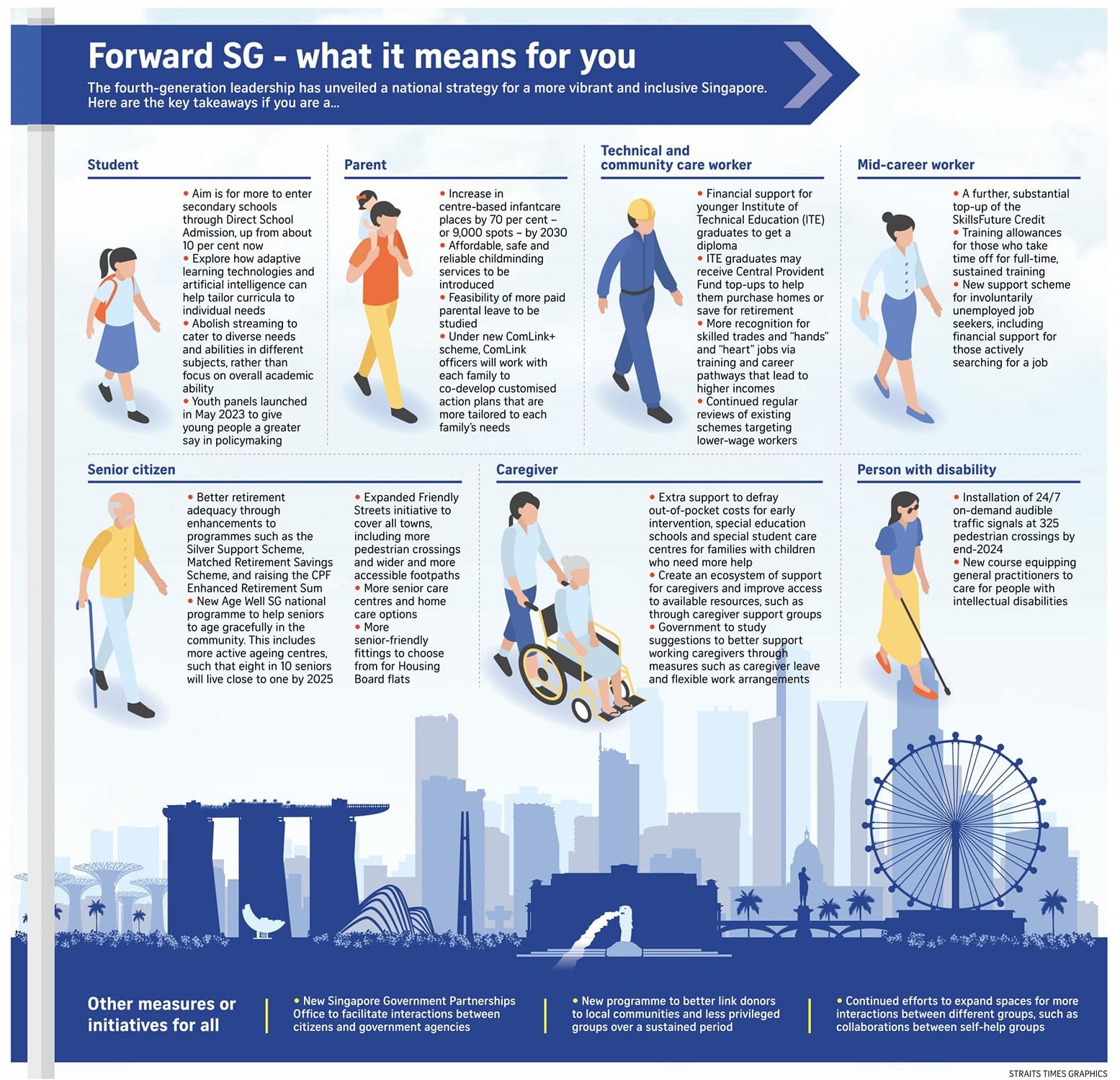
A road map towards a more equitable and thriving Singapore has been put forth by the fourth-generation (4G) leadership, fleshing out the moves the Republic will make in the coming years to stay cohesive amid a time of change.

These include a greater helping hand for groups such as the less well-off, mid-career workers and seniors, through means such as additional financial support and improved infrastructure.

And there will be more done to ensure that Singaporeans’ basic needs at every life stage will be met, such as in education, retirement, healthcare and housing.

These moves come as Singapore has reached a key inflection point where there will be more disruptions, workplace churn and impact on people’s lives, and the Government recognises that more must be done to provide assurance for the people, said Deputy Prime Minister Lawrence Wong at a press conference to launch the Forward Singapore report.


The 180-page report unveiled on Friday also articulated the mindset shifts required for Singapore to achieve the goals set out, such as for wider definitions of success and a stronger sense of collective responsibility towards one another.

It will not be possible for the Government alone to do everything through policy changes, nor is it possible for any individual to succeed on his or her own efforts alone,” DPM Wong said later at the launch of the Forward Singapore Festival, where the public can learn more about the report’s initiatives.

Instead, it will be up to everyone, including employers, community groups, families and individuals, to keep the Singapore miracle going, he added.


The report caps off a nationwide engagement exercise headed by Mr Wong that has involved more than 200,000 Singaporeans since it kicked off in June 2022.

The exercise sought to refresh Singapore’s social compact – the glue that holds society together – given the challenges facing the island, which range from a more fraught external environment to a rapidly ageing population to greater job insecurity due to rapid technological change.

One key move the 4G team intends to make to take the country forward is to create more opportunities for all Singaporeans to chart their own paths in life. This includes increasing salaries and respect for a wider range of vocations, better social support for those who face career hurdles, and nudging those who succeed to give back to society.

On the jobs and education front, the report unveiled plans to provide a “substantial top-up” of SkillsFuture Credit, as well as a “significant package” to help mature and mid-career workers reskill and upskill.

Institute of Technical Education graduates will get support to upgrade their skills early in their work life to close wage gaps, while more will be done to recognise those in jobs involving “hands” or “heart”, such as electricians and nurses.

“If society is more supportive of individuals pursuing these careers, we can create a virtuous cycle, where society in turn benefits from better and more reliable services,” it said.


Among efforts to help ageing seniors is the nationwide expansion of a pilot announced in March that will result in wider footpaths and longer green-man timings at traffic crossings.


Programmes that support retirement adequacy for those with lower incomes, such as the Silver Support Scheme and the Matched Retirement Savings Scheme, will be updated.


Young parents will also get more help, as the report recognised a need to better support families.

This includes a commitment to studying the feasibility of increasing paid parental leave, and to increase centre-based infantcare places by 70 per cent – or 9,000 spots – by 2030.

On the timeline to implement these changes, Mr Wong said the 4G team will prioritise issues that are more salient and of greater concern for Singaporeans. For instance, policy shifts have already been made or announced in the areas of housing and retirement. These include changing the housing classification system to the Standard, Plus and Prime model, and the $7 billion Majulah Package to help citizens aged 50 and over, that were announced by Prime Minister Lee Hsien Loong at the National Day Rally in August.

Other items, where specific recommendations have been set out, will be implemented in Budget 2024 and over the coming year, said Mr Wong.


Also at the press conference on Friday were other ministers including Minister in the Prime Minister’s Office Indranee Rajah, Health Minister Ong Ye Kung, Education Minister Chan Chun Sing, Manpower Minister Tan See Leng, and Social and Family Development Minister Masagos Zulkifli.

The Forward Singapore report took in people’s ideas for the country’s future, which were contributed at 275 dialogue sessions, as well as through surveys and roadshows. It noted that one topic that constantly emerged at discussions was how the idea of a “good life” had evolved, especially among the younger generation who desire meaning and purpose in life, besides a good salary. The Singapore Dream, which used to be measured by the five Cs of condominium, car, cash, credit card and country club, had fallen out of favour, but there was still a tendency for society to measure success by old yardsticks such as the size of one’s pay cheque or home, the report noted.


Mr Wong said Singaporeans today still want a good life, but it is clear from the engagements that the Singapore Dream has evolved to be about more than just material success. “It’s also about fulfilment, meaning, and purpose in what we do,” he said.

“That’s why I firmly believe the refreshed Singapore Dream is less about I, me, and mine; it’s more about we, us, and ours. It’s recognising that we are not left to fend for ourselves; but that we are all in this together.”

Besides encouraging Singaporeans to tap the range of existing programmes to give back to society, a new Singapore Government Partnerships Office will be set up for agencies to work more closely with citizens.

In sum, the report represents a vision to guide the next bound of development for the Republic, where various groups come together to build a better Singapore, it said.

Mr Wong said: “We have a full agenda ahead of us, and we look forward to working with all Singaporeans to write our next chapter of the Singapore Story,” he said.


Thursday, 20 April 2023

The policy shifts and politics of rage in a contested Singapore: DPM Lawrence Wong

In his speech on the President’s Address, Deputy Prime Minister Lawrence Wong outlined five key shifts as part of a new social compact. What was equally important was what he said about politics and the role of the opposition.
By Grace Ho, Deputy News Editor, The Straits Times, 19 Apr 2023

A new approach on skills, social support, and caring for seniors.

A new definition of success.

A renewed commitment to one another.

These were the five key shifts Deputy Prime Minister Lawrence Wong outlined on Monday as part of a new social compact, on which discussions are well under way with the nationwide engagement exercise Forward Singapore.

The ideas are not dramatically new, but reinforcing them ahead of the Forward SG report, due in the second half of 2023, will keep them fresh in the public consciousness.


More importantly, what the 4G leadership stands for is finally coming into sharper focus after 2018 when succession first became a hot-button issue, while not necessarily signalling a radical departure in policy.

Mr Wong himself took care to disabuse commentators of the view that the 4G team has shifted to the left. He pointed out that it is not a simple case of characterising positions along the traditional political spectrum of left and right, but appealing to a broad base instead of blindly copying models from other countries.

Take broadening meritocracy, for example. Mr Wong and others such as Education Minister Chan Chun Sing spoke on it during Monday’s and Tuesday’s debate on the President’s Address – and before that, Mr Wong at the launch of Forward SG in June 2022.

But even as far back as in 2013, then Deputy Prime Minister Tharman Shanmugaratnam was already speaking of a broader, “continuous meritocracy”, regardless of one’s academic background, in an interview with The Straits Times.

The proof is in the pudding. The raft of policy changes in the ensuing decade, from doing away with the PSLE T-score, to full subject-based banding and lifetime cohort participation rate, are the clearest realisation of this consistency and continuity in policy and messaging.

Ample hints have been given of other substantive changes in the works. These, too, have their early advocates.

Mr Wong’s mention of a targeted re-employment support scheme is something which labour MPs such as Mr Patrick Tay (Pioneer) have pushed for – the latter when he called for a more permanent scheme following the Covid-19 Recovery Grant, which provided temporary financial support for workers experiencing involuntary job loss and income loss during the pandemic.


More social support for vulnerable groups to ease the financial burden on parents of children attending special education schools and care centres, for example, have been prefaced by recent Budget announcements and championed by both sides of the House, including backbenchers.

“We intend to make this shift in our social strategy so every Singaporean can be confident: In this harsh, unpredictable world, we will have your back, and we will support you,” Mr Wong said on Monday.

Role of a responsible opposition

Amid the policy shifts announced, which have gathered broad support, however, the negativity in the Facebook comments on Mr Wong’s speech gives cause for concern.

Social media draws out the most misanthropic segments of the public. Yet, it is this loathing and distrust of anything the People’s Action Party (PAP) government says and does, displayed among some netizens, which I fear will become increasingly hard to stem.

It is what American political journalist Ezra Klein calls negative partisanship, or being driven not by positive feelings about what you support, but bad feelings towards the party you oppose.


Here, the opposition has a role to play. Mr Wong threw down a challenge on Monday when he said that instead of putting forth opportunistic or populist ideas that chip away at trust in the Government, the opposition should offer a serious alternative agenda and be upfront about the trade-offs and funding.

That might be a bridge too far to cross for politicians with little technocratic policy experience, but there are simple ways in which parliamentary debates can remain constructive and helpful.

Sunday, 6 February 2022

Inflation and cost of living: How concerned should we be?

Managing the pressure of inflation: How bad will it get and should you be worried?
By Tham Yuen-C, Senior Political Correspondent, The Straits Times, 5 Feb 2022

Despite efforts to bring down prices, inflation has continued to rise.

The core inflation rate, which the Government has said is a more accurate gauge for locals, hit 2.1 per cent in December 2021, year on year.

This is up from 1.6 per cent in November and 1.5 per cent in October, the month when the Monetary Authority of Singapore (MAS) raised the slope of its currency policy band to strengthen the Singdollar.

Around the world, prices are rising, putting governments under pressure.

In Singapore, Leader of the Opposition Pritam Singh highlighted the issue in his New Year's Day message, describing cost of living as a likely "major pressure point for many Singaporean households" in the year ahead.

Citing higher costs of many basic needs such as utilities, transport and medical insurance, he pledged that the Workers' Party will track what the Government does to support Singaporeans who need the most help.

MPs, too, have asked in Parliament for the Government to do more.


How bad will it get?

Economists say the situation is set to get worse before it gets better.

OCBC Bank's head of treasury and research Selena Ling reckons that core inflation may hit 2.8 per cent and stay at this elevated rate for most of the year.

MAS recently reviewed its initial core inflation forecast of 1 per cent to 2 per cent and bumped it up to 2 per cent to 3 per cent.

While this is nowhere as high as the core inflation of 5.2 per cent reached in 2011 and 6.5 per cent reached in 2008, Singapore has not seen such a rapid increase in prices since 2013 and 2014.

Price pressures may worsen as the recovery from the pandemic spurs demand, and a manpower crunch - due to border restrictions - pushes up wages, she adds.

Meanwhile, as factories roared back to life, the world experienced its biggest ever increase in electricity demand last year, pushing energy prices to record highs. The International Energy Agency expects the situation to persist for another three years.

Minister of State for Trade and Industry Low Yen Ling told Parliament last month that the Government expects global energy prices and bottlenecks in global transportation to ease gradually over the course of the year, meaning prices should come down.


Why is it a concern?

Inflation has different implications for different income groups.

Typically, those in the lower-income groups are the most squeezed when prices soar.

Spending on food makes up the bulk of their household expenditure, and with grocery prices rising, they will find themselves counting the cents to decide whether to purchase a bunch of kai lan or chye sim.

Singapore Management University law don Eugene Tan says low-wage earners, retirees, the sandwiched class and those reliant on the gig economy may find it hard to cope with the higher prices of essential items.

"Taken together, they are a large enough group to weightily add to the overall societal worries and unhappiness," he adds.

But MPs say that much of the impact on the bottom 20th percentile of households is offset by government handouts, such as U-Save rebates of up to $595 to help cover utilities bills and public transport vouchers of $30 each to help with transport costs.

There is also income support, such as Silver Support of between $720 and $3,600 per year for seniors who had low incomes in their working years, and the Workfare Income Supplement of up to $4,000 per year in cash for lower-wage workers.

Meanwhile, the middle-income earners could find their purchasing power eroded.

National University of Singapore (NUS) sociologist Tan Ern Ser says inflation may hit some middle-income Singaporeans "geared up to live the Singapore Dream".

He cites how they may find big- ticket items like cars and homes - whose prices have been rising - edging beyond their reach.

"I reckon the middle class would have to learn to live within their means and, for those married, to stay the course of being high-earning dual-income couples," says Associate Professor Tan.

Former People's Action Party (PAP) MP Inderjit Singh, who was in Parliament from 1997 to 2015, warns of political implications.

"It will hit the middle-income group the most and when it does, these are the swing voters who can make a difference at a general election," he says.

What price to pay?

The link between rising prices and their political fallout has been seen globally.

In the US, where inflation has hit 7 per cent, political watchers are already predicting that it will become a political problem for President Joe Biden during the mid-term elections to be held in November.

While Singapore did not experience runaway inflation before the 2011 General Election, SMU's Prof Tan and NUS' Prof Tan say cost-of-living issues had contributed in part to the ruling PAP's worst showing since independence.

"Not doing enough to deal with inflation can be regarded as being indicative of the government's tone-deafness to the average person's daily concerns," says SMU's Prof Tan.

MPs such as West Coast GRC's Mr Ang Wei Neng have heard residents complain about the higher electricity bills and more expensive hawker food.

To help residents who cannot cope, he has raised $100,000 for food for 200 vulnerable households. Children from rental flats get vouchers of up to $60 to join a tuition programme.

Meanwhile, raising wages is the key to helping the middle-income earners, who typically do not qualify for much government aid, says Bukit Panjang MP Liang Eng Hwa. He adds that there has to be sufficient subsidies to help this group afford housing, education and healthcare.

In fact, Singapore University of Social Sciences' associate professor of economics Walter Theseira says the combination of inflation and stagnant wages is the real issue.

It can be overcome if firms do well and raise wages soon. "People will grumble, but in six months to a year, nobody will say much any more because they are enjoying real wage growth," he adds.

Even after accounting for inflation, workers enjoyed real wage growth last year, with real median income of full-time employed residents rising 1.1 per cent, and for those at the 20th percentile, rising 4.6 per cent in 2021, Ms Low told Parliament.

Impact of GST hike

Price spikes caused by external factors are not the only concern. The impending hike in goods and services tax (GST) also looms large.

Prime Minister Lee Hsien Loong said during his New Year's Day message that the upcoming Budget will have to "start moving" on the matter, first announced in 2018 and due to take place by 2025.

Sengkang GRC MP Jamus Lim, from the Workers' Party, citing the experience of Japan, said in a Facebook post last month that the GST increase from 7 per cent to 9 per cent could "add fuel to the fire", sparking inflation and stalling gross domestic product growth.

Indeed, inflation could get worse, says Ms Ling, if companies start to price in a more than 2 percentage point increase in prices.

Companies that could not pass on their higher operating costs to consumers over the past two years may do so now due to the better economic conditions, she adds.

At the same time, if consumers expect prices to rise faster, they could also start hoarding, driving up prices even more.

Prof Theseira says that regardless of whether this eventually plays out, there will be the inevitable perception that the increase in GST will fuel higher prices.

He puts it down to this: "People don't like the idea of government policies further increasing prices at a time when they feel prices are already rising faster than they can cope with."

Mr Liang believes that the $6 billion Assurance Package set aside will go some way in addressing people's concerns, since it will stave off the tax increase for five years for most households and 10 years for lower-income households.

"What's important is that this offset helps to safeguard the purchasing power of Singaporeans," he says.


Prof Theseira says that any economist would generally agree with the Government's approach of raising the GST while providing the Assurance Package to mitigate the impact on lower-income earners.

The problem is that many people will not make the connection between the offsets and the price increases, since sticker shock hits immediately, but such subsidies typically get deposited into people's bank accounts once a month.

But Prof Theseira says he is not in favour of a delay, which will just kick the can down the road.

Instead, he suggests that the GST hike be packaged with other tax increases such as for wealth taxes, for instance.

"My view is that the GST increase can be packaged with other tax adjustments so people can see that we are collecting from groups that have benefited a lot from the last couple of years," he says, citing studies that show those in the top income groups have benefited the most from Covid-19.


Wednesday, 26 January 2022

Progressive Wage Model: Entry-level waste collection workers salary to rise to $3,260 by 2028

Higher wages and clear career pathways for 3,000 waste management workers
By Sue-Ann Tan, Business Correspondent, The Straits Times, 24 Jan 2022

Come 2028, an entry-level waste management worker can expect his salary to double to $3,260, under a new Progressive Wage Model (PWM) for the sector that is set to start from July next year, the tripartite cluster for waste management announced on Monday (Jan 24).

Such a worker earns about $1,600 to $1,800 now, said Ms Melissa Tan, chairman of the Waste Management and Recycling Association of Singapore. She is part of the tripartite cluster, which comprises the National Trades Union Congress, employers and other stakeholders.


A total of 3,000 waste management workers here will see annual wage increments, mandatory annual bonus and a career and skills progression ladder.

The workers will also get a stipulated minimum hourly overtime pay.

From Jan 2024, they will also receive an annual bonus of at least a month's pay if they have been with their employer for at least a year. This bonus does not depend on their work performance.


These recommendations were accepted by the Ministry of Manpower on Monday.

The ministry said these improvements are consistent with the guidance by the Tripartite Workgroup on Lower-Wage Workers to ensure that such workers have meaningful and sustained wage growth to gain ground with the median worker.

Senior Minister of State for Manpower Zaqy Mohamad said: "You will see about 50 per cent wage increase growth in the coming years... I think this is a good outcome between unions and employers.

"But at the same time, we want to see the sector transform in a meaningful and sustainable way."

When asked if this move will raise costs for consumers, he said that not every change in business cost translates to higher prices for consumers.

He added that transitional support for companies will be announced during the upcoming Budget.


The PWM provides a clear career progression pathway for workers to improve their wages. To do so, they must undergo structured training to upgrade their skills.


Under the PWM for the waste management industry, workers will get a clear career progression pathway from crew to supervisor in the waste collection sub-sector, for instance, and from sorter to waste sorting plant supervisor in materials recovery.

There will also be a minimum number of Workforce Skills Qualifications modules that workers have to take at each level.

With upgraded skills, the PWM will ensure that workers see increased pay over six years, to 2029. For instance, a waste collection crew member earning $2,210 next year when the PWM kicks off, will earn $2,420 from July 1, 2024, and $3,260 in 2028. This marks a compound annual growth rate of 8.1 per cent.

By 2028, a waste collection senior driver will be earning $3,960 - from $2,910 next year - while a supervisor will be earning $3,910, from $2,860.


Mr Fahmi Aliman, chairman of the Tripartite Cluster for Waste Management, said the workers in the sector deserve due recognition for their hard work.

"The committee has been working hard for the past year to come up with a PWM that will boost the wages and skills, as well as improve career progression opportunities of our waste management workers, and in time, attract more workers to the industry," he added.

Ms Tan said the sector is facing a manpower crunch, especially amid the Covid-19 pandemic, as it relies heavily on foreign workers.

“Singaporeans are not coming forward to join this industry because it is not deemed to provide glamorous jobs,” she said.

Meanwhile, demand has risen for waste management services, especially with more packaging waste generated from e-commerce and food delivery.

“I hope that the PWM will attract more Singaporeans to come on board to carry out such jobs with pride,” she added.

Sunday, 31 October 2021

HDB Prime Location Public Housing (PLH) Model: Keeping public housing in prime locations affordable, accessible and inclusive for Singaporeans

Subsidy clawback, 10-year MOP for new prime location HDB flats to keep them affordable, inclusive
By Michelle Ng, The Straits Times, 27 Oct 2021

Future Housing Board (HDB) flats built in prime, central locations will be subjected to a 10-year minimum occupation period (MOP) and additional subsidies will be clawed back by the Government upon their resale.

These are among the key measures under a new prime location public housing (PLH) model, aimed at keeping prime HDB flats affordable and inclusive, announced by National Development Minister Desmond Lee on Tuesday (Oct 26).


The first Build-to-Order (BTO) project under this model will be located in Rochor and launched next month.

The pool of resale buyers of these prime HDB flats will also be limited to households who earn not more than $14,000 a month and at least one applicant must be a Singapore citizen.

Under the PLH model, fewer flats may be set aside under HDB's Married Child Priority Scheme, which gives priority to applicants whose parents or children live in the same area.

Currently, up to 30 per cent of new flats are set aside under this scheme for families buying a flat for the first time.


At a media briefing on Tuesday, Mr Lee said the new model is to keep public housing in prime locations affordable, accessible and inclusive for Singaporeans, both at the initial purchase and at subsequent resales on the open market.

The PLH model will apply only to future public housing in prime locations and not to existing flat owners.

There will be at least one prime location public housing project launched each year, but the exact proportions will differ year on year, as it depends on site availability and the overall supply of flats across all towns, said Mr Lee.


In order for HDB to launch these prime flats at affordable prices at the BTO stage, it has to provide additional subsidies on top of the those provided for all BTO flats, said Mr Lee.

All subsidies are factored into flat prices when they are launched as BTO flats.

"But the concern is whether this would lead to the lottery effect, excessive windfall gains and whether it would be fair to BTO buyers in other parts of Singapore, who would not get these additional subsidies," he said.

A record number of HDB flats have changed hands for at least $1 million this year.

In the first nine months of this year, there were 174 million-dollar HDB flats, compared with 82 for the whole of last year, which raised eyebrows and set off concerns about home affordability.

They came on the back of a buoyant HDB resale market, in which resale flat prices also hit a record high in the third quarter of this year.


To address these concerns, the Government will claw back additional subsidies provided to PLH flats.

Flat owners will pay a percentage of the resale price to HDB when they resell their home on the open market for the first time, he said.

This will apply only to those who bought the flat from HDB and not to subsequent resale transactions.

The exact percentage will be announced at the launch of the Rochor BTO project next month, which is the first site under the PLH model, and may be adjusted for other projects in the future, he said.

Other prime locations for public housing include the future Greater Southern Waterfront.


However, buyers who want one of these flats on the resale market will have to meet the prevailing eligibility conditions for buying a flat directly from the HDB.

These include having at least one applicant who is a Singapore citizen, meeting the household income ceiling of $14,000 and not holding a private property or sold any in the last 30 months.

Singles above 35 years old will not be allowed to buy these PLH flats. This is in contrast to current rules that do not place limitations on singles above the age of 35 buying resale flats.

"Without such restrictions, the resale prices of these homes in prime locations may rise beyond the reach of many Singaporeans over time," said Mr Lee.

These conditions on the resale pool will also act as safeguards to prevent sellers from adding the subsidy recovery to their asking price in the hopes of trying to maximise gains, he added.

“Buyers will be a circumscribed group of people who meet BTO eligibility requirements, so that means not anyone can buy. And buyers will also have to bear in mind the impositions on subsequent resale on him or her,” he said.

“So that will ensure that the moderated market for the prime location public housing flats is functional.”


To ensure buyers are genuinely buying the flat to live in, instead of hoping to flip it for a windfall, the MOP for prime location HDB flats will be extended to 10 years, up from the current five.

Owners will also not be allowed to rent out their whole flat at any point in time, even after the MOP is over.

These conditions will apply to all flat owners who purchase BTO and resale flats under the PLH model.