Showing posts with label SG200. Show all posts

Saturday, 8 November 2025

38 Oxley Road site gazetted as Singapore national monument

Lee Kuan Yew’s Oxley Road home earmarked to be Singapore national monument
Singapore Government will keep all options open for 38 Oxley Road, ‘strive for solution that will unite’: David Neo in Ministerial Statement on 6 Nov 2025
By Ng Keng Gene, The Straits Times, 6 Nov 2025

  • The Government plans to gazette 38 Oxley Road as a national monument to create a public heritage space.
  • If acquired, the site will not be used for private purposes, with options kept open, respecting the Lee family's privacy.
  • A detailed study will be conducted after access is gained, with the aim to finalise plans within this government term and with no public access in the interim.
In deciding to gazette the site at 38 Oxley Road as a national monument, the Government’s considerations were for the entire site and not for the buildings and structures within it, said Acting Minister for Culture, Community and Youth David Neo.

The thinking is to develop the site into a public space like a heritage park that Singaporeans can access if it is eventually preserved and acquired, Mr Neo told the House in a ministerial statement on Nov 6.


“We will keep all options open, and strive for a solution that will unite us as a country, rather than allow this to become a point of contention or division in our society,” he added.

Mr Neo said gazetting the site of founding prime minister Lee Kuan Yew’s family home as a national monument “does not obligate the Government to keep the buildings and structures within the site in their current condition”.

Noting that the authorities have not had the chance to enter the site to assess the condition of its buildings, he said: “That is a key reason why we are opting to preserve the site rather than just specific buildings or structures.”


The Government on Nov 3 announced its intention to gazette the roughly 1,100 sq m site as a national monument, citing its historical significance and national importance.

Mr Neo said the Government will conduct a detailed study of the site if access is obtained. “We will take into account factors like their existing condition and weigh the potential benefit of retaining them against the cost.”

All options will be considered for the site, he said, including those proposed by a ministerial committee on 38 Oxley Road in 2018, which include partial or full demolition of the buildings and structures.


Regardless of the option taken, the Government will respect Mr Lee Kuan Yew and his wife Kwa Geok Choo’s wishes to protect their family’s privacy, “by removing all traces of their private living spaces from the interior of the house”, Mr Neo said.

“Under no circumstance will the interior of the house, as Mr Lee and Madam Kwa knew, be displayed or recorded or remodelled or duplicated elsewhere.”

Mr Neo noted that other countries around the world have retained and converted sites associated with their nation’s independence for public education and appreciation, citing the Gandhi Ashram in India – the home of Mahatma Gandhi, who led the campaign for India’s independence from British colonial rule.

He also brought up the Independence National Historical Park in the US, which includes buildings that have witnessed key historical milestones, such as the signing of the Declaration of Independence and its Constitution.


In many instances, said Mr Neo, changes have been made to such historical sites.

These, he said, include modifying or adapting the original buildings with new interpretive structures to better enable the public to experience the site as a park or heritage space.

That is why the Government will keep an open mind in the treatment of buildings and structures within 38 Oxley Road, he said.

Mr Neo told the House that the site was where Singapore’s early leaders formulated their vision, plans and values for the country, making it a “unique and foundational part of the story of Singapore’s independence”.

Should the Government acquire 38 Oxley Road, it will not be redeveloped for residential, commercial or other private uses, he said.

38 Oxley Road is currently owned by an entity called 38 Oxley Road Pte Ltd, whose sole shareholder is Mr Lee Kuan Yew’s younger son, Mr Lee Hsien Yang. Mr Lee Hsien Yang’s son, Mr Li Huanwu, is its director.

“Preserving the site means we will be able to avoid a situation where private parties attempt to purchase 38 Oxley Road in future just to have an address that is associated with Mr Lee’s residence,” said Mr Neo.

“I am sure all of us in this House, and the vast majority of Singaporeans, would want to make sure that situation does not happen.”

There has been a long-running dispute between Mr Lee Kuan Yew’s children over the fate of the Lee family home. The issue resurfaced in October 2024 after the death of Dr Lee Wei Ling, the sister of Mr Lee Hsien Yang and Senior Minister Lee Hsien Loong.

Mr Lee Hsien Yang subsequently submitted an application to the Urban Redevelopment Authority to demolish the property, which has been deferred.


On Nov 6, Mr Neo said the Government has decided to preserve the site “because it is the most responsible approach”.

The time has come to make a decision on the matter, he added.

“We will take the deliberate steps to decide. And we will do so in the best interest of Singapore and Singaporeans, now and for the future.”


Mr Neo said that if 38 Oxley Road is gazetted as a national monument and subsequently acquired, the Government intends to conclude its plans on the exact use and configuration of the site, including the treatment of the buildings and structures, “well within this term of government”.

In the interim, there will be no public access to the site, he added.

Singapore’s next general election must be called by 2030.

The site’s owner – Mr Lee Hsien Yang – has until Nov 17 to submit objections to the Government’s plan to gazette the site.

The National Heritage Board, which will receive any such objections, will assess them and make a recommendation to Mr Neo for his consideration.

“All objections submitted and recommendations made will be considered objectively and fairly as part of due process,” said Mr Neo.


The Government will then begin the process to acquire the site, as part of the plans to eventually make it accessible to the public, said Mr Neo. The acquisition will be done in accordance with the Land Acquisition Act.

Mr Neo noted that the site’s owner, any occupiers, and any other persons interested will be given the opportunity to submit their claims to the Singapore Land Authority (SLA) to determine the compensation.

A professional private valuer will also be appointed to assist SLA in determining the market value of the land, taking into consideration any claims submitted, he said.

If the owner is not satisfied with the compensation awarded, he can file an appeal with the Land Acquisition Appeals Board.


“The acquisition will allow the Government to take all necessary steps to safeguard the site and preserve it in keeping with its historical significance and national importance,” said Mr Neo.

Sunday, 6 October 2024

Restoration of East-West MRT Line services a combined effort by foreign workers, contractors and volunteers

East-West Line disruption from 25 to 30 Sep 2024
By Esther Loi, The Straits Times, 6 Oct 2024

It was a race against time for Indian national Dhandapani Vignesh and his rail welding crew to finish joining new rail segments in about three days to fix a section of damaged tracks between Jurong and Clementi stations.

Originally contracted to work on depot renewal projects under the Land Transport Authority (LTA), the 36-year-old construction manager, together with 20 other foreign workers from his team, were alerted at 7pm on Sept 26 that they were being roped in to repair the damaged tracks.


The team immediately got down to work, putting in nine- to 10-hour shifts from Sept 27 to 30 to finish welding – or connecting – the new rail segments to existing ones along the westbound track so that trains could run smoothly again. The new rails replaced the ones damaged by the faulty train.


Despite the pressure of the task at hand, Mr Vignesh mused that he literally “did not feel the heat much” as rail welding, which involves heating rail segments placed between ceramic moulds to join them, was done in the shade in tents.

The main challenge, he added, was having only a limited working timeframe – from around 2.30pm to midnight daily. Welding was not possible at other times of the day since the rails would expand in the daytime heat and eat into the 30mm gaps required to insert welding materials.


Mr Vignesh and his team were also heartened by the steady stream of cold drinking water almost every hour and fast-food meals provided by LTA, rail operator SMRT and even members of the public.

They were among the more than 800 workers responsible for getting the EWL train services up and running again.

Sunday, 18 August 2024

The way we tell the Singapore Story needs a refresh: Tan Tai Yong

The country’s journey was woven into the personal lives of older Singaporeans. Younger citizens can’t relate to that.
By Tan Tai Yong, The Straits Times, 17 Aug 2024

Addressing the nation in front of the 19th century Sri Temasek building at the Istana, Prime Minister Lawrence Wong opened his National Day message by recounting how, in 1965, founding prime minister Lee Kuan Yew had spent the night of Aug 8 there, just before formal separation from Malaysia, “consumed with worry over how to build a nation from scratch”. He added that the then Prime Minister and the founding leaders went on to overcome “enormous odds and laid the foundations” for the modern nation-state of Singapore.

The reference to history is a constant refrain at every National Day commemoration, when Singaporeans are reminded of the country’s journey from a small and vulnerable former colony to a thriving, successful nation-state.

Many older Singaporeans relate to the country’s journey of nation-building. They remember periods of labour unrest, urban poverty, ethnic conflicts, unstable times in Malaysia, and the domestic and international challenges following Singapore’s emergence as a new state. The Singapore Story is interwoven with their personal stories.

But for younger Singaporeans who did not live through these times, what does the Singapore Story mean? With each successive National Day, the events of Singapore’s early years will become more distant, and memories of the past will fade. History will be taught through our schools and public institutions, but a storytelling that does not resonate with personal memories and experiences runs the risk of raising scepticism, leading to a perception that official historical narratives and calls to remember our origin story are merely state-driven propaganda.

Engagements with history get further diluted when physical traces of the past start to vanish. Singapore’s rapid physical and social development since 1965 has challenged the different ways people remember and bind themselves to their community and country.

Herein lies the danger. A people that do not relate to their history will not fully appreciate the journey their country undertook, or why it adopted the values it did. Or why, in Singapore’s context, multiculturalism is such a key pillar, for example. It’s possible that such values will not be internalised and we may risk straying from them. That is why it is imperative that we imbibe our history and it strikes a chord with us, so that the values that the country upholds continue to be deeply and personally meaningful to us. At the same time, we need to understand the context of the decisions we took, so that we can adapt to changed circumstances instead of blindly mimicking past postures.

The future of our past

How, then, do we get the Singapore Story to resonate with younger Singaporeans and remain relevant for future generations?

At the ground-breaking of the Founders’ Memorial in June 2024, Senior Minister Lee Hsien Loong envisioned the Memorial as a space where Singaporeans can reflect on their ongoing nation-building journey, drawing on an understanding of our past and an appreciation of the “fundamental values and ideals” that set the long-term direction of Singapore.

His call to ensure that the Founders’ Memorial connects with future Singaporean generations presents an interesting task. It goes beyond recalling the words and deeds of Singapore’s founding fathers or knowing the history of those momentous years; it must engage younger Singaporeans who have only witnessed peace, stability and prosperity, and inspire them to understand the fundamental principles that define us as a society and country.

Singaporeans are not unfamiliar with the country’s history. The prevailing national narrative – the Singapore Story – features prominently within the educational curriculum, is recounted in biographies of political figures, showcased at National Day Parades, and exhibited across various national museums. With such frequent exposure, Singaporeans might believe they are fully knowledgeable about their country’s historical journey.

But merely knowing history might not be sufficient, as familiarity with events and personalities of the past does not necessarily make history personally relevant and meaningful. Beyond historical literacy – that is, knowing what happened – it is crucial to develop historical consciousness, which is the ability to make the past have meaning for us as individuals and as communities.

What does historical consciousness entail and how do we develop this in younger Singaporeans?

Tuesday, 23 July 2024

Singaporeans’ behaviour not aligned with country’s world-class standards

On July 17, I landed at Changi Airport Terminal 2 after a short getaway. Like others, I was expecting the renowned efficiency of our immigration process, especially after a red-eye flight.

However, what greeted us was a single, long queue stretching across the arrival hall, with immigration officers informing incoming passengers that the automated systems were down.

While system failures are inevitable, the ensuing chaos made me question whether Singaporeans truly embody the class and character we often pride ourselves on, especially when our well-oiled machineries fail.

First, when additional counters opened, people bypassed the already-formed single line, running to be at the front of the new queues.

Those who had been queueing patiently in the single line were shocked as people behind them sprinted forward.

The lack of queue organisation by the officers on duty only exacerbated the situation.

Second, when the automated lanes were being tested to see if they could resume operating, many passengers took it as a sign they were back online and again ran to the counters.

Third, people were noticeably envious of the elderly, disabled, pregnant and the young who were invited to the front of the queue along with their travel companions.

Instead of understanding and empathy, there were mutterings and glares.

There were incessant mutterings about how the Government had “failed”. While it is natural to feel frustrated in such situations, the immediate blame game seemed unproductive and ungracious.

I could identify these complaining individuals as fellow Singaporeans by their signature red passports.

This experience made me wonder if we have taken our efficient systems for granted. When these systems falter, do we still uphold the values of patience, kindness, and respect for others?

In contrast, visitors from countries like Japan and Thailand, where the arriving flights were from and which are countries known for their people’s kindness, patience and graciousness, must have been taken aback by the behaviour they witnessed.

As Singaporeans, we pride ourselves on our first-class infrastructure and efficiency. However, true first-class citizenship is reflected in our behaviour, which should match our country’s world-class standards, regardless of the circumstances.

Sim Cheng Yu

Saturday, 8 June 2024

Construction of Founders’ Memorial begins, opening slated for 2028

A memorial that honours Singapore’s founders and keeps alive their ideals in our nation-building journey
By Ng Keng Gene, Correspondent, The Straits Times, 6 Jun 2024

Construction of the Founders’ Memorial – dedicated to Singapore’s pioneers and the values they exemplified – has officially started, and it is scheduled to open in 2028.

The memorial at Gardens by the Bay’s Bay East Garden will offer visitors an “integrated gallery and gardens experience”, said the National Heritage Board (NHB).

Within its two two-storey buildings, which will be connected by a common basement, will be a viewing gallery that overlooks Singapore’s city skyline, exhibition galleries, and multi-purpose rooms for workshops and programmes.

NHB said multiple paths will extend from the memorial into the larger Bay East Garden, with the memorial itself designed to depict a path – a symbol of the nation-building journey that Singapore’s founding generation and its leaders undertook.

The ground-breaking ceremony was held at Bay East Garden on June 5, and officiated by Senior Minister Lee Hsien Loong. It was on June 5, 1959, that the first Cabinet of self-governing Singapore was sworn into office.


At a reception held at Gardens by the Bay’s Flower Field Hall after the ceremony, SM Lee said the memorial will tell of how the nation’s founding leaders “overcame the odds to build a strong, united, and independent Singapore”. Stories will capture “how they led the people of Singapore through successive battles”, he said.

“First against colonialism, then communism, and finally communalism; and how they then built a nation based on the values and ideals embodied in the pledge, launching us on the journey that has led to the Singapore that we see today.”

He was joined at the ceremony by Minister for Culture, Community and Youth Edwin Tong, Minister for National Development Desmond Lee and Founders’ Memorial Committee co-chairs Lee Tzu Yang and Tan Tai Yong, as well as community representatives including students, memorial volunteers and donors.

Those who participated in the ground-breaking planted saplings that were grafted from trees planted by Singapore’s leaders during the early years of the nation’s greening journey.

Species planted included the yellow flame (Peltophorum pterocarpum), a native species that was planted by founding prime minister Lee Kuan Yew in 1971 at Tanjong Pagar Community Club; a sea grape (Coccoloba uvifera), planted by Dr Goh Keng Swee in 1975 at Labrador Park; and a sea apple (Syzygium grande), which Mr S. Rajaratnam planted in 1980 at Block 12 North Bridge Road.

The saplings planted on June 5 will be featured in the Founders’ Memorial’s landscaping in the future, said NHB.


The memorial – mooted in 2015 following Mr Lee Kuan Yew’s death – was previously slated to be completed in 2027, but its construction timeline was affected by the Covid-19 pandemic.

Its design by Japanese architecture firm Kengo Kuma & Associates, working in collaboration with Singapore firm K2LD Architects, was announced in March 2020 following an international competition launched in January 2019.

NHB said the memorial “aims to inspire Singaporeans to commit themselves towards a better future, as it will serve as a space to capture the spirit of our nation and unify Singaporeans”.


Between June and December in 2024, a mural titled Our Memorial, Our Singapore by local illustration studio 8EyedSpud will be displayed at Bay South Garden, near the Cloud Forest and Flower Dome.

By scanning a QR code that accompanies the mural, people can select activities they are most keen to engage in at the memorial and Bay East Garden – “a continuation of the memorial’s public engagement journey”, said NHB.

They may also leave well-wishes, which may be part of future hoardings for the memorial during its construction.

Mr Lee Tzu Yang said the committee will continue to engage Singaporeans “because the Founders’ Memorial is envisioned as a space owned by every generation, including future generations of Singaporeans”.

Public workshops and a pilot exhibition – titled Semangat Yang Baru: Forging A New Singapore Spirit – have been held to gather feedback for the upcoming memorial.

More than 900 stories and artefacts have been received for the memorial thus far following a public call, and over 140,000 people attended the exhibition, Mr Lee Tzu Yang said.

A Project Citizens campaign will be launched as part of the engagement to invite Singaporeans to contribute stories about the country’s founding history.


Commemorating the nation-building journey

SM Lee said that besides focusing on key leaders in Singapore’s first two decades of nation-building, the memorial’s project team is curating an installation specially to commemorate the founding generation.

“Through their words and deeds, the memorial will bring alive the values and ideals these pioneers exemplified, championed, and inculcated into Singaporeans,” he added.

Citing the backdrop to Singapore’s independence in August 1965 – the race riots of 1964 and Indonesia’s Konfrontasi – SM Lee said that unlike the independence of other post-colonial nations, the mood in the Republic was sombre.


The founding leaders rallied the population, and Singaporeans, whatever their previous political allegiances, united behind them, said SM Lee, adding that they witnessed various milestones, such as the withdrawal of British forces and the development of the Singapore Armed Forces, as well as housing and educating the people.

Even more importantly, they established fundamental values and ideals that set the country’s long-term direction: democracy, justice and equality, meritocracy and a drive for excellence, an unwavering commitment to honest, clean government and, above all, a multiracial society, SM Lee said.

He added that while the founding leaders did not get everything right, they made the right choices on the most important issues and Singapore succeeded beyond their wildest dreams.

Singapore’s origin story is unique, he said, noting that in the post-war era, many former colonies became independent countries like the Republic.

“But not many successfully shifted from the independence struggle to nation-building, from rousing revolutionary mobilisation to the patient slog of improving people’s lives. Singapore did,” he said.


He added that while Singapore has several memorials that mark significant events in its modern history – the Civilian War Memorial and Kranji War Memorial, for instance – “we do not yet have a memorial to commemorate our nation-building journey”.

“Now, almost 60 years after Separation, and 80 years after the Second World War, the time has come for us to build one,” said SM Lee.


He added: “I hope this Founders’ Memorial will become a space where Singaporeans reflect on our ongoing nation-building journey; appreciate our precious inheritance from the founding generation; and resolve to continue building a harmonious and successful Singapore, based on our foundational values and ideals, for generations to come.”

Wednesday, 14 February 2024

PM Lee Hsien Loong addresses Singapore's public finances and reserves in Parliament on 7 February 2024

Singaporeans are both beneficiaries and stewards of the reserves: Prime Minister Lee Hsien Loong at the Debate on the Motion on Public Finances
By Tham Yuen-C, Senior Political Correspondent, The Straits Times, 8 Feb 2024

Sacrifice and careful husbandry by earlier generations was how the Republic built up its nest egg of past reserves, and the current generation should see themselves as not just beneficiaries but also trustees who protect this inheritance for future Singaporeans, said Prime Minister Lee Hsien Loong.

The past savings were built up at a unique time in Singapore’s history when it could set aside budget surpluses, and if they are gone, it will not be possible to build them up again, he stressed.

This is why it is important to have the “right instincts”: to save where possible, to resist pressures to use the reserves, and to unlock them only when really necessary, he said.


“We must not erode the patrimony, this family treasure, which we have inherited from our forefathers, nor should we burden future generations with debt nor mortgage their future,” he added.

This compact of protecting the reserves has been forged across generations of Singaporeans, and had also been upheld across both sides of the House, he said.


He reiterated the Government’s long-held stance on the reserves in response to a call by Progress Singapore Party (PSP) Non-Constituency MPs Leong Mun Wai and Hazel Poa for the Government to review its current budget and reserves accumulation policies.

The two NCMPs had proposed that more of the reserves be used to “help present-day Singaporeans reduce their financial burdens and improve their quality of life”.

They were joined in this by Leader of the Opposition Pritam Singh and Workers’ Party (WP) MPs, who repeated their party’s position that using more investment returns would not jeopardise growth of the reserves.

Mr Leong said that in the face of the goods and services tax (GST) hike and rising cost of living, accumulating reserves at the current rate “hurts the welfare of present-day Singaporeans”.

PSP’s view is that current reserves are enough, especially if the Government is raising taxes “for the sake of maintaining the current rate of reserves accumulation”.


How much is enough?

But it is a misconception that a specific number can be deemed enough when it comes to the reserves, said PM Lee.

He recounted how Singapore first tapped $4 billion of the reserves in 2008 when the global financial crisis hit, to help employers pay Central Provident Fund contributions and protect jobs.

When the Covid-19 pandemic hit, some $40 billion was drawn from the reserves to fund assurance packages and pay for vaccines to save lives and livelihoods.

That is far from the worst thing that can befall Singapore, PM Lee added. He noted that the war in Ukraine costs the Eastern European country more than US$100 million (S$134 million) a day.

These examples are why there is no sensible answer to the question of how big a nest egg is enough.


“Looking ahead 50 years, can anyone promise that Singapore will enjoy another half century of peace and tranquillity? Or guarantee that someone will come to our rescue if we ever find ourselves in the same situation as Ukraine?” he said.

“We can never say for sure how much is enough, because we do not know what kind of crises we will face in the future, or how our investments will fare.”

But that does not mean Singapore should mindlessly save for a rainy day without regard for present needs, said PM Lee.

That is why the Government had enshrined in the Constitution the “50-50” rule, which allows up to half of returns from investing the reserves to be used for current spending.

This also happens to be about the right ratio to keep the reserves in proportion with the gross domestic product, PM Lee added.

With long-term expected real returns of the reserves currently at about 4 per cent, the Government can spend about 2 per cent and save the other 2 per cent. Singapore’s economy is expected to grow at about 2 per cent a year if things go well.

Keeping this balance means the Government can count on the reserves to provide one-fifth of its annual revenue – or around 3.5 per cent of GDP – without having to double the GST, said PM Lee.


Reserves spent on current generations

Among the points Mr Leong made was that too much money from the reserves was locked up in trust and endowment funds to pay for longer-term spending, at the expense of current generations.

Ms Poa, meanwhile, suggested that it was excessive to plough the proceeds of land sales back into the reserves, since land is sold on leases and is thus more akin to a renewable resource.

The Government’s policies therefore prioritised future generations at the expense of current Singaporeans.


Rebutting these arguments, Minister in the Prime Minister’s Office Indranee Rajah said that money in these funds was “not just for the far unknown future”, but was set aside to meet specific funding commitments for the benefit of today’s Singaporeans.

These include the over $2 billion disbursed each year from the GST Voucher Fund to help lower- and middle-income households defray their GST expenses, and money in the Pioneer Generation Fund and Merdeka Generation Fund that is drawn down regularly to support Singaporeans in those cohorts.

As for funds set up to pay for large infrastructure projects, these help to smoothen the lumpy spending on such projects and ensure that future generations will not have to scramble to find money to pay for them, Ms Indranee said.

“This is prudent, thoughtful and responsible fiscal policy – not evidence of excess fiscal resources,” she added.


As for treating land sales as revenue, Ms Indranee said selling land did not generate wealth. Instead, it merely converted a physical asset into a financial asset.

The cash proceeds accrue to the reserves and are then invested to generate returns, which contribute to government spending. In this way, the proceeds of land sales are used indirectly in each year’s budget, she said.

Past savings are also a strategic asset during crises and emergencies. Thus, it would be imprudent to disclose the size of the reserves, she said in response to calls for greater transparency from PSP and WP MPs.


Take it to the ballot box

PM Lee noted that the growing political pressure to use more of the reserves was not new, and that it would always be tough to raise taxes.

Early in Singapore’s history, founding prime minister Lee Kuan Yew and his team had anticipated this, and that is why they had formulated a two-key system that required the president’s approval to unlock the country’s savings, he said.

When Singapore instituted the 50 per cent spending rule in 2001, the former prime minister intervened in the debate to remind the House that at the end of the day, the Government’s deepest obligation is to the future.

“Not just to the present; certainly not to the past,” said PM Lee.

He said that is why in taking care of today’s citizens, the People’s Action Party (PAP) Government is conscious to also safeguard the interests of young people not yet of voting age, future citizens not yet born, and the long-term interests of Singapore.


This ethos was in fact shared across the aisle in the past, he added, noting that former WP leader Low Thia Khiang had commended the Government for being prudent when it returned $4 billion to past reserves in 2009.

“Now I hear the opposition arguing that we should change the rules and draw more from reserves, and that of course they have no intention to raid the reserves, far from wanting to bankrupt Singapore,” said PM Lee.

“They say we can easily afford what they are proposing, I conclude their tune has changed.”

Mr Singh’s rejoinder was that different times call for different measures, which was why the PAP Government has said it is unlikely to return to the reserves the $40 billion it took out to deal with Covid-19.

Mr Singh, who is WP chief, also said the Prime Minister was cherry-picking what Mr Low had said.

PM Lee said the PAP is convinced that it has the right approach to stewarding the reserves.

Opposition parties who want to spend more should therefore put the issue upfront and campaign on it at the next general election, he said.

“Say you want to touch, you want to spend, you want to shift the rules,” he said. “Don’t pretend that you’re just as prudent, only more kind-hearted.”


The PAP will join the issue and convince Singaporeans that its way – taking a long-term view of the reserves, and striking the right balance between present and future needs – is the right one for Singapore, said PM Lee.

“We are confident that we will win the argument, and we’ll be able to get Singaporeans to do the right thing.”

PM Lee said he had spent 40 years of his life stewarding and safeguarding the reserves, and was now preparing to hand over to his successor a Singapore in good order, one that is more prosperous and more secure.

“I ask everyone to help them maintain the prudent policies that have served us well to keep Singapore on the right track, so that we can all continue to benefit from the nation’s success for many years to come,” he said.

Wednesday, 29 November 2023

Long Island to be reclaimed off East Coast could add 800ha of land, create Singapore’s 18th reservoir

Singapore to start environmental and engineering studies into "Long Island" off East Coast from early 2024
By Ng Keng Gene and Shabana Begum, The Straits Times, 29 Nov 2023

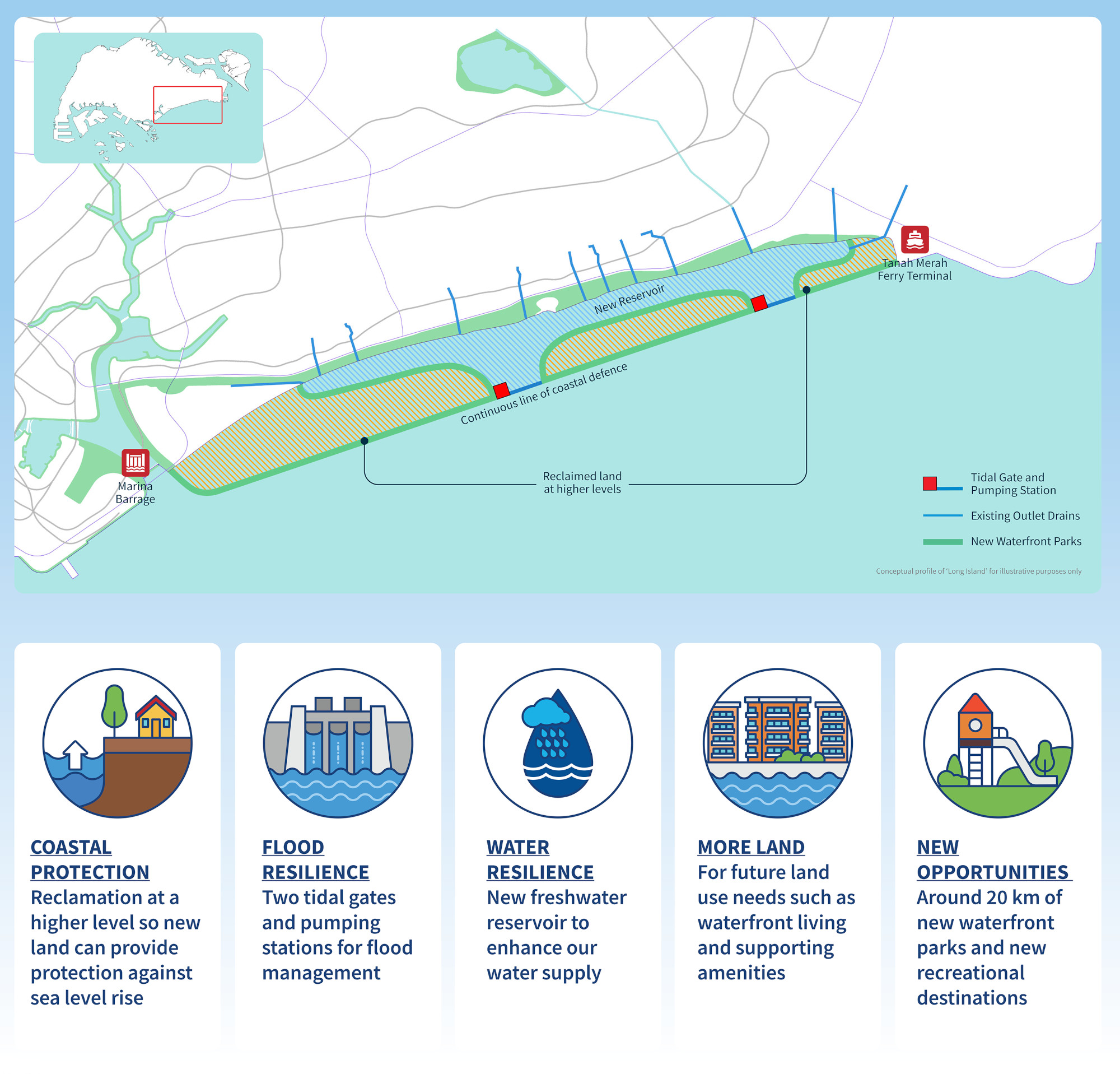
Three tracts of land could be reclaimed off East Coast Park in the coming decades, creating about 800ha of land for new homes and other amenities, as well as a new reservoir.

Called the Long Island, these land tracts – collectively about twice the size of Marina Bay – are Singapore’s response to the threat of rising sea levels and inland flooding in the East Coast area.

Land in the area is largely lower than 5m above the mean sea level, the extent that sea levels are projected to rise to by the end of this century if extreme high tides coincide with storm surges.

On Nov 28, National Development Minister Desmond Lee announced that public agencies will carry out technical studies for the Long Island project over five years, starting from early 2024.

Over the next few years, members of the public will be consulted for their ideas and suggestions for the project, which will take several decades to plan, design and develop.

The current plan is for three elongated tracts of land to be reclaimed in the area, extending from Marina East to Tanah Merah. The easternmost land tract will start from Tanah Merah, while the westernmost tract will be an extension of Marina East. Between these two tracts, a third tract will be reclaimed.

A large tidal gate and pumping station will be built in between each new land mass. These will control the water level in a new reservoir bordered by East Coast Park and the new land masses, and, in the process, reduce flood risks in the East Coast area.

National water agency PUB said the reclamation project is likely to create Singapore’s 18th reservoir.

Like the gate at Marina Barrage, the two gates at the new reservoir in East Coast will open to release excess storm water into the sea during heavy rain when the tide is low. At high tide, the pumps will be used instead to release the storm water.


Mr Lee said the new reservoir can also be used for water activities such as canoeing and dragon-boating.

Besides offering flood protection and increasing Singapore’s freshwater supply, the project will help meet future development and recreation needs, said Mr Lee.

Waterfront homes are expected to be built on the reclaimed land, along with amenities and industrial facilities. About 20km of new coastal and reservoir parks could be added, tripling the length of waterfront parks in the East Coast area, he said.


Plans for reclamation off East Coast were first unveiled in 1991, as part of the Urban Redevelopment Authority’s (URA) Concept Plan. It was envisioned then that a series of reclaimed islands would provide waterfront housing and leisure opportunities.

At the 2019 National Day Rally, Prime Minister Lee Hsien Loong said reclaiming a series of islands offshore and linking them up with barrages could protect existing low-lying areas and create a freshwater reservoir.

URA showcased a possible concept for reclamation works at its long-term plan review exhibition in 2022.


In his speech on Nov 28, Mr Desmond Lee said the Government has been studying various coastal protection options, including building a sea wall up to 3m tall that would stretch from Marina East to Tanah Merah.

The wall would be accompanied by 12 sets of tidal gates and pumping stations – one set at each of the 12 existing outlet drains along East Coast. The gates would stop seawater from flowing inland during high tide, while the pumping stations would pump storm water from the drains into the sea when the gates were closed.

Mr Lee said this option is technically feasible but not ideal for East Coast Park, as large stretches of the park would have to be closed to the public when building the sea wall. When completed, it would permanently limit park users’ access to the waterfront for recreation and sports.


The 12 tidal gates and pumping stations would take up a lot of space within East Coast Park – about the area of 15 football fields – resulting in the loss of existing greenery and recreational facilities.

Mr Lee noted that the public hopes to retain unimpeded access to the waterfront, as well as preserve the heritage and recreation spaces along the coast.

A more optimal solution is to integrate coastal protection measures with reclamation plans for the area, he added.

Saturday, 19 August 2023

Singapore Reserves Revealed

Singapore’s reserves cannot be built up again once gone: Prime Minister Lee Hsien Loong
Think of Singapore’s reserves as ‘rainy day’ money
By Goh Yan Han, Political Correspondent, The Straits Times, 16 Aug 2023

Singapore’s reserves cannot be built up again once they are gone, Prime Minister Lee Hsien Loong said in an interview published on Wednesday.

The country is no longer in a situation like it was in the 1970s and early 80s. This was when it had strong growth and budget surpluses yearly, and there was the possibility of putting aside some of the prosperity for a future rainy day, he said.

Today, Singapore is not as poor as it was before, with higher incomes and a higher standard of living. But expectations and needs have also grown, noted PM Lee.

“So, to say today you put aside systematically 2 per cent, 3 per cent of GDP (gross domestic product) and build up a sovereign fund from scratch, I think it is very hard. The economy will not be able to take it,” he said.


PM Lee said he was proud that Singapore had built up the reserves, and is anxious that the country keeps it like this for as long as it can.

“Because it is one of those things – once it is gone, it will never come back again. It is finished,” he said.

“I think we need to be very, very conscious that this is a Garden of Eden state. You are here, it is marvellous. You may not always feel great, but please be aware this is the Garden of Eden because if you come out from it, you cannot go back in again by the sweat of your brow.”


PM Lee was responding to questions on Singapore’s reserves, including its functions and its history, in an interview with national broadcaster CNA that was aired on Wednesday in a documentary titled Singapore Reserves Revealed. The interview was conducted on June 8.

When asked what the reserves mean to him, PM Lee said they are a great source of comfort and reassurance that if Singapore runs into a jam, it will not be destitute and will have “one extra card to play”.

It gives the Government confidence, but is also a reminder of the forefathers’ contributions and a responsibility to generations to come, he added.

Singapore’s reserves are managed by the Monetary Authority of Singapore (MAS), the Republic’s investment company Temasek and sovereign wealth fund GIC.

The reserves also include those of key statutory boards like the Housing Board, Central Provident Fund and JTC Corporation, which together with MAS, GIC and Temasek are listed in the Constitution as Fifth Schedule entities.


Are the reserves enough?

PM Lee said that the biggest misconception among Singaporeans on the reserves was that “there is such (a) thing as enough”.

“And how much is enough? If I have more than that, I can spend it. If I have less than that, well, maybe I hope to get there. I do not know how much is enough. There is no such idea of how much is enough,” he said.

The future is unpredictable and many things can go wrong, he added.

“From the long-term point of view, will I have enough if the world is steady and peaceful? I hope so. Will I have enough under all circumstances? That is what I do not know, and that is what the Government has to worry about on behalf of Singaporeans.”


He noted that when the global financial crisis of 2008 hit, the Government needed to draw $4 billion to $5 billion from the reserves. For the Covid-19 crisis, it needed over $40 billion.

“So, you have no idea how much you will need because Covid-19 is far from the worst thing that can happen to us,” he said.

He suggested that Singaporeans look at the reserves as “rainy-day money”.

“If it is not raining, I do not touch it. If it is a sunny day and I can afford to, I put a little bit more into it.

“However much there is, I keep on having this attitude that I would like to build it up a little bit more when I can, so that the next generation will be in a more secure position than I am today,” he said.

PM Lee added that while the Government managed to put back the money it drew for the global financial crisis, he did not think it was possible for the Covid-19 draws to be put back.

When asked if there was any anxiety over Singapore’s response to the Covid-19 crisis, PM Lee said he had no doubt that the Government was doing the right thing, and it was doing what it needed to do.

“I was relieved that we were not held back because of the lack of resources to do, at least not lack of dollars, to do what we needed to do.

“It could have been overdone, but in such situations, it is not worth trying to fine-tune,” he said, adding that the eventual spending was less than expected, though still substantial.


When asked how large the reserves are, PM Lee said he could not answer the question, but said they are “enough for most circumstances” and enough to provide a substantial support in the Budget every year, by contributing to a fifth of the Government’s revenues.

“But it may or may not be enough if you have a catastrophe – who knows what the world will bring? So, I do not ask whether it is enough; I ask, can we husband it and if possible, gradually grow it bit by bit year by year,” he said.

He noted the importance of the contributions from the reserves to Singapore’s Budget, without which the Government might have to make up the revenue from other sources, such as doubling corporate income tax or personal income tax, or increasing the goods and services tax rate further.

“When people say, why don’t we use the reserves in order to benefit the current generation? The answer – we are, to a very big degree. But you may not realise because we have gotten used to it,” he said.

When asked if the structure of having MAS, Temasek and GIC overseeing the reserves is correct and useful in today’s context, PM Lee said that from time to time, the Government has asked itself if it should have two GICs.

“Because you have a certain amount of funds now, it is not small. Conceivably, you could have two and they could compete with one another, then you would know who is doing well and who is not doing so well,” he said.

“Every few years we argue about this, but finally we will conclude that building one team is hard enough, let us concentrate on making that one team succeed. And I think we keep it like that.”

The elected president

On the singular pivotal moment in the history of Singapore’s reserves, PM Lee pointed to the time when the Government decided to recognise the reserves as being a lot of money, and needing to have a second key.

The idea was first floated by former prime minister Lee Kuan Yew in his 1984 National Day Rally speech, before the scheme was worked out and implemented over the next few years.

“I think that was the key turning point because it crystallised people’s focus. They knew that there is such a thing called the reserves, that it is quite a lot of money and that it needs to be protected,” said PM Lee.


When drafting the system, it was important to protect the reserves but not paralyse the government of the day, noted PM Lee.

He noted a phrase used by the late Mr Lee on the topic.

“The phrase which he used was that one day, if you have a rogue government, everything is finished.

“That was the way we explained and marketed it, that one day, if you have a freak election, you have the wrong team in charge, you have a rogue government who wants to raid the reserves, in one term, all your life savings of generations of Singaporeans will be gone. And therefore, we must prevent that,” said PM Lee.

He also noted that when the system of the elected presidency was first devised, there was no clear distinction in the original legislation between income from the reserves and investment returns.

In those days, the portfolio was not invested as systematically and comprehensively as it is today. The premise then was that the principal sum would be locked up, and all of the income from the reserves could be spent.

PM Lee said that when former president Ong Teng Cheong took on the role, Mr Ong asked why all the income was being spent, and asked the Government to set some aside for the future.

Mr Ong then suggested that half be split for now, and the other half for the future.

The Government accepted the suggestion and amended the Constitution.

There was an arbitrariness to the decision of the 50-50 split, said PM Lee.

“But when you do deals, 50 per cent is not an arbitrary number. Fifty per cent has a certain psychological resonance to it,” he said.

At the same time, barring accidents and if everything goes well, the reserves should be able to grow by about 2 per cent yearly.

This will ensure the contribution to the Budget every year can be maintained, said PM Lee.


The Net Investment Returns Contribution (NIRC), which comes from the reserves, is the largest contributor to the Government’s revenue yearly.

When asked about potential scenarios where the 50-50 rule could be changed, PM Lee replied: “If the world completely changed, and I would say several successors from me, from now.”

He added: “Where we are does not give me any reason to need to reconsider this 50-50 NIRC rule.”