Showing posts with label Tourism. Show all posts

Friday, 16 May 2025

Changi Airport Terminal 5 breaks ground: PM Lawrence Wong hails bold move, says Singapore must stay connected to the world

Prime Minister Lawrence Wong breaks ground on Changi Airport T5 on 14 May 2025; all SIA, Scoot flights to move there when it opens
By Vanessa Paige Chelvan, The Straits Times, 15 May 2025

Prime Minister Lawrence Wong has broken ground on Changi Airport Terminal 5 (T5), an expansion project more than a decade in the making that will position the airport to ride an expected surge in air travel within the Asia-Pacific and beyond.

With the May 14 ground-breaking, work on the mega terminal has begun, following delays owing to the Covid-19 pandemic.

National carrier Singapore Airlines (SIA) and its budget arm Scoot will consolidate their operations under one roof at T5 when the terminal opens in the mid-2030s, said operator Changi Airport Group (CAG).

The airlines now operate across Terminals 1, 2 and 3, and SIA Group said the consolidation at T5 will provide space for its future growth and improve “operational synergies”.

There will be room at T5 and other terminals for other carriers to expand their operations, CAG added.

When asked about the other airlines that could operate from T5, CAG said it was too early to tell, as flight operations are dynamic and can change over the next decade.


Designed to handle about 50 million passengers a year, T5 will effectively double the size of Changi Airport and allow it to handle 140 million passengers yearly – boosting its current capacity of 90 million by more than 55 per cent.

Passenger traffic in the Asia-Pacific – already the world’s largest air travel market, taking about a third of the global share – is projected to double in the 2040s.

CAG said the extra capacity at T5 will enable Singapore to take advantage of this growth.


While prize-winning Changi Airport is a source of pride for many Singaporeans, PM Wong said Singapore can never be complacent about its achievements and “cannot presume that our success can continue just on its own”.

Amid sharpening competition from other airports and an uncertain global economy, the Prime Minister said Singapore must continue to work hard and remain connected to the world.

Hence, it is making a “bold move” with T5’s development to ensure Singapore’s air hub stays competitive.

At present, Changi Airport is linked to more than 170 cities. With T5, the airport will be able to reach its target of more than 200 city links by the mid-2030s, said PM Wong.


Construction on T5 will intensify in the next few years and peak around 2029, said Mr Ong Chee Chiau, CAG’s managing director for Changi East.

Works completed so far include a new runway, the airport’s third; an underpass for vehicular traffic; and tunnels for baggage and automated people-mover systems similar to the Skytrain.

With three runways operational by the time T5 opens, a second control tower will be built to manage air traffic, Mr Ong said.

T5 is located within the 1,080ha Changi East development, which is almost as big as the land area of today’s Changi Airport, he added.


In a first for the airport, T5 will house a ground transport centre, bringing together the Thomson-East Coast and Cross Island MRT lines, buses, taxis and other transport services.
State-of-the-art systems

T5 will have overlapping curved roofs with varying heights, in a nod to “Singapore’s unique blend of nature and city”, said CAG.

It will also have natural light and landscaping, giving the terminal “the familiar cosy yet uplifting feel that Changi is known for”.

Besides its facade and interior, the mega terminal will have state-of-the-art systems, and will leverage technology and automation to improve efficiency and passenger experience.


Plans include baggage robots that can operate in poor weather conditions, as well as video analytics and artificial intelligence tools that can track aircraft turnarounds to predict potential delays. A turnaround refers to the time between the arrival of an aircraft and its next departure.

These technologies are being tested now to prepare for their roll-out when T5 opens, said CAG.


To make it easier for passengers to move around, three automated people-mover systems as well as travelators will reduce walking distances.

There will be two people-mover systems within T5 that can connect departing passengers to their gates and arriving passengers to two arrival immigration halls. A third people-mover system will link T5 to T2, facilitating passenger transfers to other terminals.

“Most passengers arriving in Singapore will still be able to hop onto a taxi or the MRT within 30 minutes after leaving the aircraft,” said CAG chief executive Yam Kum Weng.

Meanwhile, transfer passengers at T5 can expect to connect to another flight in less than an hour. “Faster than Changi today,” Mr Yam added.

Passengers departing from T5 will undergo security checks near their boarding gates at the multiple security screening points for each cluster of gates.

This means more flexibility for the airport operator, as it can choose to open or close a particular cluster of gates according to demand, Mr Ong said.

T5 will be powered by more clean energy to reduce the airport’s carbon footprint. Its rooftop solar system – one of Singapore’s largest – will have the potential to generate enough energy to power up to 20,000 four-room Housing Board flats for a year.

It will also be ready to support viable alternative jet fuels, including sustainable aviation fuels.

From 2025, all new light vehicles, forklifts and tractors on the airside will be electric, and T5 will be able to support a fully electric airside fleet, CAG said. The airside is the part of the airport beyond passport control, where aircraft operate.

Friday, 25 March 2022

Singapore eases virus curbs from 29 March 2022 in major step forward to living with COVID-19

Group sizes to double to 10, masks optional when outdoors, 75% can return to office from 29 March 2022

Alcohol sale and consumption at F&B outlets after 10.30pm allowed from 29 March 2022

Singapore-Malaysia land border to reopen on 1 April 2022

All vaccinated travellers can enter Singapore without quarantine from 1 April 2022, no need for VTL flights

Singapore has reached major COVID-19 milestone, but will not take 'Freedom Day' approach: PM Lee Hsien Loong
By Lim Yan Liang, Assistant Political Editor, The Straits Times, 24 Mar 2022

Singapore will significantly ease its current pandemic restrictions and live with Covid-19 as it has reached a major milestone in battling the virus, Prime Minister Lee Hsien Loong said on Thursday (March 24).

But the changes to Covid-19 rules stop short of a complete opening up, and the Republic will maintain its measured approach to dealing with the virus that has served it well since the pandemic began, PM Lee said.

He also urged Singaporeans to be psychologically prepared "for more twists and turns ahead".


Major changes that will take effect next Tuesday (March 29) include masks becoming optional outdoors, doubling maximum group sizes to 10 people, allowing 75 per cent of employees to return to workplaces, and a substantial easing of border restrictions now that the Omicron wave is well under control, PM Lee said in his live broadcast to the nation.

He noted that countries that have taken a "Freedom Day" approach - where most or all restrictions are lifted all at once - have seen Covid-19 cases rise, and with that an attendant rise in deaths.

"They have declared the pandemic over, relaxed all restrictions at once. Now they are anxiously watching their infection and mortality numbers rising rapidly again," he said.


After next week's easing, the Government will wait for the situation to stabilise before deciding on its next moves.


If all goes well, Singapore will ease up further, PM Lee said, as he cautioned against thinking that it will be a straight path to a new normal from here.

"With more interactions, we too may see another wave of cases, and Omicron will not be the last variant we encounter," he said.


While the hope is that new variants of the virus will become progressively milder and more flu-like, it is also possible that more aggressive and dangerous mutants will surface, just like Delta did, he added.

If that happens, Singapore may have to backtrack and tighten up restrictions again, he said.

"We cannot rule this out, even though we hope it will not be necessary," said PM Lee. "But whatever happens, we now have the knowledge and the means to keep everyone safe."

This could be another booster jab, or administering an updated vaccine, he said.


While Singapore has come a long way in its fight against Covid-19, the country is not yet at the finish line, he added.

"Key to our response has been the trust that Singaporeans have placed in your government, in the medical authorities, and in each other," he said.

Singaporeans have kept faith with one another throughout this journey, and this solidarity remains crucial as the country tackles fresh challenges, he added.

PM Lee urged everyone to take the latest announcements in the right spirit, and resume more normal lives, such as enjoying larger gatherings, going outdoors without masks, or reuniting with loved ones abroad.

But do not throw all caution to the wind, he said.

"Each one of us must still play our part. Comply with the revised safe management measures. If you feel ill, test yourself. If you test positive, isolate yourself at home. If you test negative, and decide to go out, please wear a mask to protect others, even outdoors, just in case," he said.

"Let us all continue to exercise personal and social responsibility to keep ourselves well, to keep others safe, and to avoid adding to the burden on our healthcare workers.

"That way, even when new problems arise, we stand a much better chance of keeping things under control and staying on the path to a new normal."


Sunday, 30 January 2022

Singapore renews Formula One deal until 2028

This year's night race to be held on 2 October 2022
By Jonathan Wong, Assistant Sports Editor, The Straits Times, 27 Jan 2022

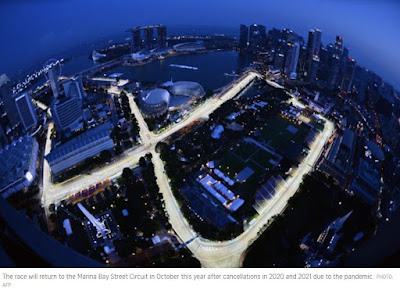
In one of the strongest signals that the country is committed to reopening and returning to life in a world with Covid-19, the Singapore Tourism Board (STB) and promoters Singapore GP on Thursday (Jan 27) announced a new seven-year deal to continue hosting a Formula One race here.

With international travel showing some signs of recovery, the agreement is the longest renewal with the Formula One Group - the previous ones were between four and five years. The longer runway is intended to help reposition Singapore again as a business and lifestyle destination and ensure the country maintains its competitive edge in the long term.

The last two night races were cancelled due to the pandemic while last year's edition was the last of the four-year extension signed in 2017. Singapore Airlines' title sponsorship also ended last year.

The latest contract is from 2022 until 2028 with this year's race scheduled for Oct 2 at the Marina Bay Street Circuit.

Mr S. Iswaran, Minister for Transport and Minister-in-charge of Trade Relations, said: "Even as we deal with the immediate challenges of the pandemic, it is important that we focus on our recovery and long-term growth. The Singapore F1 race continues to be a strong focal point for tourists, global events and business meetings.

"We have decided to continue hosting the F1 race for another seven years, after thoroughly evaluating the long-term benefits that a term extension could bring to Singapore.

"The renewal will help sustain Singapore's reputation as a global city with a vibrant lifestyle, attracting international visitors as travel rebounds, and generating business revenue and jobs for Singaporeans."

The joint statement also stressed that the stakeholders would work with the various government agencies to ensure the health and safety of all participants, staff, local and overseas fans and the community.


While three of last year's 22 races - in Italy, Portugal and Azerbaijan - were held behind closed doors, the rest proceeded with spectators in the grandstands. Some, like in Bahrain, Spain and Monaco, early in the year had reduced capacities before venues in Austria, England and the United States began welcoming full houses.

The majority of races required adults to be fully vaccinated and/or supply a negative test result though mask wearing and social distancing were loosely enforced.

Singapore has hosted several international events in recent months. On Nov 27 and 28 last year, pop star JJ Lin performed in front of 2,000 fans each night at the Sands Theatre at Marina Bay Sands under vaccination-differentiated safe management measures which allowed concert-goers to sit alongside one another without the need for social distancing.

Two weeks prior, the Bloomberg New Economy Forum welcomed 300 international business and government leaders to Sentosa's Capella hotel, with strict testing requirements for delegates so as to allow for business networking.

And in December, Singapore received more than 500 foreign travellers - players, coaches, officials, sponsors and delegates from regional and continental football bodies - for the month-long, 10-team Suzuki Cup tournament with some games at the National Stadium drawing almost 10,000 fans.


The Singapore Grand Prix is on a different scale though.

The 2019 race, the last time it was staged here, drew a three-day total of 268,000 spectators - the second-highest after the 300,000 total at the 2008 maiden race.

Overseas visitors generally comprise 40 per cent of race-goers here and the race weekend contributes about $130 million annually in tourism receipts.

There have been 12 editions since 2008 and together, they brought more than 550,000 unique foreign visitors, contributing over $1.5 billion in tourism receipts.

The tourism sector has been battered by Covid-19. Last year, there were 330,000 visitor arrivals and an estimated $1.9 billion in tourism receipts.

It is only a fraction of the 19 million visitors and $27.7 billion in receipts from before the pandemic in 2019.

The Ministry of Trade and Industry and STB fund 60 per cent of the $135 million night race costs each year, with race promoters Singapore GP footing the rest.

This year's race layout at Marina Bay will likely have to be tweaked due to the planned construction of the NS Square, a new permanent space for large-scale national events which will replace the Float@Marina Bay. The new site, scheduled to start construction in March, will be completed by the end of 2025.

Saturday, 9 October 2021

PM Lee Hsien Loong's address on COVID-19 situation, path to new normal, 9 October 2021

Treat COVID-19 seriously, but no need to live in fear: PM Lee


Zero-COVID strategy no longer feasible due to highly infectious Delta variant

Singapore's COVID-19 'new normal' expected to be 3 to 6 months away


Travel restrictions eased, health processes simplified, as Singapore stays the course on living with COVID-19

COVID-19 quarantine orders scrapped, simpler rules to be rolled out in Singapore from 11 October 2021


PM Lee Hsien Loong, ministers thank healthcare workers for bearing brunt of pandemic

COVID-19 booster shots for those 30 and above, and healthcare, front-line workers

Singapore must press on with strategy of living with COVID-19 and not be paralysed by fear: PM Lee
By Lim Yan Liang, Assistant News Editor, The Straits Times, 9 Oct 2021

Travel restrictions will be eased and health processes simplified as Singapore stays the course on living with Covid-19, said Prime Minister Lee Hsien Loong.

The Republic will press on with its strategy of living with the virus, with a "new normal" expected to be between three and six months away. Right now, the crucial step is to update mindsets on the virus, PM Lee said in his ninth address to the nation since the pandemic began.

This means treating Covid-19 as a serious adversary without living in fear of it, and adjusting healthcare and recovery measures to prioritise those at greatest risk of severe illness, he told the nation in an address on Saturday (Oct 9).

Singapore will also "drastically simplify" its healthcare protocols, said Mr Lee, who acknowledged people's concerns and frustrations about keeping up with new policies and changes to measures.

"No more complicated flow charts. People must be clear what to do if they test positive, or if they come into contact with someone who is infected," he said in the live broadcast.

To this end, home recovery will become the default for almost everyone in Singapore from Sunday, except the very youngest and oldest of patients and for those above 50 who are unvaccinated, the multi-ministry task force on Covid-19 announced on Saturday.

Testing and isolation protocols have also been streamlined to three pathways that the task force said will apply to the vast majority of cases. The revised protocols and simplified time-based discharge approach - most patients will automatically exit home isolation after 10 days - will take effect from Monday.


Health Minister Ong Ye Kung said that authorities had reset these Covid-19 protocols as the Delta variant causes high viral loads early in an infection that can be caught by a rapid test, and balanced against the unsustainability of restricting large numbers of people for prolonged periods to try and catch every case.

“A system like that is less watertight than today’s quarantine system, but it can significantly and substantively manage the risk,” he said at a multi-ministry taskforce press conference that followed Mr Lee’s address.

Unlike last year, when the consequences of infection were serious, widespread vaccination here has meant that more than 98 per cent of cases now have mild or no symptoms and can recover well at home just like if they had contracted the flu, said Mr Lee.

Only 2 per cent or fewer developed serious illness, while 0.2 per cent, or two out of every thousand cases - have died or needed intensive care unit (ICU) treatment, he noted.

"In other words, Covid-19 is no longer a dangerous disease for most of us," he said.

Now, the threat of Covid-19 is mainly to seniors - those aged 60 and above who are not vaccinated, or 80 and above even if they are vaccinated, said Mr Lee.


A disproportionate number of cases with poor outcomes were unvaccinated seniors: While they account for barely 1.5 per cent of the population, they made up two-thirds of cases that needed ICU care or died.

"The remaining one-third were vaccinated seniors," said Mr Lee.

"We feel every single loss keenly. My deepest sympathies and condolences to all the families."


Mr Lee urged unvaccinated elders to get their vaccines, while those who have been vaccinated should go for their booster shots. The third jab reduces a senior's risk of severe infection by more than 10 times, he said.

"Or to put it in another way, to the virus, the booster shot makes a vaccinated 80-year-old look like a much younger vaccinated 50-plus year-old," he said.

Noting that 142 people have died so far with six deaths on Friday alone, Singapore’s director of medical services Kenneth Mak said vaccination remains the key strategy in reducing the risk of developing severe infection.

“This is a sad statistic and we should not be numb to the fact that when a person develops a severe Covid-19 infection, he does have a high risk of dying from that infection,” he said.


From Saturday, the booster shots regime will be expanded to healthcare and front-line workers, staff in settings such as aged homes, and to people aged 30 and above.

Living with Covid-19 also means reconnecting Singapore with the world and global supply chains so as to preserve Singapore's hub status, said Mr Lee.


As part of this reopening, the Government announced on Saturday that Singapore will allow quarantine-free travel to eight more countries - including the United States, Britain and Canada - from later this month and South Korea from Nov 15.

Minister for Transport S Iswaran who was also at the press conference said that together with Brunei and Germany (which are already on the scheme), the 11 countries account for about a tenth of pre-Covid-19 annual passenger arrivals at Changi Airport.


“While still a far cry from where we were pre-Covid, this is a significant step in the reopening of our borders and crucial to reclaiming and rebuilding our status as an international aviation hub with global connectivity,” he said.

The next few months will be trying as daily cases continue to rise for a few more weeks, but the surge will level off hopefully within a month, said Mr Lee.

Everyone has a part to play in ensuring that the healthcare system does not get overwhelmed, he added. This includes cutting back on social activities, and not rushing to hospitals' accident and emergency (A&E) departments if they have mild symptoms, so that bed capacity is reserved for those who need it most.

"Unity of purpose and hearts is crucial to get us through the next few months," he stressed.


Finance Minister Lawrence Wong said that while some have called for a faster relaxation of the rules, others have expressed concerns about the health and well-being of their elders and the safety of their young children.

He said the Government is taking all these considerations to heart as it develops Singapore’s Covid-19 response and strategy.

“We want to ensure that we will always have the ability to provide medical care to anyone who falls seriously ill from Covid-19,” he said. “And that’s why we will ease out of our stabilisation measures in a calibrated manner.”


People will know when the new normal has been reached, said Mr Lee: Restrictions will largely be lifted, with only light measures in place; daily new cases will be stable at hundreds a day without growing; and hospitals will be able to go back to business as usual.

"We are in a much better position now, than a year or even six months ago," he said.

"Sometimes it may not feel like it, but we are making steady progress towards the new normal."


Sunday, 22 August 2021

Singapore sought to retain its connectivity amid COVID-19 crisis: Ong Ye Kung

Singapore tried whatever it could to revive travel with borders closed: Health Minister Ong Ye Kung at Eurocham Dialogue, 20 August 2021
By Linette Lai, Political Correspondent, The Straits Times, 21 Aug 2021

Even as its borders remained closed to most of the world, Singapore did whatever it could to revive travel and maintain its hub status over the past 18 months.

This included allowing senior executives from major companies to fly in and out of Singapore if they stuck to controlled itineraries and underwent frequent Covid-19 testing in lieu of quarantine, Health Minister Ong Ye Kung said yesterday.

These privileges were also extended to key personnel and board members of companies, as well as experts needed to maintain, repair or install critical equipment.

"To manage transmission risk, we had to limit the number of such travellers," Mr Ong told audience members at a virtual dialogue with the European Chamber of Commerce in Singapore.

As hard as it tried, the Economic Development Board could not satisfy the demand, he said. "It had to be selective, giving priority to those with a large base of employees in Singapore."

In his speech, Mr Ong gave an overview of Singapore's efforts to stay open and connected to the world despite the pandemic.

For instance, manufacturers were initially concerned about potential disruptions to the supply chain. The country responded by making efforts to keep supply lines open and maintain smooth port and air cargo operations.

"We never locked down; we never closed in," the minister said, adding that Singapore did not impose export controls even when mask supplies were low, with manufacturers continually able to access raw materials and components.

With thousands of workers unable to disembark at certain ports during the height of the pandemic - effectively trapping them at sea - Singapore developed a process to facilitate crew changes.

To date, more than 160,000 crew changes have taken place here, with the Government and industry collaborating on a global effort to vaccinate sea crew coming through the country's ports.

When Malaysia imposed its first movement control order at very short notice, many workers were stranded. Singapore made arrangements for them to find accommodation here and ensured the continued flow of supplies from north to south.


But the biggest challenge Singapore faced was the disruption to travel, which dealt a major blow to the country as people-to-people exchanges dried up, Mr Ong said.

"We are a hub and a key node in the world. If people from different parts of the world cannot come here to do business, exchange ideas, collaborate, create sparks and make things happen, we are diminished."

The minister detailed the various snags on Singapore's path to reopen its borders, starting with the demise of the travel bubble between Singapore and Hong Kong.

The bubble was slated to launch last November, then postponed to May. In May, it was derailed again, and Transport Minister S. Iswaran said on Thursday that the plan would be scrapped altogether, as both cities are taking different strategies to tackle the virus.

Mr Ong said: "It would have been a very meaningful scheme between two international cities and financial services hubs. But the stars were never aligned, and the bubble could not take off."

Another roadblock came after Singapore planned to ease travel restrictions for certain countries. Community cases spiked at Jurong Fishery Port here, and the plans were shelved as the Republic raced to vaccinate more people.

Now, with more of the population vaccinated, Singapore is once again working to reopen its borders, Mr Ong said.


The measures it took - including the painful ones - have helped keep the pandemic at bay, the minister added.

This was possible because of trust built between the people and the Government, he said.

"As a result, whenever we face challenges, people collectively come together to do their part, even making sacrifices, for the larger good and for the long term."

Saturday, 7 August 2021

Singapore's 4-stage roadmap to a COVID-19 Resilient Nation: Phase 2 Heightened Alert restrictions relaxed from 10 August 2021 as vaccination rate rises

4-stage transition towards an endemic COVID-19 world are Preparatory Stage, Transition Stage A, Transition Stage B and COVID-19-Resilient Nation


Dining-in to resume for fully vaccinated people in groups of 5 from 10 August 2021

Vaccination-differentiated measures will be introduced for higher-risk settings

Higher capacity limit for worship services, cinemas, conferences


Fully vaccinated travellers from 8 more countries can serve Stay-Home Notice at home from 20 August, 2359hrs

Work pass holders, dependants from higher-risk places can enter Singapore from 10 August if fully vaccinated

Those who opt for Sinovac and jabs under WHO emergency use listing to be considered fully vaccinated


Workers in healthcare, F&B, public sector must be vaccinated or do COVID-19 self-tests from 1 October

Singapore must be prepared for more COVID-19 infections, deaths as economy opens up


COVID-19 restrictions relaxed from 10 August, dine-in to be allowed
Singapore takes first steps in four-stage road map to a new normal of living with the virus
Differentiated COVID-19 rules for vaccinated, unvaccinated people
By Linette Lai, Political Correspondent, The Straits Times, 7 Aug 2021

From next Tuesday, fully vaccinated people will be able to dine in at eateries in groups of up to five, as part of the first steps in Singapore's four-stage road map to a new normal of living with Covid-19.

Those who are not vaccinated but have valid negative pre-event test results will be able to join them, as will people who have recovered from Covid-19.

The maximum group size for social gatherings will also go up from two to five, with households allowed to receive up to five distinct guests each day.

In addition, fully vaccinated people will be allowed to take part in large events and activities where masks are removed, such as indoor sports.

As a special concession, everyone will be able to have a meal at hawker centres and coffee shops regardless of vaccination status, as these are generally open, naturally ventilated spaces. However, they may only do so in groups of no larger than two.

Singapore's high vaccination rate has enabled the country to ease current restrictions and start moving towards becoming a "Covid-resilient nation", said Health Minister Ong Ye Kung, noting that more than 70 per cent of the population would be expected to have received both vaccine doses by National Day.


As at Thursday, nearly eight in 10 people had received at least one jab, with two-thirds having completed the full two-dose regimen.


At that point, companies will be allowed to have more staff return to the office, capped at 50 per cent of the total number who are able to work from home.


With more of the population vaccinated, the multi-ministry task force handling the pandemic will, from next Tuesday, also consider anyone who has taken vaccines listed on the World Health Organisation's (WHO) Emergency Use Listing to be eligible for differentiated safe management measures.

The list includes the Sinovac, Sinopharm and the AstraZeneca Covid-19 vaccines.

This easing of measures, termed the preparatory stage of the Republic's transition, is likely to last until early September. By then, 80 per cent of the population are expected to have received both vaccine doses, allowing the country to move to the next step - transition stage A.

This is when the economy will be further opened up, with more social activities and even travel able to take place. But in doing so, Singaporeans must be mentally prepared for the number of cases and deaths to rise, Mr Ong said.

The third step is called transition stage B, and will be marked by further economic reopening until Singapore reaches its goal of becoming a Covid-resilient nation.


The task force outlined this road map yesterday at a press conference, and gave an update on Singapore's current Covid-19 situation and the impact of measures to slow down virus transmission in the community. It is co-chaired by Mr Ong, Trade and Industry Minister Gan Kim Yong and Finance Minister Lawrence Wong.

When large Covid-19 clusters emerged in the middle of last month, Singapore's nationwide vaccination rate was only slightly over 40 per cent, Mr Ong said.

This was why the country had to tighten restrictions and revert to phase two (heightened alert).

"As a result, we prevented a possible uncontrollable rise in infections, severe illnesses and deaths," the minister said, recalling his fear that severe cases requiring intensive care would multiply exponentially.

"We managed to avert that scary scenario," he added, highlighting several positive signs in Singapore's current coronavirus situation. For instance, the number of new daily infections has remained stable, with more infected individuals isolated before they were confirmed to have the virus.


But Mr Gan sounded a word of caution. Around the world, Covid-19 cases continue to increase and a new viral variant may emerge, he said.

"If we assess that the healthcare system may be under stress, we may then need to slow down the pace of our opening."

Tuesday, 27 July 2021

Singapore's roadmap to living with COVID-19: Task force chairs deliver ministerial statements on Government's response to pandemic in Parliament, 26 July 2021

Greater use of community care facilities rather than hospitals

Shorter stays in hospitals and community care facilities

Home quarantine instead of staying at government facilities

All households to get DIY COVID-19 test kits

Vaccinated individuals travelling to safe countries could serve a shorter seven-day SHN at home

Singapore to review COVID-19 rules in early August 2021, ease measures for vaccinated people if situation under control
By Linette Lai, The Straits Times, 27 Jul 2021

Singapore will review its Covid-19 restrictions early next month, easing some measures if virus clusters are under control and hospitalisation rates remain low.

But only vaccinated people will be allowed to take advantage of these looser restrictions, as they are "much better protected against the effects of the virus", said Finance Minister Lawrence Wong yesterday.


A larger proportion of vaccinated people who have contracted the virus, but display mild or no symptoms, will also be admitted directly to community care facilities instead of first going to hospitals.

This is part of Singapore's move towards treating the virus as endemic, Health Minister Ong Ye Kung said.

His ministry also plans to allow more people to serve their quarantine at home.

In addition, it is reviewing its policies so that fully vaccinated patients - who are already discharged from isolation seven days earlier than other patients - can be discharged even earlier, and complete the rest of their isolation at home.

The two ministers, along with Trade and Industry Minister Gan Kim Yong, were giving Parliament an overview of the next steps in the country's pandemic response.


A total of 4.24 million people have received at least one dose of a Covid-19 vaccine, with 3.07 million having completed the full two-dose regimen as at Sunday.

By early next month - the midpoint of the current phase two (heightened alert) period, about two-thirds of Singapore's population would have received both doses, Mr Wong said.

Three-quarters of all seniors aged 70 and above would also have been vaccinated by then.

At that time, the authorities will assess the overall infection situation. They will also monitor the status of infected cases, to confirm that vaccines have weakened the link between infection and hospitalisation.


If all goes well, rules on social gatherings will be eased for vaccinated individuals, the minister said.

"This means that if you want to attend a large event or a religious service involving more than 100 persons, you have to be fully vaccinated," he told the House in a ministerial statement.


Further down the road, fully vaccinated travellers may see stay-home notices replaced by a rigorous testing regimen, or may just serve a shorter notice at home, instead of in a hotel, Mr Wong said.


Mr Ong said it is now clear that those who are fully vaccinated are less likely to become critically ill when they contract the virus.

"(The protocols) need to shift closer to how we treat influenza today, without extensive contact tracing and quarantine in dedicated facilities, and hospitalising only those who are very ill," he said.


On the economic front, Mr Gan stressed that businesses should prepare for Covid-19 to become endemic.

This means helping eligible employees get vaccinated and integrating the use of antigen rapid tests into work processes, as well as continuing flexible work arrangements, he said.

Businesses that are able to respond, adapt and transform quickly will emerge stronger and move ahead of the others, the minister said.


Although certain industries - such as the retail and food and beverage sectors - will continue to face challenges, the country remains on track for growth of 4 per cent to 6 per cent this year.

"Ultimately, the best way to support our businesses and workers is to bring the infection under control, push up our vaccine coverage, and reopen our economy," Mr Wong said.


Friday, 2 July 2021

Living with endemic COVID-19: Ong Ye Kung

Singapore may ease more COVID-19 curbs on 12 July 2021, says Health Minister Ong Ye Kung in interview with The Straits Times

Country transitioning to new normal, with SHN-free travel possible by year end
By Yuen Sin, The Straits Times, 2 Jul 2021

Covid-19 measures could next be relaxed on July 12 as part of Singapore's graduated reopening. This could potentially see it transitioning to a new normal and resuming travel without serving a stay-home notice by the end of the year.

"Come July 12, we are looking at opening up to (allow) more people dining together, and whether there are other steps that we can consider," Health Minister Ong Ye Kung told The Straits Times' senior health correspondent Salma Khalik in an exclusive interview yesterday.

The further easing this month would depend less on vaccination rates and more on whether Covid-19 clusters are under control, he said.


The next milestone for relaxing curbs will be in the second half of this month, when half of the country's population would have been fully vaccinated, followed by National Day on Aug 9, when two-thirds of residents would have been inoculated. The step after that would see Singapore transition to the new normal of living with endemic Covid-19, Mr Ong added.

"You want the transition to be a... step-by-step one where you progressively move towards it, as opposed to a sudden change," said the minister, who co-chairs the multi-ministry task force tackling Covid-19.


Mr Ong said he shares Singaporeans' aspirations for leisure travel to resume by the end of the year. Possible destinations would be countries with high vaccination rates that are seeing their infections dip.

For instance, countries with infection rates below two or three cases per 100,000 people could be monitored to see if travel could restart there. This includes most countries in the European Union as well as the United States.

Asked if end-August or early September would be a good time to switch gears to the new normal - given that all eligible residents who want the jab would have been inoculated - Mr Ong said this was a realistic timeframe, but there will be no "big bang opening".

The multi-ministry task force announced on June 24 that Singapore will eventually transition to a new normal where Covid-19 will be managed like other endemic diseases. Testing still remains important during the transition, said Mr Ong, who added that 37 per cent of the population are now fully vaccinated. About 59 per cent are partially vaccinated.


There were also other key considerations that nudged Singapore to move towards living with endemic Covid-19, though the decision to take that route was made on the basis of science, he added.

After an extended period of restrictions, there is a certain sense of battle weariness among people. "You cannot expect people to live like that - restricting themselves, not meeting friends, not being able to travel," he said.

Other major considerations include the trajectory of the pandemic, as well as the development of the vaccines and treatments Singapore now has at its disposal that could make living with endemic Covid-19 a possibility.

While scientists estimate that a vaccination rate of at least 80 per cent is required for the population to gain herd immunity against the Delta variant, Mr Ong said that people can still live with an endemic Covid-19 if this is not achieved.


"People will still get infected, but they are fine. And so you make Covid-19 more like influenza, you can't make Covid-19 like measles, for example, where you try to eradicate (it)."

But masks are here to stay for a long time and may be among the last of measures to be reviewed, Mr Ong said. "Masks, to me, is a very important non-pharmaceutical intervention, and may well be one of the last things we want to consider removing."