Showing posts with label Caregiving. Show all posts

Saturday, 22 February 2025

Singapore Budget 2025: Onward Together for a Better Tomorrow

PM Lawrence Wong unveils bumper SG60 Budget for all Singaporeans
By Goh Yan Han, The Straits Times, 19 Feb 2025

Every Singaporean will receive something from Budget 2025, from vouchers for all adults to personal income tax rebates, as part of an SG60 package.

Prime Minister Lawrence Wong on Feb 18 unveiled what he termed “a Budget for all Singaporeans”, which includes expanding existing schemes to benefit more citizens and greater support for seniors as well as the vulnerable.

He also set out measures to grow Singapore’s economy, help workers upskill and meet its green targets.

The broad suite of measures announced tally up to a record $143.1 billion, an increase from the $134.2 billion spent in the 2024 financial year.

This is about 18.7 per cent of Singapore’s gross domestic product, and is in line with projected trends for government spending that is expected to reach about 20 per cent of GDP by 2030.

The moves are financed by changes to the tax system made earlier in this parliamentary term that put Singapore “on a stronger fiscal footing”, and larger-than-expected revenue collections.


Corporate income tax collections were more than expected in the 2024 financial year. This is now the single largest contributor to total government revenue, higher than the Net Investment Returns Contribution (NIRC), said PM Wong as he set out the Government’s fiscal position. The NIRC refers to the returns on investments of Singapore’s reserves.

He expects a surplus of $6.8 billion, or 0.9 per cent of GDP, for the 2025 financial year.

“When Singapore thrives, every citizen benefits,” said PM Wong, who is also Finance Minister.

“Every Singaporean is supported from birth to old age, with more support given to those with less. No one is left behind.”


PM Wong said the Budget was “shaped together with all Singaporeans”. It lays out the second instalment of plans on the Forward Singapore agenda, which seeks to keep society strong and united.

He noted that Singapore has to navigate a turbulent external environment, with the US and China locked in a fierce contest for global supremacy. Despite the global uncertainties, the Republic can look ahead with a degree of confidence as it is far stronger than it was 60 years ago, he added.

Noting that 2025 marks the country’s 60th year of independence, PM Wong said: “It has been a remarkable journey, reflecting the grit and resilience of generations of Singaporeans in building our nation.”


Something for all Singaporeans

He announced a new SG60 package to recognise the contributions of all Singaporeans and share the benefits of the nation’s progress.

In July, all Singaporeans aged 21 to 59 will receive $600 in SG60 vouchers, while those aged 60 and above will get $800. These vouchers, amounting to about $2 billion, will function like the CDC ones.

Under the package, individuals will also get a 60 per cent personal income tax rebate, capped at $200, for the 2025 year of assessment.

All Singaporean babies born this year will get an SG60 Baby Gift, PM Wong added, among other measures in the package.


The hotly anticipated Budget, which comes ahead of an upcoming general election widely expected by mid-year, also tackles top-of-mind issues for Singaporeans such as cost-of-living pressures and job insecurity.


To alleviate rising costs, PM Wong announced another $800 of CDC vouchers for all Singaporean households, totalling about $1 billion. The first $500 will be given out in May 2025, while the remaining $300 will be issued in January 2026.

He also announced more utility rebates and credits for families with children to defray household expenses.


While inflation is expected to ease further in 2025, PM Wong acknowledged that Singaporeans are still adjusting to new price realities. “We will continue to provide support for as long as needed, within our means,” he said.


To help parents who have or plan to have three or more children, PM Wong detailed a new Large Families Scheme.

The scheme will disburse $16,000 to such families for each third and subsequent child born from Feb 18, and help to cover pre-school and healthcare expenses, as well as household spending.


PM Wong also announced that several schemes will be extended to private property owners, including the climate vouchers programme that all Housing Board households can currently tap to buy energy- and water-efficient household appliances.

HDB households will get an additional $100, on top of the $300 they received last year, while households in private properties will get $400 in climate vouchers.

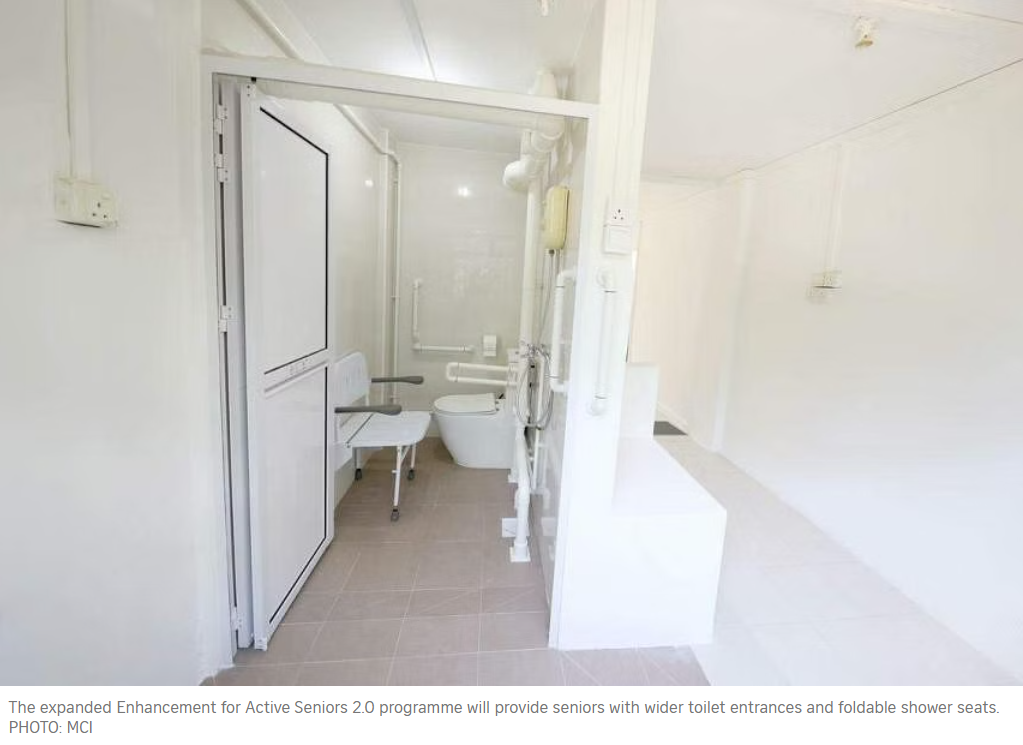
The Enhancement for Active Seniors (EASE) scheme that provides subsidised senior-friendly fittings and installations in HDB households will be extended to private property households up to 2028, said PM Wong.


Supporting workers, securing the future

While the Government has taken measures to mitigate the impact of rising costs, the best way in the longer term to adjust to higher prices is to grow the economy and increase productivity, he said.

Dedicating a significant portion of his Budget speech to new moves to grow the economy, he announced more funding for research and development and a new $1 billion fund to provide more financing options for high-growth local enterprises.

At the same time, workers must be equipped with the skills needed to stay competitive and relevant, said PM Wong.


He said that the SkillsFuture Level-Up Programme, announced in 2024 to support mid-career Singaporeans who are upskilling full-time, will also be extended to part-time training.

The Workfare Skills Support scheme, which currently covers short courses for lower-wage workers, will have an enhanced tier of support that covers longer-form courses, he added.

The Prime Minister also outlined measures to support more vulnerable groups of workers, including older workers, former offenders looking to reintegrate into society, and people with disabilities.


PM Wong said the Budget also lays the groundwork for the country to become stronger and more resilient.

It includes measures to tackle climate change, like a $5 billion top-up to the Coastal and Flood Protection Fund. The fund covers long-term plans such as land reclamation for Long Island and structures like sea walls and tidal gates.


Singapore will need to have its own domestic sources of clean power to ensure greater energy resilience, PM Wong said, adding that the country will study the potential deployment of nuclear power and take further steps to systematically build up capabilities in this area.

Apart from plans to access more sources of clean energy, the Government will accelerate efforts to decarbonise the transport sector, he said.

It will roll out a new emissions scheme and electric charging grant to incentivise the purchase of clean energy variants of heavy vehicles. Adoption of such vehicles has been slower compared with that of electric and hybrid cars.


Singapore will continue to improve its public transport system, said PM Wong, noting that $60 billion will be invested in this decade to grow and renew the rail network.

“We are continuing to study how our rail network can be expanded,” he added.


Concluding his speech, PM Wong said Singaporeans have to brace themselves for new challenges in the next phase of nation building.

The country has confronted tough external circumstances repeatedly over the past six decades, and “we can draw confidence from what we have been through together”, he added.


At every turn, Singaporeans have chosen determination over despair, innovation over stagnation, and solidarity over division, said PM Wong.

“Budget 2025 sets out clear plans for us to continue this journey with confidence.”


Sunday, 29 September 2024

No one to share the load when mum and dad get sick

Unlike in larger families where caregiving load can be spread out, an only child faces immense stress and is more likely to suffer burnout
By Elizabeth Law, Correspondent, The Straits Times, 28 Sep 2024

On a Tuesday afternoon at a coffee shop in Ang Mo Kio, Mr Glenn Poh returns to his waiting mother with two drinks: one hot and one iced. She picks the iced lemon tea.

“All my life she never used to drink cold drinks but now, she always wants something iced. It’s like she’s a small kid again,” he says of his 74-year-old mother, Madam Tan Sow Meng, who has Alzheimer’s disease.


As the only son, Mr Poh took it upon himself to look after her, personally navigating the twists and turns of caring for an ailing parent.

“Whatever needs to be done needs to be done. It’s because I was raised like this,” he says. Having seen how his mother cared for his late father after a stroke, he knew he wanted to do the same for her.

In Singapore, with its rapidly ageing population and cultural norms of filial piety, many adult children find themselves thrust into the role of caregivers.

Life can be put on hold when mum or dad falls ill, and those without siblings or other home help can find themselves shouldering the whole load.

Data shows there were at least 128,800 only children with mothers above the age of 50 in 2023, more than triple the 39,800 in 2003.

In a population of 5.92 million, 1.36 million people have mothers above the age of 50. While the number of only children is just a fraction of that total, researchers and social workers warn that unlike in larger families where the caregiving load can be spread out, only children face immense stress. Among other health challenges, they are more likely to experience burnout.

A stout man with a buzz cut dressed casually in a polo shirt, shorts and sliders, Mr Poh, 44, is unfailingly polite. He says “thank you” or “pai seh” (Hokkien for “sorry to bother”) to anyone he interacts with, and thanks The Straits Times team profusely at each of our three interviews.

He talks about his days in a methodical way, ticking off each activity as if going down a list. He says drawing up lists and “standard operating procedures” helps him find structure amid the uncertainty and constantly evolving nature of his mother’s condition.

But ask him about challenging moments, and his upper lip quivers.

The week before, rather than take her shower at the usual time, his mother fussed around with throwing away rubbish and lighting the oil lamp at the family altar.

“I shouted at her, and I asked her to go and take a bath, which she did. By the time she came out of the bathroom, I apologised but she didn’t remember. I regret it when I lose my temper with her because she cannot remember,” he says, tearing up.

“So it’s not a good feeling. Because you did something wrong, but you’re not able to make up for it.”

He admits this often happened in the initial stages, especially when he had unrealistic expectations about his mother’s condition, and became frustrated that he could not do more to help her.

Friday, 2 August 2024

Singapore spending billions to help seniors stay active, socially connected

Loneliness and social isolation: A public health threat for societies
By Judith Tan, Correspondent, The Straits Times, 29 Jul 2024

A 20-something Gen Zer who laughs with colleagues, meets friends for drinks and sees family for dinner every weekend may seem to have a rich network of interpersonal connections.

In reality, he may be lonelier than his widowed grandmother alone at home with only a domestic helper except when relatives visit on some Sundays.

Though they are similar, loneliness and social isolation are not always related. Loneliness is a subject sense of distress that occurs when a person perceives that their need for meaningful connections is unmet, even if they are surrounded by people.

While social isolation – and loneliness – has been building up for decades as family and community structures change, governments are increasingly recognising it now as a crisis.

In November 2023, the World Health Organisation (WHO) declared loneliness as a pressing global health threat.

The same year, United States surgeon-general Vivek Murthy issued an 82-page public health advisory titled Our Epidemic Of Loneliness And Isolation.

The surgeon-general said that far more than a bad feeling, loneliness and social isolation are detrimental to individual and societal health. They increase the risk of premature death by 26 per cent and 29 per cent respectively, he said.

Dr Murthy warned: “The mortality impact of being socially disconnected is similar to that caused by smoking up to 15 cigarettes a day, and even greater than that associated with obesity and physical inactivity.”


Singapore, too, is concerned about the health impact of social isolation, particularly among elderly people.

It has earmarked $800 million for improving active ageing centres supporting seniors in their communities. At the launch of Age Well SG in November 2023, Health Minister Ong Ye Kung said: “For many seniors, their biggest enemy is social isolation and loneliness. That’s when your health really deteriorates. We want them to be socially connected.”

Researchers in Singapore say that seniors who live with their children and grandchildren can feel as lonely as someone living alone, if they are ignored by their loved ones going about their own busy lives.

Data collected from the Singapore Chinese Health Study, which recruited participants between April 1993 and December 1998, found almost four in five elderly people who are socially isolated lived with their families, compared with the three in 20 living on their own.

Young people feel lonely even with social media connections

While the stereotype is that an older person with dwindling social connections is at the greatest risk of loneliness, multiple studies show that it is in fact younger people who are more likely to feel socially isolated.

According to a Gallup poll of more than 140,000 people in 2023, 27 per cent of young adults aged 19 to 29 reported feeling very or fairly lonely, compared with 17 per cent of older adults aged 65 and older.

The 2023 Gallup poll of 142 countries also found that nearly one in four people in the world feels fairly or very lonely, and that rates are about even between men and women.

A 2020 report by insurance giant Cigna based on a questionnaire answered by more than 10,400 people found that 79 per cent of Gen Zers (born between the late 1990s and early 2010s) and 71 per cent of millennials (born between 1981 and 1996) considered themselves lonely, compared with 50 per cent of baby boomers, who are now aged 60 to their late 70s.


In Singapore, a 2023 survey by the Institute of Policy Studies (IPS) had similar findings.

The straw poll, carried out between November and December 2023, surveyed 2,356 Singaporeans and permanent residents aged 21 to 64. It found that people between the ages of 21 and 34 had the highest mean score for loneliness.

In contrast, people between 51 and 64 had the lowest mean score for loneliness.

It is not surprising that young people should experience feelings of abandonment and lack of support, said psychologists. Young adults are at a transitional stage of their lives, navigating uncertainties in finding partners, establishing their careers and carving out an existence for themselves apart from their parents.

Social media too often provides connections that are only fleeting and superficial.

Saturday, 18 November 2023

Age Well SG: Singapore sets aside $800 million from FY2024 to FY2028 to help seniors age well at home, in their communities

Age Well Sg to Support Seniors to Age Actively and Independently In the Community
By Joyce Teo, Senior Health Correspondent, The Straits Times, 16 Nov 2023

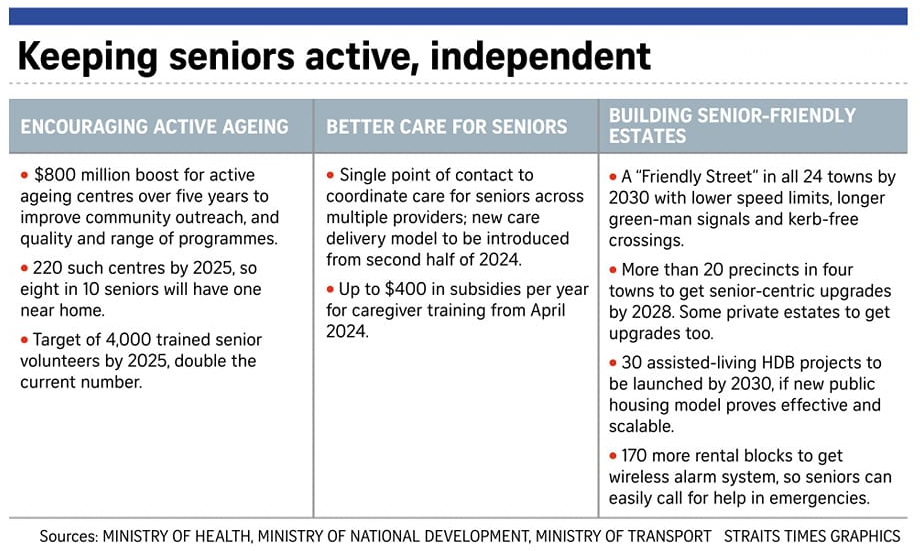
More seniors will be supported to age well in the community under a programme that will set aside $800 million over five years for active ageing centres to expand their outreach and increase the range and quality of programmes.

Announcing the increased funding and other details of a multi-ministry Age Well SG programme on Thursday, Health Minister Ong Ye Kung said: “For many seniors, their biggest enemy is social isolation and loneliness. That’s when your health really deteriorates. We want them to be socially connected.”

He was speaking at a press conference at the NTUC Health Active Ageing Centre in Lengkok Bahru, Bukit Merah, on Thursday.

There will also be improvements made to housing and streets under the Age Well SG programme, which is also spearheaded by the Ministry of National Development (MND) and Ministry of Transport.

Singapore is ageing rapidly. By 2030, it will have more than 900,000 seniors aged 65 and above, with an increasing number living alone.

Mr Ong said each active ageing centre’s annual budget hovers around $400,000 and the fund injection would lead to a budget rise of at least 50 per cent.

“With greater resourcing, we also have higher expectations for agencies now,” he added. “It is not difficult to fill out an AAC (active ageing centre) with the same visitors every day. It is much more difficult to be able to reach out to the great majority of seniors all living around (the AAC) and able to engage them in meaningful ways.”


The activities at the AACs are meant to keep seniors healthy, but they must also suit the preferences of those living in the vicinity, he said. Communal dining is one activity that allows them to make friends.

Active ageing centres will also work with community partners such as Sport Singapore or the People’s Association, and make use of all the spaces in the community, including coffee shops, pavilions and community clubs.

They will need to work closely with healthcare clusters to implement health screening services in the community and integrate with the Healthier SG preventive health strategy to keep Singaporeans healthy.


At the NTUC Health Active Ageing Centre in Lengkok Bahru, for instance, there is a weekly community health post manned by nurses and a well-being coordinator from Singapore General Hospital, who can help seniors with, say, smoking cessation, counselling and advance care planning, or connect them with home care services.

Active ageing centres will be supported by Silver Generation or SG ambassadors and new senior volunteers whom they can recruit.

The Agency for Integrated Care (AIC) will roll out a programme to train senior volunteers to run programmes at active ageing centres or befriend seniors at risk of social isolation.


Mr Ong said the aim is to double the number of senior volunteers trained by AIC to around 4,000 by 2025, up from around 1,900 Silver Generation ambassadors at the moment.

“Volunteerism is a very important way for seniors to feel that they can continue to contribute to society and the people around. It will be a core function of the AACs to drive senior volunteerism,” he added.


While active ageing centres are meant for seniors who are well, those with care needs can look forward to a wider range of solutions. The Ministry of Health (MOH) and AIC, with support from the Manpower Ministry, have launched applications for a sandbox scheme to explore the viability of new stay-in shared caregiving models in the private sector.

Five companies, including one that offers assisted living in houses, have been identified for the sandbox scheme, with the aim of servicing an estimated 800 seniors. The models will be reviewed within two years, and, if they work, they will be scaled up, Mr Ong said.

A shared caregiving model may see a few seniors living together in the same flat. They form a new kind of family, a social circle, and can support one another, he added.

“At the same time, within this new household of a few seniors, you can have caregivers at less than the ratio of one to one... And that way, we’ll also reduce the manpower needed to deliver the care services,” he said.

Participating companies will be eligible for work permit quotas and foreign manpower concessions to give them the flexibility of recruiting caregivers from traditional and non-traditional sources.


For seniors who may have to undergo repeated assessments at multiple care providers, MOH will introduce a single point of contact to coordinate all their care needs.

This will happen progressively from the second half of 2024, and will provide the seniors and their caregivers with a more seamless care journey.

The coordinating provider will use a standardised care assessment tool to plan for a senior’s care needs, which will reduce the need for multiple assessments and unnecessary referrals by different care providers.

For instance, a senior who is discharged from hospital after a fall can be referred to an active ageing centre, which will be his single point of contact.

The centre can arrange for him to receive home personal care and senior care centre services provided by a different centre.


And, from April next year, caregivers will be able to tap up to $400 in Caregivers’ Training Grant per year, double the $200 currently. They can also use their SkillsFuture Credit to pay for eligible caregiver courses.

Another part of Age Well SG involves improvements to the living environment. National Development Minister Desmond Lee said a bigger, more concerted push will be made to address seniors’ needs in the built environment.

At home, seniors will get more senior-friendly features, including bigger easy-to-press switches, home fire alarm devices and foldable shower seats in their Housing Board (HDB) flats, as MND expands the Enhancement for Active Seniors (EASE) programme into EASE 2.0, he added at the press conference.

A wireless alert alarm system will be progressively expanded to all seniors living in public rental housing, many of whom lack family support.

Outside the home, senior-centric upgrading works will be progressively rolled out in more than 20 older precincts with a high density of seniors, including Ang Mo Kio and Bukit Merah.

These include enhancements such as barrier-free access ramps and amenities like fitness trails.

To provide Singaporeans with more assisted-living options, MND, MOH and HDB will launch up to 30 Community Care Apartment projects by 2030.

These flats pair senior-friendly housing with on-site social activities and care services that can be customised according to their needs.

The first Community Care Apartment residents will move in next year, when their Bukit Batok flats are ready.

Singapore’s second Community Care Apartment project, in Queensway, was launched in late 2022.

A third one in Bedok will be available in the upcoming HDB Build-To-Order sales exercise in December.

By 2030, all towns will have “friendly streets”, with features such as kerbless crossings and lower speed limits as well as wider and more accessible footpaths, said Acting Minister for Transport Chee Hong Tat at the press conference.


Having safe roads, friendly streets and accessible facilities will give seniors the confidence to move around, he added.


Monday, 14 August 2023

The asset-rich, cash-poor have a housing dilemma

The elderly might not downsize and monetise their homes for retirement income. Their concerns centre on preserving the value of their flat and ageing in place.
By Sing Tien Foo, Published The Straits Times, 12 Aug 2023

Are homes nest eggs for retirement? It turns out the answer is not straightforward.

Delivering his National Day message this week, Prime Minister Lee Hsien Loong highlighted the Government’s desire to refresh its approach to public housing, with a special effort on adapting Housing Board estates and flats to serve a rapidly ageing population.

Although he had referred to physical infrastructure, community spaces and active ageing centres, he also highlighted the importance of retirement adequacy. More details will be announced at the upcoming National Day Rally, he said.

Ageing population, ageing homes

PM Lee’s remarks are timely. By 2030, one in four Singaporean residents will hit 65. Today, only one in three in this age group is employed. We should technically see more monetising their homes to fund their retirement.

In Singapore, the HDB has two schemes by which elderly home owners can unlock the value of their homes – the Silver Housing Bonus (SHB) and Lease Buyback Scheme (LBS).

SHB incentivises eligible households to right-size their homes. If they downsize to a three-room or smaller HDB flat, use the proceeds of the sale of their home to top up their Central Provident Fund (CPF) Retirement Account (RA) and join the CPF Life lifelong annuity scheme, they can receive a cash bonus of up to $30,000.

Similar to a reverse mortgage, the LBS allows seniors aged 65 and older to sell the tail-end of the lease to HDB while continuing to live in their homes. The proceeds will go to their CPF RA and CPF Life, with the home owner receiving a monthly income for life.

Recognising that the LBS holds the key to helping more Singaporeans unlock the value of their homes in their old age, the scheme, which was introduced in 2009 for those living in three-room and smaller flats, was subsequently expanded to include residents in all HDB flat types.

But is this thinking one-sided? Based on the 2022 population statistics of the 547,598 HDB dwellers aged 65 and older, and assuming that each household comprises two such dwellers, about 274,000 households are eligible for LBS. However, as at December 2022, only about 9,700 households – or 3.5 per cent of the estimated eligible households – have taken up the scheme.

The low response rate for the LBS betrays the popular sentiment among elderly Singaporeans that may become a problem for retirement adequacy: People seem unwilling to trade their homes for retirement income.

They are asset-rich but cash-poor

Instead, many middle-aged and retired home owners, usually referred to as the asset-rich, cash-poor segment, are more concerned if their homes will preserve their value, even as they stew over whether they can meet their financial needs in old age.

This is a problem because policymakers have long assumed that most Singaporeans purchase homes for capital appreciation, with the wealth accumulated to be freed up in old age.

In this housing life-cycle model, which has a hump-shaped curve, one accumulates wealth with age as the value of a house appreciates and the mortgage is paid off. But as homes age and begin to decline in value, the home owners must at some point sell off the property or find some way to monetise the asset, so that they can live reasonably comfortably in their golden years.

Depending on the amount drawn down, home owners can still bequeath the remaining lease to a loved one. Else, the value of the home is exhausted when its lease runs down to zero.

Persistent accumulation of housing wealth

Why aren’t Singaporeans monetising their homes? The uncertainties associated with life expectancy, bequest motives and medical expenses in old age may encourage many to keep a housing asset intact.

Sunday, 30 July 2023

Conversation on euthanasia should enter end-of-life discussions in Singapore

Assisted dying is a sensitive subject but, with its population ageing, Singapore may need to discuss what we think about it
By Salma Khalik, Senior Health Correspondent, The Straits Times, 29 Jul 2023

As more Singaporeans age, urgent discussions are taking place on how we approach end-of-life issues.

The roles of nursing homes, hospices and home palliative care are part of ongoing discussions on easing and widening different approaches towards how we age, and ultimately pass on.

There is, however, one issue that has gained traction elsewhere but which hardly ever figures in our end-of-life discussions here: assisted dying.

Assisted dying can either take the form of assisted suicide, where the final act is undertaken by the person involved, often with the aid of a medical practitioner; or euthanasia, where another person, again often a doctor, performs the act of terminating life.


Assisted dying is illegal in Singapore.

But given that our population continues to age rapidly, and more older people will increasingly find themselves in continuous pain that even palliative care can do little to help, this is not an issue we should entirely ignore. What could be at stake is the dignity and personal choice of a segment of our population.

Several countries are well ahead of Singapore on this count, both in terms of having mainstream discussions, as well as in having legal frameworks on assisted dying.

Most countries that have legalised assisted dying allow both assisted suicide and euthanasia. Some, like Switzerland, which was the pioneer in allowing assisted suicide in 1942, allow the former but keep euthanasia illegal.

Should one or both options be legalised here, to give those desperate to end their lives a way of doing so with grace?

Monday, 2 January 2023

As GST goes up, is it time to rethink support from Government?

As prices stay high and Singaporeans get older, some are calling for more government help. But what kind of help do they need, and where should the money come from?
By Grace Ho, Insight Editor, The Straits Times, 1 Jan 2023

For many, getting older stirs mixed feelings of anticipation – finally, retirement! – and anxiety for the future.

With one in four citizens here aged 65 and older by 2030, more Singaporeans will have to grapple with the challenges of living longer, from maintaining job security and health, to caregiving and finances. As seniors become more well-educated and have richer work experience, they, too, are likely to be more vocal about their needs and wants.

How can their expectations be funded sustainably? Is government aid a universal right of citizenship, or should it be targeted at the poor? These and other burning questions were tackled in a recent study on ageing-related policies by researchers from the National University of Singapore.

As part of the study, two workshops were conducted with 82 citizens of different ages and socio-economic backgrounds. Participants took a survey before the first workshop to establish their baseline sentiments on policies, and were surveyed again after the second workshop to measure the change in their opinions.

More help wanted for caregiving and health

When asked how they would make use of an extra $10,000 per person for age-related government policies and programmes, participants cited the following:
  • Health ($2,900)
  • Caregiving, to help with physical mobility ($1,700)
  • Transfer payments to seniors ($1,700)
  • Housing ($1,200)
  • Social and emotional support ($1,200)
  • Transport ($970)
Health and caregiving were top-of-mind. Those in the sandwiched generation were worried about sacrificing their wages and time, should they become caregivers for their elderly family members and children.

They felt that the Home Caregiving Grant – $200 a month in cash to support family members with at least permanent moderate disability – was not enough to tip the balance in making the decision to take on caregiving responsibilities easier.

They also wanted the state to come up with nursing care and broader caregiving arrangements, including those to manage dementia among the growing number of seniors.

Middle-income participants felt they did not have the heavily subsidised support that lower-income households enjoy. Means-testing, they said, is too blunt an instrument, especially for those who are asset-rich yet cash-poor. They proposed assistance that is more attuned to the health rather than socio-economic status of seniors.

What about caregivers whose work is unpaid and invisible? The study suggests that tax reliefs and having caregivers’ savings multiplied through the Central Provident Fund (CPF), compared with just having family members contribute to their personal bank accounts, can move the needle.

Today, the maximum annual tax relief for cash top-ups to family members’ Special/Retirement Accounts and/or MediSave Accounts is $8,000 – not a huge sum considering that some caregivers have to completely give up work, and hence their retirement security, to look after an unwell senior.

One solution is to extend this tax incentive so that caregivers have up to the Basic Retirement Sum for CPF Life, or achieve a payout equivalent to it, said Institute of Policy Studies deputy director for research and senior research fellow Gillian Koh, who is one of the study’s co-authors.

“The difference would be to either remove the current cap of $8,000 or provide more leeway to reach a sensible limit, so that anyone who is a caregiver has that assurance of a basic payout sum from CPF upon reaching 65 years of age,” she said, adding that a more ambitious target could be the Full Retirement Sum.

Depending on whether the support is more generous or restrained, some criteria can be set, such as whether there has been significant disruption to a person’s earnings. More discussion and design work are needed to identify a suitable upper limit for the top-ups. But as Dr Koh pointed out, this is not an insurmountable problem.

Where will the money come from?

At first, the participants’ preferred sources to fund the increase in public expenditure were:
  • Corporate tax ($2,200)
  • National reserves ($2,100)
  • Income tax ($1,600)
  • Stamp duty on purchases of property ($1,600)
  • Goods and services tax ($1,300)
  • Carbon tax ($1,200)
This isn’t surprising; people the world over love taxing corporates and the rich. But what’s interesting is that after they attended the workshops, 15.2 per cent of the participants said the Government should draw more on GST to meet demands for ageing-related social support.

There was a distinct shift in attitudes towards the use of GST when the policy trade-offs – as well as greater help for lower-income households, such as permanent GST vouchers and cash transfers through the Assurance Package – were explained to them.

There’s an educational dimension here: Participants with only post-secondary education were more likely than those with polytechnic diplomas, university degrees or other professional qualifications to indicate support for generating more resources from GST.

This is because those in the lower socio-economic strata, of which education is a proxy indicator, understood that they would benefit significantly from the help.

Another notable point is that participants ranked the national reserves second highest among the funding sources.

Not only did this not decrease after the workshops, but 8.3 per cent of the participants allocated even more to the reserves to finance expanded age-related policies. A similar proportion of participants also allocated more to property tax.

Does this mean that Singaporeans expect the Government to tap its own resources before relying on individual efforts or families? Not quite: The participants said in the same breath that they planned to save more and get more help from family and friends.

Wednesday, 30 March 2022

White Paper on Singapore Women’s Development proposes 25 action plans to be implemented over 10 years

Egg freezing, more flexi-work among policy changes in White Paper on Singapore women
By Tham Yuen-C, Senior Political Correspondent, The Straits Times, 28 Mar 2022

A 10-year road map to nudge society further along the road to equality between men and women will see greater support for flexible work arrangements, more help for caregivers and swifter intervention in cases of violence.

In a symbolic move, more women will also be allowed to freeze their eggs.

The long-anticipated White Paper on Singapore Women's Development, submitted to Parliament on Monday (March 28), comes after more than a year of discussions aimed at ensuring a fair and inclusive society where all citizens can realise their full potential.

It describes the barriers and challenges that still hold women back, from glass ceilings in the workplace to caregiving responsibilities at home and violence and harm online, and promises a whole-of-government effort to address them.

It also calls on Singaporeans to be conscious of gender stereotyping in their everyday actions and to try to overcome them.

Speaking to reporters earlier this month, Minister for Communications and Information Josephine Teo said: "(The White Paper) sensitises and raises the awareness that women still need our support in many ways.

"And it is very much up to each one of us in our respective roles to try and give the women in our lives the support that they need in order to fulfil their aspirations."


While policy and legislative changes over the years have removed many of the overt obstacles in the way of women's development, further success can only be had if society as a whole works to shift mindsets, said the White Paper.

A case in point is the action plan on elective egg-freezing, which Mrs Teo noted society was previously not ready to address.

From next year, women between 21 and 35 years of age, regardless of their marital status, will be allowed to freeze their eggs, reversing the longstanding policy to allow only women who have medical issues that may affect their fertility to do so.

However, only legally married couples can use their frozen eggs to try for a baby through in-vitro fertilisation (IVF). This is in line with existing IVF rules and the idea of “upholding parenthood within marriage”.

"When the idea first came up in our ground engagements, it caused some discomfort. There were worries in certain quarters that making elective egg freezing available would send the wrong signal about marriage and parenthood, that they need not be prioritised and can always be postponed," said Mrs Teo.

She added that over time, engagement efforts bore fruit and mindsets changed, and "most people came to a better understanding of the motivations of women who would take up the option".

The 115-page White Paper sets out five main areas of focus: equal opportunities in the workplace; recognition and support for caregivers; protection against violence and harm; other support measures for women, including single mothers and divorcees; and mindset shifts.

They were distilled from a year-long series of conversations to canvass views, led by Minister of State for Social and Family Development and Education Sun Xueling, Minister of State for Culture, Community and Youth and Trade and Industry Low Yen Ling and Parliamentary Secretary for Health and Communications and Information Rahayu Mahzam.

Under these focus areas sit 25 action plans - some of which had been announced previously after the White Paper was first broached in September 2020 - ranging from the concrete to the symbolic.


There will be new anti-workplace discrimination laws to weed out a minority of errant employers with unfair practices in hiring, promotion, and retrenchment, among other things. It will protect the confidentiality of women who come forward and protect them from retaliation.

With Covid-19 showing that flexible work arrangements can work, a new set of tripartite guidelines will be introduced by 2024 to set out best practices for flexible work arrangements, so as to entrench these practices.

Meanwhile, since women are four times as likely as men to take on housework and caregiving duties, and women in dual-income households are five times as likely as men to do so, there will be more support for caregivers in the form of higher grants under the Home Caregiving Grant scheme.


To address the issue of harassment towards women, a safe sport code will also be introduced, among other things, to define misconduct in the sporting environment so that athletes can take a stand against bad behavior.

A mid-point review of these measures is planned in 2027.

"Underlying... each of the action plans are the commitments we make to one another: that everyone gets a fair chance at success, can find a place for herself/himself in this nation, and that we take care of the vulnerable among us," said the document.

Monday, 28 March 2022

Will you love my autistic cousin when his parents are gone?

By Ang Qing, The Straits Times, 27 Mar 2022

If you were part of the evening rush hour on the MRT earlier this month, you might have seen an excited 1.9m-tall man humming and swaying. You might have stared at him glancing around non-stop and wondered whether he was a "suspicious-looking person" because of his visibly different behaviour.

That was likely to be my autistic cousin Zack (not his real name), who ran off without his mother after his daily training programme at Enabling Village in Bukit Merah.

Zack, 22, loves travelling on the bus and MRT but he is not allowed to go home alone because he gets distracted by his surroundings.

That day, my cousin and his peers were let go 15 minutes before the usual dismissal time at 5pm, so Zack went off on his own before his mum picked him up. What ensued was a nerve-wracking ordeal for his family. While my aunt told him to alight at certain stations over a call, he went from Redhill to Pasir Ris, then back to Joo Koon before changing to the North-South line, which is the line near his home.

At the same time, my aunt informed the MRT staff of the situation and they alerted all control stations to look out for a young man wearing an orange T-shirt. Some 90 minutes later, my cousin's phone went dead because the battery ran out.

Three hours after boarding the train, Zack was finally spotted wandering around a bus interchange near his home by his younger sister. He was wearing his orange top but it was covered by a blue jacket that he uses during training.

That is just a snapshot of the daily struggle of caring for those with special needs.

Although it might be exhausting for family members to look after them, there are many sides to them that make them lovable. For one, Zack is the most responsible citizen I know because he scans the SafeEntry QR code of every shop and station. Inadvertently, this leads to some embarrassing situations when he enters shops like salons, which are only for women.

He also never forgets the birthdays of all 19 (living) members of our extended family. Before a long day at work, it brightens my day to receive texts from him asking what I am doing.

While he can perform basic tasks like brushing his teeth, showering and mopping the floor with supervision, there are certain things that he will never be able to understand.

He sees the world literally.

Heaven is in Mandai Crematorium because this is where his loved ones - my grandfather and my 10-year-old cousin - went when they died.

Zack also cannot understand social cues. This means he can get uncomfortably close to you and will not understand why you inch away.

After receiving numerous stares from strangers gawking at Zack's behaviour whenever we go on family outings, I learnt early on that he would need a lot of care and patience for the rest of his life.

The struggles of parents with children born with special needs are many and will only pile on as they get older: the high costs for support and the onset of burnout, with the greatest concern being who will take care of their children after they are gone.