Showing posts with label PE 2017. Show all posts

Wednesday, 13 September 2023

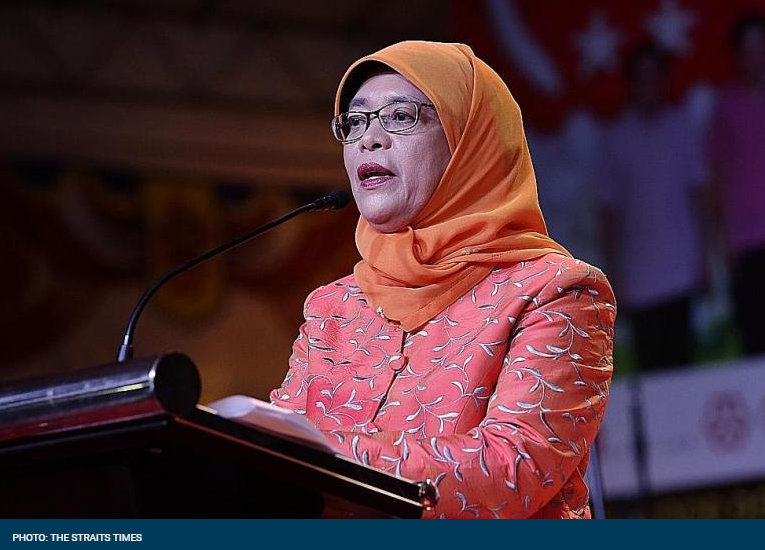
Halimah Yacob: A President For Everyone

Singapore’s eighth President Halimah Yacob reflects on the defining moments of her six years in office, from unlocking past reserves, to advocating for causes close to her heart.


Farewell, Madam Halimah: Singapore’s first female president’s last day in office
By Jean Iau and Natasha Ann Zachariah, The Straits Times, 14 Sep 2023

Six years after making history as Singapore’s first woman head of state, President Halimah Yacob left the highest office in the land with accolades of being a powerful symbol of unity for all Singaporeans.

At her farewell reception held at the Istana on Wednesday evening, Prime Minister Lee Hsien Loong said Madam Halimah’s efforts to expand opportunities for all made for a more united and inclusive Singapore, where everyone belongs and has a part to play.


He said that throughout her tenure, Madam Halimah showed the way with “grounded leadership, and a warm heart for the people”.

“Your ability to empathise and resonate with Singaporeans from all walks of life has brought our nation closer together, and reminded us that we all have a role to play to make Singapore a better home,” he added.


In her speech following PM Lee’s, Madam Halimah said the president plays “an important role in uniting and rallying people together”.

“In this capacity, I focused on creating a more caring, compassionate and just society,” she added.

Madam Halimah, 69, said she reached out to different communities and underprivileged people, and highlighted various programmes that she launched while in office.

She championed issues such as providing more support for caregivers, skills upgrading for lower-income families, and building interracial and interreligious harmony and social cohesion.

Diplomacy was also a key part of her work, and she saw it as a chance to raise Singapore’s international image, strengthen the nation’s bilateral ties, and open new economic opportunities for companies here.


As the first female president, Madam Halimah knew that she had the “distinct opportunity” to inspire other women and girls.

She shared that someone had told her she had “allowed people to imagine the president as a woman” and that “images and ideas give birth to reality”.

“I wish Mr Tharman Shanmugaratnam all the best in discharging his duties,” Madam Halimah said, addressing the President-elect, who was standing near the front of the audience with his wife, Ms Jane Ittogi.

Mr Tharman, 66, will be sworn in on 14 September, after securing 70.41 per cent of the vote at the presidential election on Sept 1.

As she left the podium, Madam Halimah received rousing applause from an audience of more than 200, including foreign diplomats, MPs and leaders from the social service sector.


With her husband, Mr Mohamed Abdullah Alhabshee, by her side, she received well wishes and took wefies with guests, including MPs from both sides of the House.

She had earlier in her speech called her family’s love, encouragement and sacrifices “the bedrock of (her) strength” and said she was forever grateful for their support.


Chua Chu Kang GRC MP Zhulkarnain Abdul Rahim, who was among the crowd, said Madam Halimah has been a unifying figure not just for Singapore but a symbol of aspiration for minority women everywhere.

“She will be remembered not only as a decisive president who supported the Government in steering our country out of the pandemic safely, but also as a president who is generous in lending her voice to speak up on behalf of various segments in our society such as youth, women and workers,” he said.


Before departing the Istana, Madam Halimah posed for pictures on the staircase by the main entrance with her family. She had said her farewells to members of the Istana staff earlier on Wednesday morning, shaking their hands and sharing laughs before taking a group photo.

Her aide-de-camp, Major Toh Su Sin, said it had been an honour to serve Singapore’s first female president. “As challenging as it was to plan and manage the range of events in Madam President’s packed diary, it was even more rewarding to be able to witness the difference she makes in the lives of others,” she said.

She added that Madam Halimah’s warmth and genuine care for everyone she meets will be missed.


Senior butler Zaidi Hashim recalled feeling awestruck on Madam Halimah’s first day in office. He said: “Madam President treated everyone with equal respect, dignity, and compassion – whether they were foreign dignitaries or her staff.

“It was bittersweet bidding farewell to her on her last day in office.”

Sunday, 1 October 2017

Reserved presidential election was right thing to do: PM Lee Hsien Loong


PM Lee spells out why he pushed for reserved election
He knew it'd be unpopular and cost votes, but sees it as necessary for multiracialism
By Tham Yuen-C, Assistant Political Editor, The Straits Times, 30 Sep 2017

Prime Minister Lee Hsien Loong has made it plain that he knew the reserved presidential election would be unpopular - and would cost his party votes.

"But I did it because I strongly believe, and still do, that this is the right thing to do," he said, addressing the unhappiness squarely for the first time last week at a closed-door dialogue.

The reason he gave is that despite the progress made in building a multiracial and multi-religious society, Singapore has "not yet arrived at an ideal state of accepting people of a different race".

His candid remarks were made to about 500 grassroots leaders at a People's Association Kopi Talk dialogue last Saturday, and an edited transcript was released by the Prime Minister's Office yesterday.

PM Lee cited recent surveys that show "we are not completely colour-blind". This will influence people's choices, he said, and he is convinced it is harder for a minority - Malay, Indian or Eurasian - to win an open election for president than it is for a Chinese.

To lend weight to his view, he pointed to the 2011 Presidential Election when there were four candidates, all Chinese.

"Where were the Farid Khans and the Salleh Maricans? Why didn't they come?... Because they knew that in an open election - all things being equal - a non-Chinese candidate would have no chance."

He added: "It is a reality."

Businessmen Salleh Marican, 68, and Farid Khan, 61, had applied to contest the recent presidential election reserved for Malays, but they did not qualify and President Halimah Yacob, 63, won in a walkover.


Another reality is racial issues crop up even in day-to-day living.

Sometimes, minorities face discrimination when looking for a job or a house to rent. Recently, a picture on a construction hoarding of a Malay girl wearing a tudung had the word "terrorist" pencilled on it.

"These are the realities we have to manage," he said.

PM Lee said the Chinese, being the majority race, may think Singapore has "arrived" as a multiracial society. They get occasional reminders when they travel abroad and encounter racism, then "you may know what it feels like to be treated as a minority", he said.

For Singapore's young, having known only racial harmony here, it is very easy to believe race does not matter any more. "We have to know our blind spots," he said, adding that the Chinese community, especially, must make a special effort to make the minorities feel welcomed and valued.

However, having multiracial presidents in itself does not make Singapore a multiracial country. "But it is an important symbol of what Singapore stands for, and a declaration of what we aspire to be," he said.

He noted that nearly two years were spent discussing and debating having a multiracial presidency.

"But it is only now that people are seized with it, after a reserved election in which only one candidate qualified," he said.

PM Lee said he could feel there was some unhappiness. "People think we may be going backwards, towards racial politics. But actually, the reality is the opposite: We are making necessary changes to strengthen our multiracial system."

He shares President Halimah's hope for that day when Singapore will not need the reserved election to ensure minority representation.

But to get to the ideal state, "we need guide ropes and guard rails to help us get there and to prevent us from falling off along the way".

"The reserved election for the president is one such guard rail."

He also said striving for multiracialism includes having the courage and determination to take pragmatic steps to get there, step by step. "That is how we will continue to expand our common space, strengthen trust and become one people, one nation, one Singapore."

Friday, 22 September 2017

NTU Majulah Lecture 2017 by DPM Tharman Shanmugaratnam

Questions raised about presidential election show that people want race to matter less: DPM Tharman
By Amelia Teng, The Straits Times, 21 Sep 2017

It is "understandable" that questions have been raised about the recent presidential election, said Deputy Prime Minister Tharman Shanmugaratnam, who last night offered a positive take on the concerns flagged.

"It is encouraging that people feel about this, and they want race to matter less in the future," he said during a dialogue at the Nanyang Technological University (NTU).

"It is encouraging because it shows that we value what we say in our Pledge."

Mr Tharman was responding to a question on whether the reserved election has entrenched even more deeply the idea of race, and whether it in fact marks a regression in race relations.

The minister, who said he himself would have also preferred a contest, "like most people", said however that the aspiration for race not to count is something that requires working towards.

"It cannot just be a pledge, it cannot be just an incantation," he said. "Sometimes, it requires a conscious act of the state.

"The reality of the matter is, not just in Singapore, but anywhere else, including the most mature democracies, that everything else (about a candidate) being equal, race, ethnicity, religion, matters."


He cited an editorial by Malaysian publication Mingguan Malaysia, on how it was unimaginable that Singapore has a Malay president when it has 75 per cent Chinese. "An insightful piece, because they are not great fans of Singapore. But they decided to write an editorial commending what happened... But we are not a special people. We have to work to be different and continue on this journey."

Mr Tharman was speaking at NTU's inaugural Majulah Lecture, a new initiative by the university that aims to tackle topics relevant to the development of Singapore.

He laid out five key shifts Singapore's education system needs to make in a changing world. These include ensuring every child has a fair chance of success, reducing academic load and broadening education. There must also be more flexibility in differentiating students, developing individuals' potential throughout life and deepening multiculturalism from young, he added.

On the last point, Mr Tharman elaborated: "Never forget that growing up as a minority is different from growing up in the majority. Never pretend it is the same."

Monday, 18 September 2017

Lessons from the Presidential Election 2017; Count for reserved PE was policy decision, Shanmugam v Sylvia Lim in Parliament

A look at 3 key issues
Now that Singapore's first president elected after changes to the system is in office, what issues have emerged from the process? Insight examines three - the reserved election, the walkover and its effect going forward, and the lead time in making the legislative changes.
By Elgin Toh, Insight Editor, The Sunday Times, 17 Sep 2017

The presidential election in 2011 is remembered as Singapore's most hotly contested. Four candidates stood in a race that went down to the wire, with Dr Tony Tan Keng Yam finally winning by 0.35 per cent of the votes.

In contrast, the election this year saw Madam Halimah Yacob elected unopposed last week - the third no-contest since elections began in 1993. Before, the president was appointed by Parliament.

Yet, this year's presidential election might go down as among the most hotly discussed.

In the lead-up to it, major changes were introduced to the way the elected presidency works, which resulted in, among other things, the election being reserved for candidates from the Malay community as it has not been represented in the office since 1970.

These changes, as well as the eventual walkover, triggered considerable debate online and in physical forums. In her swearing-in speech last Thursday, President Halimah, 63, acknowledged that some Singaporeans did not agree with the Government on the need to reserve elections.

She sought to be a unifying figure, saying: "I respect their views."

Minister in the Prime Minister's Office Chan Chun Sing, too, had earlier this month noted in a forum the unhappiness in some quarters. He said the Government had been prepared to "pay a political price" in the short term when it introduced the changes, because it strongly believed in their long-term benefits.

As President Halimah embarks on her six-year term, some of this debate offers a springboard for learning more about the elected presidency.

The reserved election was a focal point of much debate. What issues did the debate highlight about Singapore's multiracial fabric?

Another discussion trigger was the walkover. Why was there one, and what might walkovers mean for the elected presidency in the long run?

And, was there enough lead time from the mooting of the changes to the eventual election for Singaporeans to digest the changes?

Insight speaks to political observers on what, as a result, has emerged about the elected presidency as an institution.

Friday, 15 September 2017

President Halimah Yacob takes oath and makes history

Inauguration of the 8th President of the Republic of Singapore, Madam Halimah Yacob


First woman president also symbolises Singapore's multiracial dream, says PM Lee Hsien Loong
By Nur Asyiqin Mohamad Salleh, The Straits Times, 15 Sep 2017

History was made at a quarter past six yesterday evening, with the inauguration of Singapore's first Malay President after 47 years, and its first woman head of state.

Looking solemn in a peach-coloured headscarf, President Halimah Yacob, 63, took her oath in the Istana state room, flanked by Prime Minister Lee Hsien Loong and Chief Justice Sundaresh Menon.

Her rise to the highest office of the land reaffirms Mr Lee Kuan Yew's vow in the very early hours of independence on Aug 9, 1965, that Singapore "would not be a Malay nation, a Chinese nation nor an Indian nation", PM Lee said in an address to 200 guests.

When this pledge was made, the nation had a Malay head of state: Encik Yusof Ishak, who died in his third term in 1970, at the age of 60.


"President Yusof Ishak symbolised, visibly, that though we had been forced out of Malaysia primarily because we were a Chinese-majority city, independent Singapore would never in turn suppress its own non-Chinese minorities. We chose the nobler dream: A multiracial, multi-religious Singapore."

"Madam President, half a century later, you symbolise, visibly, that Singapore will persevere with this dream," PM Lee said, adding that this has become more urgent in the light of regional and global trends.

"In an age when ethnic nationalism is rising, extremist terrorism sows distrust and fear, and exclusivist ideologies deepen communal and religious fault lines, here in Singapore, we will resist this tide.

"Here, the majority will make extra efforts to ensure that minorities enjoy equal rights. That is something special, precious and fragile.

PM Lee said this is why Parliament has members from all ethnic groups. Now, the nation will regularly have heads of state who are, like President Benjamin Sheares, Eurasian, like President S R Nathan, Indian; like President Tony Tan, Chinese, and like President Halimah Yacob, Malay, and a woman.

This was the "compelling reason" the Government amended the Constitution to reserve the presidency for a community that has not held the post for five terms, he added.


Speaking after PM Lee, Madam Halimah welcomed the move to preserve Singapore's multiracialism.

"I am proud that I belong to a country that does not just say it is diverse, but lives out this diversity every single day," she said, adding that while strides have been made, it remains a constant work in progress.

"We need guideposts to help us along this journey," she added, as she addressed the palpable disquiet of the past week over her walkover in the first reserved election.

"I know that some Singaporeans would prefer to achieve this without needing reserved elections. I respect their views," she said.

"Like them, I look forward to the day when we will no longer need to rely on the provision to have reserved elections, and Singaporeans naturally and regularly elect citizens of all races as presidents."

"Today, I want to assure all Singaporeans that as your President, I will serve every one of you, regardless of race, language or religion."

PM Lee noted that the life story of the veteran unionist and former Parliament Speaker reflects the Singapore Story.


Madam Halimah said her life story is a testament to Singapore's meritocracy, a shared value the presidency embodies, together with multiracialism and stewardship.

"I have seen how much we can achieve by working together. Now, as President, my duty is to unite the people, to overcome the many challenges ahead of us, together.

"I pledge to continue this journey of service to our country. I call on all Singaporeans to join me in this endeavour," she added.

Thursday, 14 September 2017

Halimah Yacob is Singapore's First Female President; First Malay Head of State in 47 years

I want to be president for all: Halimah Yacob
First woman and second Malay to hold office will be sworn in today as Singapore's eighth head of state
By Royston Sim, Assistant Political Editor, The Straits Times, 14 Sep 2017

Madam Halimah Yacob yesterday pledged to be a president for all Singaporeans, after she was elected unopposed in the first election reserved for Malay candidates.

She will be sworn in as Singapore's eighth president at the Istana today, and create history by becoming the country's first woman president and only the second Malay to hold the office after founding president Yusof Ishak.

The former Speaker of Parliament was the only candidate who qualified to stand for election, after the Presidential Elections Committee ruled out businessmen Salleh Marican and Farid Khan for failing to meet constitutional criteria.

Returning Officer Ng Wai Choong declared her President-elect in a walkover around noon - drawing loud cheers from about 700 supporters at the People's Association Headquarters in Jalan Besar.


The move to raise the qualifying criteria for candidates and reserve this year's election, coupled with the absence of a contest, had drawn fierce criticism from some quarters.

Madam Halimah, 63, acknowledged doubts about the reserved election in her speech yesterday.


She later told reporters: "Election or no election, my promise is to really serve everyone. I will serve with great vigour, with a lot of hard work, with the same passion and commitment that I have served... for the last four decades."

The nation's eighth head of state came from humble beginnings, helping her mother sell nasi padang from a pushcart.


After joining the National Trades Union Congress as a legal officer in 1978, she rose through the ranks to become its deputy secretary-general, gaining a reputation as a tireless champion of workers' rights.

She became an MP in 2001, was appointed Minister of State for Culture, Community and Youth in 2011, and elected Speaker in 2013.

More than 500 unionists were at the nomination centre to support her yesterday, many decked out in orange - the colour she chose for her campaign to represent unity.


Madam Halimah said her election as a Malay president "shows very positively" how Singaporeans practise multiracialism - that everyone has a chance to become president.

Her becoming the nation's first female president sends a serious message about gender diversity, she added. "Every woman can aspire to the highest office of the land, if you have the courage, the determination and the will to work hard."

Flanked by her husband, retired businessman Mohamed Abdullah Alhabshee, 63, and proposer, Singapore Business Federation chairman Teo Siong Seng, she thanked her supporters and all Singaporeans for their good wishes.

Madam Halimah - who said yesterday that she would continue living in her Housing Board flat in Yishun - urged Singaporeans to stand together to confront the challenges facing the nation.

"I ask that you focus on the similarities we have, and not on our differences," she said, stressing that the country has to stay united.

Prime Minister Lee Hsien Loong said she will bring to the presidency her experience of working with Singaporeans from all walks of life, and championing workers and disadvantaged groups.

He called her yesterday to congratulate her. In a Facebook post, he wrote: "The president is the apex of our political system and the symbol of our multiracial, multi- religious nation. I am confident that Madam Halimah will fulfil her role with distinction."

Sunday, 10 September 2017

IPS Forum on the Reserved Presidential Election 2017

Reserved elections 'critical as president serves unifying role': Shanmugam
Post may be called into question if president always comes from the same race, says Shanmugam
By Elgin Toh, Insight Editor, The Straits Times, 9 Sep 2017

The changes to the elected presidency to ensure multiracial representation are important because of the president's role as a "unifying symbol of the country", Home Affairs and Law Minister K. Shanmugam said yesterday.

Without amendments to reserve elections for minorities, this symbolic role may be called into question - especially if "the president, term after term, comes from a single race", he added.

He acknowledged that some Singaporeans do not agree with the idea of reserved elections - but he noticed many would come around after being given the full facts.

Still, this is an issue on which "reasonable people can differ" he said, adding: "The fact that we were able to talk about it, debate it... in a way it helps strengthen the overall multiracial fabric."

Mr Shanmugam was speaking at an Institute of Policy Studies (IPS) forum on the reserved presidential election.

He covered a range of issues related to the presidency, including the stricter qualifying criteria for private-sector candidates and how a candidate's race is determined.


His remarks come as Singapore gets ready to elect its next president on Sept 23. Only Malay candidates can take part in this election, under new laws that reserve the election for a community, if no one from that community has been president for the last five terms.

The minister also disclosed the initial plans were to reserve elections for two groups: the Malays, as well as Indian and Other communities. But feedback from the Chinese ground prompted the inclusion of Chinese reserved elections.

"When we discussed it with our MPs, past MPs, the Chinese intelligentsia, the Chinese media, the reaction was quite clear. If you have reservations for the Indians and the Malays, you better have reservation for the Chinese," he said.

On the president's symbolic role, Mr Shanmugam noted it has been part and parcel of the presidency since independence.

Tuesday, 29 August 2017

Presidential Election 2017: Nomination Day on Sep 13, Polling on Sep 23

PE 2017 Writ issued: Nomination Day on Sep 13, Polling on Sep 23
Elections committee to check if candidates meet criteria, and inform them by Sep 12
By Charissa Yong, The Straits Times, 29 Aug 2017

Singaporeans will vote for their eighth president on Sep 23, if more than one person qualifies to run for the position.

The winning candidate will be the second Malay president in Singapore's history, and the first to be chosen in a presidential election reserved for candidates of a specific community.

But whether the nation's 2.5 million eligible voters get to cast their vote at all hinges on the Presidential Elections Committee.

It screens all presidential hopefuls to see whether they meet the required criteria and will inform them of its decision by Sep 12.

If only one candidate qualifies, he or she will be declared the president on Nomination Day, Sep 13. Otherwise, a contest is on the cards.

The contenders will be nominated at People's Association headquarters at 9, King George's Avenue.

These details were given by the Elections Department (ELD) yesterday when it announced that Prime Minister Lee Hsien Loong had issued the Writ of Election.

PM Lee later stressed in a Facebook post the significance of the reserved election, saying it is important in a multiracial country for every citizen to "know someone of his community can... and does become president from time to time, and thus represent all Singaporeans".

In the event of a contest, Polling Day, which is Sep 23, will be a public holiday. The Returning Officer will be Mr Ng Wai Choong, chief executive of the Energy Market Authority.

Three people have stepped forward to potentially join the contest: marine services firm chairman Farid Khan, 61; former Speaker of Parliament Halimah Yacob, 63; and property company chief executive Salleh Marican, 67.

Mr Farid and Mr Salleh handed in their forms last week, although neither qualify to run automatically.

Monday, 28 August 2017

President Tony Tan reflects on his presidency; Singapore's seventh president leaves office on 31 Aug 2017


It's been hard work but... very rewarding: Dr Tony Tan on his six years at the Istana
As end of his presidency nears, Dr Tan stresses the need to further strengthen social bonds
By Zakir Hussain, Political Editor and Joanna Seow, The Sunday Times, 27 Aug 2017

President Tony Tan Keng Yam leaves office this Thursday as the head of state who preceded the biggest change to the elected presidency in its 26 years.

The move to entrench multiracialism in the highest office in the land, by ensuring members of the country's main races occupy it periodically, is a change he fully supports.

He believes it will stand the nation in good stead and further fortify the social fabric at a time when the terror threat to Singapore is at its highest.

Citing the spate of recent terror attacks and disrupted terror plots around the world, he says: "Singapore is a target for terrorists."

In a measured voice, he adds: "One of these days, an incident will happen. And when that happens, it's very important to ensure we do not allow it to destroy our cohesion, or to have tensions between the various communities.

"In that respect, reserving this next election for the Malays is appropriate - unfortunately, because of these circumstances around the world which Singapore is caught up in," he says.


For Dr Tan, 77, the need for Singapore to continue reinforcing multiracialism is never-ending.

It is a key reason he cited for supporting the reserved election when the Constitutional Commission proposed the mechanism last year.

"Since the elected presidency was instituted, the presidents, including myself, have all been non-Malays," he adds in an interview at the Istana's Yusof Room, where a bust of the first president, Mr Yusof Ishak, who died in office in 1970, is displayed.

"It's good to make sure from time to time, people of different ethnic groups have the opportunity to become president so that it reflects our multiracial society," he says.

Monday, 21 August 2017

National Day Rally 2017

Building up preschools, Fighting diabetes and Making Singapore a Smart Nation


Pre-school sector to ramp up quality, offer more places
At National Day Rally, PM Lee also focuses on fighting diabetes and creating smart nation
By Royston Sim, Assistant Political Editor, The Straits Times, 21 Aug 2017

Singapore will double its annual spending on pre-schools in the next five years, to add 40,000 new places for children and improve the quality of pre-school education.

Prime Minister Lee Hsien Loong yesterday announced three initiatives to build up the pre-school sector so that every child - regardless of family background - can have the best possible start in life.

Besides increasing the number of childcare places for children aged up to four, the Government will roll out more kindergartens and set up a new centralised training institute for pre-school teachers.

"Today, every child goes to a good school. We want every child to go to a good pre-school," said Mr Lee.

"If we get this right, we will foster social mobility and sustain a fair and just society."

At his 14th National Day Rally, Mr Lee focused on building for the future, highlighting three issues that he said are important for the nation's prosperity and the well-being of its citizens in the long term.

Unlike past rallies where he spoke of Singapore's future, its economy or geopolitical issues, Mr Lee homed in this year on improving pre-school education, fighting diabetes and creating a smart nation that offers opportunities for all.

He noted that the economy is expected to grow by about 2.5 per cent this year, and, most encouragingly, productivity went up by 1 per cent last year after years of almost zero growth.

But he moved beyond immediate priorities like creating jobs to discuss longer-term issues.


He said the Government had moved decisively to transform the pre-school sector five years ago, by creating nearly 50,000 childcare and kindergarten places, increasing pre-school subsidies and raising education standards.

Anchor operators will build more childcare centres in new Housing Board developments to address a shortage of places in young towns.

To improve the quality of education, the Ministry of Education (MOE) will increase the number of its own kindergartens from 15 now to 50 in the next five years, Mr Lee said. This greater scale will allow MOE to influence and raise the quality of the whole sector, he added.

In addition, a National Institute for Early Childhood Development will be set up to consolidate existing training programmes for teachers and develop new curricula.

The Government will also work with employers to ensure salaries for pre-school teachers rise in tandem with their career progression.

Annual spending on pre-schools, which was $360 million in 2012, has more than doubled to $840 million this year. It will double further to $1.7 billion in 2022, he said.

But pouring resources into the sector will mean little unless young parents do their part, he added, as he encouraged them to have more babies.

ESM Goh Chok Tong calls for 'stronger, more inclusive' leadership team

With Prime Minister Lee Hsien Loong stating that he will step down by 70, the new generation of leaders will have to quickly establish themselves as a cohesive team, the Emeritus Senior Minister says.
Channel NewsAsia, 19 Aug 2017

Singapore's new generation of leaders will have to build a "stronger and more inclusive millennial generation team", said Emeritus Senior Minister Goh Chok Tong on Saturday (Aug 19).

Speaking at a National Day Dinner for his constituency, Marine Parade, Mr Goh said the robustness of the country's leadership pipeline is one of the determinants of how a "small boat like Singapore" will fare in a turbulent climate of internal and external challenges. Other factors, he said, include the resilience of its politics as well as the cohesiveness of its multi-racialism and social equity.


Mr Goh noted that 65-year-old Prime Minister Lee Hsien Loong has said he will step down by the age of 70.

"The fourth generation (4G) leaders will have to quickly establish themselves as a cohesive team and identify the captain amongst them," he said in the speech.

"They must try their utmost to bring in potential office-holders from outside the Singapore Armed Forces and public sector to avoid group-think. Highly competent Singaporeans outside the Government must also be prepared to step up and serve," he said.

Beyond technical competence, Mr Goh also said Singaporeans will want to know what "the leaders stand for, what kind of Singapore they want to build and what they will pass on to the fifth generation later".

Saturday, 19 August 2017

Will the fortunes of Malays change in Singapore? President is only symbolic

Singapore's envoy to Malaysia rebuts Utusan on elected presidency
By Shannon Teoh, Malaysia Bureau Chief In Kuala Lumpur, The Straits Times, 18 Aug 2017

Singapore's High Commissioner to Malaysia has issued a rebuttal to Utusan Malaysia newspaper over false allegations on Singapore's upcoming presidential election which is reserved for Malay candidates, and on its Malay community.

Mr Vanu Gopala Menon wrote to the Malay-language newspaper yesterday in reply to its Aug 14 article "Berubahkah nasib kaum Melayu di Singapura? Presiden sekadar simbolik" (Will the fortunes of Malays change in Singapore? President is only symbolic).

"Contrary to the false assertions in the commentary, the Singapore President, who is elected with a popular mandate, plays key roles in nation-building and in ensuring good governance," he wrote.

Mr Menon said these roles include being the symbol and unifier of a multiracial Singapore, the custodian of the country's reserves, and the protector of the integrity of its public service.

"Surely, Utusan Malaysia would agree that these are important tenets which every country should safeguard."

The Aug 14 Utusan article by Ms Marzita Abdullah said: "The post of President of Singapore sounds great but it is only symbolic without any political power."

She wrote: "Maybe because non-Malays in Singapore are given priority and advantages in all aspects, (previous) presidents did not have to struggle to consider the fate of their own race. Therefore, when a Malay holds the post of president, the direction that Malays are headed will surely be given attention as that race constantly feels sidelined in its own country."

In his letter, Mr Menon stressed that "Singapore's Malay community has achieved significant social and economic progress within Singapore's rules-based and meritocratic society".

He said: "We are, as a nation, proud of these accomplishments, and we will achieve further progress together. It is incorrect to say that non-Malays in Singapore have been given 'priority and advantages'. We certainly do not have a race-based system of benefits and patronage."

He added: "Singapore will not tolerate the use of race or religion to promote ill will between different segments of Singapore society, or to undermine our institutions."

He had earlier replied to Utusan's May 28 editorial on the election to counter inaccuracies that meritocracy was used as an excuse to discriminate against the community.

"The Editor did not publish my letter for reasons I could not understand other than not providing a true picture to the readers. Instead, the Editor published a second commentary, with similar inaccuracies and misrepresentations," he said.

Utusan's largest shareholder is Umno, which dominates Malaysia's ruling coalition and owns 49.77 per cent of the 78-year-old newspaper.

Tuesday, 8 August 2017

Halimah Yacob to run for President

Halimah Yacob steps down as Speaker of Parliament and MP for Marsiling-Yew Tee GRC, resigns from PAP to run for President
PM Lee Hsien Loong thanks her for contributions, says she will bring warmth, dignity if elected as president
By Tham Yuen-C, Assistant Political Editor, The Straits Times, 8 Aug 2017

A day after announcing her presidential bid, Madam Halimah Yacob resigned from her political and party posts yesterday, paving the way for her nomination in next month's election.

Her resignation as MP of Marsiling-Yew Tee GRC and member of the People's Action Party (PAP) was accepted by Prime Minister Lee Hsien Loong, who said she would bring warmth and dignity to the highest office in the land if elected.

Her move also prompted by-election calls from the Singapore Democratic Party and Reform Party.

While the GRC may not get a new MP - there is no legal requirement for a by-election when an MP leaves a GRC, even a minority MP - it will get a new grassroots adviser.

PM Lee, who is PAP's chief, said he will appoint an adviser to the ward and appoint replacements soon to the posts vacated by Madam Halimah.


* Halimah Yacob is Singapore's 8th President

The 62-year-old had also stepped down as Speaker of Parliament. The Prime Minister's Office said Deputy Speaker Charles Chong will be Acting Speaker until PM Lee nominates a person for the post when Parliament next meets.


Her resignation is necessary for contesting in next month's presidential election, which is reserved for Malay candidates to ensure the presidency reflects Singapore's multiracial society.

In a letter to PM Lee, Madam Halimah said she decided to run after careful consideration, adding she was grateful for the encouragement of friends, colleagues, family members and ordinary citizens.

Having been in the labour movement for about 40 years and in politics for 16 years, she said she would miss her residents, her constituency work in Marsiling and her role as Speaker.

But, she added: "In running for the office of the elected president, my passion and desire to serve the people continues. It is a heavy responsibility, but I hope that with the support of Singaporeans, we can do more good together."