Showing posts with label Pre-School. Show all posts

Sunday, 18 February 2024

Singapore Budget 2024: Building Our Shared Future Together


A Budget for all as Singapore tackles immediate cost-of-living challenges, invests in longer-term goals
By Goh Yan Han, Political Correspondent, The Straits Times, 17 Feb 2024

Everyone will have a slice of the Budget 2024 pie, which aims to address immediate challenges like cost-of-living pressures while investing in longer-term goals of strong economic growth, better jobs and a culture of lifelong learning.

Key policy moves include enhancements to the Assurance Package like giving out more Community Development Council (CDC) vouchers.

A significant top-up of SkillsFuture credits will benefit mid-career workers, while a corporate income tax rebate aims to help companies manage rising costs.

The Government will also be rolling out strategies to improve retirement adequacy, lower healthcare costs and provide more for lower-wage workers.

Many of these moves were signposted earlier in the Forward Singapore report released in October 2023.

Budget 2024 rolls out the first instalment of the Forward Singapore programmes, Deputy Prime Minister Lawrence Wong said in Parliament on Feb 16 as he delivered his third annual Budget speech.

He laid out a $131.4 billion proposal – about 18.3 per cent of Singapore’s gross domestic product.


These moves are part of an “ambitious agenda” to achieve the shared goals of building a nation that is vibrant and inclusive, fair and thriving, as well as resilient and united, he said.

They come amid a mixed outlook for 2024, he said. Growth in major economies is expected to be resilient, but geopolitical risks continue to loom large.

At the same time, global inflationary pressures are tipped to further recede, said DPM Wong, who is also Finance Minister.

He was “cautiously optimistic” that 2024 will be better than 2023, as he projected a $0.8 billion surplus for the upcoming financial year – “essentially a balanced fiscal position”.


Tackling cost-of-living pressures

DPM Wong acknowledged the pressure of higher living costs faced by many households.

While the economic situation is expected to improve in 2024, there are still uncertainties, which is why he has further enhanced the Assurance Package, said DPM Wong.

The package, meant to offset the impact of the goods and services tax hike, will be boosted by another $1.9 billion.

This includes an additional $600 in CDC vouchers for all Singaporean households, with the first tranche of $300 to be disbursed in end-June, and the remainder in January 2025.

All adult Singaporeans with an assessable income of up to $100,000 and who do not own more than one property will also receive a Cost-of-Living Special Payment of between $200 and $400 in cash.

Other measures to help individuals with costs include a MediSave top-up of up to $300 for about 1.4 million adult Singaporeans aged 21 to 50.


To help parents, fee caps – the maximum amount that school operators can charge – will be reduced for government-supported pre-schools. There will also be fee reductions for special education schools.


In addition, there will be a personal income tax rebate of 50 per cent, capped at $200, for the 2024 year of assessment.

Businesses will also receive help to manage rising costs, such as a 50 per cent corporate income tax rebate, capped at $40,000.


Supporting workers and businesses

A key component of the Budget is a suite of measures targeted at mid-career workers.

All Singaporeans aged 40 and above will receive a $4,000 top-up in SkillsFuture Credit as part of a new SkillsFuture Level-Up programme.


This will benefit about 1.95 million Singaporeans currently, though those younger will receive the top-up as well when they turn 40.

While the existing basic tier of $500 SkillsFuture Credit covers a wide range of courses, the new credit will only be allowed for use for selected training programmes with better employability outcomes. More details will be announced later.


Under the new programme, there will be subsidies for all Singaporeans aged 40 and above to pursue another full-time diploma at polytechnics, institutes of technical education and arts institutions from the 2025 academic year onwards. Currently, only those studying for their first diploma benefit from government subsidy.

DPM Wong also unveiled a monthly training allowance for Singaporeans aged 40 and above who enrol in selected full-time courses.

These moves are meant to help Singaporeans develop to their fullest potential, and to have productive and meaningful careers, he said.

A key priority of the Government is to ensure a strong, innovative and vibrant economy – and it will do so by focusing on productivity and innovation, he added.


DPM Wong announced a new Refundable Investment Credit, a tax credit meant to help Singapore stay competitive and attract investments from global companies.

There will also be investments to upgrade the Nationwide Broadband Network to enable mass market access to broadband speeds of up to 10 gigabits per second in the second half of this decade. This would be 10 times faster than the broadband speed in most homes today.

DPM Wong also brought up the temporary financial support scheme for the involuntarily employed, which had been mentioned in the Forward SG report.


He said that the Government is working out the parameters for the scheme, and will provide more details later in the year.

“Ours must always be an economy that provides opportunities for all; an economy that benefits the many rather than the few,” he said.

In this vein, DPM Wong announced enhancements to schemes that uplift lower-wage workers, such as the Workfare Income Supplement scheme and Workfare payouts.

The Government will also provide more support for employers who raise the wages of lower-wage workers by increasing its co-funding levels of the Progressive Wage Credit Scheme – from a maximum of 30 per cent to 50 per cent.


To encourage and support more young ITE graduates in upskilling efforts, a new ITE Progression Award will be rolled out for those aged 30 and below.

This will include a $5,000 top-up to their Post-Secondary Education Accounts when they enrol in a diploma programme, as well as a further $10,000 top-up to their Central Provident Fund (CPF) Ordinary Account when they attain their diplomas.


Help for seniors

Another area that the Budget provides for is support for the retirement needs of senior citizens.

DPM Wong said there will be adjustments to the CPF system, such as an increase in CPF contribution rates for those aged 55 to 65 by 1.5 percentage points in 2025.

Employers will be able to benefit from the CPF Transit Offset for another year, to cover half of the increase in their contributions for 2025. This will help cushion the impact on business costs.

The Enhanced Retirement Sum – the maximum amount one can put in the CPF retirement account to receive CPF payouts – will also be raised from 2025, to become four times the Basic Retirement Sum (BRS). It is currently three times the BRS.

The CPF system will also be tweaked, as the Special Account will be closed for those aged 55 and above, starting in 2025. The savings in the Special Account will be transferred to the Retirement Account, up to the Full Retirement Sum. The rest will be transferred to the Ordinary Account.


In addition, there will be enhancements to retirement support schemes for seniors who need more help. These include the Silver Support Scheme and Matched Retirement Savings Scheme.
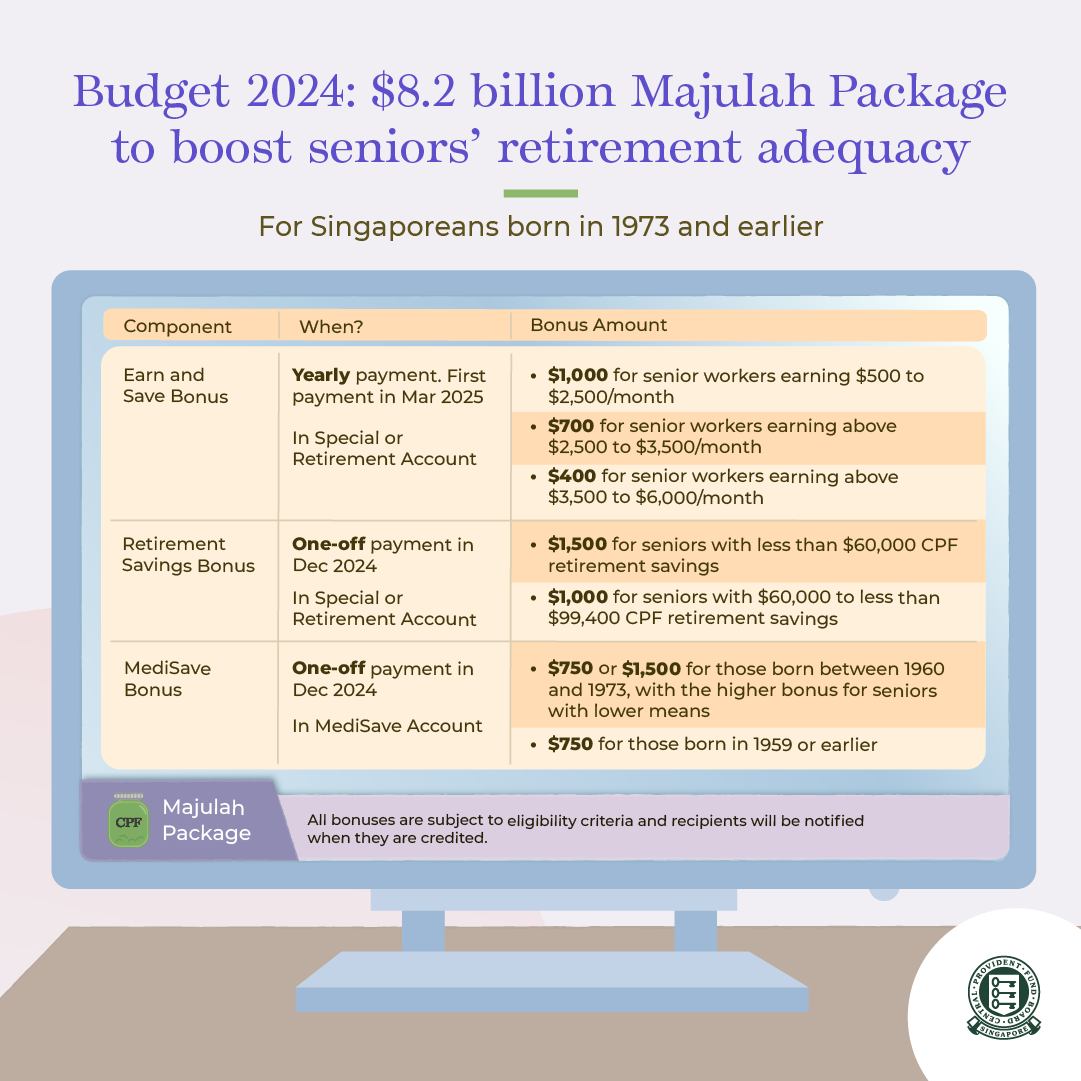

DPM Wong also provided more details on the Majulah Package, announced by Prime Minister Lee Hsien Loong at the National Day Rally in 2023. The scheme will benefit about 1.6 million Singaporeans.

The package includes an Earn and Save Bonus for seniors earning up to $6,000 a month to accumulate more retirement savings and a one-time Retirement Savings Bonus of between $1,000 and $1,500 for seniors with retirement savings below the BRS.


Rounding up his speech, DPM Wong said the Forward Singapore policy moves will cost around $5 billion in the 2024 financial year, and will in total reach close to $40 billion by the end of the decade.

Projections by the Finance Ministry in 2023 assessed that government spending would increase to around 20 per cent of GDP by 2030.

DPM Wong said that for now, that remains the Government’s assessment.

Assuming the Government stays within this range of spending increase, it should have sufficient revenues to maintain a balanced budget over the coming years, he added.

But the medium-term fiscal position is tight, as there are many pressures to spend more.

“We will have to manage these expenditures carefully, or we will end up with a significant funding gap,” he said.


This is already happening in many other advanced economies, where public finances are on an unsustainable path and fiscal systems are at risk of breaking, he added.

“We must never allow this to happen in Singapore. Instead, let us uphold the ethos of fiscal discipline and responsibility that has served us well, and ensure that our fiscal position always remains balanced, sound and sustainable.”

He reiterated that Singapore has been able to weather past storms and emerge stronger.

“I believe we can do so again in our road ahead, so long as we stay united, work together and continue to keep faith in each other.”


Parliament will debate the Budget and the spending plans of various ministries from Feb 26 to March 7.
Thursday, 23 November 2023

ComLink+: New financial incentives to spur low-income families to work towards improving their lives

Low-income families with young children to get up to $30,000 in total payouts under ComLink scheme
By Theresa Tan, Senior Social Affairs Correspondent, The Straits Times, 20 Nov 2023

Low-income families will be given financial incentives and other support if they work towards improving their lives, in a national push to give them a leg-up.

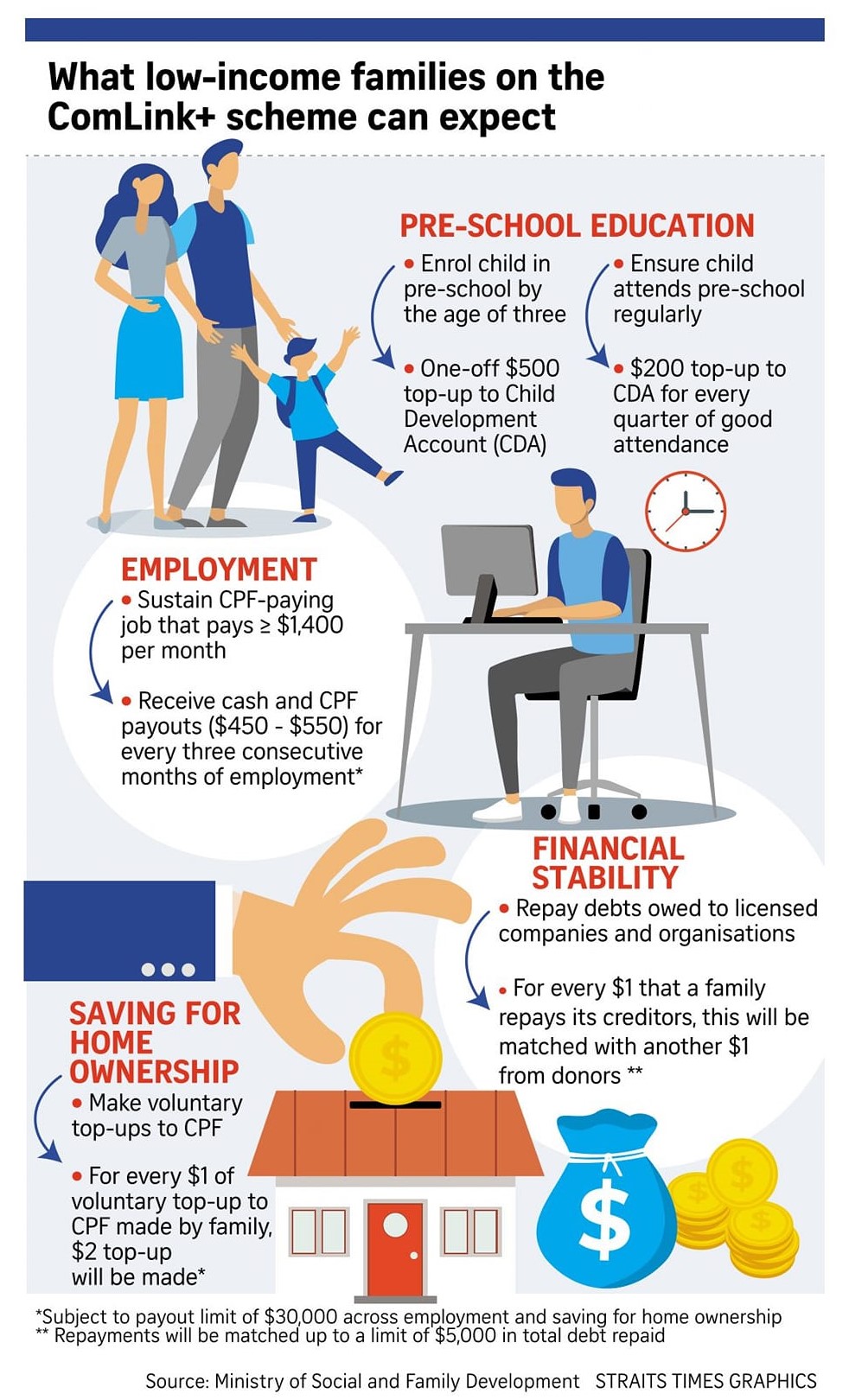
Families with children living in highly subsidised Housing Board rental flats who qualify can get up to $30,000 in total payouts if they meet certain employment criteria and make voluntary Central Provident Fund (CPF) contributions to save up to buy their own homes.


About 14,000 families on the Community Link (ComLink) scheme are eligible for these new areas of support, which will be rolled out from the second half of 2024.

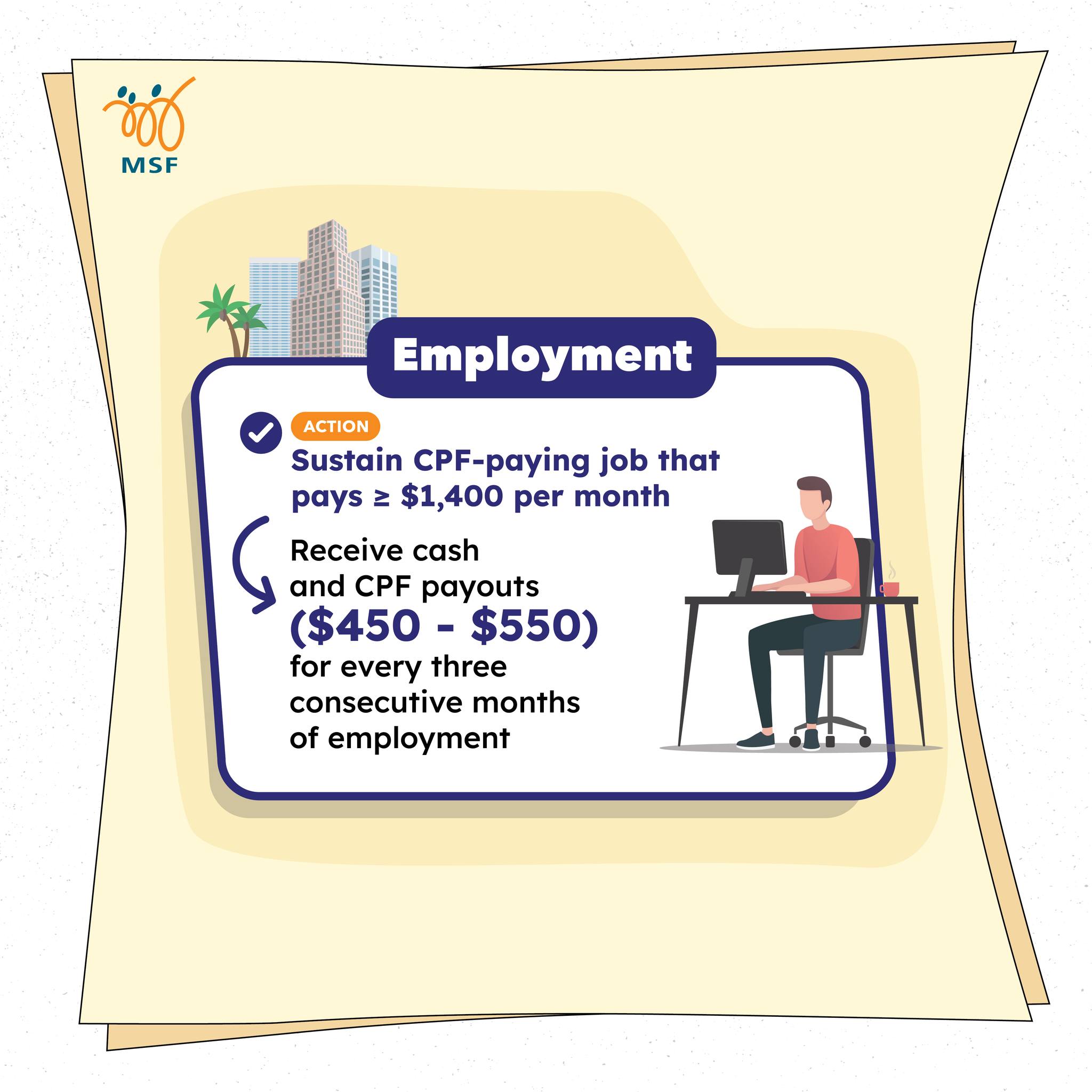
The measures are aimed at motivating families to send their children to pre-school by the age of three, find a stable job that pays CPF, and save up to buy their own homes. For example, beneficiaries can get between $450 and $550 every three months in a mix of cash and CPF payouts if they find a CPF-paying job with a salary of at least $1,400 a month.

One package helps families to clear their debt, such as for utility and housing arrears. This debt clearance package will match dollar for dollar up to $2,500 in sums repaid by the family, so the total debt cleared would be up to $5,000.

ComLink+ is a key plank of the national drive to reduce income inequality and boost social mobility under the Forward Singapore report, which was launched on Oct 27.

Speaking at the Year of Celebrating Social Service Partners appreciation event on Nov 20, Mr Masagos said: “We want Singapore to continue to be a place where social mobility is kept alive for all, especially low-income families who may face unique challenges.

“Many Singaporeans share this vision and agree that more support for low-income families is needed. At the same time, they think this needs to be done in a manner that does not erode self-reliance and agency.”


Mr Masagos described the ComLink+ scheme as a key shift beyond providing just basic, short-term social assistance. The additional financial support will help ease the financial pressures on the families and help them achieve their longer-term goals faster, he added.


“It may take a generation or more, but we know that by reinforcing families’ ability to provide their children with a good start in life today, we give them a better chance of a brighter tomorrow.”

The latest scheme builds on the existing ComLink programme that started in 2019, where low-income families with children living in HDB rental flats are given coordinated and comprehensive support ranging from job assistance to children’s development.

The ComLink+ support measures will be trialled for three years to assess their effectiveness before any potential scale-up, the Ministry of Social and Family Development (MSF) said.

Areas of support under four packages

1. Pre-school education

Each child enrolled in pre-school will get a one-time $500 top-up to the Child Development Account (CDA), which is a special savings account for the child that can be used to pay pre-school and healthcare fees, when they turn three.

Those between the ages of three and six will get a $200 top-up to their CDA every three months if they attend pre-school regularly. Regular attendance is defined as when the child is in pre-school at least 75 per cent of the time.

Local research has shown that children who attend pre-school from the age of three are less likely to require additional learning support in primary school.

However, the pre-school enrolment and attendance rate of children from lower-income families are lower than the national average, especially at the age of three and four. For example, 88 per cent of children aged three to four nationwide were enrolled in pre-school, compared with 78 per cent for those in lower-income families in 2021, the MSF told The Straits Times.

This package is funded by a corporate donor.

2. Stable employment

Beneficiaries will be given financial incentives if they find a job that pays CPF contributions with a gross salary of at least $1,400 a month. Each adult with a job that meets these criteria will get financial top-ups of between $450 and $550 in a combination of cash and CPF payouts for every quarter that he or she is employed.

If two adults in the same household qualify, they will each get an extra $50 every three months. A maximum of two adults per family can benefit from this employment package geared towards encouraging families to find a stable job.


3. Debt clearance

To help families clear their debt, this package will match dollar for dollar, up to $2,500, the amount the family repays for what the MSF calls verifiable debt. This refers to debt owed to licensed companies, such as utilities and housing arrears, that can be verified and for which repayments can be tracked. Debts to unlicensed moneylenders and sums owed to family and friends are not covered.

Families can benefit from this debt clearance package only once. To qualify, they must not be receiving financial aid from the Government’s ComCare scheme.

An MSF spokesman said: “With less disposable income and savings, lower-income families are more susceptible to falling into debt or arrears, especially if they encounter unexpected setbacks or have inherited debt.

“Even a relatively small debt can severely impact lower-income families financially, psychologically and emotionally, affecting their ability to resolve their debts and work towards long-term goals.”

This package is funded entirely by donors, including Singapore Pools.

4. Saving for home ownership

To help families save up to buy their own flats, for every dollar that the family voluntarily contributes to the CPF Ordinary Account, the Government will top up $2. A family can receive only up to $30,000 in total payouts across this package and the employment package. This package is funded by the Government and DBS Bank, an anchor partner for ComLink+.

Mr Masagos said over 170 partners, which includes DBS, OCBC, UOL’s Pan Pacific Hotels Group, are providing support to ComLink families in various ways.

The financial top-ups will be given for as long as the family remains eligible for the particular package or until the family reaches the payout limit specified for each package, whichever is earlier.

These four areas of support in the packages were designed based on the key needs and aspirations families on ComLink had shared, the MSF said.


Mr Masagos said ComLink officers will be trained to act as family coaches to motivate and support families in working towards their goals.

He said: “When families feel understood and supported, they are more likely to actively participate in the decision-making process and take steps towards their goals. With support from family coaches to meet their immediate needs and stabilise their situations, families tell us they feel more optimistic about their future.”

Thursday, 18 June 2020

National Broadcast: SM Tharman Shanmugaratnam on A Stronger and More Cohesive Society

Singapore to strengthen social compact to keep society united
Tharman spells out steps to stave off social polarisation and despair in the face of crisis
By Grace Ho, Senior Political Correspondent, The Straits Times, 18 Jun 2020

Singapore cannot defy the global economic downturn. But it must "absolutely defy" the loss of social cohesion, the polarisation and the despair that are taking hold in many other countries, said Senior Minister Tharman Shanmugaratnam.

Even as the COVID-19 pandemic ravages economies, he said Singapore must strengthen its social compact by helping those who have lost jobs to find work, by keeping social mobility alive and by assuring Singaporeans that help is at hand when they meet difficulties.

Mr Tharman, who is Coordinating Minister for Social Policies, also said mature workers would get special help in finding jobs so that no employer rejects them on account of their age.

Speaking yesterday from the Devan Nair Institute of Employment and Employability, in the fifth of six national broadcasts by ministers on Singapore's post coronavirus future, he said job losses and disrupted schooling have widened social divisions around the world.

He cautioned against thinking that Singapore is immune to these trends: "No society remains cohesive simply because it used to be."

The Government's first priority is to save jobs and help those laid off to return to work. This, he said, cannot be left to market forces.


Mr Tharman, who helms the new National Jobs Council that oversees efforts to help Singaporeans stay employable, said this is why the Government is working with companies, sector by sector, to take on Singaporeans through temporary assignments, attachments and traineeships.

"No amount of unemployment allowances can compensate for the demoralisation of being out of work for long," he said.

Special attention will be paid to workers in their 50s and 60s, and the Mid-Career Pathways programme will be scaled up so that they can prepare for more permanent jobs, he added. But this is a national effort that requires employers to change their thinking.

Mr Tharman said: "No Singaporean who is willing to learn should be 'too old' to hire. And no one who is willing to adapt should be viewed as 'overqualified'.

"Our workers will be able to build on their skills and experience, and we will have a more capable and motivated workforce, with a strong Singaporean core, that every employer can rely on."

He added that good schools are critical to social mobility, and Singapore must never become a society where social pedigree and connections count for more than ability and effort. "There is nothing natural or preordained about social mobility," he said, noting that successful countries have found this harder to sustain with time. "It therefore requires relentless government effort, quality interventions in schools and dedicated networks of community support to keep social mobility alive."

Hence, the Government is equalising opportunities when children are young, such as by expanding the Kidstart programme to help lower-income families. Plans are also afoot to equip all secondary school students with a personal laptop or tablet by next year, seven years ahead of the original target.


A strong spirit of solidarity is also important. Key to this, he said, is strengthening support for lower income Singaporeans at work.

He pointed out that cleaners, security officers and landscape workers have seen their wages increase by 30 per cent in real terms over the last five years under the Progressive Wage Model. The eventual goal is for every sector to have progressive wages, with a clear ladder of skills, better jobs and better wages for those with lower pay.

Those in short-term contract work should also have more stable jobs, better protection and the chance to progress in their careers, he said. "It may lead to a small rise in the cost of services that we all pay for. But it is a small price for us to pay for better jobs and income security for those who need it most, and a fair society."


He noted that the social compact is also about the "self-effort and selflessness" that must be strengthened in the country's culture.

"It is about the networks and initiatives that we saw spring up in this COVID-19 crisis... And it is about how we draw closer to each other, regardless of race, religion or social background. It is how we journey together. A forward-looking, spirited and more cohesive society."

Wednesday, 3 June 2020

Streets and schools come alive again as Singapore reopens after COVID-19 circuit breaker

Most shops stay shuttered but about 75% of economy will resume operations in Phase One from 2 June 2020
By Chang Ai-Lien, Science and Health Editor, The Straits Times, 3 Jun 2020

The streets got a little busier yesterday and public transport hummed into full gear despite moderate commuter numbers as Singapore emerged from its circuit breaker period to resume some activities that had been shut down due to the COVID-19 outbreak.

Most shops remained shuttered, but some masked workers marched back to offices, and some factories were buzzing again.

Around 75 per cent of the economy is expected to resume operations in phase one, with about one-third of workers returning to work on-site, up from 17 per cent during the circuit breaker.

If infection rates remain low and stable, Singapore could be allowed to ease into phase two of its reopening by the end of this month, where almost the entire economy will resume operations, the multi-ministerial task force set up to combat the outbreak has said.

Yesterday, 2 June, there were four cases reported in the community out of 544 new COVID-19 cases, with foreign workers in dormitories accounting for the majority of infections.

Still, Singaporeans returned to schools and workplaces cautiously, as will be the norm for some time to come.

They must get used to a new normal of living with restrictions, stressed National Development Minister Lawrence Wong, who co-chairs the task force.

"Reopening means there will be an increase in activities and human contact, and more opportunities for the virus to spread. That is why we decided to implement a phased approach and not open the floodgates all at once," he said in a Money FM 89.3 radio interview.

A small traffic jam formed on Bishan Road at about 7am as parents drove their children to school.

Many students had remained home for close to two months, and precautions were in place when a limited number were allowed back.


While Primary 6 pupil Japhanie Tan, 12, was delighted to meet her friends, she will have to get used to wearing her face mask throughout the day and talking through it, as well as walking in single file at least a metre away from her friends.

Some returned to offices for the first time in a while, if working from home was not an option.

Friday, 29 May 2020

Singapore could move to Phase 2 of COVID-19 reopening before end-June 2020

Task force fleshes out plans for next steps in reopening Singapore economy
It will decide in mid-June whether to move to phase two of process by end of the month
By Lim Min Zhang, The Straits Times, 29 May 2020

Even as Singapore prepares for the lifting of the circuit breaker measures on Tuesday, 2 June, a ministerial task force yesterday fleshed out plans for how the country might move on to phase two of opening up the economy by the end of next month.

National Development Minister Lawrence Wong said that a decision will be made in mid-June on whether conditions are right for Singapore to allow a broader range of activities by the end of the month.


This move into phase two of Singapore's calibrated reopening will hinge on keeping the community spread of COVID-19 low and stable over the next two weeks, he said, adding the caveat that the time-line could change, given how fluid the situation is.

If this timeline is given the go-ahead, then, subject to restrictions, people will be able to dine in at food outlets, exercise at stadiums, visit swimming pools and have small gatherings before the end of next month.

"We will decide by the middle of June on whether we want to take the next step to move to phase two," said Mr Wong, who is co-chair of the multi-ministry task force tackling the coronavirus pandemic.


But for this to happen, fellow co-chair and Health Minister Gan Kim Yong stressed the importance of exercising caution even after Tuesday, when Singapore exits the circuit breaker and enters the first phase of its reopening: "I think if we start with a big bang party, we are going to get into trouble."

About 75 per cent of the economy can resume operations in phase one, which the authorities had earlier said would last four to six weeks but may now give way to phase two earlier. In the first phase, schools will gradually restart, and more Singaporeans will return to workplaces, though dining in will still not be allowed.


Almost the entire economy is expected to reopen in phase two. Retail shops and consumer services can open for business, but masks will still be compulsory for anyone stepping outside his home.

Eateries will reopen but no more than five diners will be allowed per table at food and beverage outlets, including hawker centres. Tables will have to be placed at least 1m apart.


Mr Wong said people will be able to catch up with their friends and relatives, but social gatherings will be capped at five per group. He said the number struck a "reasonable balance" between the risks involved and allowing families to meet.

Meanwhile, some activities - which involve close contact in enclosed spaces - are deemed to carry higher risk of transmission and may be allowed to resume only later in phase two, when sufficient safety measures are in place. These include going to cinemas, religious services, bars and clubs.

"All of these venues, based on our experience and overseas experience, have been instances where there have been cases of transmissions in such settings, and so we want to take a more cautious approach for activities in these areas to resume," said Mr Wong.

Stressing that things can change if the situation worsens, he added that the task force was sharing its plans so that businesses can start planning ahead. "But importantly, those that are looking ahead to reopen should make use of this time now to start preparing and putting in place all the necessary safeguards and precautions."


Asked if the timeline had been moved forward on account of pressure from businesses, Mr Wong said the timeline "is premised on what we think is safe to do from a public health point of view".

Meanwhile, Singapore announced a change in discharge criteria for its COVID-19 patients. Mr Gan said all those who are assessed to be clinically well by the 21st day of their illness can be discharged. Previously, they needed two negative swab tests, 24 hours apart.

As a further precaution, these patients must stay at home or in their dormitories for a further seven days.

Saturday, 23 May 2020

Singapore residents to get improved version of reusable masks from 26 May to 14 June 2020, as part of the third mask collection exercise

New free masks more comfortable, have better filtration
Residents can collect them from CCs, RCs or vending machines from Tuesday, 26 May
By Calvin Yang, The Straits Times, 22 May 2020

Singapore residents can collect new reusable masks from Tuesday, in a third mask distribution exercise that will span three weeks.

The latest distribution of these masks - which are more comfortable to wear and have better filtration qualities - will take place until June 14. The previous two rounds in February and April lasted about a week each.

About six million reusable masks have been prepared for this exercise, similar to the previous one. Collection counters will be set up at 109 community clubs (CCs) and 661 residents' committee centres (RCs) across Singapore.

This time, residents can also pick them up from 24-hour vending machines. About 400 machines will be placed at all CCs for those unable to pick up their free masks from the collection counters.

Residents with a valid identification card can collect one reusable mask each. This includes foreign domestic workers, foreign workers not living in dormitories and international students living in hostels. The Manpower Ministry will distribute masks to foreign workers living in dormitories.


Residents who want to pick up their masks from CCs or RCs can do so only from 10am to 6pm daily during the first week of the collection period, from Tuesday to June 1.

Those who want to collect their masks from vending machines can do so at any time during the three-week period.

This will give everyone access to the masks without having to rush for them, Trade and Industry Minister Chan Chun Sing told reporters yesterday during a visit to Pek Kio Community Centre.

The vending machines, provided by Temasek Foundation, will be operational from 10am on Tuesday. Each machine has an attached guide comprising three steps on how to collect the masks.

The reusable masks, available in adult and children sizes, use new materials to improve their comfort and resistance to droplets.

They are made of at least three layers of material and have a filtration efficiency of at least 95 per cent, even after 30 washes.

Mr Chan, who is also deputy chairman of the People's Association, said the Government had distributed the first generation of reusable masks last month because they were the "fastest available" at that time.

It was already looking for newer materials to make better masks back then, he added. "So, there was a gap between the first batch of reusable masks, which was a basic cloth material, and the second batch of reusable masks, which is an improved cloth material."

To avoid crowding at the collection points, residents are encouraged to collect the masks on behalf of those who live with them. They have to bring along their household members' identification cards, birth certificates or any government-issued identification with a barcode.


Safe distancing measures and temperature taking will be in place at the collection points. The high-touch areas of the vending machines are treated with a self-disinfecting coating that can last for three months. The machines will be cleaned and restocked regularly.

Priority for children-size masks will be given to those aged 12 years old and below.


Mr Chan said stockpiling masks for future disruptions has to be an ongoing effort.

"Nobody knows how long and how widespread this pandemic will be, and one should never be complacent about any supply lines, including masks," he added.

Wednesday, 20 May 2020

Singapore's COVID-19 circuit breaker ends on 1 June 2020; economy to reopen in three phases

Ministers spell out road map to keep nation safe and restart businesses over next months
By Linette Lai, Political Correspondent, The Straits Times, 20 May 2020

Singapore's circuit breaker will formally end on June 1, as the country gradually restarts its economy in three phases over the next several months.

This will not mean a return to life before the coronavirus, National Development Minister Lawrence Wong said yesterday, outlining the broad plan for the months ahead.

Singapore will proceed with caution in the first phase, where many existing restrictions will continue. This phase is expected to last at least four weeks.

If all goes well, it will then move into the second transitionary phase, which could spread over several months.

Further easing of measures would follow in the third phase, where a "new normal" will remain until an effective vaccine or treatment is found.

New cases are expected to rise as people gradually resume activities, and stricter measures could be implemented at any point if the situation worsens.

While some may be disappointed that they will not be able to go out freely and socialise at the end of the circuit breaker, the reopening needs to be done carefully, said Mr Wong at a press conference yesterday.


"We have to do this in a careful and calibrated manner as we don't want to risk a flaring up of the virus. And importantly, we do not want to sacrifice the efforts all of us have put into controlling the outbreak," he said.

He added that the Government will continue to support businesses and workers that are unable to open on June 2.


In the first phase, dubbed "safe reopening", about a third of Singapore's workers will be able to resume work at their workplaces, said Trade and Industry Minister Chan Chun Sing. The rest will continue to work from home.

"This will allow three-quarters of our economy to resume normal operations," he said.

Priority will be given to critical sectors and businesses that operate in settings with lower transmission risks. Those returning to their workplaces or offices include workers or staff who are required to use machinery or specialised terminals.

Meanwhile, retail stores will stay closed, and there will be no dining in at restaurants, during this period.

Schools will gradually reopen next month and certain healthcare services will resume. Places of worship will also reopen, but only for private worship.

Social gatherings will still be prohibited, although exceptions will be made for people visiting their parents or grandparents. Visits will be limited to one a day, with a maximum of two visitors who should be from the same household.


Singapore will move into the second phase if community transmission rates remain "low and stable" and the dormitory situation remains under control.

In this "safe transition" phase, people will gradually be able to resume more social activities. More businesses will be allowed to reopen, including retail outlets, gyms and fitness studios as well as tuition and enrichment centres.

In this phase, which could last several months, small social gatherings and dining in at food and beverage outlets may be allowed.

The idea is to take the country towards its new normal phase called "safe nation", in which social, cultural, religious and business gatherings are expected to resume. However, limits will be put in place on gathering sizes.

Similarly, places offering services that involve prolonged close contact, such as massages, or with crowds in enclosed spaces, such as cinemas, will reopen only with strict safety management measures in place.

On public transport, commuters will have to wear masks and refrain from talking.


Singapore will also gradually reopen its borders for essential travel. However, this will be carried out separately from the three phases of restarting its economy as the global situation remains volatile.