Sunday, 24 February 2013

SAF officer's sterling Afghan service

He is 1st Singaporean awarded US Bronze Star, at end of memorable 6 months there
By David Ee, The Straits Times, 23 Feb 2013

ON A clear, moonlit night last August, Major Cai Dexian was cycling home from work when sirens abruptly pierced the silence. It was close to midnight.

Diving behind the nearest shelter, his mind raced: Which direction was the rocket headed? Where would it land?

He was not in Bukit Timah where he lives in a condominium. The 28-year-old was in a military base in the southern Afghan city of Kandahar, assisting the Nato-led International Security Assistance Force, or ISAF.

Taleban insurgents had just fired a mortar at his base. Luckily for him, the rocket landed harmlessly on the base's southern fringe.

Over the six months he spent there, not a week would go by without incoming rocket attacks. Fortunately, there were no casualties among the several thousand strong contingent of coalition soldiers there.

Despite the relative safety of the base, these moments drilled in him the need to be always on full alert. "There is that moment of apprehension when you're uncertain of your safety," recalled Maj Cai, who returned from his tour of duty last October. "If the rocket lands directly on you, there's no shelter that would protect you."

The officer is among more than 470 Singapore Armed Forces (SAF) servicemen who have served in Afghanistan since 2007.

Two weeks ago, Defence Minister Ng Eng Hen announced that all troops would be home by June, ending the SAF's six-year deployment there, as Afghan forces begin to take over responsibility for their country's security.

Keep kampung spirit, even in a big city

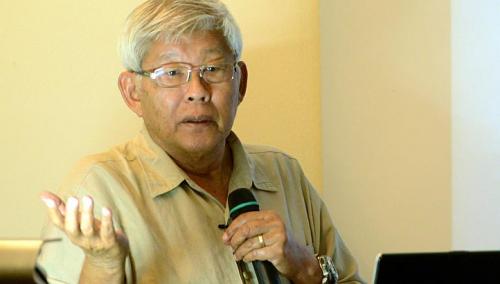
Pioneering Singapore architect Tay Kheng Soon says the real concern for any society isn't overcrowding, but how cohesive and trusting the community will be.
By Cheong Suk-wai, The Straits Times, 23 Feb 2013

WHILE many Singaporeans are complaining of cramped and intense city living these days, pioneering architect Tay Kheng Soon is confident that Singapore still has room for two million more people - and keep the kampung community spirit.

The solution is to house them compactly within a 2,187ha stretch of land in southern Singapore, from Pandan Reservoir in the west to East Coast Park, he said.

This was his startling proposal at a talk on Thursday night to about 100 people here, as part of an ongoing lecture series by master architects organised by the Singapore Institute of Architects.

Singaporeans fed up with crowded trains and public spaces flinched at the projection in the recent population White Paper that the 5.3 million-strong population here may burgeon to 6.9 million in 2030. The Government's Land Use Plan then detailed how it would reclaim more land and consolidate military training grounds to free up more space for all.

But disquiet continued, even after a five-day debate on the issue in Parliament.

Mr Tay however thinks "if it has to", the city-state can accommodate two million more residents comfortably.

He elaborates on his proposal: The southern coastline will house homes, offices, schools and factories for the extra two million residents. Places like the Keppel and Marina Bay golf courses there would have to go, along with the port, whose operations will be consolidated in Tuas in future.

The area around Gardens By The Bay could feature waterfront homes, he suggested.

Interestingly, no one at the talk challenged his proposal. The audience posed only three questions: whether or not women should do national service; how to deepen the dialogue between architects and city planners here; and if a research institute for architects should be set up.

A plan to house 2 million more people

Veteran architect proposes building up southern coast
By Leonard Lim, The Straits Times, 22 Feb 2013

Even as the debate continues over the 6.9 million figure in the population White Paper, veteran architect Tay Kheng Soon said at an industry lecture last night that Singapore can accommodate a population increase of up to two million.

All two million would be housed on a 2,187ha swathe of land along the southern coastline, stretching from Pandan Reservoir in the west to the East Coast Park beach.

Land where the Keppel and Marina Bay golf courses are currently sited would make way for housing, as would the port area once container port functions are consolidated in Tuas in the long term.

Space around the Gardens by the Bay would cater to the super-rich, with homes built on the sea to entice those keen on waterfront living. Some parts of the south would also be for schools, offices and factories.

And while this might mean Singapore loses its biggest beach, he said all other areas, including green and heritage spaces, need not be "disturbed".

Mr Tay's "southern intensification" proposal comes two weeks after an intense parliamentary debate over the population White Paper that projects Singapore's population rising by 1.6 million by 2030.

"What I hear is a lot of grumbling (about the White Paper), so let us as a profession contribute," said the former president of the Singapore Institute of Architects who is known for his outspoken and at times radical views.

Saturday, 23 February 2013

Frontline Connects《前线开讲》Singapore’s Population Issues


《前线开讲》

播出日期:2013年 2月22日晚上10点30分 8频道

《新加坡人口问题》

政府公布了有关我国未来人口政策的白皮书,勾勒出到2030年新加坡的人口估计发展的趋势。

有关白皮书引起全国民众高度关注,70多名议员也在国会中热烈辩论,最终议员们以大多数赞成票,通过了由议员、连荣华所提出的修正动议。

虽然如此,李显龙总理还是希望新加坡人继续关注和讨论这些问题,为新加坡将来的发展做好充分的准备。

Spend more, to keep healthcare affordable

By Jeremy Lim, Published TODAY, 22 Feb 2013

Singapore’s health system is lauded internationally for its ability to achieve outstanding health outcomes at very low national spending. Yet, 72 per cent of Singaporeans believe “we cannot afford to get sick these days due to high medical costs”, according to a 2012 Mindshare survey.

How can this be? Our low national spending on healthcare is the envy of the world and yet Singaporeans are so worried about healthcare costs.

What makes a great healthcare system? Healthcare planners the world over dream of the ideal health system: High quality, low cost and universal access for all citizens. How would Singapore rank along these dimensions?

The quality of Singapore healthcare is top-notch; 850,000 medical tourists in 2012 is testament to our high standards.

What about access? Geography advantages us and, unlike many large countries which need extraordinary measures to provide for far-flung populations, Singaporeans are hardly a stone’s throw from a doctor and barely a 15-minute drive from a hospital.

Our weakness lies in affordability, or at least the perception of affordability. Ironically, why we spend so little may account for why there is so much anxiety.

New coins to feature local icons; Third Series coins to be issued into circulation on 25 June 2013

By Magdalen Ng, The Straits Times, 22 Feb 2013

A NEW series of coins depicting Singapore landmarks is due out in the middle of the year.

The new coins, designed by Singaporean designer Fabian Lim, will look and feel quite different from existing ones.

Their appearance will be essentially Singaporean, featuring the Merlion, Port of Singapore, Changi Airport, public housing and the Esplanade.


They will be made of multiply plated steel, a steel core with other alloys plated on it. This material is lighter and cheaper to produce than that used for existing coins, bringing savings of 35 per cent to 40 per cent, compared to the cost of production last year.

Mr Lim is a designer with home-grown agency Royal Fly, and has previously designed commemorative coins for the Monetary Authority of Singapore (MAS).

The new series will be sized progressively by denomination, so the five-cent coin will be the smallest and the $1 coin the biggest. The $1 coin will retain its octagonal shape but will become bigger than the 50-cent coin. It will also be bimetallic and will have two colours - a silver middle and gold on the rims. The one-cent coin - which has not been issued since April 2002, partly because it costs more than its face value to mint - will not be re-introduced.

Each coin will have a different edge pattern to help the visually impaired better distinguish between them. The denomination numerals will also be larger for easier identification.

Singapore's leap into the space industry

New office to research, develop sector, grow talent pool and related business
By Grace Chua, The Straits Times, 22 Feb 2013

SINGAPORE announced a new push into another potentially lucrative economic sector yesterday - this time setting its sights as far as outer space.

The Government will set up a new office to research and develop the futuristic space industry, particularly the manufacture and launch of satellites.

Called the Office for Space Technology and Industry (OSTIn), it will also work with universities to develop the talent pool for the industry, help satellite companies grow their business here and collaborate with other countries' space agencies.

Two Singapore companies also announced ambitious new plans for Singapore's fledgling space programme.

ST Electronics, an arm of mainboard listed ST Engineering, said it has started the design and development of the first made- in-Singapore commercial satellite.

Images from the satellite, to be launched in 2015, could be used for disaster and environmental monitoring, agriculture, resource exploration and maritime observation and security.

Meanwhile, local technology firm IN.Genius outlined plans to send the first Singaporean into space on National Day 2015.

The formation of the space office, which will come under the control of the Economic Development Board, was announced by Second Minister for Trade and Industry S. Iswaran at the annual Global Space Technology Convention at the Sheraton Towers hotel.

"Singapore (has) good reasons to be excited by the promising potential the space industry has for our economy," he said.

Space could ignite interest in science and engineering among the young and provide knowledge-intensive jobs that the country wants, said Mr Iswaran.

NUS to offer free online courses to public

By Amelia Teng, The Straits Times, 22 Feb 2013

THE National University of Singapore (NUS) is joining other schools worldwide to offer free online courses to the public, with the first two to be rolled out in January next year.

It is partnering United States-based online education company Coursera to do this, and the plan is to offer two to three new courses each year on the firm's website.

The first two courses - Unpredictable? Randomness, Chance And Free Will and Write Like Mozart: An Introduction To Classical Music Composition - will run for eight and six weeks respectively.

Each weekly session - consisting of video presentations, guided exercises and peer-to-peer assessment - will last from 11/2 to three hours.

The courses will be taught by Professor Valerio Scarani from the Centre for Quantum Technologies and Associate Professor Peter Ivan Edwards from the Yong Siew Toh Conservatory of Music.

Prof Edwards has incorporated online instruction in his modules for more than five years.

"There are people out there who are intelligent and want to learn things. It's not too much work for me to reformat my lessons and put them online," said the 40-year-old.

Prof Scarani, who is also 40, said: "I think these courses are not about grades or certification; it's about putting NUS out there globally and telling people about its quality education."

NUS is among 29 universities from 13 countries which have inked new agreements to offer courses using Coursera's platform, bringing the company's total number of university partnerships to 62. Other schools include Rutgers University, the University of Tokyo and Leiden University.

Coursera is one of the major providers of free online learning, alongside others such as edX and Udemy.

Friday, 22 February 2013

Watch Singapore short films online

SGFilm Channel on YouTube will offer 40 works in its first year
By Boon Chan, The Straits Times, 21 Feb 2013

You read about an awardwinning short film by a local film-maker - but then have no idea where to watch it.

But now, a new channel on YouTube offering short films by local directors for free is just the ticket.

The SGFilm Channel, was launched yesterday. It will also show trailers of upcoming local feature films.

Feted director Royston Tan, 36, says: "Whenever I travel to festivals with a new film, people always ask to see my other films. I can now refer them to SGFilm Channel where they can also discover other short films from Singapore." His 10-minute-long Sons (2000), about a father seeking to reach out to his son, is available on the channel.

As Mr Yeo Chun Cheng, director of Singapore Film Commission (SFC), notes: "Short films are an important stepping stone for many of our film-makers, for it is where they cut their teeth."

SGFilm Channel will start by offering 40 short films in its first year, rolling out 10 new titles each quarter. The short films, defined as those under 30 minutes long, include fiction, non-fiction, animation and experimental works.

The channel was created and is managed by local centre for photography and filmmaking Objectifs, and is part of Watch Local, an initiative by SFC to promote appreciation of home-grown films.

Refreshed Kindergarten Curriculum Framework

Clearer learning goals set for pre-schools
New guidelines will push a common standard and discourage 'overteaching'
By Stacey Chia, The Straits Times, 21 Feb 2013

PARENTS will now have a better idea of what their children need to learn in kindergarten before starting primary school.

In language, they need to know how to write their first name, recognise frequently used words such as "at", ask simple questions like "why" and "what", and follow instructions like "draw a picture and colour it".

In numeracy, they should be able to count up to at least 10, do simple addition and recognise basic shapes. When it comes to social skills, they should learn to carry out tasks confidently, and get along with other children.


By spelling out these "learning goals" in an updated kindergarten curriculum framework, the Ministry of Education (MOE) wants to set a common standard among some 1,500 pre-schools here, amid concerns about their uneven quality. It also hopes to convince anxious parents that there is no need to "overteach" their children, such as sending them for enrichment classes.

The updated framework, which is used by teachers and parents as a general guide, was unveiled yesterday during a visit to Ascension Kindergarten by Ms Indranee Rajah, Senior Minister of State for Education and Law.

For the first time, learning goals were spelt out - unlike the old guidelines which were vague on this. The targets were crafted after consulting primary and preschool teachers and early childhood experts.

While the new guidelines are not mandatory, the ministry said pre-schools are "strongly encouraged" to follow them.

The aim is to get pre-schools lagging behind to level up - and not to restrict them from doing more than the bare minimum, said Ms Indranee.

"Those who have very high standards should continue to do so. The thrust of what we're trying to do is to make sure that everybody meets a certain standard."

Call for laws on flexi-work for mums

Proposal is part of PAP Women's Wing's suggestions to MOM
By Tessa Wong, The Straits Times, 21 Feb 2013

THE People's Action Party Women's Wing is calling for new laws to compel employers to give mothers flexible work arrangements.

The proposal, part of a position paper submitted to the Ministry of Manpower (MOM) yesterday, is one several measures it suggests to get more women back into the workforce.

The resident labour force participation rate for women is 57.7 per cent, in contrast to that for men, which is 76 per cent.


The proposed flexi-work legislation would include a provision allowing workers - both male and female, with children below the age of 12 - to request a change in the number of hours, and when and where they work. Similar laws already exist in countries such as Belgium, France and the Netherlands.

Workers would also be allowed to take no-pay leave for up to one year to take care of their children, and guaranteed positions in their companies when they return.

The Women's Wing hopes that these laws could be introduced within the next two to three years but suggested that the Government could start by first setting clear guidelines on flexi-work for employers.

West Coast GRC MP Foo Mee Har and Marine Parade GRC MP Fatimah Lateef led a team of Women's Wing members in drafting the paper over six months, with input from party activists and businesses.

Median Household Income from Work Increased in 2012

Incomes up for most, not for poorest
But real income of bottom 10% rose last year if imputed rentals taken out
By Goh Chin Lian, The Straits Times, 21 Feb 2013

SINGAPOREAN households are earning more income from work, the latest official figures show, though the rise was not across the board.

Lower- and middle-income families saw their earnings go up last year - even after taking into account inflation - continuing a trend over the past five years.

But the bottom 10 per cent did not do as well: Their real income, after adjusting for inflation, actually fell last year.

Some economists attributed the slip to the restructuring of Singapore's economy that has slowed growth and hastened inflation.

Still, for the majority of households, the figures from the Department of Statistics (DOS) painted a picture of improved standards of living. The DOS report was released yesterday, ahead of Budget Day next Monday.

It shows the median monthly household income - the midpoint of a range - rising from $7,040 in 2011 to $7,570 last year.

This worked out to a 7.5 per cent increase, but when inflation and changes in household size were taken into account, the rise slowed to 1.9 per cent.

Over the past five years, the median real monthly income has risen by a total of 13 per cent.

As for households in the bottom 10 per cent, their incomes shrank by 1.2 per cent last year, a reversal from the previous year's growth of 5.8 per cent.

The decline was a result of including imputed rentals on owner-occupied homes in the calculation of the consumer price index (CPI) used to adjust for inflation.

Imputed rental, a proxy for housing prices, represents the rent a person would have paid if he was not the owner of his home.

As this is notional and not cash actually spent, the DOS report noted that if it was removed from the equation, the bottom 10 per cent would have enjoyed an income rise of 0.8 per cent.