Thursday, 10 August 2023

NDP 2023: Onward As One

A celebration to remember
This year's NDP marks first full-scale parade at Padang since 2019, and President Halimah's last as head of state
By Kok Yufeng, The Straits Times, 10 Aug 2023

It was a National Day Parade (NDP) of firsts and lasts as the Padang came alive on Wednesday with light, sound and colour to mark Singapore’s 58th year of independence.

There was a concert-like atmosphere at the annual birthday bash as a 27,000-strong crowd sang along to old and new local tunes.

Their LED-equipped drumsticks lit up the stands as they thumped to the beat with drum kits that came with each NDP funpack.

Many arrived at the Padang well before the festivities kicked off at 5.35pm.

Undeterred by the sweltering heat and enhanced security measures, which included checks on individuals and vehicles, thousands more gathered at nearby Marina Bay.

Some arrived as early as 3pm – about three hours before the party started.

They were well prepared with phones and cameras to capture the experience, including the 10-minute fireworks display at the end of the two-hour parade.


With “Onward As One” as this year’s theme, it was the first time that full-scale NDP celebrations were held at the Padang since 2019, after the Marina Bay floating platform had its swansong parade in 2022.

The floating platform has hosted 11 NDPs since 2007. It will be replaced by NS Square, a permanent structure expected to be completed by end-2026, whereupon it will be the primary venue for future parades.

Wednesday was also the first time since 2019 that the parade and ceremony segment of the NDP featured full-scale physical marching contingents, comprising 1,700 participants from the military, civil defence, youth uniformed groups, and various social and economic groups.


Making its inaugural NDP appearance was the Digital and Intelligence Service, the fourth arm of the Singapore Armed Forces (SAF), which formed one of five guard of honour contingents.

It was also the last NDP for President Halimah Yacob as head of state – her six-year term as president ends on Sept 13.


She received a rousing welcome when she arrived, shortly after Prime Minister Lee Hsien Loong, and later inspected the marching contingents commanded by Lieutenant-Colonel Ragumaran Davindran – the first army supply officer to be given the role.

A 21-gun presidential salute was fired from 25-pounder artillery guns stationed on military rafts near Merlion Park, and a video montage of Madam Halimah’s past NDP involvements as president was later shown as the crowd waved their national flags in tribute.


Before her arrival, NDP attendees were entertained by hosts Joakim Gomez, Hazelle Teo, Eswari Gunasagar and Fauzie Laily, who kept spirits high with games and several rounds of the Padang Wave before the parade went live at 6pm.

Deyi Secondary School’s marching band, decked out in bright pink uniforms, had the crowd at the edge of their seats as 16-year-old drum major Caspar Ho executed a flawless series of mace throws.


Moments later, spectators watched in awe as eight Red Lion parachutists made freefalls from a height of about 3km – all landing safely to resounding cheers.

Then came the marching-in of the 34 parade contingents, the state flag fly-past and a bomb burst manoeuvre performed by a group of F-16D+ fighter jets in a soaring salute to the nation.


There was still more aerial action to come as the Republic of Singapore Air Force put on a thrilling display to commemorate its 55th anniversary. A highlight was a new cross turn and vertical climb stunt to signify progress and prosperity for the nation.


Another addition to 2023’s NDP was the Total Defence Parade, which involved 650 participants.

With six large, colourful floats modelled after everyday objects such as an umbrella and a barbell – each representing a pillar of Total Defence – the new segment gave a fresh, whimsical spin to the national defence concept.


This was accompanied by a drive-past of military and civil defence assets from the SAF, Singapore Police Force and Singapore Civil Defence Force.

As night fell and the show segment of the parade got under way, another unique – if unseen – aspect of 2023’s parade filled the air.

During the show’s second act, titled Our Strength, a subtle floral fragrance with a woody undertone emanated through the stands at the Padang, evoking the scent of a flowering Tembusu tree.


The smell was specially created to accompany a blossoming flower dance by the Soka Gakkai Singapore Women’s Division and local dance troupe Dance Inspiration.

Those watching at home were given an augmented viewing experience, with each of the NDP show’s four acts featuring themed floor projections and 3D effects.

At the show’s climax, fireworks erupted over the Padang as screens showed an animated golden lion leaping skywards, symbolising Singapore’s youth leading the future of the country.

An energetic rendition of this year’s theme song Shine Your Light and a medley of past NDP songs followed, before everyone recited the national pledge and sang the National Anthem.


Ms Mira Lee, 28, who works in the events industry, said it was nice to see fellow Singaporeans out in full force despite the hot weather.

“Plenty of work has clearly gone into this to showcase some of Singapore’s best, and I am grateful for the show they put on,” she added.

Ms Joey Lim, 31, who last attended an NDP two decades ago, said she especially enjoyed the show segment because it was vibrant and colourful.

“The parade was just as great as last time, and I hope I can attend it every year,” said the administrative worker, who came with her family. “It has been a memorable day for me.”


Sunday, 30 July 2023

Conversation on euthanasia should enter end-of-life discussions in Singapore

Assisted dying is a sensitive subject but, with its population ageing, Singapore may need to discuss what we think about it
By Salma Khalik, Senior Health Correspondent, The Straits Times, 29 Jul 2023

As more Singaporeans age, urgent discussions are taking place on how we approach end-of-life issues.

The roles of nursing homes, hospices and home palliative care are part of ongoing discussions on easing and widening different approaches towards how we age, and ultimately pass on.

There is, however, one issue that has gained traction elsewhere but which hardly ever figures in our end-of-life discussions here: assisted dying.

Assisted dying can either take the form of assisted suicide, where the final act is undertaken by the person involved, often with the aid of a medical practitioner; or euthanasia, where another person, again often a doctor, performs the act of terminating life.


Assisted dying is illegal in Singapore.

But given that our population continues to age rapidly, and more older people will increasingly find themselves in continuous pain that even palliative care can do little to help, this is not an issue we should entirely ignore. What could be at stake is the dignity and personal choice of a segment of our population.

Several countries are well ahead of Singapore on this count, both in terms of having mainstream discussions, as well as in having legal frameworks on assisted dying.

Most countries that have legalised assisted dying allow both assisted suicide and euthanasia. Some, like Switzerland, which was the pioneer in allowing assisted suicide in 1942, allow the former but keep euthanasia illegal.

Should one or both options be legalised here, to give those desperate to end their lives a way of doing so with grace?

Sunday, 23 July 2023

WP and PAP: Counting the costs of scandals

The recent revelations of extramarital affairs within the parties have left the public troubled, with questions about what to expect of their leaders and members, and the standards for politics in Singapore.
By Gillian Koh, Published The Straits Times, 21 Jul 2023

The dust has far from settled. But after leaders of the People’s Action Party (PAP) and the Workers’ Party (WP) recently addressed the questions hanging over the conduct of their members, we at least have more information to help make sense of these politically tumultuous times.

The WP leaders addressed the issue of the “inappropriate exchange” between its parliamentarian, Mr Leon Perera of Aljunied GRC, and its member, Ms Nicole Seah who contested in East Coast GRC in the 2020 General Election – they did indeed have an extramarital affair.

They have resigned from the party, which in effect means that Mr Perera will also no longer be a Member of Parliament.

The ruling PAP has also lost two of its MPs due to similar transgressions – Mr Tan Chuan-Jin, who resigned as Speaker of Parliament, and Ms Cheng Li Hui, who left her Tampines GRC seat.

How do we assess the parties’ responses, and what will these developments mean for the political ecosystem going forward?


Loss of representation

For the Workers’ Party, it is the loss of a second of only 10 duly elected MPs after GE2020, the point being that each one of these was presumably a hard-fought victory.

If it did mean as much as we imagine then it is difficult to fathom why better judgment did not prevail over Mr Perera.


In the case of the resignation of the People’s Action Party MPs, the matter of personal indiscretions and lying to party leadership were equally egregious, if not more so, given Mr Tan’s position.

But the WP as an opposition party has had to struggle harder to establish credibility, build trust, and wrest seats from the PAP.

Arguably, the price paid by the WP is far costlier; the loss in representation of an alternative voice – more significant to us.


Affairs, a cause for resignation?

On another point, the PAP that has built its reputation on high standards of probity, propriety, and personal conduct, has also been bruised by developments in its camp over the past few weeks.


Given that Mr Tan was Speaker, this means that the ability to remain impartial in the House was, at least technically, compromised well before the hot mic incident criticising WP MP Jamus Lim took place. What needs to be established is whether it had indeed been compromised in relation to his treatment of fellow parliamentarian Cheng.

On the other hand, the WP did not address the issue of the extramarital affair directly at its media conference announcing the resignations.

Instead, the message was more about the fact that Mr Perera and Ms Seah had not been honest with the leaders when they were asked whether there was any basis to the allegations about their affair.

WP secretary-general Pritam Singh revealed only that the WP leaders did persist in asking Mr Perera and Ms Seah if there was any truth to the allegations, but he did not provide a definitive statement on his party’s stance on extramarital affairs among its members and parliamentarians.


What Mr Singh did refer to was the pain that the Perera-Seah affair must have caused the families concerned and when such affairs happen, identifying with that as a married man himself.

Hence, there was the empathy for the affected families and an appeal to the public to let the matter rest now. When asked, he did not suggest that there was a party line on such affairs, but offered a line on party discipline and accountability to the leadership as the central issue at hand.

He also delivered a more general statement that he wanted his party’s parliamentarians to do Singapore proud and be committed to serving Parliament and Singaporeans well.

It would be useful to learn in the coming days if this is the correct reading of the differences in how the parties view the issue: Is private conduct, such as that engaged in by the four party members, something that is cause for formal discipline within the parties? Is it only a problem if it bleeds into formal public duty or is it a non-negotiable?


Leaders chasing leads, managing the damage

On the detailed management of the problems, in the PAP’s case, the parliamentarians involved admitted to the extramarital affair but lied about terminating it. Questions have been raised as to why such leeway was given since its discovery after the 2020 General Election, and even after February 2023, when firm action is expected by the public, given the PAP’s no-nonsense reputation.

PM Lee has tried to explain it and we can expect more to be said in a ministerial statement when Parliament sits in early August.


In the WP’s case, the members denied it right up to the point when the evidence was made public. And it is of concern to think that Mr Perera was going to victimise his driver, not only by sacking him but checking on legal action in relation to what was presented as a baseless allegation.

After all, we are to believe that Mr Singh and his senior colleagues seemed to have been taken in by claims by Mr Perera that the whistleblower, his driver, was a disgruntled employee, and did not question the latter directly.

In addition, perhaps in due course, we will learn if Ms Seah told the party about the affair when she is said to have confessed it to her family after it ended, or truly kept its leaders in the dark.


Recovery and doing better for parties and nation

Supporters of both parties will be disappointed, but because the next general election is still a while away, there is a lot that the parties can do to rebuild their reputation, their standing with voters, not only by the quality and lived-out values of their candidates but also through how the candidates have engaged and served them, practically.

Meanwhile, it was good that WP chairman Sylvia Lim spoke specifically about how the constituents in Aljunied GRC, where she is an MP, will continue to be served. It assures them that this has been thought about.

It is not new territory of course as MPs in Sengkang are already filling the gap left by the resignation of Ms Raeesah Khan for misleading Parliament in alleging misconduct by the police. Mr Faisal Manap from Aljunied GRC is doing double-duty in Sengkang GRC for minority representation there.

In terms of the future of Aljunied GRC, there is worry about how the issue of costs for improper payments by Ms Lim in relation to historical town council matters in Aljunied GRC will affect her standing, and how the investigations on Mr Pritam Singh in relation to the Raeesah Khan issue is going to affect him too.

This seems perilous.

We do not know yet how this could affect the representation of and service to Aljunied constituents but surely the WP will be considering various scenarios in its forward-planning.


Surely this is the time for the WP’s volunteers and also prospective candidates to rise up. It is unlikely that the battle-hardened WP will waste a crisis. WP secretary-general Singh did say that the search for good candidates is ongoing. Given what has happened, volunteers hoping to stand will be far more cautious in making a decision to put themselves forward, and the leaders, equally careful in their choices.

While case histories will always be instructive, will the WP’s internal codes of conduct be revised to institutionalise its expectations of parliamentarians?

The PAP is undoubtedly impacted by the recent arrest of Transport Minister S. Iswaran by the Corrupt Practices Investigation Bureau (CPIB). If he is proven guilty, it will also deal a big blow to the ruling party, from losing an anchor minister in the West Coast GRC.


With the unequivocal line of its party secretary-general on honesty and personal conduct in recent days, there could be no doubt about the expectations and level of scrutiny that citizens will place on party leaders and their every action going forward.

It has various codes of conduct but yet again, all parts – rules, values, the right people, and peer pressure – have to be in place for a strong political ecosystem to prevail.

Generally, those who wish to be our representatives in Parliament will be reminded to do so for the right reasons, that matters of personal conduct are important in Singapore; that honesty between party members and leaders, parliamentarians and citizens, spouses and family members, is expected.


These are teachable moments for politics and governance in Singapore and if absorbed for what they are, will serve us well in the future, when the hurt is over.

Saturday, 10 June 2023

Tharman Shanmugaratnam to run for President in Singapore

Senior Minister Tharman to run for President, will resign from Government and PAP on 7 July 2023
By Goh Yan Han, Political Correspondent, The Straits Times, 9 Jun 2023

Senior Minister Tharman Shanmugaratnam will be running for president in the upcoming election, stepping aside from politics after 22 years.

“I wish to inform you that I have decided to put myself forward as a candidate in the forthcoming presidential election. I hence wish to retire from politics and all my positions in Government,” he said in a letter to Prime Minister Lee Hsien Loong on Thursday. PM Lee is also secretary-general of the People’s Action Party (PAP).

Mr Tharman said he plans to resign from the PAP and step down from his posts as senior minister and coordinating minister for social policies on July 7 – a month from Thursday.

This is so that he can first fulfil his immediate commitments in Singapore and internationally, and ensure that arrangements are fully in place for his constituents in Jurong GRC to be well served for the rest of the electoral term, he said.


In a reply letter, PM Lee accepted his resignation and thanked him for his “distinguished service to Singapore”.

“Your departure from the Cabinet and the Party will be a heavy loss to me and my team. We will miss your leadership, insightful views, and wise counsel,” said PM Lee.

“But I understand why you have decided to make this move and run for president. It is in keeping with the spirit of public service and sense of duty that you have shown all these years,” he added.

Mr Tharman will also step down as chairman of the Monetary Authority of Singapore (MAS), deputy chairman of Singapore’s sovereign wealth fund GIC, chairman of the Economic Development Board’s International Advisory Council and other responsibilities he has been undertaking in his ministerial capacity.

“I have been humbled by the requests I have received in recent months, from Singaporeans from different walks of life, to stand in the presidential election if President Halimah chose not to stand again,” he said.


He added that it had been a difficult decision, and that he consulted his family and gave careful thought to how he could best serve the country in the years ahead.

“I believe that I can now best serve Singapore not in politics, but in a different role that has to be above politics,” he said.

“If I am fortunate enough to be elected as president, I will represent the unity of Singaporeans, of all races and religions, social backgrounds, and political leanings, at a time when views in the population are becoming more diverse.”

He added that he would be thorough and impartial in fulfilling the constitutional duties of the president with regard to the prudent use of the nation’s reserves and the key appointments that preserve the integrity of the Singapore system, and do his best to project Singapore’s interests and voice of reason in an increasingly turbulent world.


Mr Tharman also thanked PM Lee for his leadership, advice and openness to collegial debate through the years.

PM Lee said that should Mr Tharman be elected as the next president, he was confident that Mr Tharman would “carry out these duties scrupulously” and with “the independence of mind” he has always displayed.

Mr Tharman’s announcement comes after incumbent President Halimah Yacob said on May 29 that she would not be running for a second term. The election has to be called before the end of Madam Halimah’s six-year term, which expires on Sept 13.


Mr Tharman, 66, is the first candidate to throw his hat in the ring as no other presidential hopeful has made his intentions public.

He satisfies the public service requirement for eligibility under the law, due to his ministerial posts.

Under the public sector service requirements laid down in the Constitution, presidential candidates must have held office – for at least three years – as a minister, chief justice, Speaker of Parliament, attorney-general, Public Service Commission chairman, auditor-general, accountant-general or permanent secretary, among others.


Mr Tharman was first elected to Parliament in November 2001 in Jurong GRC, and has been re-elected four times since.

His current posts include Senior Minister since 2019, Coordinating Minister for Social Policies since 2015, and MAS chairman since 2011.

He has been deputy chairman of GIC since 2019, and chairs its Investment Strategies Committee.

His previously held portfolios include deputy prime minister, finance minister and education minister.

Before stepping into politics, he spent most of his professional career at MAS.


On the international stage, Mr Tharman has been chairman of the Group of Thirty, an independent global council of leading economic and financial policymakers, since January 2017.

Since April 2017, he has also been chairing the G20 Eminent Persons Group on Global Financial Governance, to review the system of multilateral financial institutions.

Mr Tharman’s decision to stand raises questions about who will take over his current posts and cover for him in his constituency.


He is the anchor minister of Jurong GRC, which is also represented by Senior Parliamentary Secretary for Health and Law Rahayu Mahzam, Dr Tan Wu Meng, Mr Xie Yao Quan and Mr Shawn Huang.

There is no requirement under the law to call a by-election if an MP resigns, even if that member is a minority.

In 2017, when Madam Halimah made her plans known that she would be stepping down as MP of Marsiling-Yew Tee GRC, she said she would ask PM Lee to assign another MP to her constituency to help out.


Tuesday, 2 May 2023

May Day Rally 2023

‘We will always have your back’: 4G team will look after workers in these dark times, says DPM Lawrence Wong
By Goh Yan Han, Political Correspondent, The Straits Times, 1 May 2023

Amid global economic uncertainty and geopolitical tensions, Deputy Prime Minister Lawrence Wong said that he and his 4G team are fully committed to looking after workers and helping them earn a better living.

They will do so by working closely with the National Trades Union Congress (NTUC) and the labour movement, to ensure sustained growth and good jobs for all, he said.

“In these dark times, this is my promise to you,” said Mr Wong at the May Day Rally on Monday where he was the main speaker.

Come what may, we will always be there with you, for you, and we will always have your back,” he said, addressing about 1,400 labour movement leaders, workers and tripartite partners at the Suntec Singapore Convention & Exhibition Centre.


In his speech, Mr Wong elaborated on points made in April by Prime Minister Lee Hsien Loong on the multiple global storms ahead. He also spoke on how the nationwide engagement Forward Singapore exercise will help workers.

“As we grow the economy, we will also fight the ills of inequality,” he said.

“Singapore must never succumb to the kind of harsh inequality we see in so many other countries. However treacherous the terrain ahead, so long as Singapore continues to progress, all Singaporeans must continue to progress – no one must be left behind.”


This is why the Government is undertaking the Forward Singapore exercise, he said. The exercise, launched in June 2022, will culminate in a report in the second half of 2023.

Mr Wong said that in its Forward Singapore review, the Government is studying how it can invest more in every worker – to help them take ownership of their own careers, continuously reskill and upskill, and take up better jobs and opportunities throughout their working lives.

One way is by shifting SkillsFuture to a “higher gear”, he said, and making skills training and lifelong learning a key pillar of the refreshed social compact with every worker.

Another is by paying special attention to those in vocational and technical roles, as well as Institute of Technical Education and polytechnic graduates.

“We will help them deepen their skills through different pathways, so they can secure better salaries and career paths in the professions they have trained for and have the aptitude for,” said Mr Wong.


He added that professionals, managers and executives will also have to reskill and upskill themselves – given the rapid technological advancements such as in artificial intelligence, which suggest that more human tasks could be taken over by machines.

Noting that it can be hard to juggle work and family responsibilities while studying, Mr Wong said the Government will reduce costs and lower barriers to training.

The Government is also looking at how to further uplift lower-wage workers and professionalise skilled trades, provide more support for those who lose their jobs and enable all workers to meet their retirement needs. It is working closely with the NTUC on the possible solutions, he said.

Acknowledging that workers are concerned about other things apart from jobs, such as the cost of living, Mr Wong said he had implemented comprehensive support measures, including those in Budget 2023.

“We have done everything we can to lessen the stresses and strains that people feel on the ground, and we will continue to do so,” he said.

Another concern is public housing, where the Government has been ramping up the supply of Build-to-Order flats, but there are still worries about affordability.


Mr Wong asked Singaporeans not to look just at the headline price of a Build-To-Order flat, but to also consider how prices relate to income and the proportion of income needed to service the housing loan.

For example, a four-room BTO flat in a new town cost about $40,000 in 1980. Median household income then was around $900, and a typical household would use about a quarter of its income to service the loan.

Today, the price of a four-room BTO flat in a non-mature estate like Bukit Batok costs about $350,000, said Mr Wong.

While the price of the flat has risen nearly 10 times, so has median household income from $900 to $9,000, he added.

In addition, there are housing grants of up to $80,000 for first-timers, said Mr Wong.

“Affordable and accessible public housing – like access to first-rate education and healthcare – will always be a key part of our social compact in Singapore,” he said.

“As long as the PAP (People’s Action Party) remains in charge, we will ensure quality public housing that is affordable and accessible for our children and future generations.”


In his speech, Mr Wong also noted the global storms ahead that PM Lee had warned of – the Russia-Ukraine war, US-China tensions, and increasing protectionism undermining the multilateral global trade system.

These developments will make it harder for Singapore to compete, grow its economy, create jobs and earn a living. But what it must have enough of are “ingenuity and innovation; guts and gumption”, he said.

“That’s the only way we can and will prevail, even when the odds are stacked against us.”

He said that tripartism is one of Singapore’s greatest and most sustainable competitive advantages.


Noting how other First World countries have seen industrial relations break down, Mr Wong said Singapore must not allow that to happen.

“Businesses and governments will push back, further fuelling deep divisions in society. Then it becomes a vicious cycle, because once trust is lost, it’s very hard to recover,” he said.

“Fortunately, Singapore is on the right track. We have a lot going for us, and our tripartite approach ensures that Team Singapore has the best chance of overcoming challenges and seizing new opportunities.”

Mr Wong said this was not the first time Singapore has had to respond to grave challenges.

“Each time we were pushed to the limit, we did not fold and crumble. Instead, we gritted our teeth, worked even harder to defy the odds, and bounced back stronger. That’s how we built today’s Singapore, and that’s how we will keep on making it better.”


Friday, 21 April 2023

PM Lee Hsien Loong’s speech at the Debate on the Motion of Thanks to the President in Parliament on 19 April 2023

Amid unprecedented global situation, remain united, be go-getters and uphold Singapore’s reputation: PM Lee Hsien Loong
By Goh Yan Han, Political Correspondent, The Straits Times, 20 Apr 2023

Amid an unprecedented global situation that is graver than what Singapore has experienced for a very long time, it is important that the nation should stay united.

Singapore must not allow itself to be divided along fault lines, or turn inwards like what other countries with larger populations and domestic markets are doing, said Prime Minister Lee Hsien Loong on Wednesday.

Instead, Singaporeans must remain united, maintain the go-getting spirit, and uphold the country’s good standing in the world, he added.

PM Lee spent over a third of his 50-minute speech in Parliament laying out the challenges facing Singapore strategically and economically, and the implications for the country.


While Singapore’s relationships with neighbours such as Indonesia and Malaysia are close, stable and encouraging, the situation further afield has turned much more troubling, even dangerous, he warned.

“Singaporeans need to realise the gravity of the external situation. We are facing not just one storm, but several,” he said on the third day of the debate on the President’s Address. The address had laid out the key priorities of the Government going into the second session of the 14th Parliament.


The storms include the Russia-Ukraine war, deepening hostility between the United States and China, and protectionism undermining the multilateral trading system.

PM Lee called for continued unity as he noted that Singaporeans have come through repeated challenges over the past six decades because they have worked together, taken adversity in their stride, and kept faith with one another.


Elsewhere, opposing groups are getting worked up, mobilising their followers, and pitting citizens against one another, said PM Lee.

“In Singapore, when faced with a divisive issue, our approach has always been to find a middle way, bridge the differences, strike compromises and heal divisions. Not grand posturing; not playing cultural or identity politics; not dividing and polarising people,” he said.

“Our instinct always is to keep Singaporeans together. We have to keep on thinking and acting like this. Please do not take our harmony for granted. It is a very precious thing, and very fragile. We must continuously work on it, and build up our social cohesion and national strength.”


The troubled external environment will create new stresses and strains in society, which must not divide Singaporeans along fault lines in society, such as the “haves” versus “have nots”, or “locals” versus “foreigners”, or between different races and religions, said PM Lee.

High inflation from the war will cause difficulties for many households, especially lower- and middle-income families, he said.

Tensions between China and the US will expose the population to “emotional pulls, commercial pressures and influence campaigns, from one side or the other, to take their point of view and support their cause”.


There will also be more uncertain growth and greater disruption with the fracturing of the global trading system.

“In this new troubled world, it is all the more important for us to close ranks. Divided, we stand no chance,” he said.

“We must not shy away from hard choices, but deal squarely with difficult issues based on facts and sound analysis.”

Apart from remaining united, it is equally important that Singaporeans have the go-getting spirit of self-reliance and enterprise, to create prosperity for the nation and achieve the best they can in a very troubled world, said PM Lee.


This is an attitude Singapore has always had and has not forgotten, he noted, citing examples of Singaporeans who have ventured overseas as far as Rwanda.

“But we are not just asking Singaporeans to work harder as individuals. We have a strategy to make a living for our nation as a global city and an international hub. It will be tough, because globalisation is going the wrong way,” said PM Lee.

He noted that larger countries may be able to afford the costs of turning inward, but as a small island state, Singapore cannot.

“Our survival depends on our being able to do business with the world, to deliver value to others. So our strategy must be to double down on staying open and connected to the world, and continue making ourselves useful as a global city and an international hub.”

But staying open and connected means being exposed to competition from the world, so Singapore must maintain its edge by continually upgrading capabilities and building new ones. It must also transform and restructure the economy to stay abreast of new technologies and industries, he added.


The quality of the country’s government and leaders matters, too, he added. As part of leadership renewal, the 4G ministers are increasingly responsible for the safety and well-being of the country, PM Lee said, as he called on Singaporeans to elect leaders they trust to take the country forward.

He also urged people to embrace the outsized ambition and effort of earlier generations for the city-state to be an exceptional place in the world.


This means continuing to uphold Singapore’s good international reputation, turning opportunities into successes and keeping consistent principles.

“This is the way for Singapore to be taken seriously, and to count for more than our size. We may be a small island state, but we are not a small people, and neither are our hearts nor our aspirations. Let us think boldly, aim high, and seek far.”

Thursday, 20 April 2023

The policy shifts and politics of rage in a contested Singapore: DPM Lawrence Wong

In his speech on the President’s Address, Deputy Prime Minister Lawrence Wong outlined five key shifts as part of a new social compact. What was equally important was what he said about politics and the role of the opposition.
By Grace Ho, Deputy News Editor, The Straits Times, 19 Apr 2023

A new approach on skills, social support, and caring for seniors.

A new definition of success.

A renewed commitment to one another.

These were the five key shifts Deputy Prime Minister Lawrence Wong outlined on Monday as part of a new social compact, on which discussions are well under way with the nationwide engagement exercise Forward Singapore.

The ideas are not dramatically new, but reinforcing them ahead of the Forward SG report, due in the second half of 2023, will keep them fresh in the public consciousness.


More importantly, what the 4G leadership stands for is finally coming into sharper focus after 2018 when succession first became a hot-button issue, while not necessarily signalling a radical departure in policy.

Mr Wong himself took care to disabuse commentators of the view that the 4G team has shifted to the left. He pointed out that it is not a simple case of characterising positions along the traditional political spectrum of left and right, but appealing to a broad base instead of blindly copying models from other countries.

Take broadening meritocracy, for example. Mr Wong and others such as Education Minister Chan Chun Sing spoke on it during Monday’s and Tuesday’s debate on the President’s Address – and before that, Mr Wong at the launch of Forward SG in June 2022.

But even as far back as in 2013, then Deputy Prime Minister Tharman Shanmugaratnam was already speaking of a broader, “continuous meritocracy”, regardless of one’s academic background, in an interview with The Straits Times.

The proof is in the pudding. The raft of policy changes in the ensuing decade, from doing away with the PSLE T-score, to full subject-based banding and lifetime cohort participation rate, are the clearest realisation of this consistency and continuity in policy and messaging.

Ample hints have been given of other substantive changes in the works. These, too, have their early advocates.

Mr Wong’s mention of a targeted re-employment support scheme is something which labour MPs such as Mr Patrick Tay (Pioneer) have pushed for – the latter when he called for a more permanent scheme following the Covid-19 Recovery Grant, which provided temporary financial support for workers experiencing involuntary job loss and income loss during the pandemic.


More social support for vulnerable groups to ease the financial burden on parents of children attending special education schools and care centres, for example, have been prefaced by recent Budget announcements and championed by both sides of the House, including backbenchers.

“We intend to make this shift in our social strategy so every Singaporean can be confident: In this harsh, unpredictable world, we will have your back, and we will support you,” Mr Wong said on Monday.

Role of a responsible opposition

Amid the policy shifts announced, which have gathered broad support, however, the negativity in the Facebook comments on Mr Wong’s speech gives cause for concern.

Social media draws out the most misanthropic segments of the public. Yet, it is this loathing and distrust of anything the People’s Action Party (PAP) government says and does, displayed among some netizens, which I fear will become increasingly hard to stem.

It is what American political journalist Ezra Klein calls negative partisanship, or being driven not by positive feelings about what you support, but bad feelings towards the party you oppose.


Here, the opposition has a role to play. Mr Wong threw down a challenge on Monday when he said that instead of putting forth opportunistic or populist ideas that chip away at trust in the Government, the opposition should offer a serious alternative agenda and be upfront about the trade-offs and funding.

That might be a bridge too far to cross for politicians with little technocratic policy experience, but there are simple ways in which parliamentary debates can remain constructive and helpful.

Thursday, 9 March 2023

White Paper on Singapore’s response to COVID-19

Singapore flags errors, good calls and lessons from the ‘complex and wicked’ COVID-19 pandemic
By Salma Khalik, Senior Health Correspondent, The Straits Times, 8 Mar 2023

Singapore has looked at how it performed in its fight against Covid-19 and concluded that while it got several big calls right, it slipped up on a few aspects.

The White Paper on the nation’s performance, released on March 8, was not a self-congratulatory exercise but an effort to understand how it can build on its successes and avoid the errors committed in the fog of war, when the next big pandemic knocks on its doors.

The 92-page document listed eight things that Singapore did well, such as not letting the healthcare system get overwhelmed and saving lives and livelihoods, six where there was scope for improvement, including over-calibrating safe management measures which were not always consistent, and near disastrous stumbles in handling outbreaks in migrant workers’ dormitories.

There were also seven lessons listed in preparing for the next crisis.

An important lesson which was weaved in throughout the paper was to not rely on past pandemics to provide the road map for dealing with the next one, but instead, to be flexible enough to cope with nasty surprises.


Some of the problems that dogged Singapore’s response stemmed partly from the Government basing most of its actions on the previous major outbreak, the Severe Acute Respiratory Syndrome or Sars – which was caused by a virus in the same family as the one responsible for Covid-19.

The paper stated: “It was soon clear that in building pandemic preparedness on a Sars model, we had not adequately challenged certain assumptions.”

When the first cases appeared in the migrant workers’ dorms, “the prevailing view was that asymptomatic transmission was not possible” – since that was the case with Sars – resulting in insufficient precautions. As a result of that misjudgment, “the dormitory outbreak had every possibility of becoming a major disaster”.

Because Sars did not spread easily, the Government initially said masks were not required unless the person was feeling unwell. This advice was also spurred by the shortage of masks which the Government wanted to keep for healthcare workers.

The White Paper said we could have been less definitive in our position on mask-wearing. Instead, when masks became mandatory in April 2020, the public viewed the policy as a U-turn, contradicting the Government’s earlier position – which “undoubtedly affected public trust and confidence in our handling of the crisis”.

Deputy Prime Minister Lawrence Wong, who co-chaired the multi-ministry task force on Covid-19, said at the release of the White Paper: “So while the lessons will help give us a better sense of preparedness, we must never fight the last war.


“We must not allow the lessons to become hard coded into a certain doctrine that might lead us down the wrong path, especially if the next virus turns out to be very different in character and nature from what we have experienced so far.”

Mr Wong noted that while Singapore is now better prepared, it can never be complacent.

But there are things Singapore can and will do to prepare for the next pandemic, no matter how different it might be. These include building strong public health expertise, institutionalising the use of science and technology, strengthening forward planning, and reviewing stockpiling strategies and further diversifying critical supplies.

When the next pandemic hits – and it will, said Mr Wong – the Government needs to decide on what to prioritise and adapt quickly to changing situations. The focus should be “broader brush but more implementable measures, and to guard against the instinct to aim for unrealistic standards of perfection”.


In a complex and fast-moving crisis, the normal government machinery does not have the bandwidth to plan future operations. So a dedicated forward planning team will be set up to ask the “what if” questions, and prepare ahead for situations which have not yet arisen and perhaps may not arise at all.

Covid-19, said Mr Wong, “has been a very complex and wicked problem on a grand scale, with many twists and turns and disruptions and surprises along the way. We had to operate in a fog of war. We had to make decisions amid conditions of incomplete information.”

With the benefit of hindsight, “we probably could have handled certain situations differently”, he added, pointing to the foreign worker’s dormitory outbreaks as one of the most challenging difficulties faced during the pandemic.

This was also highlighted in the White Paper, which draws on an internal review led by former head of civil service Peter Ho. It said: “There were a few close calls, the most dangerous being the outbreak in the migrant worker dormitories that put more than half a million migrant workers at risk with the threat of the infection spilling over into the wider local community.

“Had that happened, Singapore could have experienced a devastating surge of infections that would have overwhelmed its healthcare system. Mortality rates would have been catastrophic. The economy would have suffered even more with a significant proportion of the workforce out of action.”

Although several things could have been done better, the paper concluded: “The quality of governance throughout the crisis has been generally high. Through a strong Whole-of-Nation response to the pandemic, we have effectively preserved lives and livelihoods.”


Singapore’s procurement and roll-out of vaccines for the entire population was a high point of its response, said Mr Wong. It was among the first countries in the world to get the mRNA vaccines, with the first batch arriving in December 2020.

Vaccination was clearly such an important way out of this pandemic for the world and for Singapore,” he added. “Overall, our whole vaccine strategy from procurement, to the rolling out of the vaccines, to the communication to actually delivering jabs to people, I think we have generally done well, and that has enabled us to get through this pandemic.”

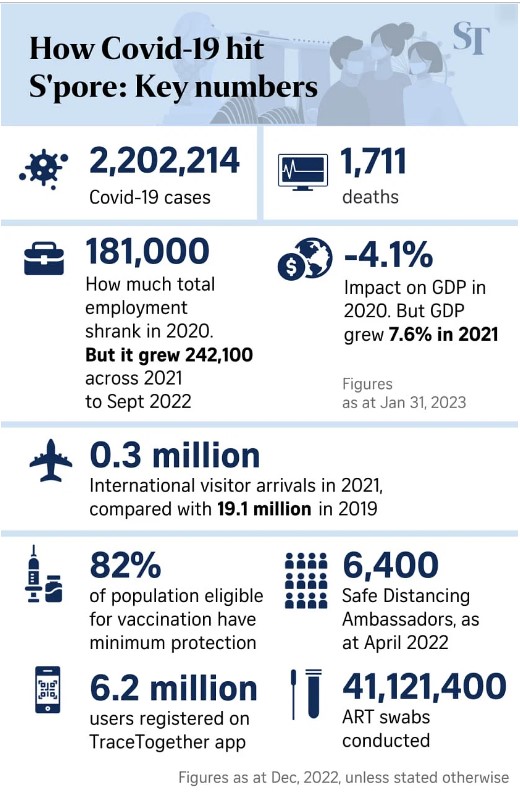
With $72.3 billion spent on fighting the pandemic over three years, the resident unemployment rate was kept below 5 per cent, students could continue their education at home with 35,000 computing devices loaned out to them in 2020 and 2021, while the case fatality rate was kept to less than 0.1 per cent. This is among the lowest globally, with the average of about 1 per cent worldwide.

Mr Wong said this spending is being reviewed by the Auditor-General’s Office as he, too, as Finance Minister, wants every dollar accounted for.

So how would he grade Singapore’s fight against the pandemic? His reply: “I can’t possibly give a grade because I was being examined. So it’s for people to examine me and give me a grade.”

The White Paper, on the other hand, concluded: “This crisis of a generation showed us, and the world, what Singaporeans are capable of when faced with a severe existential test.


“It marks a certain maturity of Singapore as an economy, as a people, and as a nation. We can be proud of how far we have come. And we will learn from the experiences of the last three years to be better prepared for the next pandemic.”

The White Paper is available at go.gov.sg/covid-19-white-paper. It will be debated in Parliament later this month.