Wednesday, 8 June 2016

URA bans new eateries at Upper Thomson, Little India and Bedok dining spots due to parking woes

Popular dining spots in Upper Thomson, Little India and Bedok added to list
By Yuen Sin, The Straits Times, 7 Jun 2016

With a slew of old-school restaurants and buzzy new hipster joints, some of which are open round the clock, Thomson Village near Upper Thomson Road is a magnet for diners in the evenings and on weekends.

But the area's popularity has created parking and traffic problems, with multiple instances of illegal parking occurring regularly, and residents in nearby estates complaining about restaurant patrons who park in front of their gates and block their cars.

To prevent the situation from deteriorating, the Urban Redevelopment Authority (URA) has banned additional eateries from opening in shophouses in sections along Jalan Todak, Soo Chow Walk, Sin Ming Road and Shunfu Road, as well as Upper Thomson Road.

The area is one of three new spots that the URA, working with the Land Transport Authority, placed on a list of spots with a ban on the opening of new eateries on May 30, "to address the traffic and indiscriminate parking concerns from the residents there due to the existing eating houses in the area".

The other areas are the Little India Historic District, which includes sections along Serangoon Road, Jalan Besar and Kitchener Road, and an area near Bedok Road, including shophouses along Jalan Pari Burong.

There are around 30 eateries in shophouses in Thomson Village, about 12 in the Bedok area, and close to 50 in the Little India Historic District.

Professional bodies representing architects, engineers and real estate agents have been asked to update their members in a circular released by URA. Under the rules, existing eateries can carry on if there are no complaints. But a new food business can move in only if it takes over the space from another unit that is approved for use as an eating house, the URA said.

Tuesday, 7 June 2016

Swiss voters reject 'money for nothing' income plan

Swiss say 'no' to basic income for all
Voters reject plan for government to pay a guaranteed monthly income without any conditions
The Straits Times, 6 Jun 2016

ZURICH/BERN • Swiss voters yesterday rejected by a wide margin a proposal to introduce a guaranteed basic income for everyone living in the wealthy country after an uneasy debate about the future of work at a time of increasing automation.

Supporters of the plan said that introducing a monthly income of 2,500 Swiss francs (S$3,500) per adult and 625 francs per child under 18 no matter how much they work would promote human dignity and public service.

Opponents, including the government, said it would cost too much and weaken the economy.

Projections by the GFS polling outfit for Swiss broadcaster SRF showed that nearly four out of five voters opposed the bold social experiment launched by Basel cafe owner Daniel Haeni and allies in a vote under the Swiss system of direct democracy.

Mr Haeni acknowledged defeat but claimed a moral victory. "As a businessman, I am a realist and had reckoned with 15 per cent support. Now, it looks like more than 20 per cent or maybe even 25 per cent. I find that fabulous and sensational," he told SRF. "When I see the media interest, from abroad as well, then I say we are setting a trend."

Conservative Switzerland is the first country to hold a national referendum on an unconditional basic income, but others are examining similar plans.

Monday, 6 June 2016

Inequality dashes retirement dreams

The number of seniors under pressure to continue working is growing, making retirement out of their reach
By Lydia Lim, Associate Opinion Editor, The Sunday Times, 5 Jun 2016

I remember a recent conversation with two friends, a married couple, about Bob Buford's book Halftime.

In it, Mr Buford - a Texas tycoon who made his fortune from cable television - splits life into two halves; the first is a quest for success and the second, a quest for significance. In this paradigm, people spend the first part of their lives acquiring assets for themselves, including an education and a career, and the second part giving back. Today, the Halftime Institute he set up helps people in many countries, including here in Singapore, in their quest for meaning in life.

But this Halftime paradigm, I have come to realise, is relevant only to a small select group of workers.

The response of my friends was telling. While the husband shared my enthusiasm for the Halftime approach, the wife asked immediately: "Isn't Halftime only for professionals and others on good incomes? Most people have to work for money. They can't afford to think about meaning."

She would know since she runs a small business that aims to provide jobs for single mothers and other women in financial need.

Her question was a wake-up call for me because I had long viewed myself as enlightened in my thinking on retirement. When my father announced his plans to stop work, I quickly got him a copy of transitions expert Nancy Schlossberg's book Revitalising Retirement, which shifts the focus in retirement planning from savings - also known as one's financial portfolio - to identity, relationships and purpose, or what she terms "psychological portfolio".

Now, I see that those of us who have portfolios of any kind to speak of are the fortunate ones. There are many who do not. In fact, a majority of people may well have no choice but to work into their old age so as to meet their needs and those of their family.

School meal subsidies extended to needy secondary school students from 27 June 2016

All secondary school, and special education students on assistance schemes will benefit
By Priscilla Goy, The Sunday Times, 5 Jun 2016

Subsidies under the Ministry of Education's (MOE) School Meals Programme will be extended to benefit older children when the second school semester starts.

Currently, only primary school pupils on MOE's Financial Assistance Scheme (FAS) and special education (SPED) pupils aged seven to 12 on the SPED FAS benefit from the programme.

From June 27, subsidies will be extended to all secondary school and special education students on these two schemes.

Some 25,000 to 27,000 more students will benefit, said Acting Minister for Education (Schools) Ng Chee Meng.

He said yesterday that the programme is being extended so that there will be a "more inclusive education system, where all can benefit from the opportunities provided, regardless of background".

"We hope that with the School Meals Programme, students can learn better with a full stomach," he added. "Their concentration and ability to focus will be enhanced, and their learning journey would be better."

Under the School Meals Programme, primary school pupils receive subsidies of $2 a meal for seven meals per school week. Secondary school students will receive subsidies of $2.50 a meal.

Special education students will receive the same amount as those in mainstream schools.

Singapore's journey towards a collective consciousness: Han Fook Kwang

By Han Fook Kwang, Editor At Large, The Sunday Times, 5 Jun 2016

It has been almost four years since I started writing regularly in The Sunday Times, and my pieces have now been compiled in a book that will be in the bookshops later this week.

Re-reading my first column made me recall why I picked up my writing pen again after I stepped down as editor of The Straits Times in 2012.

When I wrote "The trouble with $2,200 bikes and $600 chairs" about public unhappiness over the way the National Parks Board had bought expensive bicycles for its staff, I received a flood of e-mails from readers.

One in particular made a deep impression. The person wrote: "I am often baffled when confronted by the statistics and rationalisation presented by government spokespersons. I don't have the intellectual capacity or verbal skill to argue against them... but in my heart, I know it is not right. So too do the many Singaporeans out there. Most of us do not have the words sometimes but we know in our gut when we feel something is not quite right.

"So it is so important for someone with the ability to say it for us. So we can say: 'Aha, that's what I feel. That's what I meant too'."

She might have over-generalised somewhat the failings of authority, but her provocative words made me restart my writing career, and I have since kept up on a range of topics, including politics, the economy, society and transport.

Indeed it has been a fertile time for commentators, especially after the watershed General Election 2011, and as the country enters the post-Lee Kuan Yew era.

There is anticipation of change to a more rounded society where the politics is more forgiving, but there is also concern over where it is heading.

Saturday, 4 June 2016

'See the True Me' disability awareness campaign launched

People with disabilities in the spotlight
Campaign launched to raise awareness of how to interact with and support them
By Janice Tai, The Straits Times, 3 Jun 2016

Six in 10 people with disabilities do not feel that they are socially included, accepted or given opportunities to achieve their potential, a government survey has found.

Of the general public who were polled, only 3 per cent of respondents would be comfortable marrying someone with a disability, and just one-third are fine with being close friends with a person with disabilities.

People also view those with autism or intellectual impairments less favourably compared with persons with physical disabilities.

These are some of the findings from a series of surveys last year by the National Council of Social Service (NCSS) that polled a total of 3,500 people, including caregivers of those with disabilities.

Yesterday, the council launched a $5 million, five-year campaign to raise awareness of disability issues.


Survey findings have been used to shape the campaign, which includes talks and a website to provide guidance on how to interact with people with disabilities.

Minister for Social and Family Development Tan Chuan-Jin, who launched the "See The True Me" campaign yesterday, said Singapore has made much progress in building the infrastructure needed for people with disabilities to get around, but that is not enough.

"Beyond the physical hardware and infrastructure, what is even more important is to raise awareness within the wider community of disability issues, and to nurture the right attitudes when interacting with persons with disabilities among us," he said.

Singapore society: Getting to the future with honour

By Lim Siong Guan and Joanne H. Lim, Published The Straits Times, 2 Jun 2016

Last year, Singapore celebrated 50 years of independence. We had risen from Third World to First in economic terms.

But Madam Halimah Yacob, Speaker of Parliament, said at the launch of the Honour International Symposium recently that Singapore 50 years from now will have to be defined much more in social terms than economic ones. "Economic vibrancy is important, but life has to be more than economics and countries have to be more than GDP," she asserted.

WILL SINGAPORE FALL?

Sir John Bagot Glubb, a British soldier, scholar and author, wrote an essay entitled The Fate Of Empires And Search For Survival (William Blackwood and Sons, 1978).

Glubb analysed nations as rising through the Ages of Pioneers, Conquests, Commerce and Affluence, and falling thereafter through the Ages of Intellect, Decadence and Decline. Each stage has its own characteristics:
- Age of Pioneers, a period of amazing initiative, enterprise, courage and hardihood.
- Age of Conquests, where the principal objects are glory and honour for the nation.
- Age of Commerce, when values start shifting from the self-sacrifice of the initial pioneers to self-interest, the acquisition of wealth taking precedence over everything else.
- Age of Affluence, where money replaces honour and adventure as the objective of the best young men.
- Age of Intellect, when business people who had made their wealth seek the praise of others by supporting art, music and literature, and institutions of higher education.
- Age of Decadence, which comes about due to an extended period of wealth and power, selfishness, love of money and loss of a sense of duty.
Glubb came to his conclusions by studying 11 empires over 3,000 years.

12-year-old boy honoured by SCDF for helping car accident victims as passers-by snap photos

12-year-old given Public Spiritedness Award; spotlight on issue of bystanders taking photos instead of offering help
By Rachel Oh, The Straits Times, 3 Jun 2016

The issue of bystanders taking photographs instead of offering help during times of need has come to the fore following a 12-year-old boy's act of selflessness.

The boy, Ashvin Gunasegaran, had rushed to help victims of a car accident in Yishun on Tuesday because, he said, other passers-by were "too busy taking pictures with their phones instead of helping".

The behaviour of the bystanders might reflect a desire to update friends on social media about accidents, said experts in the field.

Dr Brian Lee, head of the communication programme at SIM University's School of Arts and Social Sciences, said updating one's social networking profile could be an instinctive reaction to accidents such as Tuesday's.

"Some gadget users are obsessed with taking selfies and snapping pictures, so that they can feed their social media profiles with 'exciting' pictures or videos that can 'wow' their circle of online friends and (others in the) community...

"It has become their instinct to record almost anything, not to mention the unusual ones, for their social media feeds," said Dr Lee.


Ashvin, a Yishun Primary School pupil, was on his way home from school with his classmates on Tuesday when he witnessed the traffic accident involving two cars in Yishun. Despite warnings from his friends that it might be dangerous, Ashvin went to help one of the drivers - a pregnant woman who he said was crying and in pain when he reached her.

He also checked if the other driver - a Singapore Civil Defence Force (SCDF) officer - was fine, and waited for an ambulance called by a passer-by to arrive before leaving the scene.

Yesterday, Ashvin was given a Public Spiritedness Award by the SCDF for his deeds.

Speaking to the media yesterday, he said: "(The victims) weren't screaming for help, and I was scared that the accident might have been fatal."

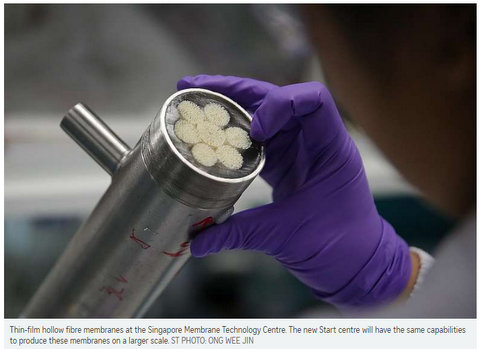
New membrane tech centre to boost Singapore's water security

By Lin Yangchen, The Straits Times, 3 Jun 2016

A national centre has been set up to hasten the commercialisation of membrane technology for applications such as desalination and wastewater treatment.

This comes as increasingly uncertain global weather patterns and regional fluctuations in water supply underscore the urgency of boosting Singapore's water security.

The $30 million facility, the first of its kind in the Asia-Pacific, will achieve this aim as well as enhance Singapore's reputation as a global water hub, having turned a resource scarcity into an economic advantage.

The Separation Technologies Applied Research and Translation (START) Centre was launched yesterday at CleanTech Park, an eco-business park near Nanyang Technological University (NTU), by Minister for the Environment and Water Resources Masagos Zulkifli.

Companies working in collaboration with START will have access to comprehensive facilities for fabricating membranes, assembling them into complete systems and analysing their performance.

Staff will include industry experts from companies such as GE and Hyflux, and negotiations are in progress with some 15 water companies to work on joint projects.

START is supported by NTU, the Economic Development Board, national water agency PUB and the National Research Foundation. NTU's innovation arm, NTUitive, will lead the university's efforts in partnership with industry.

Barack Obama to host PM Lee Hsien Loong to state dinner at White House in August 2016

White House state dinner for PM Lee Hsien Loong a rare honour: Analysts
Dinner during August visit a strong sign of Singapore's standing in US, say analysts
By Jeremy Au Yong, US Bureau Chief, The Straits Times, 3 Jun 2016

US President Barack Obama will host Prime Minister Lee Hsien Loong to a state dinner at the White House in August - a rare diplomatic honour that marks the strength of ties between the two countries.

Singapore will be only the fifth Asian country to have a leader honoured with a state dinner during the Obama administration and the only one from South-east Asia.

The others are China, India, Japan and South Korea.

The White House and PM Lee said the visit was a testament to how far ties have grown during the tenure of President Obama.

"I look forward to the visit," wrote PM Lee on his Facebook page. "It will mark the progress we have made, especially with this administration. It will also be a chance to see how we can build on our friendship beyond the November US elections."

A statement from the White House said the visit and dinner will mark the 50th anniversary of diplomatic relations, and the two leaders will "highlight the enduring principles that have inspired the tremendous growth in our cooperation".

White House state dinners are grand affairs and are regarded as one of the highest diplomatic honours the US government can give.

Washington analysts told The Straits Times that the decision to hold a state dinner for PM Lee was a strong sign of the island nation's standing in the country.